Within Fluency Trap
The Prompts That Expose Shallow Understanding
Good self-explanation moves beyond paraphrase by forcing you to connect steps with because, if, therefore and unless.
On this page
- Paraphrase versus causal explanation
- Prompt words that force connections
- Examples from worked problems and arguments
Page outline Jump by section
Introduction
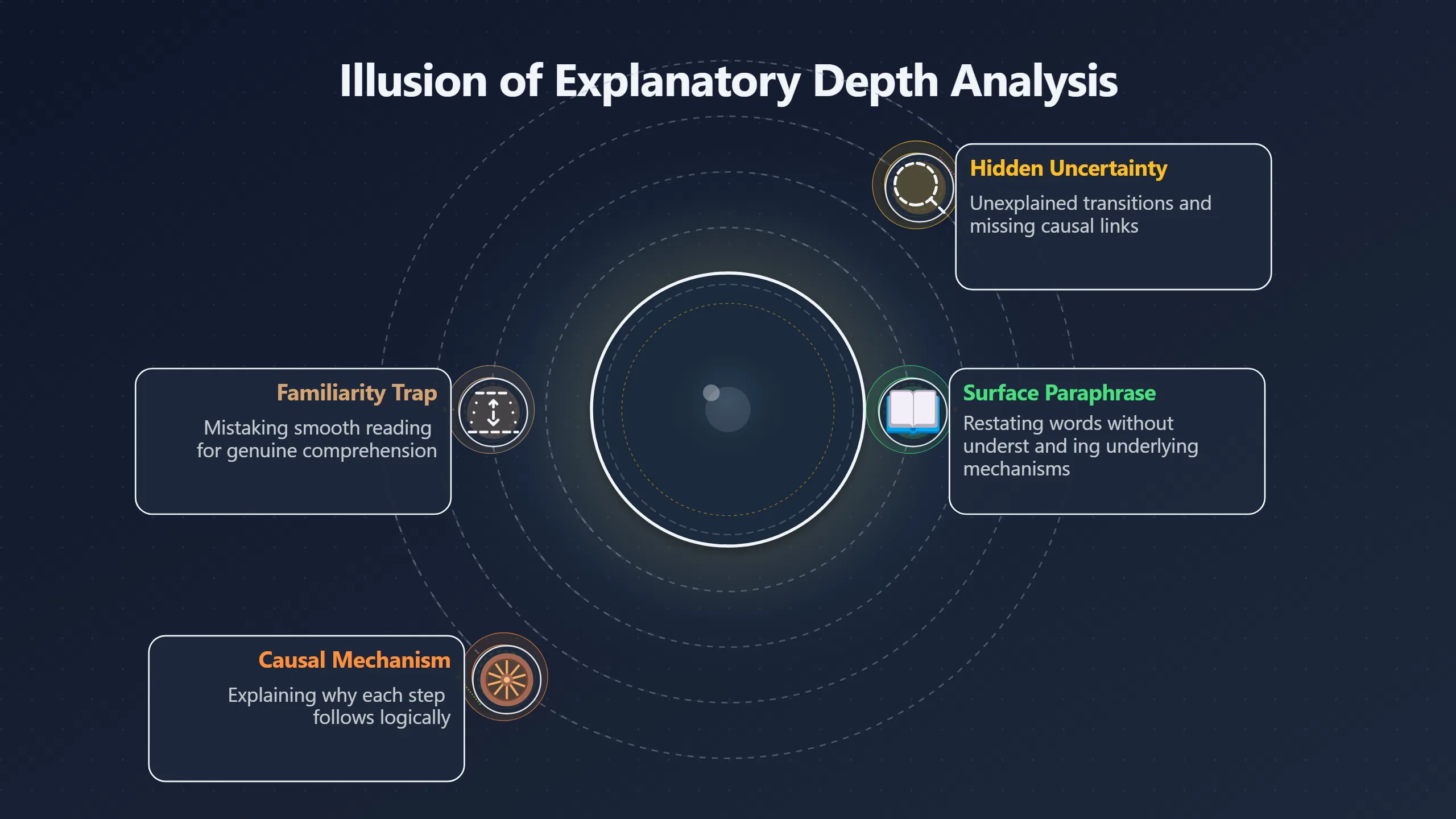
Recognising an explanation is not the same as understanding it. One of the fastest ways to expose the difference is to explain the idea yourself, step by step, without relying on the original wording. Good self-explanation does not ask, “Can I repeat this?” It asks, “Can I show why each step follows from the previous one, what assumptions it depends on, and when it would stop working?” Research on self-explanation and the illusion of explanatory depth consistently shows that these prompts improve learning because they reveal missing causal links rather than allowing learners to rely on familiarity alone. [Andy Matuschak+2PMC]andymatuschak.orgChi et al 1994 Eliciting self explanations improves understanding1989) study concerned the learning of a pro- cedural skill from examples provided in a physics text. Generally, a worked-.Read more…
 Within the broader distinction between familiarity and genuine understanding, self-explanation is valuable because it turns hidden uncertainty into visible questions. The moment you struggle to connect one step to the next is often the moment you discover what you do not yet understand.
Paraphrase versus causal explanation
Many learners believe they understand material because they can restate it in different words. That is useful for checking memory, but it often leaves the underlying mechanism untouched.
A paraphrase answers, “What did this say?” A causal explanation answers, “Why does this happen?” or “How does one step produce the next?” Those are different cognitive tasks. Successful learners tend to add information that is not explicitly written in the material, filling in omitted assumptions and explaining why a particular principle applies rather than merely describing what happened. [Andy Matuschak]andymatuschak.orgChi et al 1994 Eliciting self explanations improves understanding1989) study concerned the learning of a pro- cedural skill from examples provided in a physics text. Generally, a worked-.Read more…
For example:
Surface paraphraseCausal self-explanation”The pressure increases.”“The pressure increases because the same force is distributed over a smaller area.”“The policy reduced emissions.”“The policy reduced emissions because it changed incentives, making high-emission choices more expensive.”“The algorithm chose this option.”“The algorithm chose this option because this feature carried the strongest weight under the model’s decision rule.”
The second version forces you to supply the missing mechanism. If you cannot do that, the gap becomes immediately visible.
Prompt words that force connections
The most useful self-explanation prompts are small but demanding. They interrupt passive reading by requiring causal links instead of recognition.
Instead of asking whether you understand a passage, ask questions that require explicit connections:
- Because: Why is this step true? What causes it?
- Therefore: What follows logically from this?
- If: Under what conditions would this still hold?
- Unless: What assumption would make this fail?
- How: What process links the beginning to the outcome?
- Why not: Why does an obvious alternative not work?
- Compared with what: Why is this explanation better than another?
- What must already be true: Which hidden assumptions are necessary?
These prompts work because they prevent the learner from accepting unexplained transitions. Rather than moving smoothly from one statement to the next, they require each step to earn its place.
Notice how the wording changes the task:
Weak prompt: “Explain this idea.”
Strong prompt: “Explain why this step follows from the previous one without repeating the author’s wording.”
The second prompt demands construction rather than repetition.
Research synthesised across many studies shows that prompted self-explanations produce a moderate positive effect on learning across different ages, subjects and instructional settings, particularly when learners are encouraged to explain relationships and principles instead of merely reviewing content. [Clearinghouse]clearinghouse.edu.tum.deOpen source on tum.de.
Worked problems: explaining the missing steps
Worked examples are especially vulnerable to creating false confidence because every decision has already been made. The learner sees a complete solution and mistakes smooth reading for genuine understanding.
[Self-explanation changes the task.]education.asu.eduself explanation effectA Model of the Self-Explanation Effectby K VanLehn · 1992 · Cited by 588 — Thus, studying examples properly raises the learning rate on s…
Instead of reading:
- Apply formula.
- Substitute values.
- Simplify.
- Obtain answer.
Pause after each line and ask:
- Why is this formula appropriate here rather than another one?
- Which feature of the problem tells me to use it?
- What would happen if this assumption were false?
- Could I predict the next step before looking?
- Could I explain this step to someone without pointing at the page?
Classic studies of worked examples found that students who generated these kinds of explanations learned more effectively than those who simply studied completed solutions. Importantly, effective learners often supplied principles that were absent from the printed example, building richer mental models instead of memorising procedures. [Andy Matuschak+2education.asu.edu]andymatuschak.orgChi et al 1994 Eliciting self explanations improves understanding1989) study concerned the learning of a pro- cedural skill from examples provided in a physics text. Generally, a worked-.Read more…
A practical signal of shallow understanding is needing to keep looking back at the example. A stronger sign of understanding is being able to predict the next move before it appears.
Arguments: explaining why reasons actually support conclusions
Self-explanation is equally useful outside mathematics or science. [education.asu.edu]education.asu.eduself explanation effectA Model of the Self-Explanation Effectby K VanLehn · 1992 · Cited by 588 — Thus, studying examples properly raises the learning rate on s…
Suppose an argument claims:
Increasing housing supply reduces prices.
A superficial explanation repeats:
“More housing lowers prices.”
A stronger self-explanation asks: [education.asu.edu]education.asu.eduself explanation effectA Model of the Self-Explanation Effectby K VanLehn · 1992 · Cited by 588 — Thus, studying examples properly raises the learning rate on s…
- Through what economic mechanism?
- Which assumptions about demand remain unchanged?
- Under what conditions might prices not fall?
- Which evidence would contradict this claim?
These prompts expose whether you understand the causal chain or merely recognise a familiar slogan.
The same approach works when evaluating research papers, business strategies or public policy. Instead of accepting a conclusion, explain the mechanism linking evidence to the conclusion. If that chain cannot be reconstructed, confidence should decrease.
Why explaining often lowers confidence
Many people experience an unexpected drop in confidence when attempting detailed explanations. That is usually a sign of improved calibration rather than worse learning.
Research on the illusion of explanatory depth demonstrates that people commonly believe they understand complex systems until they attempt to explain them in detail. Explaining reveals omitted mechanisms, hidden assumptions and uncertain transitions that familiarity had concealed. [PMC]pmc.ncbi.nlm.nih.govby L Rozenblit · 2002 · Cited by 1507 — We argue that the illusion of depth seen with explanatory knowledge is a separate phenomenon f…
This explains why self-explanation often feels uncomfortable. It replaces the question: [education.asu.edu]education.asu.eduself explanation effectA Model of the Self-Explanation Effectby K VanLehn · 1992 · Cited by 588 — Thus, studying examples properly raises the learning rate on s…
“Does this seem familiar?”
with the harder question:
“Can I reconstruct how it works?”
Those are not equivalent tests.
The temporary feeling of uncertainty is therefore productive. It identifies exactly where further study should be directed instead of allowing false confidence to persist.

Common mistakes that weaken self-explanation
Several habits reduce the value of self-explanation: [education.asu.edu]education.asu.eduself explanation effectA Model of the Self-Explanation Effectby K VanLehn · 1992 · Cited by 588 — Thus, studying examples properly raises the learning rate on s…
- Repeating the author’s sentences. This tests memory more than understanding.
- Skipping obvious-looking steps. The “obvious” transitions often hide the missing mechanism.
- Explaining outcomes instead of processes. Knowing what happened is different from knowing why.
- Never considering failure conditions. Every explanation depends on assumptions.
- Accepting labels as explanations. Naming a concept (“feedback loop”, “market forces”, “selection pressure”) is not the same as explaining how it operates.
A useful rule is that every technical term should eventually unpack into an understandable process.
A practical self-explanation routine
A short routine can make self-explanation systematic rather than occasional. [education.asu.edu]education.asu.eduself explanation effectA Model of the Self-Explanation Effectby K VanLehn · 1992 · Cited by 588 — Thus, studying examples properly raises the learning rate on s…
After reading one paragraph, solving one step or reviewing one argument:
- Close the source.
- Explain the idea aloud or in writing using your own words.
- Insert “because” after every major claim.
- Identify one assumption beginning with “this only works if…”.
- Describe one situation beginning with “this would fail when…”.
- Predict what should happen next before checking the answer.
- Compare your explanation with the original and identify the first missing mechanism rather than every missing detail.
The goal is not producing polished explanations. It is finding the precise point where your understanding stops. Each missing causal connection becomes a specific learning target, turning vague familiarity into knowledge that can be reconstructed, applied and tested independently.
Amazon book picks
Further Reading
Books and field guides related to The Prompts That Expose Shallow Understanding. Use these as the next step if you want deeper reading beyond the article.
Why Don't Students Like School?
Focuses on meaningful understanding rather than repetition.
eBay marketplace picks
Marketplace Samples
Topic-anchored marketplace searches for visual, collectible, or second-hand items related to this page.



Endnotes
-
Source: pmc.ncbi.nlm.nih.gov
Link: https://pmc.ncbi.nlm.nih.gov/articles/PMC3062901/Source snippet
by L Rozenblit · 2002 · Cited by 1507 — We argue that the illusion of depth seen with explanatory knowledge is a separate phenomenon f...
-
Source: education.asu.edu
Title: self explanation effect
Link: https://education.asu.edu/sites/g/files/litvpz656/files/lcl/self-explanation_effect.pdfSource snippet
A Model of the Self-Explanation Effectby K VanLehn · 1992 · Cited by 588 — Thus, studying examples properly raises the learning rate on s...
-
Source: andymatuschak.org
Title: Chi et al 1994 Eliciting self explanations improves understanding
Link: https://andymatuschak.org/files/papers/Chi%20et%20al%20-%201994%20-%20Eliciting%20self-explanations%20improves%20understanding.pdfSource snippet
(1989) study concerned the learning of a pro- cedural skill from examples provided in a physics text. Generally, a worked-.Read more...
-
Source: clearinghouse.edu.tum.de
Link: https://www.clearinghouse.edu.tum.de/wp-content/uploads/2023/09/CHU-KR-25_ENG_Bisra_2018_Selbsterklaerungen.pdf
Additional References
-
Source: ncolr.org
Link: https://www.ncolr.org/jiol/issues/pdf/10.2.3.pdfSource snippet
This study examined the effects of self-explanation prompts on problem-solving performance. In total, 47 students were recruited and trai...
-
Source: researchgate.net
Link: https://www.researchgate.net/publication/225510840_Assisting_self-explanation_prompts_are_more_effective_than_open_prompts_when_learning_with_multiple_representationsSource snippet
ve monitoring and reflection, helping students articulate reasoning, detect...Read more...
-
Source: cambridge.org
Link: https://www.cambridge.org/core/journals/judgment-and-decision-making/article/broad-effects-of-shallow-understanding-explaining-an-unrelated-phenomenon-exposes-the-illusion-of-explanatory-depth/9B9B8927C3E530EBCF0453504730E3F3Source snippet
Cambridge University Press & AssessmentExplaining an unrelated phenomenon exposes the illusion...by EA Meyers · 2023 · Cited by 13 — The...
-
Source: medien.ifi.lmu.de
Title: de I Think I Get Your Point, AI!
Link: https://www.medien.ifi.lmu.de/pubdb/publications/pub/chromik2021iui/chromik2021iui.pdfSource snippet
The Illusion of Explanatory...by M Chromik · 2021 · Cited by 256 — According to psychologi- cal research deliberate self-explanation res...
-
Source: youtube.com
Title: The Illusion of Explanatory Depth: You Don’t Understand It Like You Think
Link: https://www.youtube.com/watch?v=yDJuCWUC5P8Source snippet
You Don't Know Anything - The Illusion of Explanatory Depth - FutureIQ...
-
Source: youtube.com
Title: You Don’t Know Anything
Link: https://www.youtube.com/watch?v=_ak0k7GNCjMSource snippet
The Illusion of Understanding: Phil Fernbach at TEDxGoldenGatePark...
-
Source: elementsoflearning.home.blog
Link: https://elementsoflearning.home.blog/2022/09/29/enhancing-worked-examples-with-self-explanation/Source snippet
worked examples with self-explanation29 Sept 2022 — Self-explaining involves generating an explanation for oneself in order to make sense...
-
Source: youtube.com
Title: Self-Explanation: Help Students Connect and Deepen Learning
Link: https://www.youtube.com/watch?v=hSLPFMiJcQcSource snippet
Ed-Talk: Engaging Students to Promote Deeper Learning - Michelene T.H. Chi...
-
Source: youtube.com
Title: The Illusion of Understanding: Phil Fernbach at TEDx Golden Gate Park
Link: https://www.youtube.com/watch?v=2SlbsnaSNNMSource snippet
Self-Explanation: Help Students Connect and Deepen Learning...
-
Source: youtube.com
Title: Ed-Talk: Engaging Students to Promote Deeper Learning
Link: https://www.youtube.com/watch?v=uC-9lViDGL0
Topic Tree