Within Deliberate Practice
Can argument maps expose weak reasoning?
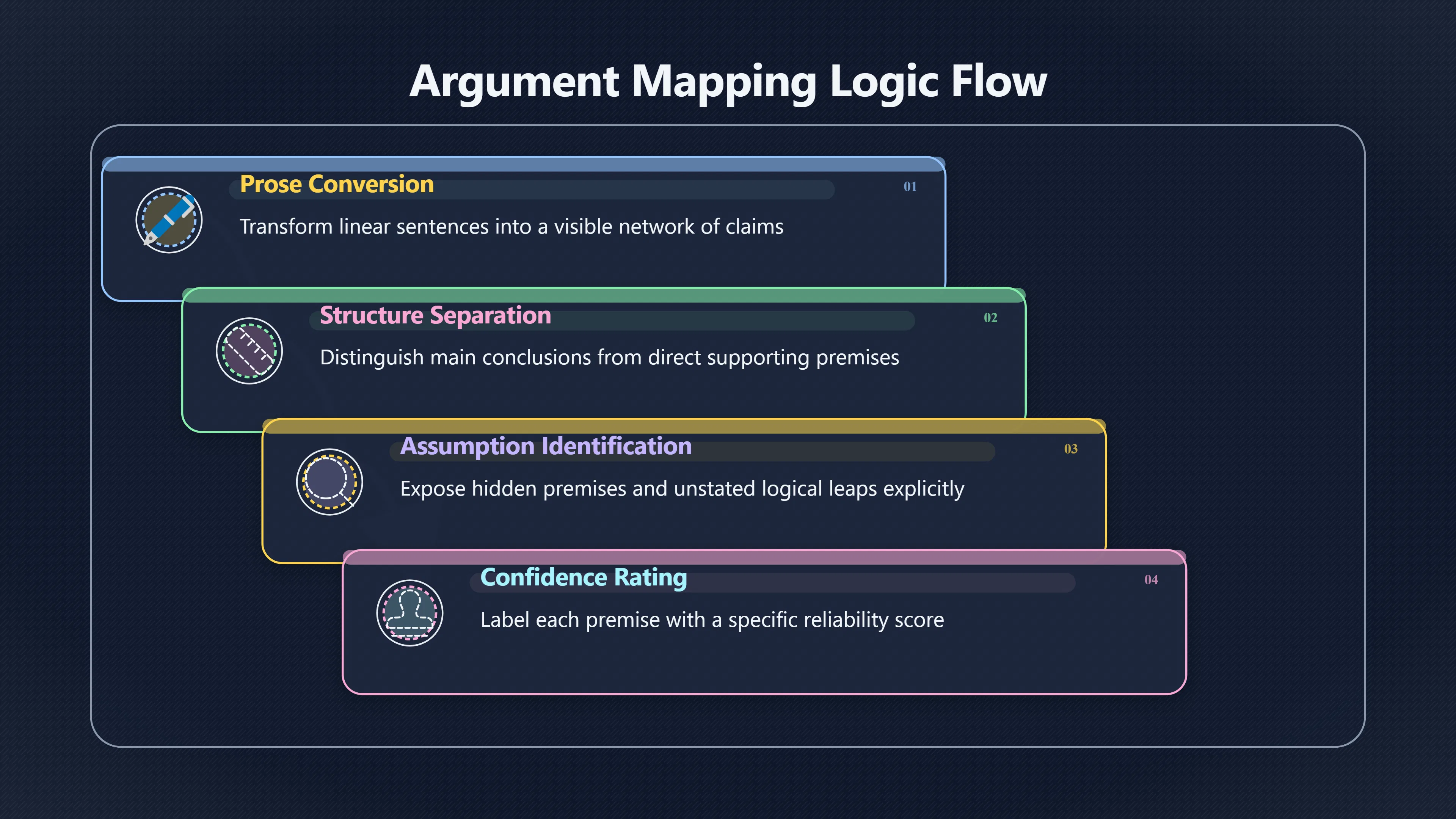
Argument maps turn messy prose into visible claims, reasons and assumptions so weak links can be fixed instead of vaguely criticised.
On this page
- How argument maps turn prose into structure
- Finding hidden assumptions and unsupported links
- Practice drills with short articles and memos
Page outline Jump by section
Introduction
Argument maps are one of the most effective tools for finding weak premises because they convert a flowing piece of prose into a visible network of claims, reasons and assumptions. Once every supporting statement has to occupy its own place on a map, vague persuasion becomes explicit reasoning. Weak evidence, missing links, hidden assumptions and unsupported leaps are much harder to overlook. Research on argument mapping suggests that, when used as part of deliberate practice with feedback, it can produce larger improvements in critical thinking than many traditional discussion-based approaches.[ResearchGate+2ResearchGate]researchgate.netResearchGate(PDF) Argument Maps Improve Critical ThinkingComputer-based argument mapping greatly enhances student critical think- ing, mo…
 For someone trying to improve analytical thinking, the value is practical rather than philosophical. Instead of asking the general question, “Is this argument convincing?”, an argument map asks several narrower questions: What exactly is the conclusion? Which premises support it? Which premises depend on each other? Which assumptions have been left unstated? Those questions expose the weakest parts of the reasoning before they become habits.
How argument maps turn prose into structure
Ordinary writing unfolds one sentence after another, but reasoning is rarely linear. Authors move between evidence, examples, assumptions and conclusions without always signalling the logical relationships. Argument maps replace that sequence with a diagram in which each box contains a single claim and arrows indicate which claims support or attack others. This makes the inferential structure—not merely the wording—visible.[U Sask LibGuides+2reasons.io]libguides.usask.caU Sask Lib Guides Critical Thinking Tutorial: Argument MappingU Sask LibGuidesCritical Thinking Tutorial: Argument Mapping - Research Guides8 Jan 2026 — An argument map is a visual representation of…
A well-constructed map normally separates:
- the main conclusion
- direct supporting premises
- intermediate conclusions that support later claims
- objections and counterarguments
- rebuttals
- implicit assumptions added where the argument would otherwise fail
This separation matters because people often criticise arguments at the wrong level. They attack a conclusion when the real weakness lies several steps earlier in an unsupported intermediate claim.
Consider a short example:
“The council should ban cars from the city centre because air pollution is harmful.”
In prose this sounds straightforward. Mapping quickly reveals several missing links:
- Air pollution in this city is caused substantially by cars.
- A ban would reduce pollution enough to matter.
- The benefits outweigh the economic and practical costs.
- No less restrictive policy would achieve similar results.
None of these assumptions automatically follows from the original sentence. Once they are visible, each becomes something that can be tested with evidence rather than accepted implicitly.
Finding hidden assumptions and unsupported links
Many arguments fail not because the stated premises are false, but because essential premises were never stated.
Logicians often describe such incomplete arguments as enthymemes—arguments that rely on an unstated assumption. Argument mapping encourages learners to reconstruct these hidden premises explicitly before evaluating the reasoning. Recent research in computational argumentation has also focused on identifying implicit premises because automated reasoning systems cannot reliably assess an argument until these missing steps have been represented.[arXiv]arxiv.orgUnderstanding Enthymemes in Argument Maps: Bridging Argument Mining and Logic-based ArgumentationAugust 16, 2024…
Several common warning signs emerge once an argument has been mapped.
A premise supports nothing
Sometimes writers include facts that appear impressive but contribute nothing to the conclusion.
For example:
- Company revenue increased.
- The CEO graduated from a prestigious university.
- Therefore the company is well managed.
After mapping, the educational background simply hangs disconnected unless an additional premise explains why it is relevant.
A conclusion rests on only one fragile premise
Some conclusions depend entirely on a single uncertain claim.
For example:
- Social media caused lower exam scores.
- Therefore schools should prohibit student phone use.
If the causal premise is poorly supported, the whole argument becomes vulnerable. The map identifies exactly where further evidence is needed.
Independent reasons are confused with linked reasons
Argument maps distinguish between premises that work independently and premises that only support the conclusion together.
For example:
- All medicines with ingredient X reduce symptoms.
- Drug A contains ingredient X.
Neither premise alone supports the conclusion. Together they do.
Students frequently separate linked premises incorrectly, creating the illusion of multiple reasons when there is really only one combined inference. Studies of argument-mapping instruction note that visualising these relationships helps instructors diagnose such errors more precisely.[ResearchGate]researchgate.netResearchGate(PDF) Argument Maps Improve Critical ThinkingComputer-based argument mapping greatly enhances student critical think- ing, mo…
Hidden value judgements
Many policy arguments rely on unstated values rather than hidden facts.
For example:
- Public parks should remain undeveloped.
- Therefore housing should not be built there.
The missing premise might be:
- Preserving public green space is more important than increasing housing supply in this case.
Making value assumptions explicit improves disagreement because participants can discuss the real point of contention instead of arguing about secondary facts.
Why weak premises often survive in fluent writing
Fluent prose can disguise poor reasoning because readers naturally fill in missing steps.
Psychologists refer to this tendency as generating coherence: readers unconsciously complete incomplete explanations if the overall story feels plausible. Argument maps interrupt this process by forcing every supporting claim to be represented individually. If a reader cannot draw an arrow from one statement to another without inventing extra information, the argument contains a missing premise.
This explains why people often feel an argument is persuasive yet struggle to explain exactly why. The persuasive impression comes from narrative flow, while the logical support remains incomplete.
Mapping therefore separates two different questions:
- Does this sound convincing?
- Does each conclusion genuinely follow from its stated support?
Those questions often produce different answers.
Practice drills with short articles and memos
Argument mapping improves through repeated, focused exercises rather than occasional use. The goal is not producing beautiful diagrams but repeatedly identifying where reasoning depends on assumptions that deserve inspection.
Useful drills include:
- Map a newspaper editorial. Restrict yourself to the main conclusion and no more than six supporting claims. Then identify one unstated assumption that must be true for the argument to succeed.
- Map a workplace memo. Managers frequently justify recommendations with mixed evidence, predictions and priorities. Separate factual premises from value judgements before evaluating either.
- Compare two competing opinion pieces. Construct separate maps before deciding which is stronger. Avoid comparing conclusions until each structure has been analysed independently.
- Delete one premise. Remove each premise in turn and ask whether the conclusion still follows. Premises whose removal collapses the argument deserve the closest scrutiny.
- Strengthen the weakest link. Rather than criticising the argument immediately, ask what additional evidence would make its weakest premise more credible. This develops charitable interpretation alongside critical evaluation.
A useful habit is to label each premise with a confidence rating—for example, high, medium or low confidence. The conclusion should never be treated as more certain than its weakest essential supporting premise.
Common mistakes when learning argument mapping
Beginners often make predictable errors that reduce the method’s usefulness.
- Mapping sentences instead of claims. A single sentence may contain several propositions that need separate boxes.
- Including rhetorical flourishes. Emotional language, repetition and examples should not be confused with independent reasons.
- Ignoring assumptions. If an arrow requires an invisible logical step, the missing premise should usually appear explicitly.
- Treating every disagreement as an objection to the conclusion. Many disagreements target premises instead, making the conclusion easier to evaluate once the supporting chain has been repaired.
- Making maps too large. Extremely detailed maps become difficult to inspect. It is often better to map the central argument first and expand only the branches that require closer analysis.
Research on educational use also notes that overly complex maps can increase cognitive load, particularly for beginners. Effective instruction therefore introduces the technique gradually and combines it with feedback rather than expecting learners to master large, intricate diagrams immediately.[Wikipedia]WikipediaArgument mapArgument map
Why argument maps fit deliberate practice
Argument mapping aligns closely with deliberate practice because it converts an invisible mental skill into an observable performance.
Instead of receiving vague feedback such as “your reasoning needs work”, learners receive precise corrections:
- this premise is unsupported
- these two premises should be linked
- this assumption is missing
- this objection attacks the wrong claim
- this conclusion overreaches the available evidence
These are concrete reasoning moves that can be practised repeatedly. Studies of computer-assisted argument mapping report that structured practice with timely feedback can substantially improve critical thinking performance compared with more conventional instruction, although success depends on sustained coaching rather than simply drawing diagrams.[ResearchGate+2ResearchGate]researchgate.netResearchGate(PDF) Argument Maps Improve Critical ThinkingComputer-based argument mapping greatly enhances student critical think- ing, mo…
The greatest benefit is not producing attractive diagrams. It is learning to notice, almost automatically, when a conclusion depends on a premise that has not yet earned the weight being placed upon it. Once that habit develops, readers become less vulnerable to persuasive writing that appears coherent while resting on fragile or unstated assumptions.
Amazon book picks
Further Reading
Books and field guides related to Can argument maps expose weak reasoning?. Use these as the next step if you want deeper reading beyond the article.
Critical Thinking
Covers evaluating claims, evidence, and logical structure in everyday arguments.
The Thinker's Guide to Analytic Thinking
Focuses on analyzing arguments, identifying assumptions, and evaluating reasoning.
How to Read a Book
Teaches close analytical reading that complements argument mapping practice.
Super Thinking
Provides structured thinking tools that reinforce identifying weak reasoning.
eBay marketplace picks
Marketplace Samples
Example marketplace items related to this page. Use the search link to explore similar finds on eBay.

Endnotes
1.
Source: researchgate.net
Link:https://www.researchgate.net/publication/28763750_Argument_Maps_Improve_Critical_Thinking
Source snippet
ResearchGate(PDF) Argument Maps Improve Critical ThinkingComputer-based argument mapping greatly enhances student critical think- ing, mo...
2.
Source: researchgate.net
Title: 304805904 Using Argument Mapping to Improve Critical Thinking Skills
Link:https://www.researchgate.net/publication/304805904_Using_Argument_Mapping_to_Improve_Critical_Thinking_Skills
Source snippet
Using Argument Mapping to Improve Critical Thinking Skills19 Feb 2026 — Empirical evidence consistently shows that CAAM can significantly...
3.
Source: reasons.io
Title: Critical Thinking with Argument Maps
Link:https://reasons.io/learn/01
Source snippet
Argument maps are tree-like structures called directed graphs which more accurately represents good reasoning...
4.
Source: arxiv.org
Link:https://arxiv.org/abs/2408.08648
Source snippet
Understanding Enthymemes in Argument Maps: Bridging Argument Mining and Logic-based ArgumentationAugust 16, 2024...
Published: August 16, 2024
5.
Source: Wikipedia
Title: Argument map
Link:https://en.wikipedia.org/wiki/Argument_map
6.
Source: youtube.com
Title: Charting the Thicket: Using Argument Mapping to Explore Controversial Topics
Link:https://www.youtube.com/watch?v=f833pHMlJjk
Source snippet
Critical Thinking - 1.6 Argument Mapping...
7.
Source: libguides.usask.ca
Title: U Sask Lib Guides Critical Thinking Tutorial: Argument Mapping
Link:https://libguides.usask.ca/CriticalThinkingTutorial/ArgumentAnalysis/ArgumentMapping
Source snippet
U Sask LibGuidesCritical Thinking Tutorial: Argument Mapping - Research Guides8 Jan 2026 — An argument map is a visual representation of...
8.
Source: ddd.uab.cat
Title: Argument map
Link:https://ddd.uab.cat/pub/expbib/2009/34875/oratoria09/Argument_map
Source snippet
map - Wikipedia, the free encyclopedia5 Jul 2016 — Argument maps are commonly used in the context of [teaching]({{ 'teaching/' | relative_url }}) and applying critical think...
9.
Source: drcharlesmrusso.substack.com
Title: argument mapping
Link:https://drcharlesmrusso.substack.com/p/argument-mapping
Source snippet
Mapping - by Dr. Charles M. Russo, PhDStudies in higher education and e-learning contexts consistently show that mapping improves critica...
10.
Source: oreilly.com
Title: Argument Mapping
Link:https://www.oreilly.com/library/view/an-introduction-to/9780470195093/OEBPS/c11.htm
Source snippet
An Introduction to Critical Thinking...In an argument map, arrows link premises to their conclusions. Here is a simple one with only one...
11.
Source: mindonmap.com
Title: argument mapping
Link:https://www.mindonmap.com/blog/argument-mapping/
Source snippet
Furthermore, this map reveals the argument's unseen composition, displaying how to lift the support claim.Read more...
Additional References
12.
Source: quizlet.com
Link:https://quizlet.com/891951998/argument-mapping-flash-cards/
Source snippet
Argument Mapping FlashcardsA hidden assumption will always offer conjoint support for its conclusion/sub-conclusion. Image: Mapping Hidde...
13.
Source: philosophy.hku.hk
Link:https://philosophy.hku.hk/think/arg/complex.php?m=1
Source snippet
hku.hk[A10] Argument mappingAn (simple) argument is a set of one or more premise with a conclusion. A complex argument is a set of argume...
14.
Source: reasoninglab.com
Link:https://www.reasoninglab.com/wp-content/uploads/2013/10/Argument-Maps-the-Rules.pdf
15.
Source: readlite.in
Link:https://readlite.in/concepts/identify-hidden-assumptions
Source snippet
A hidden assumption is an unstated belief or premise that an argument depends on to work.Read more...
16.
Source: psychologytoday.com
Title: improving critical thinking through argument mapping
Link:https://www.psychologytoday.com/gb/blog/thoughts-thinking/201811/improving-critical-thinking-through-argument-mapping
Source snippet
9 Nov 2018 — To clarify, an argument map is a visual representation of a logically structured network of reasoning, in which the argument...
17.
Source: insightassessment.com
Title: Insight Assessment Mapping Decisions and Arguments
Link:https://insightassessment.com/iaresource/mapping-decisions-and-arguments/
Source snippet
Mapping Decisions and Arguments - Insight AssessmentThis paper illustrates one effective approach to teaching the diagrammatic convention...
18.
Source: vaia.com
Link:https://www.vaia.com/en-us/explanations/psychology/cognitive-psychology/argument-mapping/
Source snippet
Argument Mapping: Examples & Techniques | Vaia27 Nov 2024 — The key components of an argument map are claims, premises, objections, rebut...
19.
Source: comm.pitt.edu
Title: argument claims reasons evidence
Link:https://www.comm.pitt.edu/argument-claims-reasons-evidence
Source snippet
pitt.eduArgument: Claims, Reasons, Evidence - CommunicationArguments are claims backed by reasons that are supported by evidence. Argumen...
20.
Source: logiccheck.net
Title: introducing argument mapping
Link:https://www.logiccheck.net/post/introducing-argument-mapping
Source snippet
9 Jul 2020 — I'll walk you through how argument mapping works and begin to apply mapping principles to often heated, but perfectly reason...
21.
Source: ecampusontario.pressbooks.pub
Link:https://ecampusontario.pressbooks.pub/criticalthinking1234/chapter/introduction/
Source snippet
(See Figure 1, for an example...Read more...
Topic Tree