Within Three Parts
When should you distrust your confidence?
The right self-checks can reveal when confidence is running ahead of evidence, alternatives or feedback.
On this page
- Signs that confidence is outrunning evidence
- Questions that trigger better self monitoring
- Using feedback to recalibrate judgement
Page outline Jump by section
Introduction
Confidence is useful because it allows decisions to be made without endless hesitation. The problem is that confidence and accuracy are only loosely connected. People often feel most certain precisely when they have overlooked key evidence, failed to consider alternatives, or mistaken familiarity for understanding. Research on judgment calibration consistently finds that subjective certainty frequently exceeds objective accuracy, particularly on difficult questions and when people are asked to justify answers from memory.[APA+2Wikipedia]apa.orgThis bias is thought to be robust…Read more…
 Metacognitive checks are practical ways of asking whether your confidence deserves to be trusted. Rather than trying to eliminate confidence, they aim to calibrate it—bringing certainty into closer alignment with the strength of the available evidence. Good thinkers therefore treat confidence as information to evaluate rather than proof that they are right.
Signs that confidence is outrunning the evidence
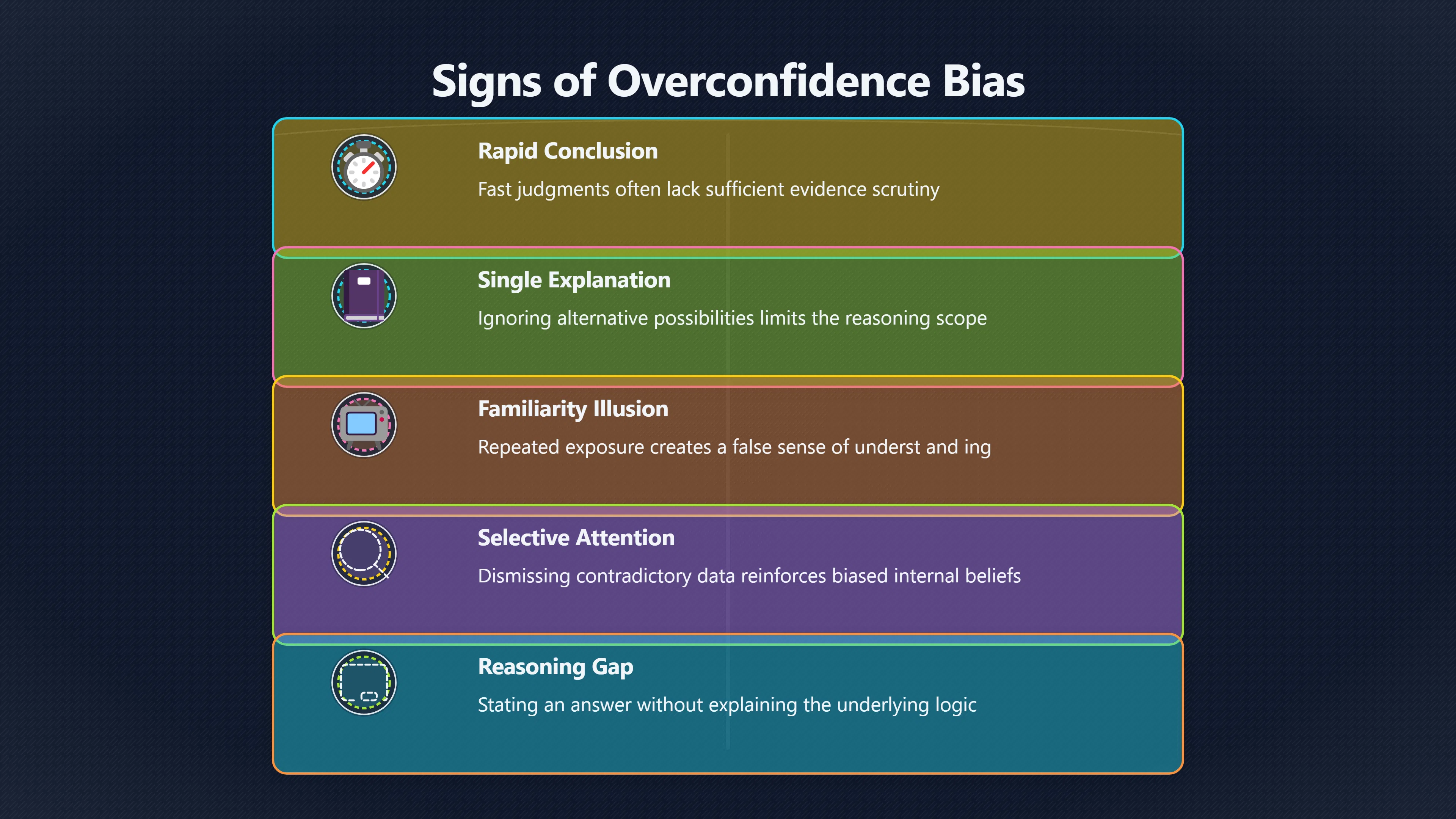
Overconfidence is not simply “feeling confident”. It is confidence that exceeds what the available evidence justifies. Because people rarely notice this directly, useful metacognitive checks focus on observable warning signs.
Common indicators include:
- The answer arrived unusually quickly. Fast judgments are often appropriate, especially in areas of genuine expertise, but speed alone is not evidence that a conclusion is correct. Automatic responses deserve additional scrutiny when the decision is unfamiliar or consequential.
- Only one explanation comes to mind. The first plausible explanation is often treated as the only explanation. If no serious alternatives have been considered, confidence may reflect a narrow search rather than a strong conclusion.
- The evidence feels familiar rather than convincing. Repeated exposure to an idea can create an illusion of truth or understanding. Recognising an argument is not the same as having critically evaluated it.[Wikipedia]WikipediaMay 8, 2026 — Metacognition is an awareness of one's thought processes and an understanding of the patterns behind them. It is "thinking…
- Disconfirming evidence is ignored. Confidence becomes unreliable when attention shifts towards supporting information while contradictory evidence is dismissed as exceptional.
- The conclusion feels clearer than the reasoning. If you can state your answer but cannot explain why competing answers are wrong, your certainty may exceed your understanding.
These warning signs matter because overconfidence is often a calibration problem rather than an intelligence problem. Highly capable people can become overconfident when working outside their expertise, relying on incomplete evidence, or becoming emotionally invested in a conclusion.[IDEAS/RePEc]ideas.repec.orgIDEAS/RePEcJudgmental overconfidence: Three measures, one bias?by G Fellner · 2012 · Cited by 102 — Overconfidence is used to explain var…
Questions that trigger better self-monitoring
The most effective metacognitive checks interrupt automatic certainty before a decision becomes fixed. Instead of asking, “Am I right?”, ask questions that test the quality of the reasoning process.
Useful prompts include:
- What evidence would change my mind? If no conceivable evidence could alter your conclusion, the problem is often commitment rather than reasoning.
- What is the strongest alternative explanation? Generating at least one credible rival explanation reduces the tendency to mistake the first answer for the best answer.
- How confident should I be, numerically? Assigning an explicit probability—for example, 70% rather than “I’m sure”—encourages calibration and makes later comparison with outcomes possible.
- What assumptions am I making? Many confident judgments rest on unstated assumptions about missing facts, intentions or future events.
- If someone I respected disagreed, what argument would I expect them to make? This encourages genuine perspective-taking rather than constructing a weak “straw man” objection.
- How much of my confidence comes from evidence and how much from familiarity, experience or reputation? Separating these sources often reveals that certainty has been borrowed from context rather than earned by the current evidence.
These questions work because they redirect attention from defending a conclusion to evaluating the process that produced it. Educational research on metacognition consistently finds that explicitly teaching learners to plan, monitor and evaluate their thinking improves the quality of self-regulation, particularly when these questions are embedded in real tasks rather than taught as abstract rules.[EEF]educationendowmentfoundation.org.ukEEFMetacognition and self-regulation | EEFMetacognition and self-regulation approaches to teaching support pupils to think about their own learning
Use feedback to recalibrate judgement
The most reliable way to reduce overconfidence is to compare predictions with reality repeatedly.
Calibration improves when people keep track of:
- predictions they made before knowing the outcome;
- how confident they were at the time;
- what actually happened; and
- why any errors occurred.
This matters because memory is selective. Once outcomes are known, hindsight makes earlier uncertainty difficult to remember, creating the impression that “I knew it all along”. Recording forecasts before receiving feedback exposes this illusion and provides a more accurate picture of judgment quality.[Wikipedia]WikipediaOverconfidence effectOverconfidence effect
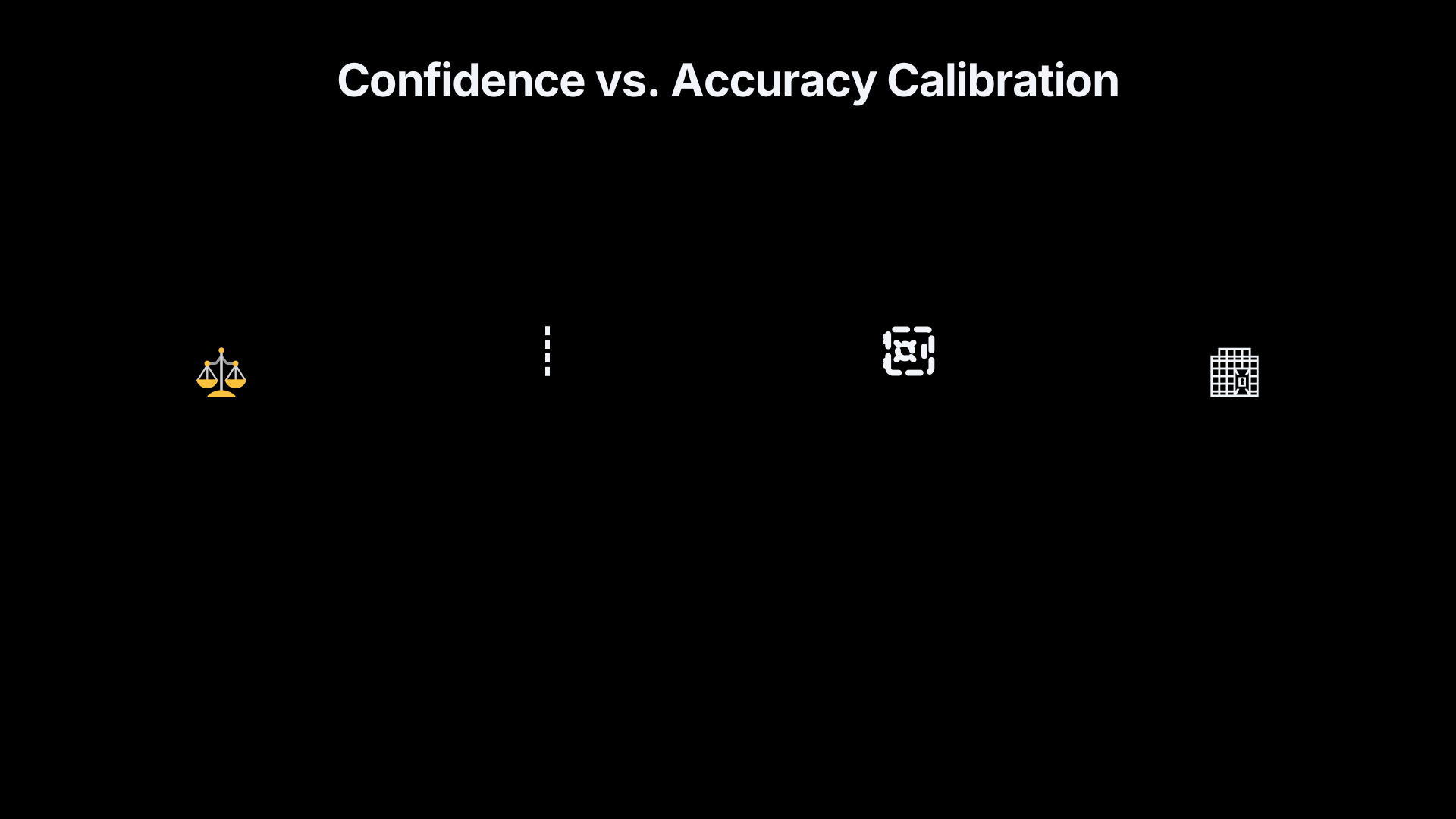
A simple calibration habit is to attach confidence ratings to important decisions:
ConfidenceWhat it should roughly mean60%More likely correct than not, but substantial uncertainty remains.80%Strong evidence, though meaningful doubt is still possible.95%Only appropriate when the chance of being wrong is genuinely very small.
After enough decisions, compare confidence with outcomes. If statements made with 80% confidence prove correct only 60% of the time, confidence is inflated. If they are correct almost every time, confidence may actually be too low.
Research on calibration shows that people frequently provide confidence intervals that are far too narrow, revealing greater certainty than their knowledge supports. Learning from repeated feedback gradually widens uncertainty estimates to more realistic levels.[Wikipedia+2ResearchGate]WikipediaOverconfidence effectOverconfidence effect
Why overconfidence survives even when we know about it
Knowing that overconfidence exists does not eliminate it.
Several mechanisms make it persistent:
- Commitment strengthens belief. Once a decision has been made publicly, people often interpret subsequent evidence in ways that justify the existing choice, increasing confidence even without improving accuracy. Recent experimental work suggests that the act of deciding itself can inflate confidence by biasing how later information is interpreted.[Cambridge University Press & Assessment]cambridge.orgCambridge University Press & AssessmentWhen deciding creates overconfidence | Judgment and…by PJ Boyle · 2025 · Cited by 6 — We demons…
- Small amounts of knowledge create an illusion of mastery. Brief exposure to a topic may produce enough familiarity to feel knowledgeable while leaving major gaps unnoticed. Recent research on health information illustrates how limited knowledge can produce unwarranted confidence in self-diagnosis.[PMC]pmc.ncbi.nlm.nih.govMetacognition and diagnostic decision-making: short "blips" of…by S Hong · 2026 — This study demonstrates that brief exposure to me…
- Confidence feels like evidence. People often mistake the subjective feeling of certainty for objective support, even though confidence is generated by the mind rather than directly by external reality.
- Success provides uneven feedback. Correct outcomes do not necessarily prove good reasoning. A poor process can occasionally produce the right answer by luck, reinforcing excessive confidence.
These mechanisms explain why simply warning people about overconfidence has limited effects. Better calibration requires structured reflection and repeated comparison between confidence and actual performance.
A practical metacognitive routine
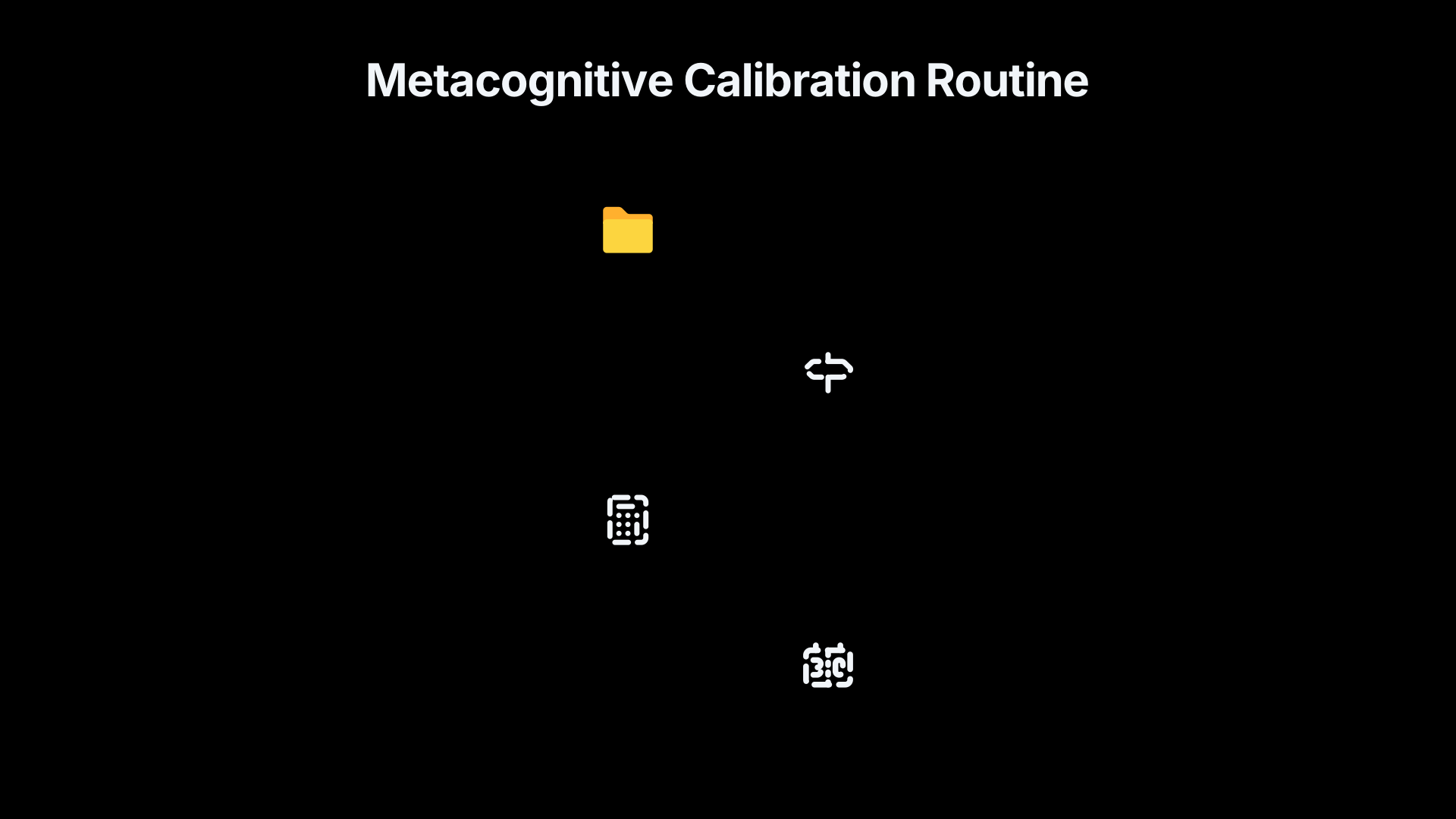
Before trusting a high-confidence judgment, pause long enough to perform four quick checks:
- Evidence: What facts directly support this conclusion?
- Alternatives: What is the strongest competing explanation?
- Uncertainty: How confident should I actually be, expressed as a probability rather than a feeling?
- Feedback: How will I discover later whether this judgment was accurate?
The routine takes only a few moments, but it shifts thinking from defending beliefs to evaluating them. The goal is not constant doubt. Instead, it is appropriately calibrated confidence—being highly certain when the evidence is genuinely strong, cautious when uncertainty remains, and always willing to update judgment when new information appears.
eBay marketplace picks
Marketplace Samples
Example marketplace items related to this page. Use the search link to explore similar finds on eBay.




Endnotes
1.
Source: apa.org
Link:https://www.apa.org/pubs/journals/features/cou-0000105.pdf
Source snippet
This bias is thought to be robust...Read more...
2.
Source: Wikipedia
Title: Overconfidence effect
Link:https://en.wikipedia.org/wiki/Overconfidence_effect
3.
Source: researchgate.net
Link:https://www.researchgate.net/publication/4818450_Overconfidence_in_Probability_and_Frequency_Judgments_A_Critical_Examination
Source snippet
In the first part of the...Read more...
4.
Source: Wikipedia
Link:https://en.wikipedia.org/wiki/Metacognition
Source snippet
May 8, 2026 — Metacognition is an awareness of one's thought processes and an understanding of the patterns behind them. It is "thinking...
Published: May 8, 2026
5.
Source: ideas.repec.org
Link:https://ideas.repec.org/a/eee/joepsy/v33y2012i1p142-154.html
Source snippet
IDEAS/RePEcJudgmental overconfidence: Three measures, one bias?by G Fellner · 2012 · Cited by 102 — Overconfidence is used to explain var...
6.
Source: educationendowmentfoundation.org.uk
Link:https://educationendowmentfoundation.org.uk/education-evidence/[teaching
Source snippet
n learning...
7.
Source: cambridge.org
Link:https://www.cambridge.org/core/journals/judgment-and-decision-making/article/when-deciding-creates-overconfidence/CFBE92B067A3DF55E5DB9A05CF497064
Source snippet
Cambridge University Press & AssessmentWhen deciding creates overconfidence | Judgment and...by PJ Boyle · 2025 · Cited by 6 — We demons...
8.
Source: pmc.ncbi.nlm.nih.gov
Link:https://pmc.ncbi.nlm.nih.gov/articles/PMC12988131/
Source snippet
Metacognition and diagnostic decision-making: short "blips" of...by S Hong · 2026 — This study demonstrates that brief exposure to me...
9.
Source: pmc.ncbi.nlm.nih.gov
Link:https://pmc.ncbi.nlm.nih.gov/articles/PMC12730000/
Source snippet
Experimental Study of Overconfidence Biases in Young...by DG Gültekin · 2025 · Cited by 2 — This bias makes individuals overly confident...
Additional References
10.
Source: youtube.com
Link:http://www.youtube.com/watch?v=EJbX7gzc6gI
Source snippet
Metacognition overconfidence calibration judgment Metacognitive calibration: a methodological expansion and empirical [application]({{ 'application/' | relative_url }}) - ISLS...
11.
Source: columbia.edu
Title: FINN Framing Effects on Metacognitive Monitoring and Control 813 21
Link:https://www.columbia.edu/cu/psychology/metcalfe/PDFs/FINN-Framing%20Effects%20on%20Metacognitive%20Monitoring%20and%20Control%20-%20813-21.pdf
Source snippet
Framing effects on metacognitive monitoring and controlby B FINN · 2008 · Cited by 182 — Simply framing immediate judgments in terms for...
12.
Source: scribbr.co.uk
Title: What Is Overconfidence Bias? | Definition & Examples
Link:https://www.scribbr.co.uk/bias-in-research/the-overconfidence-bias/
Source snippet
18 Mar 2023 — Overconfidence bias is a type of cognitive bias that causes us to think we are better in some areas than we really a...
13.
Source: tll.mit.edu
Title: Teaching + Learning Lab Metacognition
Link:https://tll.mit.edu/teaching-resources/how-people-learn/metacognition/
Source snippet
Teaching + Learning LabMetacognition - Teaching + Learning Lab - MITMetacognition is the process by which learners use knowledge of the t...
14.
Source: youtube.com
Title: Metacognitive calibration: a methodological expansion and empirical application
Link:http://www.youtube.com/watch?v=uOcSfstAf-M
Source snippet
Why Overconfident People Miss Their Own [Mistakes]({{ 'mistakes/' | relative_url }}) | Dunning-Kruger Effect...
15.
Source: science.org
Link:https://www.science.org/doi/10.1126/sciadv.ady0441
Source snippet
Deciding for others alters metacognition leading to...Feb 25, 2026 — Specifically, responsibility for others changes metacognitive biase...
16.
Source: youtube.com
Title: Why Overconfident People Miss Their Own Mistakes | Dunning-Kruger Effect
Link:http://www.youtube.com/watch?v=XlMf78CuEd4
Source snippet
Metacognition Tricks That Make You Smarter...
17.
Source: youtube.com
Title: Overconfidence in decision-making
Link:http://www.youtube.com/watch?v=DVQlvgO0y94
Source snippet
Talk: Systematic review and meta-analysis of the calibration of confidence judgments in individuals…...
18.
Source: academic.oup.com
Link:https://academic.oup.com/pnasnexus/article/4/5/pgaf133/8118889
Source snippet
key to calibrating trust and optimal decision making with AIby D Lee · 2025 · Cited by 19 — Metacognitive sensitivity, measured by meta-d...
19.
Source: rahnevlab.gatech.edu
Link:https://rahnevlab.gatech.edu/documents/papers/Shekhar%26Rahnev%282021%29PsychReview.pdf
Source snippet
A substantial body of research has demonstrated...Read more...
Topic Tree