Within Sharper Thinking
Why First Answers Feel So Convincing
The Cognitive Reflection Test shows how tempting first answers can feel right before they have been checked.
On this page
- What reflection tests reveal
- Why simple puzzles can mislead
- How to check appealing answers
Page outline Jump by section
Introduction
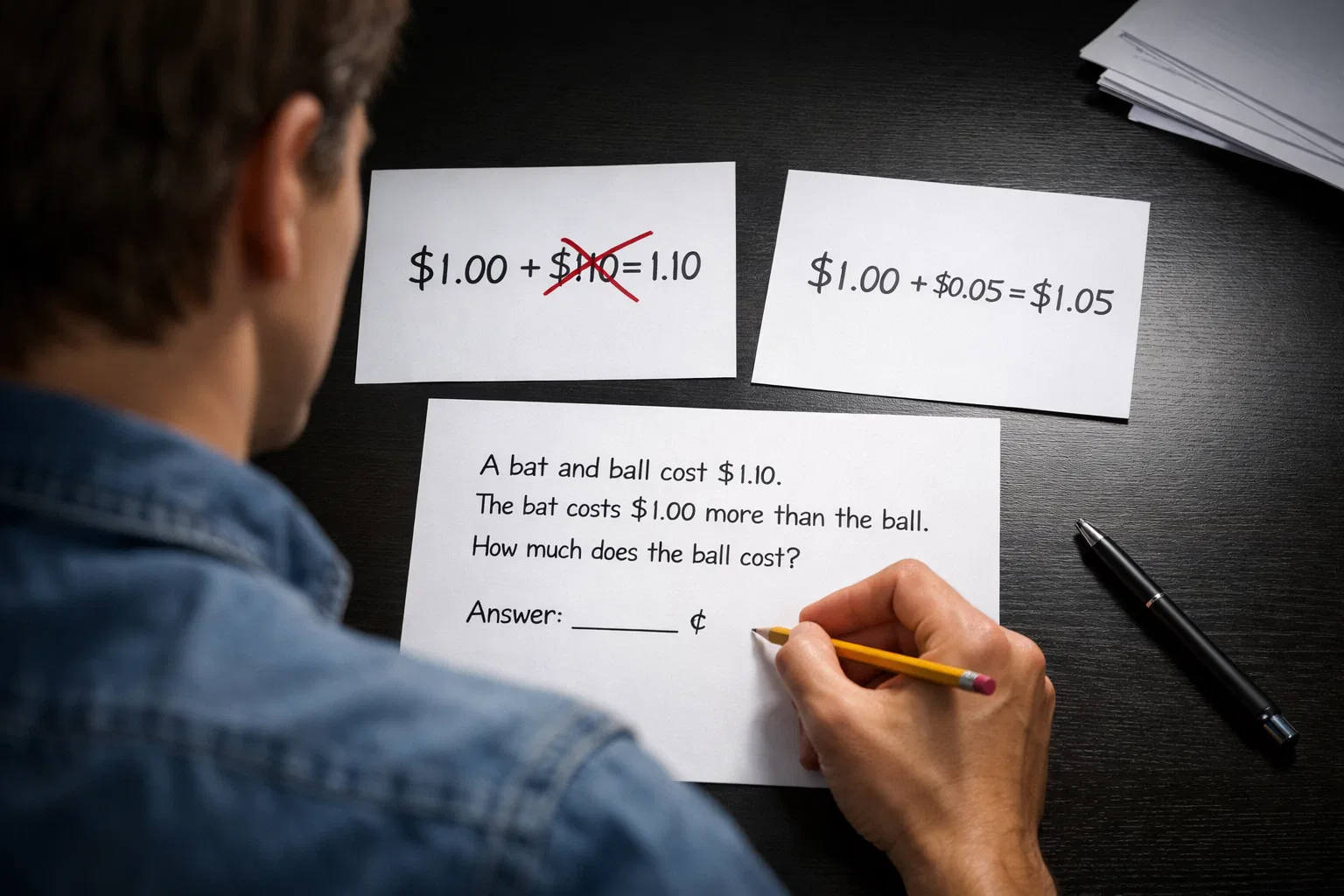
The Cognitive Reflection Test is famous because its questions make a wrong answer feel almost insultingly obvious. In the classic “bat and ball” puzzle, many people first say the ball costs 10 cents; checking the arithmetic shows it must cost 5 cents. That small mistake captures a larger thinking problem: some answers feel convincing not because they have been tested, but because they arrived quickly, matched the surface pattern, and reduced mental effort.
For improving analytical skills, the value of reflection tasks is not that they prove who is “smart”. It is that they create a clean, memorable demonstration of a first-answer trap. They show how a fluent answer can outrun verification, why simple-looking puzzles can mislead, and how a brief checking routine can catch errors before they harden into confidence.
What reflection tests reveal
Shane Frederick introduced the original three-item Cognitive Reflection Test in 2005 as a short way to measure a person’s tendency to resist reporting the first answer that comes to mind. The questions were deliberately simple in wording but designed to cue an intuitive wrong response before the correct one was reached through a small amount of reflection.[bear.warrington.ufl.edu]bear.warrington.ufl.eduThe bat costs $1.00 more than the ball. How much does the ball cost?Read moreCognitive Reflection and Decision Makingby S Frederick · 2005 · Cited by 8140 — By contrast, consider this problem: A bat and a ball cost…
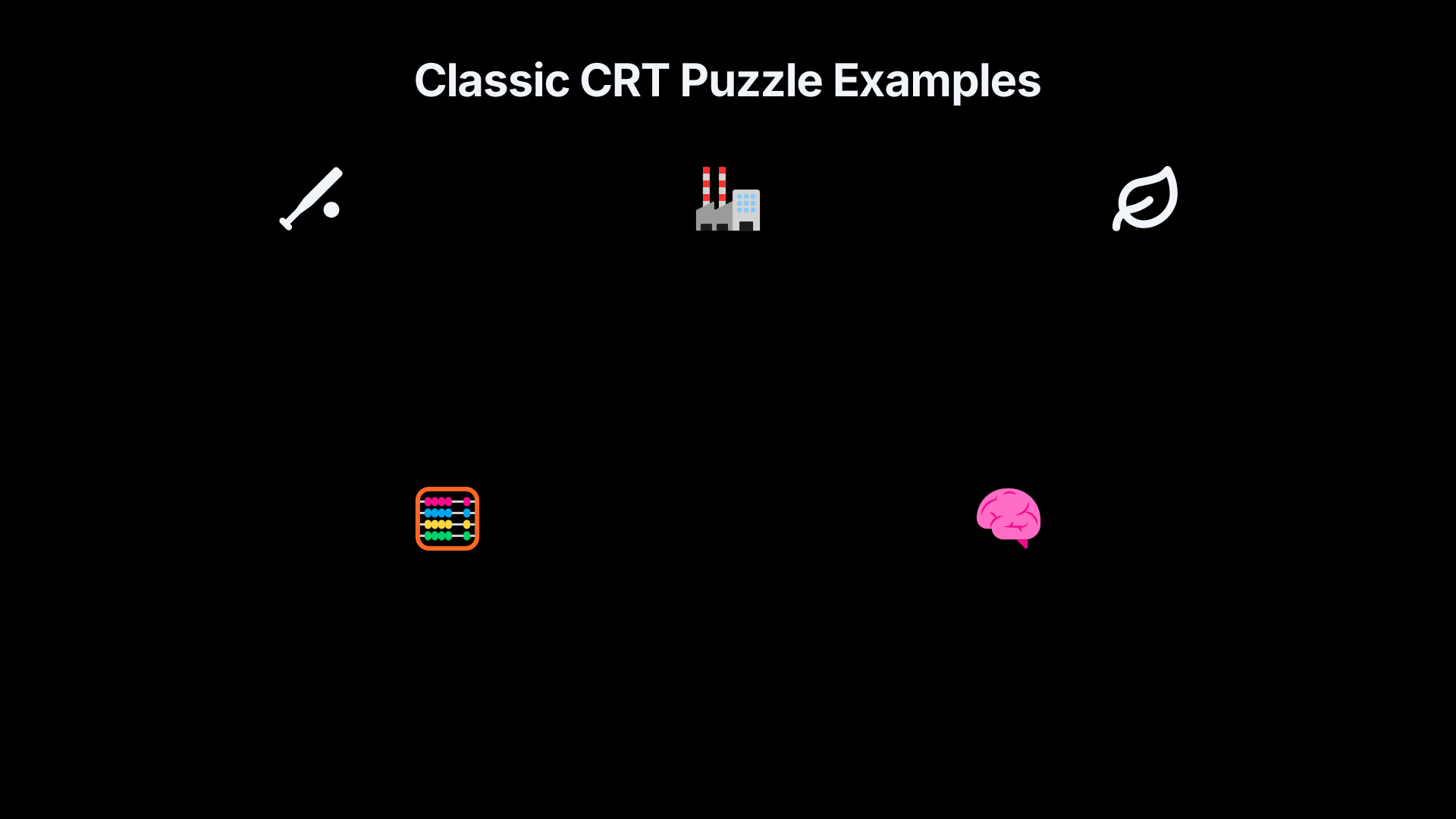
The three classic items use everyday arithmetic rather than specialist knowledge. A bat and ball problem tempts “10 cents”; a machine-and-widget problem tempts “100 minutes”; a lily-pad growth problem tempts “24 days”. The correct answers are 5 cents, 5 minutes and 47 days. The trap is not complex mathematics. It is the mismatch between how easy the question feels and how carefully it needs to be parsed.[Society for Judgment and Decision Making]sjdm.org2005). The CRT was designed to assess a specific cognitive ability. A bat and a ball cost $1.10 in total. The bat costs $1.00 more than…
That is why the test became influential in judgement and decision-making research. It offers a compact example of “miserly processing”: accepting an answer that is available and plausible enough, rather than spending extra effort to check it. Later work found that CRT performance can predict performance on a range of heuristics-and-biases tasks, even when researchers account for other individual-difference measures such as cognitive ability and thinking dispositions.[PubMed]pubmed.ncbi.nlm.nih.govThe Cognitive Reflection Test as a predictor of…by ME Toplak · 2011 · Cited by 1590 — In this study, we showed that the CRT is a…
The practical lesson is narrower and more useful than “always distrust your intuition”. First answers are often useful in familiar, low-stakes situations. The CRT matters because it isolates a particular failure mode: when a problem has been built, or happens naturally, so that the surface reading triggers a seductive but wrong answer.

Why simple puzzles can mislead
The bat-and-ball puzzle works because it lets the mind replace the real question with an easier one. The phrase “£1.00 more” or “$1.00 more” invites a rough split of the total into a large part and a small part. “10 cents” feels compatible with the total of 1.10, so it slips through unless the person checks whether the bat is exactly one unit more than the ball.
That checking step is tiny but decisive. If the ball cost 10 cents and the bat cost one unit more, the bat would cost 1.10, making the total 1.20. The intuitive answer violates the condition in the question. The mistake survives because the first answer satisfies a looser impression of the problem, not the actual constraint.
This is the central feature of first-answer traps: they do not always feel like guesses. They often feel like recognition. A person sees a familiar structure, retrieves a fitting response, and experiences fluency as evidence of correctness. Reflection tests expose the gap between “this came easily” and “this has been checked”.
The same pattern appears beyond puzzle books. A headline may suggest one cause before the data support it. A project failure may seem to have an obvious culprit before alternative explanations are compared. A price, risk or probability may feel reasonable until the base numbers are written down. The CRT is useful because it gives a small, controlled model of that wider analytical hazard.
The evidence is useful, but not simple
The CRT is often described as a measure of overriding intuition with reflection, but the research record is more complicated. Some studies suggest that CRT scores are not a pure measure of “reflection” alone, because the items also depend on numeracy and calculation skill. Sinayev and Peters argued that CRT performance can be strongly shaped by numerical ability, not only by the willingness to suppress an intuitive answer.[Frontiers]frontiersin.orgFrontiers Cognitive reflection vscalculation in decision makingMay 7, 2015 — by A Sinayev · 2015 · Cited by 274 — We focused on testing whether the Cognitive Reflection H…
Other researchers have examined how people actually solve CRT items rather than treating each answer as a simple window into either intuition or reflection. Szászi and colleagues used protocol analysis to explore solution strategies and found that CRT performance involves multiple abilities and routes, not a single mental switch from fast to slow thinking.[PhilPapers]philpapers.orgPhil Papers B. AczelPhil Papers B. Aczel
There is also evidence that the “slow reasoning corrects fast intuition” story can be too neat. Bago and De Neys argued, using work on the bat-and-ball problem, that correct responses may sometimes have an intuitive component too. In other words, better thinkers are not always people who first think wrongly and then repair the error; in some cases, they may sense the conflict or even the correct direction earlier than the standard story suggests.[Wim De Neys]wdeneys.orgOpen source on wdeneys.org.
The fairest interpretation is that the CRT is a strong demonstration tool and a useful research measure, but not a complete diagnostic of thinking quality. It captures a family of abilities: noticing conflict, resisting a fluent answer, parsing the wording, doing the calculation, and caring enough to verify. Those are exactly the ingredients that matter in first-answer traps.
Why the first answer feels so convincing
First answers gain force from several overlapping cues. None of them guarantees truth, but all of them can feel like truth.
Fluency feels like accuracy. An answer that comes quickly is easier to trust. The mind often treats ease of retrieval as a sign that a response is familiar, coherent or likely.
Surface fit hides constraint failure. In the bat-and-ball problem, “10 cents” fits the rough shape of the total, but not the exact “one unit more” relationship. The answer is locally plausible and globally wrong.
Stopping early saves effort. Reflection costs attention. If the problem appears easy, the mind has little motivation to spend more energy on it.
Confidence can arrive before verification. People do not always wait to check an answer before feeling sure. The feeling of having solved the problem can precede the work needed to prove it.
The trap is often invisible from inside. A person who gives the intuitive answer may not experience themselves as careless. They may experience the question as straightforward. That is what makes first-answer traps dangerous in real decisions: the error does not necessarily announce itself as an error.
Familiarity creates a second trap
The original CRT has become widely known. That creates a measurement problem: people who have seen the items before may remember the answers rather than reflect in the moment. Stieger and Reips identified familiarity as a limitation for the CRT, because prior exposure can raise scores and complicate interpretation.[peerj.com]peerj.comOpen source on peerj.com.
The story is not one-sided. Białek and Pennycook found that the CRT can remain robust to multiple exposures in some respects, with correlations to other variables persisting even when people have encountered the items before. Their argument suggests that exposure may improve raw scores without completely destroying the test’s usefulness.[Springer]link.springer.comOpen source on springer.com.
For everyday analytical skill, this distinction matters. Memorising the answer to the bat-and-ball problem does not mean you have become immune to first-answer traps. It means you have learnt one trap. The transferable skill is not the answer “5 cents”; it is the habit of asking, “What exactly must be true for my answer to be right?”
How to check appealing answers
Reflection does not require turning every decision into a long analysis. It means adding a small friction point at the moments when a fast answer is likely to mislead. The aim is to catch the cheap errors before investing in more elaborate reasoning.
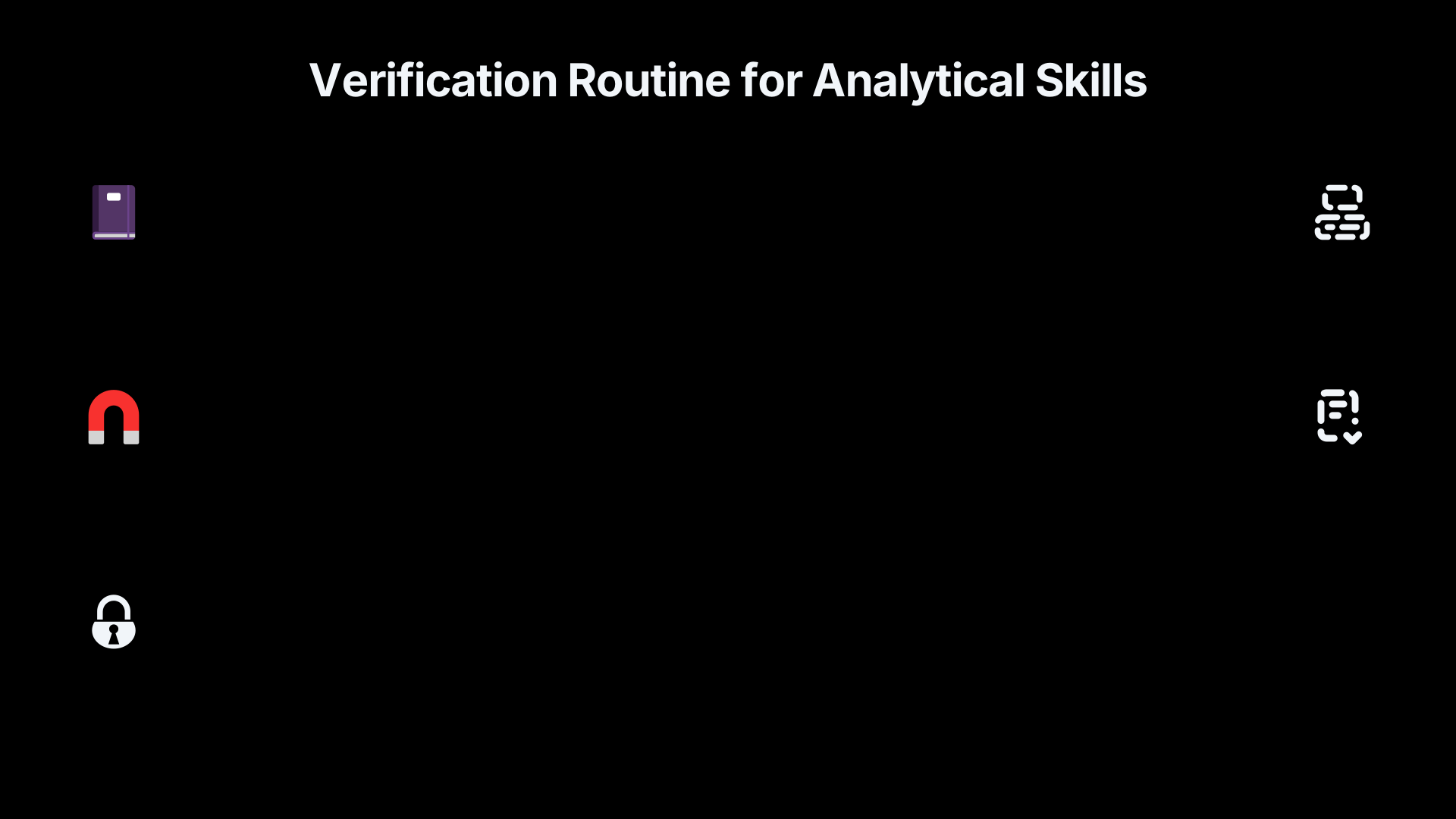
A useful checking routine has three moves:
- Restate the condition. Put the exact relationship into your own words. In the bat-and-ball problem, the key condition is not just the total; it is the difference between the two prices.
- Test the answer backwards. Insert your first answer into the original question. If the ball costs 10 cents, does the bat cost one unit more and does the total still work?
- Look for the lure. Ask what answer the question seems designed to tempt. In real life, ask what interpretation is easiest, most emotionally satisfying, or most familiar.
This routine is especially valuable when the first answer is simple, confident and consequential. The stronger the feeling of obviousness, the more useful a quick verification becomes. That does not mean the first answer is wrong; it means it has not yet earned trust.
What this teaches about better thinking
The deepest lesson of the Cognitive Reflection Test is not that people are irrational. It is that the mind often uses reasonable shortcuts in situations where a shortcut can be baited. The same machinery that helps us move quickly through ordinary life can misfire when the wording, numbers or incentives are arranged to reward a second pass.
For analytical skill, reflection tests therefore offer a compact training image: pause at the point where the answer feels complete. Check the constraint. Run the answer backwards. Distinguish fluency from proof. This is a small habit, but it changes the moment that matters most: the moment before a plausible answer becomes a settled belief.
Amazon book picks
Further Reading
Books and field guides related to Why First Answers Feel So Convincing. Use these as the next step if you want deeper reading beyond the article.
Thinking, Fast and Slow
Directly explains the fast-answer versus checking process illustrated by Cognitive Reflection Test problems.
The Art of Thinking Clearly
Covers common mental shortcuts and methods for spotting reasoning traps.
Predictably Irrational
Shows how systematic thinking errors create convincing but incorrect judgments.
Nudge
Explores how automatic judgments shape choices and how better decision structures help.
eBay marketplace picks
Marketplace Samples
Example marketplace items related to this page. Use the search link to explore similar finds on eBay.



Endnotes
1.
Source: bear.warrington.ufl.edu
Title: The bat costs $1.00 more than the ball. How much does the ball cost?Read more
Link:https://bear.warrington.ufl.edu/brenner/mar7588/Papers/frederick-jep2005.pdf
Source snippet
Cognitive Reflection and Decision Makingby S Frederick · 2005 · Cited by 8140 — By contrast, consider this problem: A bat and a ball cost...
2.
Source: link.springer.com
Link:https://link.springer.com/article/10.3758/s13421
Source snippet
The Cognitive Reflection Test as a predictor of performance...by ME Toplak · 2011 · Cited by 1590 — In this study, we showed tha...
3.
Source: philpapers.org
Title: Phil Papers B. Aczel
Link:https://philpapers.org/rec/SZATCR-2
4.
Source: peerj.com
Link:https://peerj.com/articles/2395/
5.
Source: link.springer.com
Link:https://link.springer.com/article/10.3758/s13428-017-0963-x
6.
Source: philpapers.org
Title: BAGTSS 4
Link:https://philpapers.org/rec/BAGTSS-4
7.
Source: youtube.com
Title: Behavioral Econ
Link:https://www.youtube.com/watch?v=OjtQdiZFE2M
Source snippet
Cognitive Reflection Test...
8.
Source: youtube.com
Title: Cognitive Reflection Test
Link:https://www.youtube.com/watch?v=eREmDMkP1fE
Source snippet
Why Smart People Make Bad Decisions — Thinking, Fast and Slow Explained...
9.
Source: sjdm.org
Link:https://sjdm.org/dmidi/Cognitive_Reflection_Test.html
Source snippet
(2005). The CRT was designed to assess a specific cognitive ability. A bat and a ball cost $1.10 in total. The bat costs $1.00 more than...
10.
Source: pubmed.ncbi.nlm.nih.gov
Link:https://pubmed.ncbi.nlm.nih.gov/21541821/
Source snippet
The Cognitive Reflection Test as a predictor of...by ME Toplak · 2011 · Cited by 1590 — In this study, we showed that the CRT is a...
11.
Source: frontiersin.org
Title: Frontiers Cognitive reflection vs
Link:https://www.frontiersin.org/journals/psychology/articles/10.3389/fpsyg.2015.00532/full
Source snippet
calculation in decision makingMay 7, 2015 — by A Sinayev · 2015 · Cited by 274 — We focused on [testing]({{ 'testing/' | relative_url }}) whether the Cognitive Reflection H...
Published: May 7, 2015
12.
Source: wdeneys.org
Link:https://www.wdeneys.org/data/reprint%20TAR%20The%20Smart%20System%201%20%2B%20supp.pdf
13.
Source: pmc.ncbi.nlm.nih.gov
Link:https://pmc.ncbi.nlm.nih.gov/articles/PMC6800670/
14.
Source: pmc.ncbi.nlm.nih.gov
Link:https://pmc.ncbi.nlm.nih.gov/articles/PMC4423343/
15.
Source: pubmed.ncbi.nlm.nih.gov
Link:https://pubmed.ncbi.nlm.nih.gov/25740762/
16.
Source: pmc.ncbi.nlm.nih.gov
Link:https://pmc.ncbi.nlm.nih.gov/articles/PMC4490207/
17.
Source: pmc.ncbi.nlm.nih.gov
Link:https://pmc.ncbi.nlm.nih.gov/articles/PMC4722428/
18.
Source: pmc.ncbi.nlm.nih.gov
Link:https://pmc.ncbi.nlm.nih.gov/articles/PMC11927432/
19.
Source: pmc.ncbi.nlm.nih.gov
Link:https://pmc.ncbi.nlm.nih.gov/articles/PMC6909056/
20.
Source: pubmed.ncbi.nlm.nih.gov
Link:https://pubmed.ncbi.nlm.nih.gov/27651989/
21.
Source: Wikipedia
Title: Cognitive reflection test
Link:https://en.wikipedia.org/wiki/Cognitive_reflection_test
22.
Source: dictionary.cambridge.org
Link:https://dictionary.cambridge.org/dictionary/english/cognitive
23.
Source: mannhowie.com
Title: Cognitive Reflection Test
Link:https://mannhowie.com/cognitive-reflection-test
24.
Source: sjdm.org
Link:https://sjdm.org/~baron/journal/15/151029/jdm151029.html
Additional References
25.
Source: youtube.com
Title: Why Smart People Make Bad Decisions — Thinking, Fast and Slow Explained
Link:https://www.youtube.com/watch?v=9KBUR7hjxIs
Source snippet
"Cognitive Reflection Test" bat ball How to Solve the "If a Bat and Ball Cost $1.10 in Total..." Cognitive Reflection Test or Question Ho...
26.
Source: youtube.com
Link:https://www.youtube.com/watch?v=K0O1_nwAky0
Source snippet
Daniel Kahneman: The Bat and Ball Puzzle...
27.
Source: researchgate.net
Link:https://www.researchgate.net/publication/333653470_Assessing_the_validity_of_inferences_from_scores_on_the_cognitive_reflection_test
28.
Source: researchgate.net
Link:https://www.researchgate.net/publication/51097609_The_Cognitive_Reflection_Test_as_a_Predictor_of_Performance_on_Heuristics-and-Biases_Tasks
29.
Source: researchgate.net
Link:https://www.researchgate.net/publication/314280671_The_cognitive_reflection_test_revisited_exploring_the_ways_individuals_solve_the_test
30.
Source: researchgate.net
Link:https://www.researchgate.net/publication/326134901_The_Cognitive_Reflection_Test_A_Measure_of_IntuitionReflection_Numeracy_and_Insight_Problem_Solving_and_the_Implications_for_Understanding_Real-World_Judgments_and_Beliefs
31.
Source: researchgate.net
Link:https://www.researchgate.net/publication/331105394_The_Smart_System_1_evidence_for_the_intuitive_nature_of_correct_responding_on_the_bat-and-ball_problem
32.
Source: semanticscholar.org
Link:https://www.semanticscholar.org/paper/A-limitation-of-the-Cognitive-Reflection-Test%3A-Stieger-Reips/ac754eade69fcabdbb4155e6985d83eba6eadf9e
33.
Source: merriam-webster.com
Link:https://www.merriam-webster.com/dictionary/cognitive
34.
Source: scribd.com
Link:https://www.scribd.com/document/522033720/I-Frederick-S-Cognitive-Reflection-and-Decision-Making
Topic Tree