Within Problem Framing
When the Question Already Contains the Answer
A problem statement can quietly choose the answer before the reasoning has begun.
On this page
- How solution shaped wording narrows the search
- Common signs of a premature frame
- How to rewrite the question before deciding
Page outline Jump by section
Introduction
A solution-shaped problem statement is a question that quietly decides the answer before the reasoning has begun. Instead of asking what is causing a problem or what outcome is desired, it asks how to implement a particular remedy. The result is that alternatives disappear from consideration, evidence is filtered through a narrow lens, and hidden assumptions become difficult to notice. In practical terms, “How do we automate this process?” and “What is causing delays in this process?” may lead to completely different investigations, even when they refer to the same situation. Research on decision framing, problem structuring and decision quality consistently shows that the way a problem is framed influences which options are considered, what information is collected, and what counts as a successful outcome.[Decision Professionals+2Structured Decision Making]decisionprofessionals.comDecision ProfessionalsDecision QualityThis framework proposed captures the quality of decisions, with the evidence that all decisions sha…
 This matters because people often spend most of their effort improving answers while leaving the question itself unexamined. A well-argued solution can still fail if it solves the wrong problem.
How Solution-Shaped Wording Narrows the Search
The mechanism is simple: the wording of the problem defines the search space.
Consider these two questions:
- “How do we get employees back into the office?”
- “What working arrangement best supports productivity, coordination and retention?”
The first assumes that returning to the office is the objective. The second treats office attendance as one possible option among several. The difference is not semantic. It changes what evidence becomes relevant, which stakeholders are consulted, and which alternatives are allowed into the discussion.
Decision researchers describe framing as the process that determines how a decision is scoped and approached. Once a frame is adopted, people tend to search within it rather than question it.[Structured Decision Making]structureddecisionmaking.orgframing the decisionStructured Decision MakingFraming the decision15 Aug 2023 — A frame is a perspective on a decision that defines how that decision is scop…
A useful way to think about solution-shaped questions is that they contain an unspoken sentence:
- “How do we automate this?” really means “Automation is the right answer; help us implement it.”
- “How do we train staff to comply?” implies “Staff behaviour is the main problem.”
- “How do we cut costs?” implies “Cost reduction should take priority over other goals.”
The hidden claim often receives less scrutiny than the proposed solution itself.
This is one reason why operational research developed problem structuring methods. These approaches were created for situations where disagreement exists not only about the answer but about what the problem actually is. Rather than assuming a single correct formulation, they encourage exploration of competing representations of the situation.[theorsociety.com+2ResearchGate]theorsociety.comwicked problems faced by the managers of organisations.Read more…
Hidden Assumptions That Travel Inside the Question
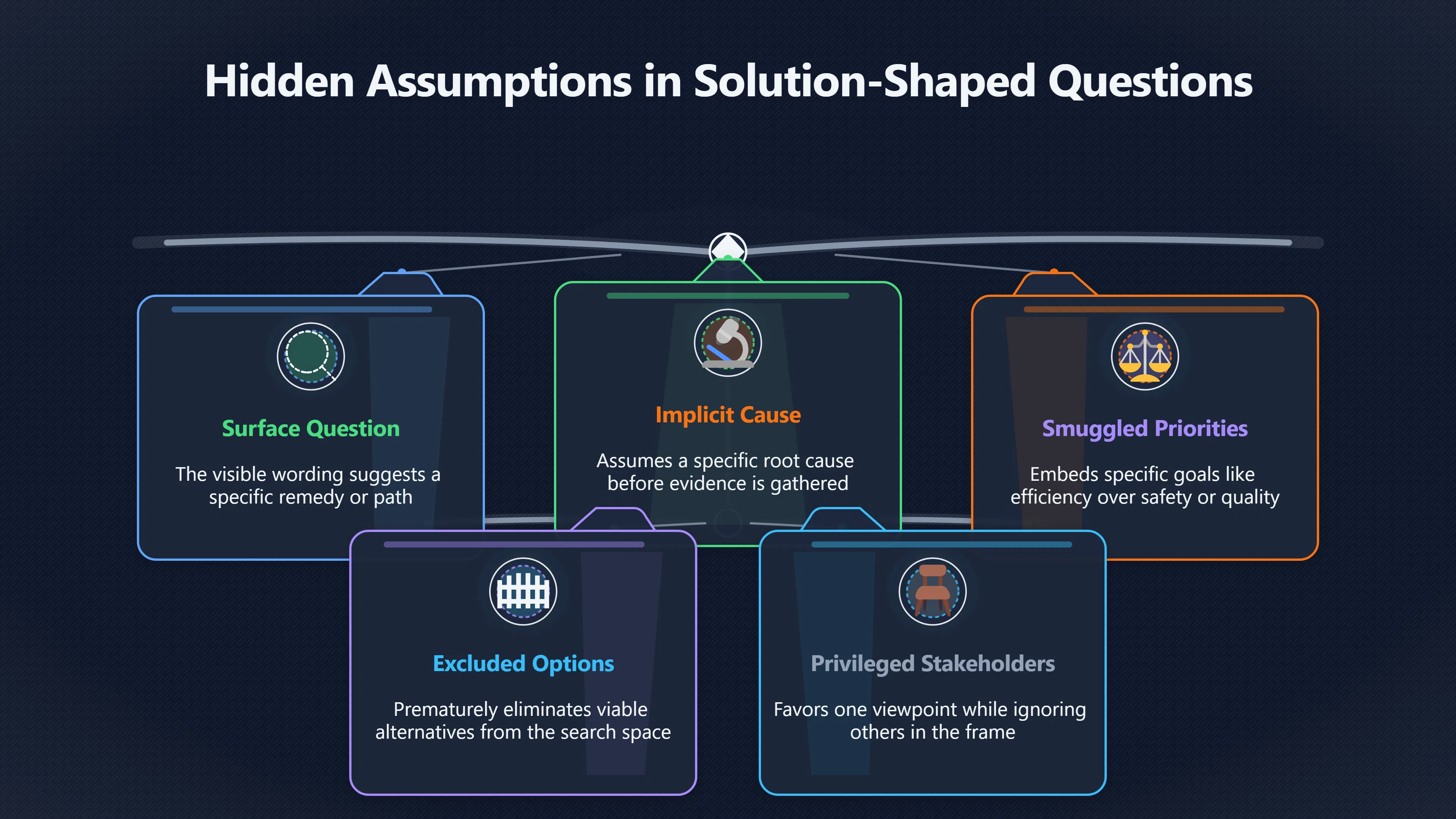
A solution-shaped problem statement usually carries several assumptions at once.
Assumptions about causes
Many questions assume a cause before evidence supports it.
For example:
- “How do we motivate employees to work harder?”
- “How do we stop customers abandoning their baskets?”
The first assumes motivation is the main constraint. The second assumes abandonment is a behavioural problem rather than a pricing issue, a usability issue, or a deliberate comparison-shopping behaviour.
When the assumed cause is wrong, reasoning becomes an exercise in elaborating an error.
Assumptions about goals
A question can also smuggle in priorities.
“How do we maximise efficiency?” assumes efficiency is the dominant objective. Yet a situation may require balancing efficiency against resilience, safety, quality or employee wellbeing.
Decision-quality frameworks emphasise that framing should make objectives explicit rather than treating them as unquestioned givens.[Decision Professionals+2Decision Frameworks]decisionprofessionals.comDecision ProfessionalsDecision QualityThis framework proposed captures the quality of decisions, with the evidence that all decisions sha…
Assumptions about available options
Some questions exclude possibilities before they are evaluated.
“Which replacement car should I buy?” assumes buying another car is necessary. A broader frame might include public transport, cycling, car-sharing or changing travel patterns. Structured decision-making guidance frequently uses examples like this to show how an initial frame can prematurely restrict alternatives.[Structured Decision Making]structureddecisionmaking.orgframing the decisionStructured Decision MakingFraming the decision15 Aug 2023 — A frame is a perspective on a decision that defines how that decision is scop…
Assumptions about who matters
Questions often privilege one stakeholder perspective.
“How do we reduce support costs?” frames the issue from the organisation’s viewpoint. “How do we reduce support costs while maintaining customer satisfaction?” recognises that more than one perspective is relevant.
The narrower the stakeholder set, the greater the risk that important consequences remain invisible.

Common Signs of a Premature Frame
Several warning signs suggest that a problem statement may already contain an answer.
A preferred solution appears in the question.
If a proposed technology, policy, process or intervention is named before the problem has been analysed, the frame may be solution-shaped.
Only one class of answers seems possible.
A useful problem statement should allow multiple plausible explanations or interventions. If every reasonable answer points in the same direction, the frame may be too restrictive.
The question begins with implementation rather than understanding.
“How do we roll this out?” and “How do we convince people?” often appear before the underlying need has been tested.
Alternative explanations sound irrelevant.
When people react to competing explanations with “that’s not what we’re discussing”, the frame may already have excluded possibilities that deserve attention.
Disagreement focuses on tactics rather than diagnosis.
Teams frequently debate which version of a solution to adopt while never examining whether the solution category itself is appropriate.
Problem-framing practitioners often describe this pattern as jumping from symptoms to remedies without spending enough time clarifying the actual decision or problem definition.[Lean Enterprise Institute+2Atlassian]lean.orgEnterprise Institute Problem Framing at the Fuzzy Front-End of Lean ProductLean Enterprise InstituteProblem Framing at the Fuzzy Front-End of Lean Product…August 20, 2014 — 20 Aug 2014 — Lean emphasizes proble…
Why Smart People Miss the Assumptions
The danger is not confined to inexperienced thinkers. Hidden assumptions are difficult to detect precisely because they are embedded in language that feels reasonable.
Several factors contribute:
- Familiar solutions become mentally available first.
- Organisational incentives reward action more than reframing.
- Previous successes encourage reuse of old remedies.
- Teams often inherit problem definitions from earlier discussions.
Once a frame becomes accepted, questioning it can appear obstructive. Yet studies of framing effects show that different presentations of the same decision can produce different preferences and choices, even when the underlying facts remain unchanged. Presenting alternatives side by side tends to reduce this effect because it exposes options that a narrow frame might hide.[PubMed]pubmed.ncbi.nlm.nih.govFraming Options as Choice or Opportunity14 Apr 2014 — A "choice" frame, where all treatment options are explicit, is less likely to…
The challenge is not that people are irrational. It is that the frame determines what seems worth considering.

How to Rewrite the Question Before Deciding
The goal is not to eliminate assumptions entirely. Every problem statement requires some assumptions. The goal is to make them visible.
A practical method is to remove the proposed solution and restate the desired outcome.
Instead of:
- “How do we automate customer support?”
Ask:
- “How can customer enquiries be handled more effectively while maintaining quality and controlling costs?”
Instead of:
- “How do we get more people back to the office?”
Ask:
- “What working arrangements best achieve collaboration, productivity and retention?”
The revised versions widen the search space without making it unlimited.
Another useful test is to ask:
- What assumption must be true for this question to make sense?
- What if that assumption is false?
- What alternative problem statement would then become plausible?[designsprint.academy]designsprint.academywhat is problem framing?22 Feb 2023 — Problem Framing is evidence-driven and decision-oriented. It uses structured facilitation, visual data, and specific exerc…
For example:
- “How do we improve training?” assumes insufficient training.
- If training is already adequate, the issue might instead involve incentives, process design or resource constraints.
- The reframed question becomes: “What factors are preventing consistent performance?”
This technique forces the hidden premise into the open where it can be evaluated rather than silently accepted.
The Key Habit: Separate Diagnosis from Remedy
One of the most valuable thinking habits is maintaining a temporary separation between understanding the problem and selecting a solution.
Problem structuring research emerged largely because complex situations often lack a single uncontested definition. Different stakeholders may frame the same situation in different ways, and each frame highlights different causes, goals and options.[theorsociety.com+2Wikipedia]theorsociety.comwicked problems faced by the managers of organisations.Read more…
A useful problem statement therefore leaves room for discovery. It identifies the situation that needs attention without prematurely deciding why it exists or how it should be fixed.
When the question already contains the answer, reasoning becomes a search for confirmation. When the question remains open enough to challenge its own assumptions, reasoning becomes a genuine investigation. That difference often determines whether people arrive at a better solution—or merely a more sophisticated version of the first idea that came to mind.
Amazon book picks
Further Reading
Books and field guides related to When the Question Already Contains the Answer. Use these as the next step if you want deeper reading beyond the article.
What's Your Problem?
Directly tackles the danger of jumping to solutions before understanding the problem.
Smart Choices
Encourages careful framing of objectives and alternatives before choosing actions.
Thinking in Systems
Helps readers look beyond obvious fixes to underlying structures and causes.
McKinsey Mind
Covers issue trees and hypothesis-driven thinking that discourage premature solution fixation.
eBay marketplace picks
Marketplace Samples
Example marketplace items related to this page. Use the search link to explore similar finds on eBay.




Endnotes
1.
Source: theorsociety.com
Link:https://www.theorsociety.com/ORS/ORS/Community/SIGs-List/Problem-Structuring-Methods.aspx
Source snippet
wicked problems faced by the managers of organisations.Read more...
2.
Source: researchgate.net
Link:https://www.researchgate.net/publication/325069423_The_characteristics_of_problem_structuring_methods_A_literature_review
Source snippet
The characteristics of problem structuring methodsProblem structuring methods (PSMs) are a class of qualitative operational research (OR)...
3.
Source: Wikipedia
Title: Problem structuring methods
Link:https://en.wikipedia.org/wiki/Problem_structuring_methods
Source snippet
Problem structuring methodsProblem structuring methods (PSMs) are a group of techniques used to model or to map the nature or structur...
4.
Source: lean.org
Title: Enterprise Institute Problem Framing at the Fuzzy Front-End of Lean Product
Link:https://www.lean.org/the-lean-post/articles/problem-framing-at-the-fuzzy-front-end-of-lean-product-design/
Source snippet
Lean Enterprise InstituteProblem Framing at the Fuzzy Front-End of Lean Product...August 20, 2014 — 20 Aug 2014 — Lean emphasizes proble...
Published: August 20, 2014
5.
Source: atlassian.com
Link:https://www.atlassian.com/team-playbook/plays/problem-framing
Source snippet
How to Use the Problem Framing MethodProblem framing is a problem-solving method that's designed to align the entire team with one soluti...
6.
Source: decisionprofessionals.com
Link:https://www.decisionprofessionals.com/who-we-are/decision-quality
Source snippet
Decision ProfessionalsDecision QualityThis framework proposed captures the quality of decisions, with the evidence that all decisions sha...
7.
Source: structureddecisionmaking.org
Title: framing the decision
Link:https://www.structureddecisionmaking.org/the-steps/framing-the-decision/
Source snippet
Structured Decision MakingFraming the decision15 Aug 2023 — A frame is a perspective on a decision that defines how that decision is scop...
8.
Source: decisionframeworks.com
Link:https://decisionframeworks.com/blog/the-art-of-framing-defining-problems-and-opportunities
Source snippet
Decision FrameworksThe Art of Framing: Defining Problems and Opportunities...8 Aug 2024 — Decision Quality is a structured approach to e...
9.
Source: pubmed.ncbi.nlm.nih.gov
Link:https://pubmed.ncbi.nlm.nih.gov/24732048/
Source snippet
Framing Options as Choice or Opportunity14 Apr 2014 — A "choice" frame, where all treatment options are explicit, is less likely to...
10.
Source: activecollab.com
Title: problem framing
Link:https://activecollab.com/blog/project-management/problem-framing
Source snippet
How To Land Solutions Worth Pursuing11 Mar 2025 — Problem framing is a design thinking method used to analyze, define and understand comp...
11.
Source: designsprint.academy
Title: what is problem framing
Link:https://www.designsprint.academy/blog/what-is-problem-framing
Source snippet
?22 Feb 2023 — Problem Framing is evidence-driven and decision-oriented. It uses structured facilitation, visual data, and specific exerc...
Additional References
12.
Source: decisioneducation.org
Link:https://www.decisioneducation.org/decision-chain/helpful-frame
Source snippet
Helpful FrameTo properly frame a decision, we need to define what it is that we are deciding, what we are not deciding, what we should ta...
13.
Source: go.mccombs.utexas.edu
Link:https://go.mccombs.utexas.edu/TEE-BLG-Strategic-Decision-Making.html
Source snippet
McCombs School of BusinessStrategic Decision Making | Texas Executive EducationDecision quality describes a process of strategic decision...
14.
Source: prospectus.governmentcampus.co.uk
Link:https://prospectus.governmentcampus.co.uk/04-data-and-analytics/foundations-of-or-problem-structuring-methods/
Source snippet
of Operational Research (OR)The purpose of this course is to develop a critical and practical understanding of Problem Structuring Method...
15.
Source: alvinhermanto.medium.com
Title: problem framing what it is and how to write a problem statement 401720cd5a41
Link:https://alvinhermanto.medium.com/problem-framing-what-it-is-and-how-to-write-a-problem-statement-401720cd5a41
Source snippet
Framing: What it is and How to Write a Problem...Problem framing is not problem solving. It is challenging preconceived assumptions and...
16.
Source: forbes.com
Title: how to frame a problem to find the right solution
Link:https://www.forbes.com/sites/palomacanterogomez/2019/04/10/how-to-frame-a-problem-to-find-the-right-solution/
Source snippet
The 40-20-10-5 rule · 2. Research and collect information · 3. Rephrase and Focus · 4. Challenge Assumptions · 5. Broaden and narrow the...
17.
Source: grounded.systems
Title: problem structuring methodology in [practice]({{ ‘practice/’ | relative_url }})
Link:https://www.grounded.systems/2024/03/problem-structuring-methodology-in-practice/
Source snippet
Problem Structuring: Methodology in Practice29 Mar 2024 — Current perspectives on approaches to problem structuring in operational resea...
18.
Source: evolvingorganisation.co
Title: problem framing method in decision making
Link:https://evolvingorganisation.co/post/problem-framing-method-in-decision-making
Source snippet
Problem Framing Method in Decision-Making29 Apr 2025 — The Problem Framing Method is a powerful approach that transforms how teams identi...
19.
Source: chaturvedimayank.wordpress.com
Title: what are problem structuring methods
Link:https://chaturvedimayank.wordpress.com/2021/07/14/what-are-problem-structuring-methods/
Source snippet
are Problem Structuring Methods?14 Jul 2021 — problem structuring methods are metamethods. They are “about” and “come before” processes o...
20.
Source: youtube.com
Link:https://www.youtube.com/watch?v=OngdUxBBC24
Source snippet
define, and prioritize complex business problems...
21.
Source: youtube.com
Title: Reframing: How to Solve the Right Problems? Thomas Wedell-Wedellsborg
Link:https://www.youtube.com/watch?v=eukpuF9Nt8k
Source snippet
Are You Solving the Right Problem? - Unleashed E19 Thomas Wedell-Wedellsborg...
Topic Tree