Within Causation
Why Randomised Trials Make Causal Claims Stronger
Random assignment helps test causal claims by making groups more comparable than ordinary observation usually allows.
On this page
- What random assignment fixes
- What randomisation still cannot guarantee
- When observational evidence remains useful
Page outline Jump by section
Introduction
Randomised trials are among the strongest tools for testing whether an intervention genuinely causes an outcome rather than merely being associated with it. Their key advantage is not that they eliminate every source of error, but that they create comparison groups that are, on average, similar before the intervention begins. By assigning participants to groups by chance rather than by choice, randomised trials greatly reduce selection bias and confounding, making it more credible that differences observed afterwards are due to the intervention itself rather than pre-existing differences between participants.[Wikipedia]WikipediaRandomized controlled trialRandomized controlled trial
 Within the broader challenge of distinguishing correlation from causation, randomised trials provide a practical way to ask the counterfactual question: what would have happened if otherwise similar people had received a different treatment or policy? While no study design is perfect, careful randomisation usually provides a fairer comparison than ordinary observation alone.
What random assignment fixes
The central problem in causal reasoning is that people who receive an intervention are often different from those who do not. Patients choosing a new treatment may be healthier or more motivated. Schools adopting a new teaching method may already have stronger leadership. Businesses that introduce a new policy may differ from those that do not in ways that are difficult to measure.
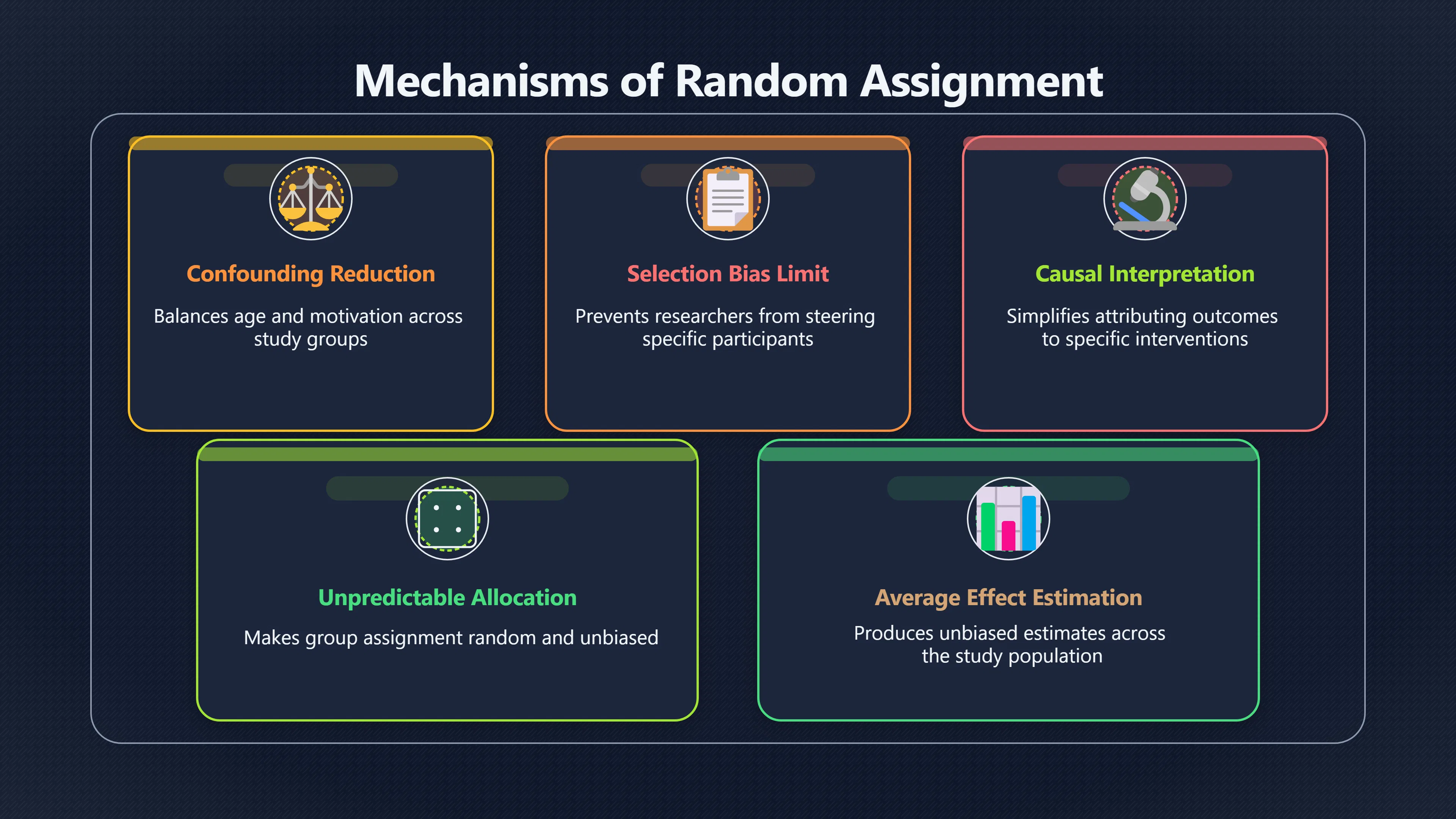
Random assignment tackles this problem by making allocation unpredictable. Because neither researchers nor participants determine who receives the intervention, both known and unknown characteristics are expected to be balanced between groups when the sample is sufficiently large. Any remaining differences are largely due to chance rather than systematic bias.[Wikipedia]WikipediaRandomized controlled trialRandomized controlled trial
This balancing has several important consequences:
- It reduces confounding. Factors such as age, motivation, income or previous health are less likely to be concentrated in one group.
- It limits selection bias. Researchers cannot consciously or unconsciously steer particular participants into preferred groups when allocation is properly concealed.
- It simplifies causal interpretation. If groups begin similarly and receive different interventions, later differences are more plausibly attributed to the intervention itself.
For example, imagine evaluating a new job-training programme. If participation is voluntary, those who enrol may already be more motivated to find work. Higher employment afterwards could reflect motivation rather than programme quality. Random allocation makes motivation, on average, equally common in both groups, giving a much fairer test of the programme’s effect.
Why fair comparison is more important than perfect prediction
Randomisation does not guarantee that every individual receives the treatment best suited to them. Instead, it produces an unbiased estimate of the intervention’s average effect across the study population.
This distinction matters because causal questions concern interventions rather than prediction. A retailer might accurately predict which customers will spend more, but prediction alone does not reveal whether sending a voucher causes additional spending. Randomly assigning vouchers allows researchers to estimate the effect of the voucher itself rather than the characteristics of customers who happened to receive one.
The logic is similar across medicine, education, economics and public policy: the goal is to compare like with like as closely as possible before asking whether changing one factor changes the outcome.[Wikipedia]WikipediaRandomized experimentRandomized experiment
What randomisation still cannot guarantee
Randomisation is powerful, but it is not magic. A well-designed trial can still produce misleading results if other problems remain.
Small samples can produce chance imbalances
Random assignment balances groups on average, not perfectly in every trial. With small samples, one group may still end up older, sicker or more experienced simply through chance. Larger studies reduce this risk because random variation averages out over many participants.[Wikipedia]WikipediaRandomized controlled trialRandomized controlled trial
Bias after randomisation
Even when allocation is fair, later stages of the study can introduce bias.
Examples include:
- participants dropping out at different rates;
- researchers or participants knowing treatment assignments and changing behaviour accordingly;
- outcomes being measured differently across groups;
- selective reporting of favourable results.
For these reasons, high-quality trials often use allocation concealment, blinding where feasible, pre-registered protocols and standardised outcome measures. Reporting standards such as CONSORT exist to improve transparency and help readers judge trial quality.[PMC]pmc.ncbi.nlm.nih.govPMCHow to Conduct a Randomized Controlled TrialCONSORT = Consolidated Standards of Reporting Trials. RCT = randomized controlled trial. Formulating the…Read more…

Average effects may hide important variation
A trial typically estimates the average treatment effect. Some participants may benefit greatly, others may experience little effect, and some may even be harmed.
Understanding which groups respond differently often requires additional analysis and sometimes further studies. A statistically significant average effect does not mean every individual should expect the same outcome.[PMC]pmc.ncbi.nlm.nih.govCONSORT 2010, 15. Baseline data. [Retrieved November…Read more…
Results may not generalise
People who volunteer for trials are not always representative of the wider population. Clinical trials may exclude older adults or people with multiple medical conditions. Educational trials may involve unusually motivated schools.
Consequently, a trial can have excellent internal validity—showing that the intervention caused the observed effect within the study—while leaving open questions about whether the same effect will occur elsewhere.[PMC]pmc.ncbi.nlm.nih.govCONSORT 2010, 15. Baseline data. [Retrieved November…Read more…
When observational evidence remains useful
Randomised trials are not always possible.
Some questions cannot be randomised ethically. Researchers cannot randomly assign people to smoke, breathe polluted air or experience poverty. Other interventions may be too expensive, too disruptive or too slow to study experimentally.
Observational studies therefore remain essential for many important questions. They are particularly valuable when:
- randomisation would be unethical;
- rare or long-term outcomes are being studied;
- researchers need evidence from large, representative populations;
- early signals are needed before trials can be organised.
Modern observational research uses techniques such as matching, statistical adjustment and causal modelling to reduce confounding, but these methods cannot guarantee that every relevant difference has been accounted for. The possibility of unmeasured confounders remains an important limitation.[Wikipedia]WikipediaOpen source on wikipedia.org.
Increasingly, researchers combine evidence from both approaches. Randomised trials provide highly credible estimates of causal effects under controlled conditions, while observational studies help assess how well those findings apply to broader populations and real-world settings. Statistical methods can integrate both sources to improve estimates while preserving the strengths of randomisation.[PMC]pmc.ncbi.nlm.nih.govCausal Inference Methods for Combining Randomized Trials…by B Colnet · 2024 · Cited by 298 — In this paper, we review the growing l…
Using randomised evidence as a critical thinker
When evaluating a causal claim based on a randomised trial, ask a few focused questions rather than assuming the label “randomised” settles the matter:
- Were participants genuinely assigned at random?
- Was allocation concealed so researchers could not influence group assignment?
- Were both groups treated similarly apart from the intervention?
- Did many participants drop out or switch groups?
- Are the participants similar enough to the people or settings where the findings will be applied?
- Is the reported effect practically meaningful as well as statistically significant?
Randomised trials deserve their reputation because they are designed to create fair comparisons, not because they are immune to error. Their strength lies in reducing one of the hardest problems in causal reasoning—systematic differences between comparison groups—while still requiring careful execution, transparent reporting and thoughtful interpretation.

Amazon book picks
Further Reading
Books and field guides related to Why Randomised Trials Make Causal Claims Stronger. Use these as the next step if you want deeper reading beyond the article.
Bad Science
Covers clinical trials, bias, randomisation and common mistakes in interpreting evidence.
Thinking, Fast and Slow
Provides broader foundations for evaluating evidence, judgment and causal conclusions.
The Book of Why
Explains causal reasoning, including why stronger study designs such as randomised trials improve causal claims.
Causal Inference
Directly covers randomised experiments, causal identification and the strengths and limits of trial evidence.
eBay marketplace picks
Marketplace Samples
Example marketplace items related to this page. Use the search link to explore similar finds on eBay.




Endnotes
1.
Source: Wikipedia
Title: Randomized controlled trial
Link:https://en.wikipedia.org/wiki/Randomized_controlled_trial
2.
Source: Wikipedia
Title: Randomized experiment
Link:https://en.wikipedia.org/wiki/Randomized_experiment
3.
Source: Wikipedia
Title: Causal inference
Link:https://en.wikipedia.org/wiki/Causal_inference
4.
Source: pmc.ncbi.nlm.nih.gov
Title: PMCHow to Conduct a Randomized Controlled Trial
Link:https://pmc.ncbi.nlm.nih.gov/articles/PMC10753608/
Source snippet
CONSORT = Consolidated Standards of Reporting Trials. RCT = randomized controlled trial. Formulating the...Read more...
5.
Source: pmc.ncbi.nlm.nih.gov
Link:https://pmc.ncbi.nlm.nih.gov/articles/PMC6019115/
Source snippet
CONSORT 2010, 15. Baseline data. [Retrieved November...Read more...
6.
Source: pmc.ncbi.nlm.nih.gov
Link:https://pmc.ncbi.nlm.nih.gov/articles/PMC12499922/
Source snippet
Causal Inference Methods for Combining Randomized Trials...by B Colnet · 2024 · Cited by 298 — In this paper, we review the growing l...
7.
Source: Wikipedia
Link:https://en.wikipedia.org/wiki/Confounding
Additional References
8.
Source: nature.com
Link:https://www.nature.com/articles/s43856-026-01721-4
Source snippet
(STROBE) statement: guidelines for reporting observational studies... randomized trials: extension of the CONSORT 2010 statement. JAMA 3...
9.
Source: researchgate.net
Link:https://www.researchgate.net/publication/345970702_Causal_inference_methods_for_combining_randomized_trials_and_observational_studies_a_review
Source snippet
Causal inference methods for combining randomized trials...16 Nov 2020 — In this paper, we review the growing literature on methods for...
10.
Source: facebook.com
Link:https://www.facebook.com/groups/853552931365745/posts/1878694608851567/
Source snippet
r. Just go through it and if items can't be checked...Read more...
11.
Source: dokumen.pub
Link:https://dokumen.pub/the-doctors-guide-to-critical-appraisal-4nbsped-9781905635979.html
Source snippet
The Doctor's Guide to Critical Appraisal [4 Reporting of noninferiority and equivalence randomized trials: An extension of the CONSOR...
12.
Source: youtube.com
Title: Observational Studies Versus Experiments
Link:https://www.youtube.com/watch?v=s3cthy3evWE
Source snippet
Randomized controlled trials causal inference confounding selection bias Causality, association, correlation, random error, bias, and con...
13.
Source: researchgate.net
Title: Randomized Clinical Trials
Link:https://www.researchgate.net/topic/Randomized-Clinical-Trials/2
Source snippet
Randomization prevents confounding (makes the baseline prognostic factors equal...Read more...
14.
Source: youtube.com
Link:https://www.youtube.com/watch?v=gGaWU8XEoGk
Source snippet
Controlled Experiments: Crash Course Statistics #9...
15.
Source: youtube.com
Title: Randomized control trial (RCT) explained
Link:https://www.youtube.com/watch?v=mWfjbmRZowM
Source snippet
4 - What Does Imply Causation? Randomized Control Trials...
16.
Source: youtube.com
Title: Randomized Controlled Trials (RCTs)
Link:https://www.youtube.com/watch?v=Wy7qpJeozec
Source snippet
Observational Studies Versus Experiments...
17.
Source: youtube.com
Title: Controlled Experiments: Crash Course Statistics #9
Link:https://www.youtube.com/watch?v=kkBDa-ICvyY
Source snippet
Randomized Controlled Trials (RCTs)...
Topic Tree