Within Probabilities
When Expected Value Is Not Enough
Expected value helps compare gambles, but it can hide ruinous, irreversible, or unfair downside risks.
On this page
- How expected value simplifies uncertainty
- Why ruin changes the decision
- How risk appetite limits good looking bets
Page outline Jump by section
Introduction
Expected value is one of the most useful ideas in decision-making because it combines the probability of different outcomes with their consequences into a single average. It helps compare uncertain options that cannot be judged by looking only at the most likely result. However, expected value is not a complete decision rule. A choice can have an attractive average outcome while still exposing you to a small chance of catastrophic, irreversible, or personally unacceptable harm.
 Better analytical thinking therefore requires asking two questions rather than one. First, what is the expected value of this decision? Second, is there any outcome that would be unacceptable even if it is unlikely? Keeping these questions separate helps explain why sensible people sometimes reject positive expected-value opportunities, buy insurance, diversify investments, or refuse bets that appear favourable on paper.
How expected value simplifies uncertainty
Expected value works by multiplying each possible outcome by its probability and adding the results together. If one option has a higher expected value than another, it produces the better average result over many similar decisions.
This averaging process is powerful because it avoids focusing only on the best-case or worst-case scenario. For repeated, independent decisions—such as quality control, insurance pricing, or large numbers of comparable investments—expected value is often the right starting point.
The simplification is also its limitation. Expected value compresses an entire distribution of outcomes into a single number. Two choices can have identical expected values while exposing the decision-maker to very different patterns of risk.
For example:
- Option A guarantees a gain of £100.
- Option B offers a 99% chance of gaining £102 but a 1% chance of losing £10,000.
Depending on the precise figures, Option B could have a higher expected value than Option A. Yet many people would reasonably reject it because the rare loss is severe enough to outweigh the modest improvement in average return.
The expected value calculation is mathematically correct. The mistake is assuming that the average alone captures everything that matters.
Why ruin changes the decision
Expected value works best when losses are recoverable and decisions can be repeated many times. It becomes much less informative when one bad outcome permanently prevents future opportunities.
This idea is often described as risk of ruin. Ruin does not necessarily mean bankruptcy. It refers to any outcome from which recovery is impossible or so costly that future gains become irrelevant. Examples include:
- losing all investment capital;
- permanent disability from an avoidable risk;
- destroying a company’s reputation;
- suffering an irreversible environmental disaster;
- ending a career through one reckless decision.
Once ruin occurs, future positive expected values cannot compensate because the decision-maker no longer has the opportunity to benefit from them. This is why survival itself becomes an objective alongside maximising average returns. Research on risk of ruin and long-term betting strategies shows that maximising average gains without considering survival can lead to eventual failure even when individual bets have positive expected value.[Wikipedia]WikipediaRisk of ruinRisk of ruin
A simple illustration makes the distinction clear. Imagine repeatedly accepting a gamble with a slight positive expected value but a small probability of losing everything each time. On paper, each individual gamble is favourable. Over many repetitions, however, the cumulative probability of eventual ruin becomes substantial. Long-term success therefore depends not only on expected gain but also on avoiding irreversible losses.[Wikipedia]WikipediaKelly criterionKelly criterion
Why averages can hide unacceptable outcomes
Several features of real-world decisions make expected value an incomplete guide.
Catastrophic losses are not ordinary losses
A loss that permanently changes your situation is different from a routine setback. Losing 5% of an investment portfolio and losing 100% are not merely different in size—they change what decisions remain available afterwards.
This asymmetry explains why businesses maintain emergency reserves, governments prepare for rare disasters, and individuals buy insurance despite its negative expected monetary value. The aim is not to maximise average wealth but to prevent unacceptable states.
One-off decisions differ from repeated decisions
Expected value assumes that similar decisions can often be repeated. Many important choices cannot.
Examples include:
- choosing whether to undergo a high-risk medical procedure;
- launching a company using all personal savings;
- entering a dangerous expedition;
- accepting a job that requires relocating a family.
There may never be enough repetitions for the long-run average to dominate the single realised outcome. In these situations, downside protection deserves greater weight than expected value alone.
Small probabilities still matter
People sometimes dismiss events with very low probabilities. Yet a tiny probability multiplied by an enormous consequence can become highly relevant.
This is particularly important when consequences are irreversible. Even if the probability remains uncertain, the possibility of extreme damage justifies examining the downside separately rather than allowing it to disappear inside an average calculation.
How risk appetite limits good-looking bets
Different people can rationally reject the same positive expected-value opportunity because they have different limits on acceptable downside risk.
Risk appetite reflects the amount and type of loss someone is prepared to tolerate in pursuit of potential gains. It depends on factors such as:
- available financial reserves;
- ability to recover from setbacks;
- responsibilities to others;
- legal or ethical obligations;
- psychological tolerance for uncertainty.
An entrepreneur with diversified assets may accept risks that would be reckless for someone investing their entire life savings. Likewise, an airline or nuclear operator is expected to reject risks that might be acceptable in low-consequence consumer markets because the downside includes loss of life and widespread harm.
Rather than asking only, “Is this gamble favourable on average?”, disciplined decision-makers ask:
- What is the worst plausible outcome?
- Can I survive it?
- Can I recover from it?
- Would I still accept this outcome if it occurred tomorrow?
These questions place boundaries around expected-value reasoning instead of replacing it.
Balancing expected value with downside protection
Good analytical thinking combines expected value with explicit constraints on unacceptable loss.
A practical sequence is:
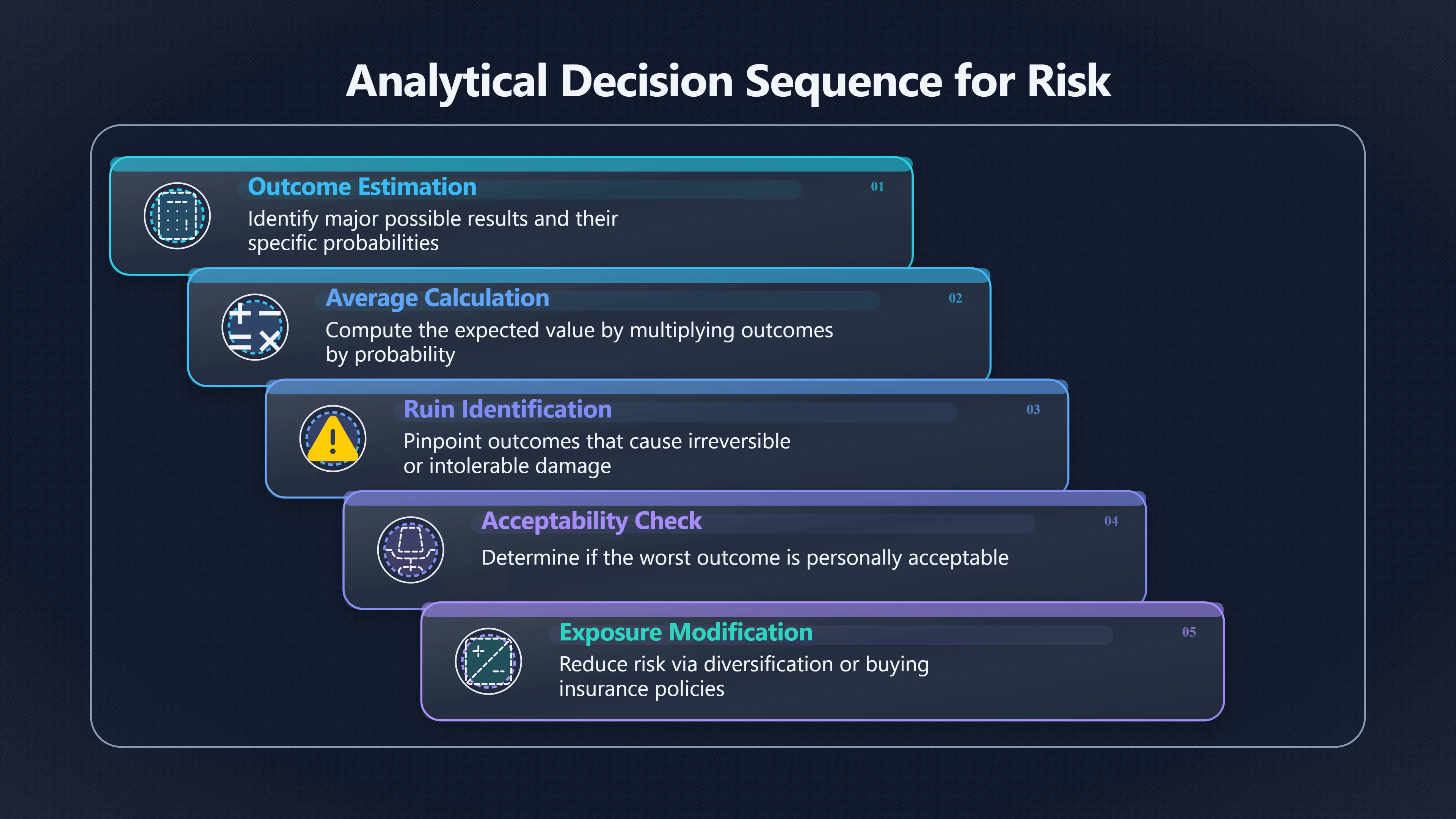
- Estimate the major outcomes and their probabilities.
- Calculate the approximate expected value.
- Identify outcomes that would be irreversible or intolerable.
- Decide whether those outcomes are acceptable regardless of their contribution to the average.
- Modify the decision if necessary by reducing exposure, diversifying, buying insurance, limiting position size, or avoiding the risk altogether.
Investment practice illustrates this balance. The Kelly criterion seeks to maximise long-run growth by recommending an optimal fraction of wealth to risk when probabilities are known. In practice, however, many investors deliberately use only a fraction of the recommended amount because probability estimates are imperfect and reducing exposure substantially lowers the chance of severe drawdowns or ruin.[Wikipedia+2Frontiers]WikipediaKelly criterionKelly criterion
The broader lesson extends well beyond finance. Expected value is an excellent tool for comparing uncertain opportunities, but it should always be checked against the possibility of outcomes that would permanently damage your ability to pursue future opportunities.

Key takeaway
Expected value answers an important question: what happens on average? It does not answer a different, equally important question: what happens if things go very badly?
Analytical thinking improves when these questions are kept separate. Use expected value to compare opportunities, but screen every decision for unacceptable downside risk. If a rare outcome would cause irreversible harm, eliminate future options, or violate your personal or organisational limits, that downside can reasonably outweigh an attractive average return. The strongest decisions maximise opportunity while preserving the ability to continue making good decisions in the future.
Amazon book picks
Further Reading
Books and field guides related to When Expected Value Is Not Enough. Use these as the next step if you want deeper reading beyond the article.
eBay marketplace picks
Marketplace Samples
Live-tested eBay searches with available results related to this page.



Endnotes
1.
Source: Wikipedia
Title: Risk of ruin
Link:https://en.wikipedia.org/wiki/Risk_of_ruin
2.
Source: Wikipedia
Title: Kelly criterion
Link:https://en.wikipedia.org/wiki/Kelly_criterion
3.
Source: karlwhelan.com
Link:https://www.karlwhelan.com/Papers/Ruin.pdf
Source snippet
Probabilities for Strategies with Asymmetric Riskby K Whelan · 2025 — The Kelly criterion predicts that the log of expected wealth is max...
4.
Source: frontiersin.org
Link:https://www.frontiersin.org/journals/applied-mathematics-and-statistics/articles/10.3389/fams.2020.577050/full
Source snippet
Practical Implementation of the Kelly Criterion: Optimal...by A Carta · 2020 · Cited by 12 — In this paper, we discuss the Kelly criteri...
5.
Source: dictionary.cambridge.org
Link:https://dictionary.cambridge.org/dictionary/english/expected
Source snippet
English meaning - Cambridge Dictionarybelieved to be going to happen or arrive: The expected counterattack never happened. The painting...
6.
Source: nickyoder.com
Title: The Kelly Criterion
Link:https://nickyoder.com/kelly-criterion/
Source snippet
Quantitative Trading1 Jan 2021 — The Kelly Criterion is a useful tool for assessing the qualitative shape of risk versus reward and under...
Additional References
7.
Source: medium.com
Link:https://medium.com/coinmonks/how-to-invest-like-kelly-without-making-her-look-too-sad-208e988a9dcb
Source snippet
How to Invest Like Kelly Without Making Her Look Too SadI went on to explain that betting more than the Kelly Criterion suggests increase...
8.
Source: researchgate.net
Link:https://www.researchgate.net/publication/389314931_The_Kelly_Criterion_And_Utility_Function_Optimisation_For_Stochastic_Binary_Games_Submartingale_And_Supermartingale_Regimes
Source snippet
In this paper, we consider only the mathematical foundations and derive the Kelly criterion by.Read more...
9.
Source: reddit.com
Link:https://www.reddit.com/r/options/comments/mn14jc/kellys_criterion_for_gamblers_one_of_the_most/
Source snippet
gy typically yields less than the expected value for the strategy.Read more...
10.
Source: tradingcalcs.com
Title: Kelly tells you how much to risk per trade.Read more
Link:https://tradingcalcs.com/comparisons/kelly-criterion-vs-risk-of-ruin
Source snippet
Kelly Criterion vs Risk of Ruin - TradingCalcsKelly Criterion and Risk of Ruin are both risk management tools, but they answe...
11.
Source: news.ycombinator.com
Title: So OVER-estimating f,
Link:https://news.ycombinator.com/item?id=37996991
Source snippet
"Just One More" Paradox – Kelly Criterion [video]Oct 24, 2023 — It's because the risk of ruin increases quickly if you overestimate optim...
12.
Source: journalplus.co
Title: What is Risk of Ruin?
Link:https://journalplus.co/learn/glossary/risk-of-ruin
Source snippet
Formula, Calculator & Examples7 Feb 2025 — Usually defined as losing 50-100% of your account. A 10% risk of ruin means there's a 1 in 10...
13.
Source: possiblywrong.wordpress.com
Title: risk of gamblers ruin
Link:https://possiblywrong.wordpress.com/2017/01/02/risk-of-gamblers-ruin/
Source snippet
of (gambler's) ruin | Possibly Wrong - WordPress.com2 Jan 2017 — The idea is that we can pick a maximum acceptable risk of ruin– such as...
14.
Source: youtube.com
Title: Why Risk Management Beats Entry Selection
Link:https://www.youtube.com/watch?v=i1FphjJQSXg
Source snippet
ArcAlpha Academy 3.01 - YouTube Why Risk Management Beats Entry Selection — ArcAlpha Academy 3.01 - YouTube...
15.
Source: youtube.com
Title: Expected Value vs. Real World Decisions Using the St. Petersburg Paradox
Link:https://www.youtube.com/watch?v=JuBSwccIayM
Source snippet
The St. Petersburg Paradox: Why We Don't Just Maximize Money...
16.
Source: youtube.com
Title: Gambler’s Ruin: The Math That Destroys Your Bankroll
Link:https://www.youtube.com/watch?v=s3bKvV2TWVA
Source snippet
Expected Value vs. Real World Decisions Using the St. Petersburg Paradox...
Topic Tree