Within Teach It
Why Explaining Beats Rereading Alone
Explaining from memory forces recall, connection-making, and gap-finding more strongly than rereading alone.
On this page
- Retrieval as a stronger test than recognition
- Self explanation as gap finding work
- Why preparing to teach changes how you study
Page outline Jump by section
Introduction
One of the strongest ways to test whether you genuinely understand an idea is to close the book and explain it from memory. Reading can create a powerful feeling of familiarity, but familiarity is not the same as understanding. Self-explanation—trying to teach a concept in your own words without looking at your notes—forces you to retrieve information, connect ideas into a coherent explanation, and expose the places where your understanding is incomplete. Research in cognitive psychology consistently shows that this combination of retrieval and explanation produces more durable learning than repeated rereading or passive review alone.[psychnet.wustl.edu]psychnet.wustl.eduRoediger Karpicke 2006 PPSThe Power of Testing Memoryby HL Roediger III · Cited by 3306 — In this article, we review research from both experimental and educationa…
 Within the broader idea of plain-English teaching as a thinking test, self-explanation is valuable because it measures what you can reconstruct yourself rather than what you can recognise on a page. The difficulty of the exercise is not a flaw; it is the mechanism through which better understanding develops.
Why recognition feels like learning but recall reveals understanding
Reading the same material several times usually becomes easier. Sentences feel familiar, examples seem obvious, and technical terms appear recognisable. Unfortunately, this ease can be misleading.
Recognition depends on external cues. When the information is in front of you, your brain can often identify the correct idea without having to rebuild it. Retrieval asks a different question: can you produce the idea without those cues? That difference is crucial because real thinking rarely comes with the answer already visible.
This distinction explains the well-known “testing effect”, more accurately called retrieval practice. Experiments by Henry Roediger and Jeffrey Karpicke found that students who spent more time actively recalling material retained substantially more after a delay than students who spent the same time rereading it, even though the rereading group often felt more confident immediately afterwards. The act of retrieval strengthens later access to the memory instead of merely refreshing familiarity.[psychnet.wustl.edu]psychnet.wustl.eduRoediger Karpicke 2006 PPSThe Power of Testing Memoryby HL Roediger III · Cited by 3306 — In this article, we review research from both experimental and educationa…
Repeated rereading therefore has a paradoxical weakness: it often improves confidence faster than it improves long-term understanding. Retrieval practice feels harder precisely because it demands reconstruction rather than recognition.[Department of Education]education-ni.gov.ukDepartment of Education Retrieval PracticeDepartment of EducationRetrieval Practice:April 29, 2025 — Karpicke and Roediger (2008) noted that students who repeatedly re-read texts…
Self-explanation turns recall into a search for gaps
Simply recalling isolated facts is valuable, but explaining those facts in plain language demands something richer.
A successful explanation requires you to:
- retrieve the relevant facts;
- organise them into a logical sequence;
- identify causal relationships rather than isolated definitions;
- translate specialist language into everyday language; and
- notice where the explanation becomes vague or incomplete.
Each hesitation is informative. If you cannot explain why one step follows another, you have discovered a genuine gap instead of merely discovering that you forgot a word.
This process also counters the illusion of explanatory depth—the tendency to believe we understand how something works until we attempt a detailed explanation. People commonly overestimate their understanding of mechanisms because they possess familiar labels or broad intuitions. Requiring a full explanation exposes the missing causal links.[Wikipedia]WikipediaIllusion of explanatory depthIllusion of explanatory depth
For example, someone may confidently define “inflation” or “natural selection” while reading a textbook. Asking them to explain, from memory, exactly how one event leads to the next often reveals missing steps they did not realise were missing.
Why preparing to teach changes how you study
Knowing that you will have to explain something later changes how you approach learning in the first place.
Instead of trying to memorise sentences, learners begin asking questions such as:
- Why does this happen?
- What causes the next step?
- Could I explain this without using technical vocabulary?
- What example would make this clear?
These questions encourage organisation rather than accumulation. Instead of storing disconnected facts, learners build networks of relationships that can be reconstructed later.
Research on self-explanation has repeatedly shown that generating explanations while learning improves understanding because learners actively integrate new information with what they already know rather than copying information passively. Combined with retrieval practice, explanation becomes both a learning activity and a diagnostic tool.[My College]my.chartered.collegeusing evidence based practices that support metacognitionMy CollegeUsing evidence-based practices that support metacognition26 Feb 2024 — The aim of this article is to investigate the efficacy o…
Importantly, the goal is not to deliver a polished lecture. The value comes from discovering where the explanation fails.

Why explaining is harder than rereading—and why that matters
Many learners judge study methods by how fluent they feel. By that standard, rereading appears highly effective because every pass becomes easier.
The evidence points in the opposite direction.
Learning strategies that feel effortful during study often produce stronger long-term retention than strategies that feel smooth and comfortable. Retrieval requires mental effort because memories must be reconstructed, and that reconstruction itself strengthens later recall. Researchers sometimes describe this as a “desirable difficulty”: appropriately challenging retrieval improves learning even though it feels less successful at the time.[psychnet.wustl.edu]psychnet.wustl.eduRoediger Karpicke 2006 PPSThe Power of Testing Memoryby HL Roediger III · Cited by 3306 — In this article, we review research from both experimental and educationa…
This helps explain a common experience:
- During rereading: “I know this already.”
- During explanation: “I thought I knew this, but I cannot explain why this step happens.”
The second experience is more valuable. It transforms hidden ignorance into visible learning targets.
A practical explain-from-memory routine
A simple routine combines retrieval with self-explanation without requiring elaborate tools.
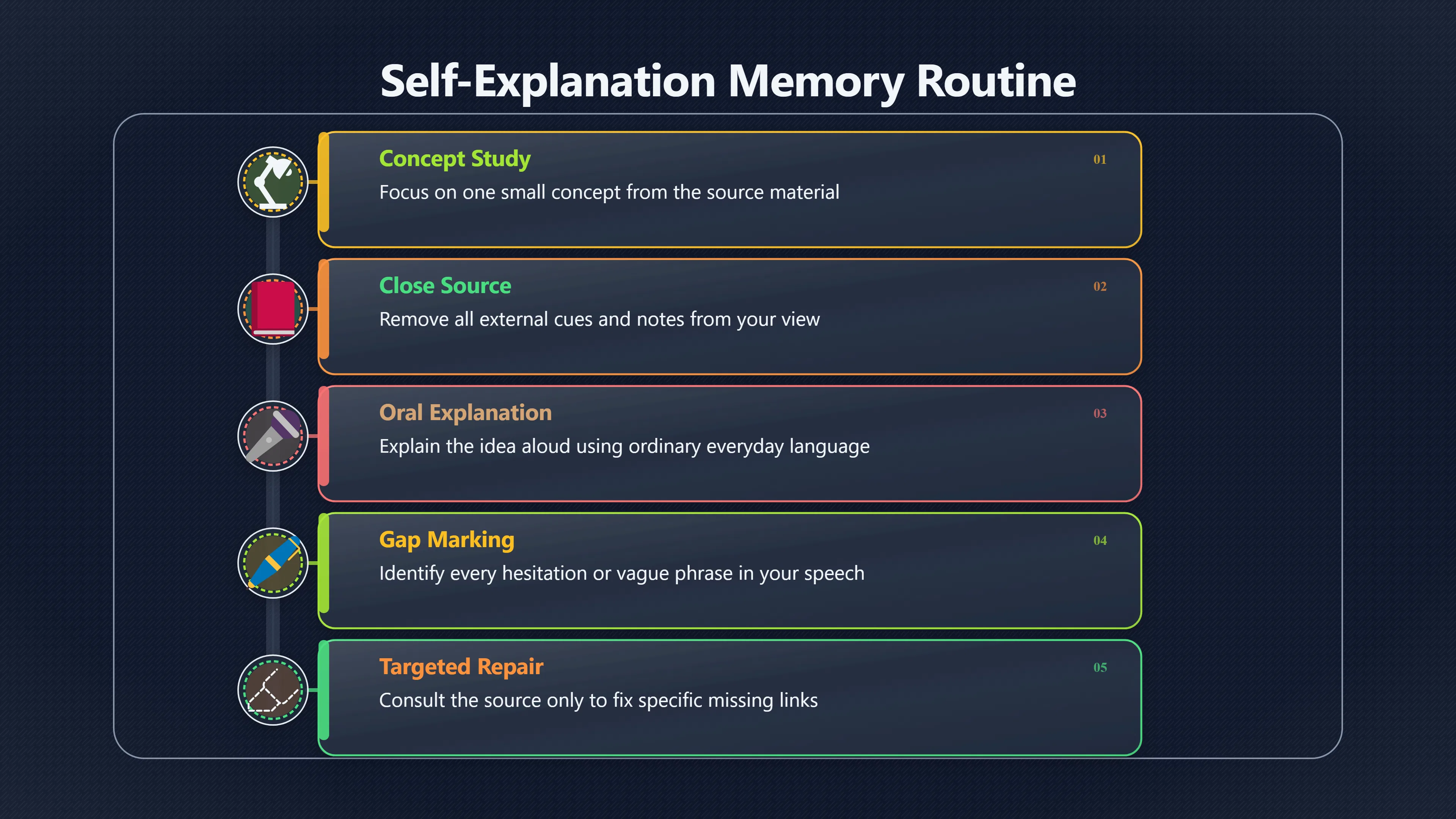
- Study one small concept.
- Close the book or notes.
- Explain the idea aloud or on paper using ordinary language.
- Mark every hesitation, missing step, or vague phrase.
- Return briefly to the source only to repair those specific gaps.
- Repeat the explanation from memory until the complete chain can be reconstructed without prompts.
Notice that the checking stage comes after the explanation, not during it. Looking at the notes too early turns retrieval back into recognition.
Keeping explanations narrow also improves accuracy. Explaining “why vaccines stimulate immune memory” or “why overfitting reduces performance on new data” is usually more productive than attempting to explain an entire discipline at once.
What the evidence suggests
Across decades of educational psychology, retrieval practice has become one of the most consistently supported learning strategies for improving long-term retention. Studies have shown benefits across different ages, subjects and learning environments, while reviews conclude that actively retrieving information generally outperforms additional study time devoted solely to rereading.[psychnet.wustl.edu+2Wikipedia]psychnet.wustl.eduRoediger Karpicke 2006 PPSThe Power of Testing Memoryby HL Roediger III · Cited by 3306 — In this article, we review research from both experimental and educationa…
Self-explanation complements retrieval by improving understanding rather than simple recall. Explaining forces learners to organise knowledge into coherent causal models and exposes misconceptions that recognition-based study often conceals. Together, retrieval and self-explanation create a more demanding but more informative test of understanding than passive review.
For someone trying to improve analytical thinking, that combination is the central lesson: do not judge understanding by how familiar information looks. Judge it by how well you can rebuild the idea from memory, explain why each step follows the previous one, and identify exactly where your explanation breaks down.
eBay marketplace picks
Marketplace Samples
Live-tested eBay searches with available results related to this page.


Endnotes
1.
Source: psychnet.wustl.edu
Title: Roediger Karpicke 2006 PPS
Source snippet
The Power of Testing Memoryby HL Roediger III · Cited by 3306 — In this article, we review research from both experimental and educationa...
2.
Source: Wikipedia
Title: Testing effect
Link:https://en.wikipedia.org/wiki/Testing_effect
3.
Source: Wikipedia
Title: Illusion of explanatory depth
Link:https://en.wikipedia.org/wiki/Illusion_of_explanatory_depth
4.
Source: youtube.com
Title: Henry Roediger
Link:https://www.youtube.com/watch?v=oqae85jbfbE
Source snippet
The Testing Effect: The Science of How To Actually Remember...
5.
Source: education-ni.gov.uk
Title: Department of Education Retrieval Practice
Link:https://www.education-ni.gov.uk/sites/default/files/2025-04/May%20Newsletter%20-%20Retrieval%20Practice%20%20What%20it%20is%2C%20Why%20it%20Works%20and%20How%20to%20Do%20It%20Better.PDF
Source snippet
Department of EducationRetrieval Practice:April 29, 2025 — Karpicke and Roediger (2008) noted that students who repeatedly re-read texts...
Published: April 29, 2025
6.
Source: my.chartered.college
Title: using evidence based practices that support [metacognition]({{ ‘metacognition/’ | relative_url }})
Link:https://my.chartered.college/impact_article/using-evidence-based-practices-that-support-metacognition/
Source snippet
My CollegeUsing evidence-based practices that support metacognition26 Feb 2024 — The aim of this article is to investigate the efficacy o...
7.
Source: frontiersin.org
Link:https://www.frontiersin.org/journals/psychology/articles/10.3389/fpsyg.2021.797395/full
Source snippet
Retrieval Practice Is Effective Regardless of Self-Reported...by C Wiklund-Hörnqvist · 2022 · Cited by 28 — Our findings provide behavio...
Additional References
8.
Source: yukaichou.com
Link:https://yukaichou.com/gamification-analysis/retrieval-practice-testing-effect-roediger-karpicke-learning/
Source snippet
Retrieval practice is the learning strategy of actively recalling information from memory, through self-testing, free recall...Read more...
9.
Source: learninglab.psych.purdue.edu
Title: 2009 Karpicke Butler Roediger
Link:https://learninglab.psych.purdue.edu/downloads/2009/2009_Karpicke_Butler_Roediger.pdf
Source snippet
Do students practise retrieval when they study on their own?1 May 2009 — We propose that many students experience illusions of competence...
Published: May 2009
10.
Source: structural-learning.com
Title: testing effect retrieval practice
Link:https://www.structural-learning.com/post/testing-effect-retrieval-practice
Source snippet
The Testing Effect: Why Retrieval Practice Works29 Dec 2025 — Testing helps learners recall facts, according to Bjork (1994)...
11.
Source: pmc.ncbi.nlm.nih.gov
Link:https://pmc.ncbi.nlm.nih.gov/articles/PMC9170123/
Source snippet
the relationship between retrieval practice, self...by AN Frankenstein · 2022 · Cited by 37 — Across two experiments, we examine the pot...
12.
Source: youtube.com
Title: This One Study Technique Changes Everything (Most Students Miss It)
Link:https://www.youtube.com/watch?v=iGBDi1WkofI
Source snippet
The Testing Effect & Retrieval practice: the number 1 study hack...
13.
Source: youtube.com
Title: The Testing Effect: The Science of How To Actually Remember
Link:https://www.youtube.com/watch?v=jXm2qqfDCr0
Source snippet
This One Study Technique Changes Everything (Most Students Miss It)...
14.
Source: youtube.com
Title: The Testing Effect & Retrieval practice: the number 1 study hack
Link:https://www.youtube.com/watch?v=G6u9_lbW2hY
Source snippet
Make It Stick by Brown Roediger McDaniel...
15.
Source: youtube.com
Title: Make It Stick by Brown Roediger Mc Daniel
Link:https://www.youtube.com/watch?v=P8wrvWFzpUk
Topic Tree