Within Decision Routines
Which unknown could break the plan?
The useful question is not whether more research is possible, but which unknowns could change the decision before it locks in.
On this page
- Assumptions most likely to be wrong
- Assumptions that would hurt most
- Information that would actually change the choice
Page outline Jump by section
Introduction
When a decision will be difficult or expensive to reverse, the key question is not whether you could gather more information. It is whether there is any unknown that could realistically change what you should do before you commit. Every major decision contains uncertainty, but not every uncertainty deserves equal attention. The most useful uncertainty check identifies the assumptions that are both plausible and decision-changing, then tests those before the point of no return.
 This approach prevents a common mistake: spending time reducing uncertainty that has little practical value while ignoring one unanswered question that could overturn the entire plan. Decision analysis, public-sector appraisal guidance and research on judgement all converge on the same principle: uncertainty should shape what is investigated before commitment, not become an excuse for endless delay. [GOV.UK+2scholarworks.umb.edu]GOV.UKthe green book 2026The Green Book (2026)5 Feb 2026 — Green Book guidance should be used proportionately. Business cases should contain sufficient detail to…
Which unknown could actually break the plan?
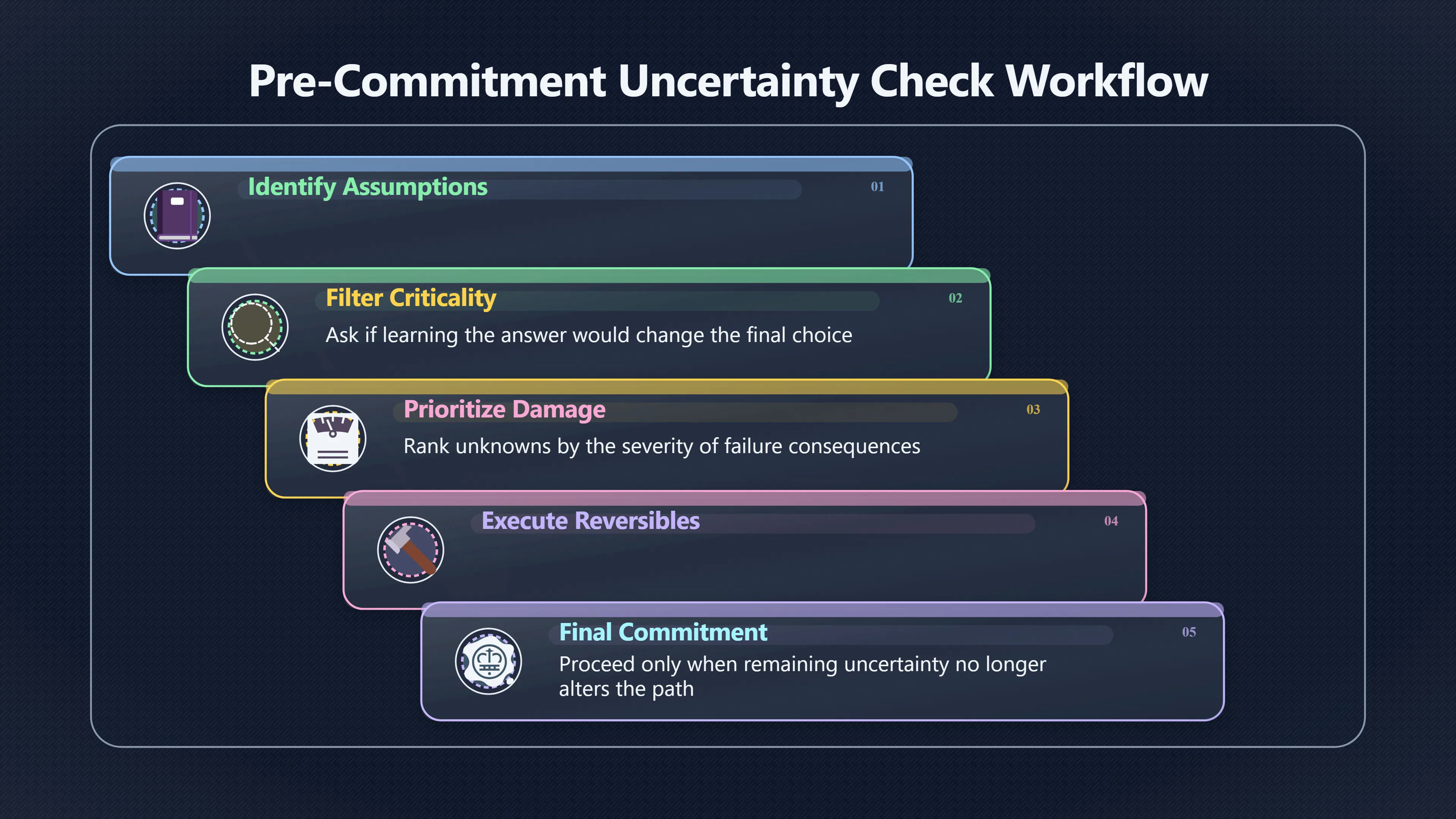
Not every missing fact deserves equal attention. A useful uncertainty check begins by asking a simple question:
If we learned the answer tomorrow, would we choose differently?
If the answer is no, the uncertainty is interesting but not decision-critical. If the answer is yes, it becomes a priority before irreversible commitment.
This idea comes from decision analysis, where the “value of information” depends on whether additional evidence would improve the decision rather than simply increase confidence. Information has practical value only when it changes the preferred course of action. [scholarworks.umb.edu]scholarworks.umb.eduAn application of value-of-information to decision process…by J Keisler · 2009 · Cited by 9 — This meant assuring that decision makers…
For example:
- A company considering a factory investment may be uncertain about future electricity prices. If the investment remains worthwhile across a wide range of prices, further forecasting adds little value.
- If profitability depends entirely on one uncertain planning permission, resolving that question before construction becomes highly valuable.
- Someone considering a career move may not need perfect salary forecasts but may need certainty about whether relocation is actually required.
The objective is to separate uncertainties that merely affect forecasts from those that could reverse the decision itself.
Assumptions most likely to be wrong
People rarely make decisions using only observed facts. Most plans rely on assumptions that feel obvious because they remain unstated.
Useful uncertainty checks deliberately expose these assumptions before commitment.
Typical examples include:
- customers will adopt the product quickly;
- construction costs will remain within budget;
- regulations will not change;
- suppliers will deliver on time;
- key staff will remain available;
- competitors will respond slowly.
Research on optimism bias consistently shows that planners tend to underestimate costs, underestimate delays and overestimate benefits, particularly for novel or complex projects. Because these errors are systematic rather than random, simply feeling confident provides little protection. Public-sector appraisal guidance therefore recommends explicitly adjusting for optimism bias and improving evidence before final approval rather than assuming forecasts are unbiased. [GOV.UK+2GOV.UK]GOV.UKgreen book supplementary guidance optimism biasGreen Book supplementary guidance: optimism bias21 Apr 2013 — This guidance provides cost and time uplift percentages for generic project…
A practical exercise is to complete the sentence:
“This decision only works if…”
Every completion reveals an assumption that can be challenged or tested.
Assumptions that would hurt most
Likelihood is only half the problem. Some assumptions may be unlikely to fail yet create catastrophic consequences if they do.
A simple prioritisation matrix helps distinguish:
AssumptionLikelihood of being wrongDamage if wrongPriorityMinor demand forecast errorModerateLowLowRegulatory approvalLowVery highHighKey technical capabilityModerateHighHighOffice decoration costsHighLowLow
This prevents teams from spending disproportionate effort on uncertainties that are easy to investigate but relatively unimportant.
The guiding question becomes:
“If this assumption failed tomorrow, would the decision still make sense?”
If not, it deserves testing before commitment.
Information that would actually change the choice
Many organisations collect information because it is available rather than because it is useful.
Decision-quality improves when evidence gathering begins with the decision rather than the data.
Useful questions include:
- Which single uncertainty could reverse our preferred option?
- What evidence would convince us not to proceed?
- Which measurement would reduce the biggest decision risk?
- Are we trying to become more certain, or simply more comfortable?
This discipline limits unnecessary research while focusing effort on genuinely decision-changing evidence. Decision-analysis research describes this as concentrating on information with high expected decision value rather than information that merely reduces curiosity. [scholarworks.umb.edu]scholarworks.umb.eduAn application of value-of-information to decision process…by J Keisler · 2009 · Cited by 9 — This meant assuring that decision makers…
Test before you lock in
Many high-stakes failures occur because organisations commit fully before testing their most uncertain assumptions.
Whenever possible, uncertainty should be reduced through reversible experiments rather than irreversible commitments.
Examples include:
- running a pilot before a nationwide rollout;
- building a prototype before full manufacturing;
- hiring contractors before permanent expansion;
- testing customer demand with limited release before scaling production;
- making conditional agreements rather than binding long-term contracts.
These approaches do not eliminate uncertainty. They reduce the cost of discovering mistakes while options remain open.
The value comes from preserving flexibility until the assumptions that matter most have been examined.

Use a pre-mortem to expose hidden uncertainty
One practical technique is the pre-mortem, developed by psychologist Gary Klein. [scribd.com]scribd.comtion, improving scenario analysis over mere scenario development by…Read more…
Instead of asking why a plan might fail, participants imagine that the decision has already failed spectacularly and then work backwards to explain what happened.
This simple change in perspective helps overcome social pressures that discourage criticism of a favoured plan. Team members often identify concerns they would otherwise hesitate to raise because the exercise legitimises scepticism rather than treating it as opposition. [Harvard Business Review+2ResearchGate]hbr.orgHarvard Business Review Performing a Project PremortemHarvard Business ReviewPerforming a Project PremortemSeptember 1, 2007 — Reprint: F0709A In a premortem, team members assume that the pro…
The most valuable outputs are not long lists of hypothetical risks. They are the few failure explanations that reveal previously hidden assumptions which can still be tested before commitment.
Avoid two opposite mistakes
Uncertainty checks are designed to balance two common errors.
The first is premature commitment. Teams become emotionally invested in a preferred option and interpret new information as confirmation instead of challenge.
The second is analysis paralysis. Decision-makers continue collecting information even after additional evidence is unlikely to change the choice.
A useful stopping rule is:
- continue investigating while new evidence could realistically change the decision;
- stop investigating once remaining uncertainty no longer changes the preferred option and begin monitoring instead.
This principle also appears in public appraisal guidance, which emphasises proportionality: the effort spent reducing uncertainty should match the scale, complexity and irreversibility of the decision rather than seeking perfect knowledge. [GOV.UK]GOV.UKthe green book 2026The Green Book (2026)5 Feb 2026 — Green Book guidance should be used proportionately. Business cases should contain sufficient detail to…
A practical uncertainty check before irreversible commitment
Immediately before making an irreversible decision, ask five questions:
- Which assumption is both uncertain and essential for success?
- If that assumption proved false tomorrow, would we still choose this option?
- What single piece of evidence would most improve this decision?
- Can we test that assumption with a smaller, reversible step?
- If we cannot reduce the uncertainty, have we consciously accepted the remaining risk?
These questions shift attention from eliminating all uncertainty to identifying the unknowns that genuinely matter. The goal is not perfect prediction. It is ensuring that commitment follows the most important learning, rather than preceding it.
Amazon book picks
Further Reading
Books and field guides related to Which unknown could break the plan?. Use these as the next step if you want deeper reading beyond the article.
Thinking in Bets
Directly addresses incomplete information, uncertainty, probabilities, and separating good process from lucky outcomes.
Decisive
Covers reality-testing assumptions and preparing to be wrong before a decision becomes hard to reverse.
The Signal and the Noise
Explains how uncertainty, noise, evidence quality, and probability affect real-world judgement.
Superforecasting: The Art and Science of Prediction
Teaches how to identify what would change a forecast and update beliefs as evidence arrives.
eBay marketplace picks
Marketplace Samples
Live-tested eBay searches with available results related to this page.



Endnotes
-
Source: GOV.UK
Title: the green book 2026
Link: https://www.gov.uk/government/publications/the-green-book-appraisal-and-evaluation-in-central-government/the-green-book-2026Source snippet
The Green Book (2026)5 Feb 2026 — Green Book guidance should be used proportionately. Business cases should contain sufficient detail to...
-
Source: scholarworks.umb.edu
Link: https://scholarworks.umb.edu/cgi/viewcontent.cgi?article=1021&context=msis_faculty_pubsSource snippet
An application of value-of-information to decision process...by J Keisler · 2009 · Cited by 9 — This meant assuring that decision makers...
-
Source: GOV.UK
Title: green book supplementary guidance optimism bias
Link: https://www.gov.uk/government/publications/green-book-supplementary-guidance-optimism-biasSource snippet
Green Book supplementary guidance: optimism bias21 Apr 2013 — This guidance provides cost and time uplift percentages for generic project...
-
Source: assets.publishing.service.gov.uk
Link: https://assets.publishing.service.gov.uk/media/5a74dae740f0b65f61322c72/Optimism_bias.pdfSource snippet
Green Book Guidance – Optimism BiasFor instance, high optimism bias may be acceptable for a strategic outline business case but would not...
-
Source: researchgate.net
Link: https://www.researchgate.net/publication/3229642_Performing_a_Project_PremortemSource snippet
(PDF) Performing a Project PremortemThe pre-mortem, in which a group imagines that its chosen course has already failed and works backwar...
-
Source: researchgate.net
Link: https://www.researchgate.net/publication/264591874_Decisionmaking_under_uncertainty_with_various_assumptions_about_available_information_IEEE_Transactions_on_Systems_Man_and_Cybernetics_14_888-900Source snippet
mber of alternative actions in the context of uncertainty.Read more...
-
Source: finance-ni.gov.uk
Title: Risk and optimism bias.Read more
Link: https://www.finance-ni.gov.uk/articles/useful-links-developing-appraisalsSource snippet
Useful links for developing appraisals | Department of FinanceThis page lists a number of guides to specific types of impact [assessment]({{ 'assessment/' | relative_url }}) i...
-
Source: GOV.UK
Title: the green book appraisal and evaluation in central government
Link: https://www.gov.uk/government/publications/the-green-book-appraisal-and-evaluation-in-central-governmentSource snippet
Green Book5 Feb 2026 — The Green Book is the government's guidance on appraisal, the process of assessing the costs, benefits and risks o...
-
Source: hbr.org
Title: Harvard Business Review Performing a Project Premortem
Link: https://hbr.org/2007/09/performing-a-project-premortemSource snippet
Harvard Business ReviewPerforming a Project PremortemSeptember 1, 2007 — Reprint: F0709A In a premortem, team members assume that the pro...
Published: September 1, 2007
-
Source: frontiersin.org
Link: https://www.frontiersin.org/journals/psychology/articles/10.3389/fpsyg.2011.00305/fullSource snippet
Cognitive Constraints on Decision Making under Uncertaintyby C Lebiere · 2011 · Cited by 39 — Decision making under uncertainty can be be...
Additional References
-
Source: themindcollection.com
Link: https://themindcollection.com/premortem-analysis/Source snippet
Premortem Analysis: How to Anticipate FailureIt's a method to avoid both, the regret and the failure itself. It hinges on a simple yet cr...
-
Source: theuncertaintyproject.org
Link: https://www.theuncertaintyproject.org/tools/pre-mortemSource snippet
Pre-MortemThe pre-mortem analysis is a tool intended to increase the probability of a project's success. It is based on 'prospective hind...
-
Source: acadmathsci.org.uk
Title: understanding hm treasurys green book a guide for mathematical scientists
Link: https://www.acadmathsci.org.uk/2025/11/06/understanding-hm-treasurys-green-book-a-guide-for-mathematical-scientists/Source snippet
Understanding HM Treasury's Green Book: A guide...6 Nov 2025 — The FAS's business case followed the Five Case Model, addressing its stra...
-
Source: youtube.com
Link: https://www.youtube.com/watch?v=CEAR5Zsld6gSource snippet
Using PreMortem Analysis to Make Better Decisions with Gary...Gary Klein. Gary is the creator of PreMortem Analysis, a powerful tool des...
-
Source: newoon.com
Title: the hidden power of pre mortem analysis in business development
Link: https://newoon.com/the-hidden-power-of-pre-mortem-analysis-in-business-development/Source snippet
The Hidden Power of Pre-Mortem Analysis in Business...9 Apr 2025 — A pre-mortem is a forward-looking risk assessment technique where a t...
-
Source: strategy-engine.pages.dev
Link: https://strategy-engine.pages.dev/chapters/chapter-27-decision-making/Source snippet
How do cognitive biases distort strategic decisions, and how can you mitigate them?Read more...
-
Source: get-alfred.ai
Link: https://get-alfred.ai/blog/pre-mortem-techniqueSource snippet
The Pre-Mortem Technique: Gary Klein's 30% Risk-Spotting...26 May 2026 — Gary Klein's 2007 HBR pre-mortem improves failure prediction by...
Published: May 2026
-
Source: scribd.com
Link: https://www.scribd.com/doc/85021339/The-Premortem-TechniqueSource snippet
tion, improving scenario analysis over mere scenario development by...Read more...
-
Source: youtube.com
Title: Decision Analysis 2: EMV & EVPI
Link: https://www.youtube.com/watch?v=tbv9E9D2BRQSource snippet
Calculating the Value of Information with DPL Professional - YouTube Calculating the Value of Information with DPL Professional - YouTube...
-
Source: turningdataintowisdom.com
Link: https://www.turningdataintowisdom.com/the-decision-making-model-you-learned-is-designed-for-a-world-that-no-longer-exists/Source snippet
They fail because assumptions go unchecked. In a fast-changing world, organizations need...
Topic Tree