Within Argument Maps
What Your Decision Map Says to Check Next
Mapping a choice reveals which facts still need checking before confidence is justified.
On this page
- Marking unsupported reasons
- Separating confidence from missing evidence
- Using job offer checks as a practical example
Page outline Jump by section
Introduction
A personal decision map is most useful not when it confirms what you already think, but when it reveals what you do not yet know. In argument mapping, a decision often appears stronger once its reasons are written down. Yet the real value comes from identifying unsupported claims, hidden assumptions, and missing facts that must be checked before confidence is justified. A visible map can expose the gap between “I feel ready to decide” and “I have enough evidence to decide well”.
 Research on argument mapping consistently shows that making reasoning explicit improves critical thinking because it forces claims and supporting evidence into a structure that can be examined rather than merely felt. At the same time, studies of confidence and decision-making show that people frequently become confident before gathering all the information that would improve judgement. The combination makes evidence gaps especially important: they are the places where additional checking could materially change a decision.[University of Southampton Web Archive+2AJET]web-archive.southampton.ac.ukUniversity of Southampton Web ArchiveArgument Maps Improve Critical Thinkingby CR Twardy · Cited by 356 — Computer-based argument mapping…
What Your Decision Map Says to Check Next
When people map a decision, they often discover that some reasons are supported by evidence while others are merely beliefs, impressions, or expectations. The map becomes a guide to future information gathering.
Consider a simple decision: “I should buy this house.” Supporting reasons might include affordability, location, investment potential, and quality of life. Once these reasons are placed on a map, each can be inspected separately. Some branches may already have evidence, such as mortgage calculations. Others may depend on assumptions, such as expected future property values or neighbourhood development plans.
The practical question becomes: which branch contains the largest uncertainty? Instead of gathering information randomly, the map highlights the evidence gaps most likely to affect the conclusion.
This mirrors a broader principle from evidence-based decision-making: high-quality decisions depend on evidence that is relevant, reliable, and appropriately reflects uncertainty. Missing information is not evenly distributed across a decision. Some gaps are trivial; others sit beneath a crucial supporting reason.[QCMR]qcmr-1.itrcweb.orgQCMR3 Evidence-Based DecisionsToday — Evidence fit for decision making is relevant, reliable, based on appropriate data and judgment, and…
Marking Unsupported Reasons
A useful decision map distinguishes between supported reasons and unsupported reasons.
Unsupported reasons are not necessarily wrong. They are simply claims for which adequate evidence has not yet been collected. Common examples include:
- Predictions about future outcomes.
- Assumptions about costs or risks.
- Judgements based on limited experience.
- Generalisations from a small number of examples.
- Information heard second-hand but not verified.
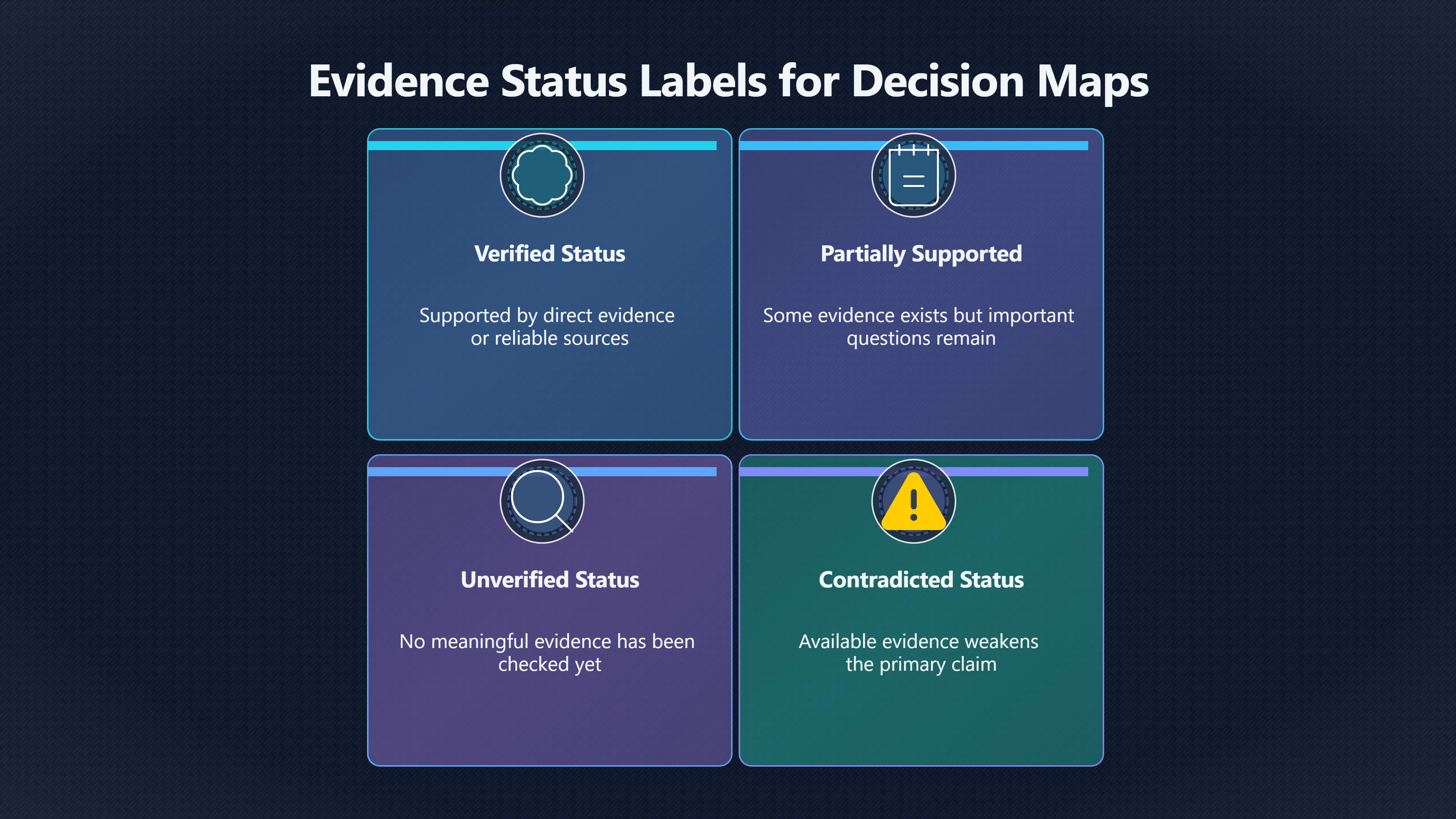
One practical technique is to label each reason according to its evidence status:
StatusMeaningVerifiedSupported by direct evidence or reliable sourcesPartially supportedSome evidence exists but important questions remainUnverifiedNo meaningful evidence has been checkedContradictedAvailable evidence weakens the claim
This prevents all reasons from appearing equally strong simply because they occupy similar positions in the diagram.
Argument-mapping research emphasises that the process of linking reasons to evidence improves evaluation because it makes support relationships visible. A reason that looked persuasive in conversation can appear surprisingly weak once the supporting evidence is absent from the map. University of Southampton Web Archive+2Research Repository[web-archive.southampton.ac.uk]web-archive.southampton.ac.ukUniversity of Southampton Web ArchiveArgument Maps Improve Critical Thinkingby CR Twardy · Cited by 356 — Computer-based argument mapping…
Hidden assumptions often create the largest gaps
Many evidence gaps are not missing facts but unstated assumptions.
For example:
- “This role will advance my career.”
- “The cheaper option will be good enough.”
- “The risk is unlikely to occur.”
- “I can adapt to the longer commute.”
Each statement may be functioning as a support for the decision without being explicitly recognised. Once written into the map, the assumption becomes a claim that can be investigated rather than silently accepted.
Research on argument mapping highlights the importance of exposing these hidden premises because they frequently carry much of the argumentative weight despite receiving little scrutiny.[UAB Digital Document Repository]ddd.uab.catDigital Document Repository Argument mapUAB Digital Document RepositoryArgument map - Wikipedia, the free encyclopedia5 Jul 2016 — The purpose of mapping is to uncover the logic…
Separating Confidence from Missing Evidence
One of the most valuable lessons from decision mapping is that confidence and evidence are not the same thing.
People often feel increasingly confident as they construct a coherent story around a decision. However, psychological research shows that confidence can become disconnected from accuracy. Studies of calibration—the relationship between confidence and correctness—find that better decisions emerge when confidence is aligned with the quality of available evidence rather than with the strength of a person’s intuition or narrative.[Emerald Publishing+2Alexandria]emerald.comImproving decision making through visual knowledgeEmerald PublishingImproving decision making through visual knowledge calibration29 Mar 2023 — calibration helps to close the gap between…
A decision map helps separate these two questions:
- How confident am I?
- What evidence supports that confidence?
If confidence is high but several critical branches remain unsupported, the map provides a warning signal. The appropriate response is not necessarily to delay the decision indefinitely. Instead, it is to identify which missing facts would most improve confidence calibration.
Research on information-seeking under uncertainty suggests that confidence can influence whether people search for additional information, yet people do not always seek available evidence even when uncertainty remains. Visualising evidence gaps makes those opportunities harder to ignore.[Oxford University Research Archive]ora.ox.ac.ukford University Research ArchiveConfidence and information seeking in decision making under…by L Wei · 2021 · Cited by 1 — This thes…

Not every gap deserves equal attention
A common mistake is trying to eliminate all uncertainty.
Decision maps work better when they prioritise high-impact gaps. Ask:
- Would resolving this uncertainty change my choice?
- Does this claim support a central branch or a peripheral one?
- Is reliable evidence reasonably available?
- What is the cost of being wrong?
A missing fact about a minor feature may not justify further investigation. A missing fact about a major financial obligation or legal risk probably does.
The goal is not perfect information. It is sufficient evidence for the importance and consequences of the decision.
Using Job-Offer Checks as a Practical Example
Job offers provide a useful example because people often feel positive about an opportunity before fully examining the details.
Imagine the conclusion in a decision map is:
“I should accept this job offer.”[indeed.com]indeed.comjob offer considerations18 Important Considerations Before Accepting a Job Offer4 May 2026 — You should seriously assess a job offer before accepting it, w…
Supporting reasons might include:[indeed.com]indeed.comjob offer considerations18 Important Considerations Before Accepting a Job Offer4 May 2026 — You should seriously assess a job offer before accepting it, w…
- Higher salary.
- Better career progression.
- More interesting work.
- Flexible working arrangements.
- Strong company reputation.
At first glance, the map may look persuasive. The evidence-gap exercise begins by asking what supports each reason.
For the salary branch, the evidence check might reveal unanswered questions about bonuses, pension contributions, healthcare, annual leave, or commuting costs. Career progression may depend on promotion policies that have not been discussed. Flexible working arrangements may be based on verbal impressions rather than written terms.[Indeed+2Larson Maddox]indeed.comjob offer considerations18 Important Considerations Before Accepting a Job Offer4 May 2026 — You should seriously assess a job offer before accepting it, w…
A further branch might concern the legal status of the offer itself. In the UK, conditional and unconditional job offers carry different implications, and accepting an offer before understanding the conditions attached to it can introduce risks that were not represented in the original decision narrative.[GOV.UK]GOV.UKJob offers: your rightsSeptember 26, 2011 — Rights of employees when accepting conditional and unconditional job offers and about breach of contract…
Once these gaps are visible, the map naturally generates a checklist of targeted questions:
- What exactly is included in the compensation package?
- What conditions remain before the offer becomes final?
- What are the notice and probation terms?
- How often are promotions awarded?
- What are the expected working hours in practice?
The decision map therefore becomes more than a diagram. It becomes an evidence-gathering plan.
Turning Evidence Gaps into Better Decisions
The most productive decision maps are not those with the largest number of reasons. They are the ones that clearly distinguish established facts from assumptions, expectations, and unanswered questions.
A useful final review asks:
- Which supporting reasons have the weakest evidence?
- Which assumptions have never been tested?
- Which missing facts could reverse the conclusion?
- Does my confidence match the actual quality of evidence?
By treating missing evidence as visible components of the map rather than as background uncertainty, decision-makers gain a clearer picture of what deserves investigation before commitment. The result is not certainty. It is a more disciplined connection between what is known, what is merely believed, and what still needs to be checked.[Emerald Publishing+2Alexandria]emerald.comImproving decision making through visual knowledgeEmerald PublishingImproving decision making through visual knowledge calibration29 Mar 2023 — calibration helps to close the gap between…
Amazon book picks
Further Reading
Books and field guides related to What Your Decision Map Says to Check Next. Use these as the next step if you want deeper reading beyond the article.
Thinking, Fast and Slow
Explains confidence, judgement errors, evidence evaluation, and why people decide before gathering enough information.
The Pyramid Principle
Teaches explicit structuring of arguments and supporting evidence, closely aligned with argument mapping concepts.
Critical Thinking
Directly addresses evaluating claims, identifying unsupported assumptions, and assessing evidence gaps.
Decisive
The New York Times-bestselling authors of Switch and Made to Stick offer a fascinating tour through the workings of our minds to reveal h...
eBay marketplace picks
Marketplace Samples
Example marketplace items related to this page. Use the search link to explore similar finds on eBay.



Endnotes
1.
Source: ajet.org.au
Link:https://ajet.org.au/index.php/AJET/article/download/1154/402/3631
Source snippet
Improving critical thinking using web based argument...by S Butchart · 2009 · Cited by 136 — In this paper we describe a simple software...
2.
Source: ddd.uab.cat
Title: Digital Document Repository Argument map
Link:https://ddd.uab.cat/pub/expbib/2009/34875/oratoria09/Argument_map
Source snippet
UAB Digital Document RepositoryArgument map - Wikipedia, the free encyclopedia5 Jul 2016 — The purpose of mapping is to uncover the logic...
3.
Source: emerald.com
Title: Improving decision making through visual knowledge
Link:https://www.emerald.com/md/article/61/8/2374/284010/Improving-decision-making-through-visual-knowledge
Source snippet
Emerald PublishingImproving decision making through visual knowledge calibration29 Mar 2023 — calibration helps to close the gap between...
4.
Source: indeed.com
Title: job offer considerations
Link:https://www.indeed.com/career-advice/starting-new-job/job-offer-considerations
Source snippet
18 Important Considerations Before Accepting a Job Offer4 May 2026 — You should seriously assess a job offer before accepting it, w...
Published: May 2026
5.
Source: GOV.UK
Title: Job offers: your rights
Link:https://www.gov.uk/job-offers-your-rights
Source snippet
September 26, 2011 — Rights of employees when accepting conditional and unconditional job offers and about breach of contract...
Published: September 26, 2011
6.
Source: web-archive.southampton.ac.uk
Link:https://web-archive.southampton.ac.uk/cogprints.org/3008/1/reasonpaper.pdf
Source snippet
University of Southampton Web ArchiveArgument Maps Improve Critical Thinkingby CR Twardy · Cited by 356 — Computer-based argument mapping...
7.
Source: ora.ox.ac.uk
Link:https://ora.ox.ac.uk/objects/uuid%3A39d7574e-5e7c-4346-890a-6ebb6cc9a7a2
Source snippet
ford University Research ArchiveConfidence and information seeking in decision making under...by L Wei · 2021 · Cited by 1 — This thes...
8.
Source: qcmr-1.itrcweb.org
Link:https://qcmr-1.itrcweb.org/3-evidence-based-decisions/?print=pdf
Source snippet
QCMR3 Evidence-Based DecisionsToday — Evidence fit for decision making is relevant, reliable, based on appropriate data and judgment, and...
9.
Source: researchrepository.universityofgalway.ie
Link:https://researchrepository.universityofgalway.ie/server/api/core/bitstreams/4034a5fa-43a2-4fb3-b889-847ee48dbb60/content
Source snippet
evaluation of argument mapping as a method...by CP Dwyer · 2012 · Cited by 238 — The current research examined the effects of a critical...
10.
Source: alexandria.unisg.ch
Link:https://alexandria.unisg.ch/server/api/core/bitstreams/39c76278-8308-4d16-adaf-92bf6e1f10fb/content
Source snippet
Improving decision making through visual knowledge calibrationby C Muntwiler · 2023 · Cited by 11 — calibration helps to close...
11.
Source: larsonmaddox.com
Title: how to decide if a job offer is worth taking
Link:https://www.larsonmaddox.com/en-gb/industry-insights/career-advice/how-to-decide-if-a-job-offer-is-worth-taking
Source snippet
(2026 Guide)To decide if a job offer is worth taking, assess the salary against market rates, weigh the benefits and flexibility, conside...
Additional References
12.
Source: linkedin.com
Link:https://www.linkedin.com/pulse/how-decide-between-two-job-offers-tom-gardiner
13.
Source: app.croneri.co.uk
Link:https://app.croneri.co.uk/topics/making-job-offers/how-manage-hiring-process?product=283§ion=6578
Source snippet
When making a conditional offer, you need to give the candidate all of the information they need to make a considered decision.Read more...
14.
Source: informingscience.org
Link:https://www.informingscience.org/Publications/5220?Source=%2FJournals%2FJITEResearch%2FArticles%3FVolume%3D0-0
Source snippet
Informing Science InstitutePromoting Critical Thinking Through Argument Mappingby F Crudele · 2023 · Cited by 23 — In this regard, argume...
15.
Source: youtube.com
Link:https://www.youtube.com/watch?v=cgbpsONQlYY
Source snippet
Critical Thinking with Argument MapsThe purpose of creating an argument map is to organize the various ideas laid out in a text in a logi...
16.
Source: minerva-access.unimelb.edu.au
Link:https://minerva-access.unimelb.edu.au/handle/11343/214519
Source snippet
courses in argument mapping could dramatically improve critical thinking when combined with...
17.
Source: bi.team
Link:https://www.bi.team/wp-content/uploads/2025/09/Stay-calibrated_-a-practical-guide-to-[debiasing
Source snippet
TStay calibrated: a practical guide to debiasing decision-...by M Egan · 2025 — To be well-calibrated means your confidence in your ju...
18.
Source: bps.org.uk
Title: lack information doesnt discourage confident decisions
Link:https://www.bps.org.uk/research-digest/lack-information-doesnt-discourage-confident-decisions
Source snippet
British Psychological SocietyLack of information doesn't discourage confident decisions4 Dec 2024 — Recent work suggests information inad...
19.
Source: ambition.co.uk
Link:https://www.ambition.co.uk/blog/2015/06/how-do-i-choose-between-two-job-offers
Source snippet
mpare: Job title. Salary. Full Benefits - think about not only the...Read more...
20.
Source: direct.mit.edu
Title: Considering What We Know and What We Don t Know
Link:https://direct.mit.edu/opmi/article/doi/10.1162/opmi.a.3/131590/Considering-What-We-Know-and-What-We-Don-t-Know
Source snippet
and Confidence Guide Value Integration...by R Frömer · 2025 · Cited by 14 — We propose that people compensate for missing or imprecise i...
21.
Source: robertwalters.co.uk
Title: how to decide between two job offers
Link:https://www.robertwalters.co.uk/insights/career-advice/blog/how-to-decide-between-two-job-offers.html
Source snippet
15 May 2023 — Struggling to decide between two job offers? Our experts share some crucial things to consider when deciding which offer to...
Published: May 2023
Topic Tree