Within Online Claims
Where Did This Claim Really Start?
A claim becomes easier to judge when readers can follow it back to the first document, dataset, video, or eyewitness account.
On this page
- Why reposts and screenshots weaken evidence
- How to find the original source or context
- When the source trail goes cold
Page outline Jump by section
Introduction
One of the quickest ways to judge an online claim is to ask a simple question: where did this information first come from? Viral posts, screenshots, clipped videos and copied headlines often travel much farther than the original material they describe. As they are reposted, important details can disappear, captions can change, and speculation can gradually become presented as fact.
 Tracing a claim back to its earliest identifiable source does not guarantee that the claim is true. However, it gives you the best chance of seeing the evidence in its original form: the full document instead of a cropped screenshot, the complete video instead of a short clip, the original dataset instead of a chart, or the eyewitness account before other people added interpretation. This habit is a core part of evidence-based thinking and is reflected in the SIFT digital literacy method, which encourages readers to trace claims, quotations and media back to their original context before deciding what to believe.[University of Chicago Library Guides]guides.lib.uchicago.eduUniversity of Chicago Library GuidesThe SIFT Method - Evaluating Resources and Misinformation30 Jun 2025 — Trace Claims, Quotes, and Medi…
Why reposts and screenshots weaken evidence
Every step away from the original source creates another opportunity for information to change.
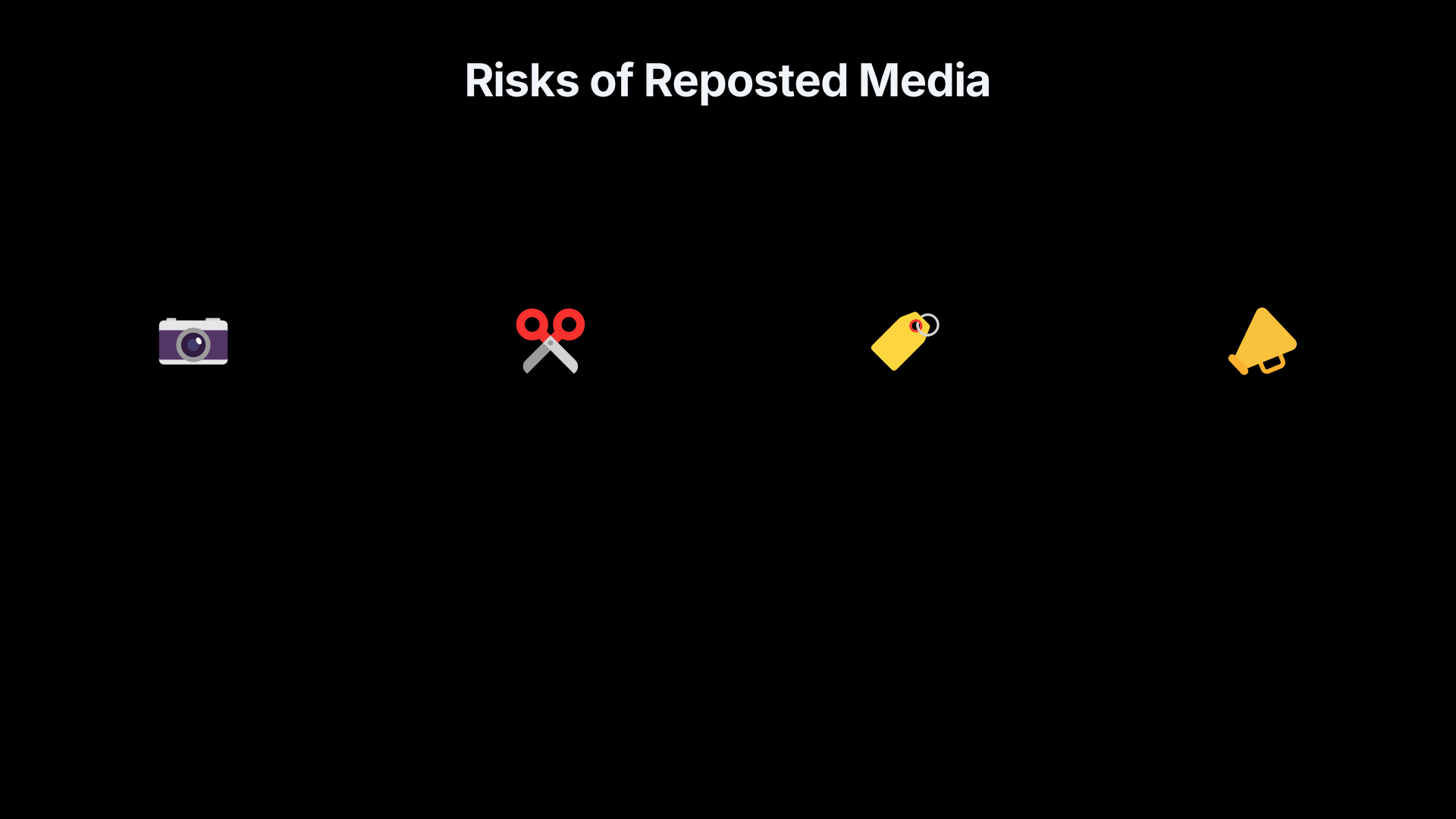
A screenshot of a headline may omit the article itself. A quote card may remove qualifying sentences. A short video may begin after the crucial event has already happened. Even when every repost is made in good faith, the audience gradually loses access to the information needed to evaluate the claim.
Several common problems arise:
- Loss of context. A photograph from years ago may be presented as if it depicts a current event.
- Selective editing. Short clips can omit what happened immediately before or after.
- Broken attribution. A claim originally described as “unconfirmed” may later circulate without that qualification.
- Repeated copying. Hundreds of accounts may repeat exactly the same statement, creating the appearance of independent confirmation when they all rely on one original source.
This is why counting reposts is a poor substitute for evaluating evidence. A thousand copies of the same unsupported claim do not create a thousand independent pieces of evidence.
How to find the original source or context
Tracing a claim is often less about advanced investigation than about following a careful chain backwards.
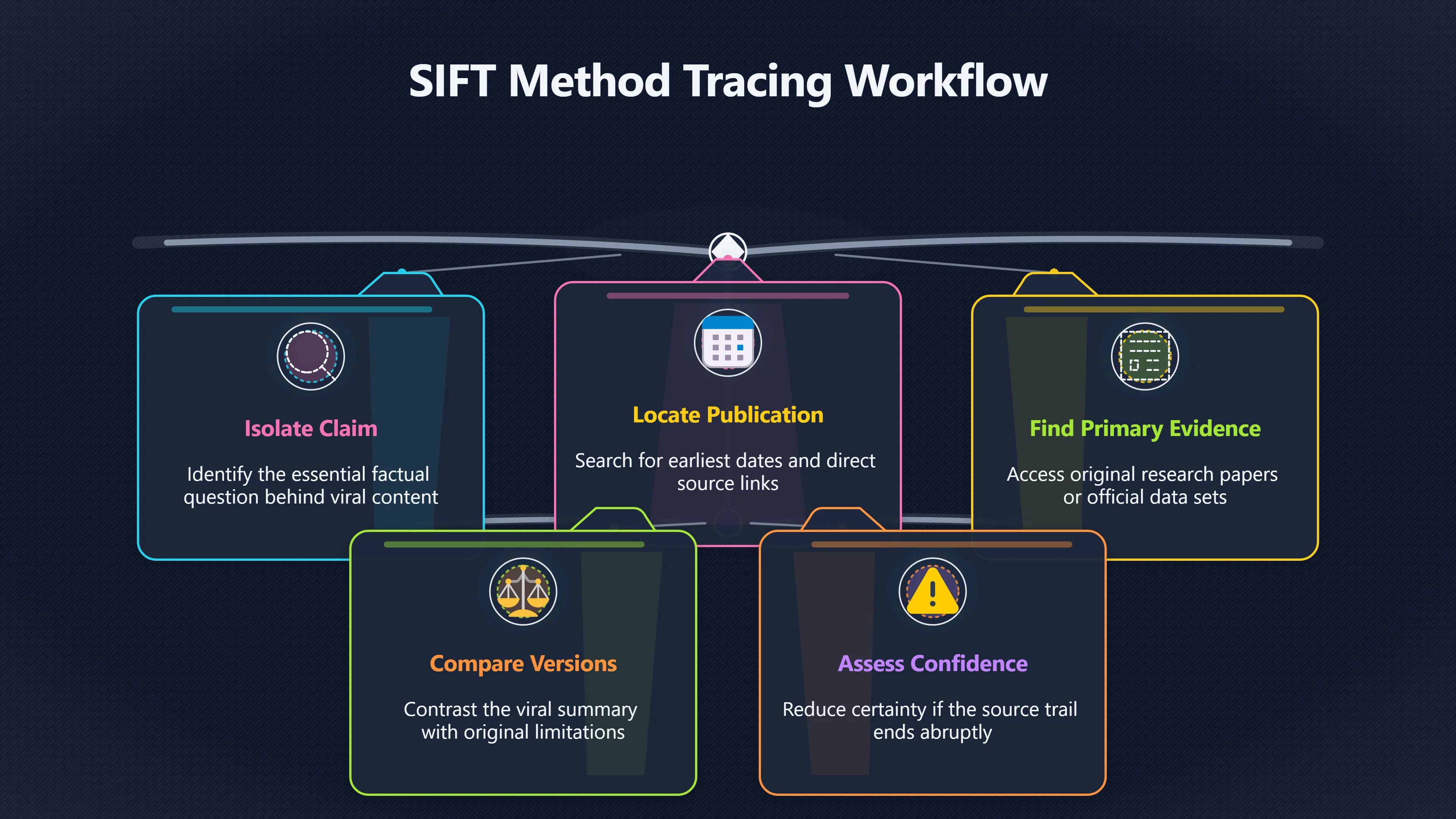
Start with the claim itself
First isolate exactly what is being claimed.
Instead of searching for the wording used in a viral post, reduce it to its essential factual question. For example:
- Is this supposedly based on a scientific paper?
- Is it describing an official statistic?
- Is it quoting a named person?
- Is it referring to a video or photograph?
This helps distinguish evidence from commentary. The claim usually points towards the type of original source you should expect to find.
Look for the first publication
Search for distinctive phrases from the claim while avoiding assumptions that later articles are original.
Useful indicators include:
- the earliest publication date;
- direct links to reports, datasets or court documents;
- named organisations that produced the information;
- original press releases or research papers rather than summaries.
If every article cites another report, continue following the citations until you reach the first identifiable source rather than stopping at the first article you encounter. Guidance based on the SIFT method recommends tracing claims back to the original publication instead of relying on repeated summaries.[researchguides.austincc.edu]researchguides.austincc.eduOftentimes, the more a story is shared, the more it can acquire misleading context in the form…Read more…
Find the primary evidence
Different claims have different primary sources.
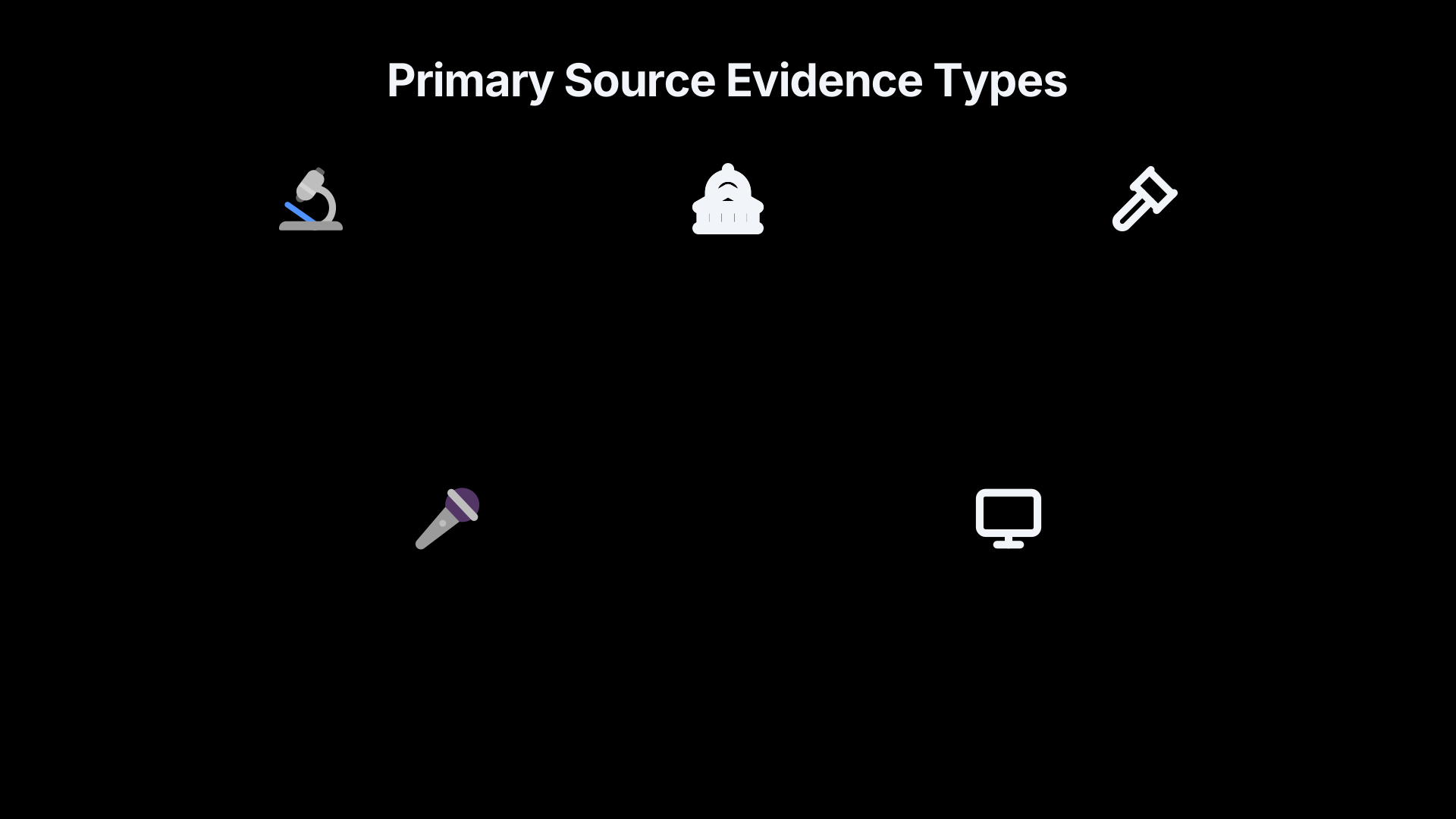
Claim typeBest original evidenceScientific findingResearch paper, preprint or journal articleGovernment statisticOfficial dataset or statistical releaseLegal claimCourt judgment or filed documentsSpeech or quotationFull transcript or recordingVideo incidentEarliest upload or original recordingPhotographOriginal image and accompanying metadata where available
Reading the original material often reveals important limitations that disappear in later retellings. A research paper may report a modest statistical association while news coverage describes a dramatic breakthrough. An official report may include uncertainty ranges or methodological caveats omitted from social media summaries.
Tracing images and videos
Visual material often feels persuasive because it appears to show events directly. Yet images and videos are especially vulnerable to losing context.
Reverse image search tools can help identify where an image appeared previously, whether it has been reused from an unrelated event, or whether higher-resolution versions exist with additional information. Similarly, locating an earlier upload of a video may reveal a longer recording that changes how the incident is understood. Educational guides on evaluating online media consistently recommend tracing visual material back to its earliest available publication before accepting captions or interpretations attached to later reposts.[Rowan University LibGuides+2LAVC Library]libguides.rowan.eduRowan University LibGuidesEvaluating Images & Media - Evaluating Online Sources10 Nov 2025 — TRACE claims, quotes, and media back to the…
When examining visual evidence, ask:
- Does a longer version exist?
- When was this first published?
- Who recorded it?
- Has the location or date been independently confirmed?
- Does the accompanying caption appear only in later reposts?
The answers often separate genuine documentation from misleading presentation.
When the source trail goes cold
Sometimes the trail simply ends.
Perhaps the viral post refers vaguely to “experts”, “a recent study”, or “internal documents” without naming them. A screenshot may show no publication date, no author and no identifiable organisation. A quotation may circulate widely without anyone linking to where it was supposedly said.
When this happens, the absence of evidence becomes informative.
A claim is not automatically false because the original source cannot be found. However, confidence should decrease when:
- no primary document can be located;
- every article merely repeats another report;
- citations point in circles;
- the alleged source never actually published the quoted claim;
- only screenshots exist where original documents should be available.
Rather than filling gaps with assumptions, treat unsupported claims as unresolved until better evidence appears.
Common mistakes when tracing evidence
Even careful readers can fall into predictable traps.
Mistaking the earliest search result for the earliest source. Search engines rank pages by many factors besides publication date.
Confusing popularity with confirmation. Hundreds of websites may all rely on one mistaken report.
Stopping at a press release. Press releases summarise evidence from the perspective of the issuing organisation. Whenever practical, read the underlying report or study.
Ignoring corrections. Original publishers sometimes issue updates or corrections that later screenshots never reflect.
Assuming a primary source is automatically correct. A first-hand witness can still misremember events, a government report can contain errors, and a scientific paper can later be revised. Finding the original source is the beginning of evaluation, not the end.
A practical habit that improves judgement
Professional fact-checkers often work backwards rather than forwards. Instead of asking whether a viral post looks convincing, they ask what original evidence would have to exist if the claim were true, then look for that evidence directly. This approach—sometimes called tracing to the original context—is closely related to lateral reading, where readers leave the page in front of them to investigate claims independently rather than judging credibility from presentation alone. University of Chicago Library Guides+2researchguides.austincc.edu[guides.lib.uchicago.edu]guides.lib.uchicago.eduUniversity of Chicago Library GuidesThe SIFT Method - Evaluating Resources and Misinformation30 Jun 2025 — Trace Claims, Quotes, and Medi…
With practice, this becomes a fast mental routine:
- Identify the precise claim.
- Determine what kind of original evidence should exist.
- Follow citations backwards until you reach the earliest available source.
- Compare the viral version with the original material.
- If the original cannot be found, reduce confidence instead of filling the gap with certainty.
The more easily a claim can be traced back to identifiable, inspectable evidence, the easier it becomes to judge what is genuinely known, what has been inferred, and what has simply been repeated.
Amazon book picks
Further Reading
Books and field guides related to Where Did This Claim Really Start?. Use these as the next step if you want deeper reading beyond the article.
The Skeptics' Guide to the Universe
Provides general methods for evaluating online information.
eBay marketplace picks
Marketplace Samples
Example marketplace items related to this page. Use the search link to explore similar finds on eBay.




Endnotes
1.
Source: researchguides.austincc.edu
Link:https://researchguides.austincc.edu/c.php?g=612891&p=10451614
Source snippet
Oftentimes, the more a story is shared, the more it can acquire misleading context in the form...Read more...
2.
Source: libguides.rowan.edu
Link:https://libguides.rowan.edu/EvaluatingOnlineSources/images_media
Source snippet
Rowan University LibGuidesEvaluating Images & Media - Evaluating Online Sources10 Nov 2025 — TRACE claims, quotes, and media back to the...
3.
Source: lib.lavc.edu
Link:https://lib.lavc.edu/c.php?g=1009146&p=7554202
Source snippet
LAVC LibraryTrace Claims, Quotes and Media to Their Original Context2 Jun 2026 — ir Original Context Fakeout! Click here to watch a field...
4.
Source: cypresscollege.libguides.com
Link:https://cypresscollege.libguides.com/c.php?g=1167619&p=8526725
Source snippet
Method for Evaluating Online Sources: SIFT Step 4: TRACE26 Mar 2026 — The below video [4:10] discusses the use of fact-checking sites, al...
5.
Source: guides.lib.uchicago.edu
Link:https://guides.lib.uchicago.edu/c.php?g=1241077&p=9082322
Source snippet
University of Chicago Library GuidesThe SIFT Method - Evaluating Resources and Misinformation30 Jun 2025 — Trace Claims, Quotes, and Medi...
6.
Source: libguides.mnsu.edu
Link:https://libguides.mnsu.edu/sourcecredibility/trace
Source snippet
It includes an evaluation activity to...Read more...
Additional References
7.
Source: libguides.eku.edu
Title: Eastern Kentucky University Libraries Step 4: TRACE
Link:https://libguides.eku.edu/sift/trace
Source snippet
4: TRACE - Evaluating Information: S.I.F.T. (The Four...30 Sept 2024 — TRACE claims, quotes, and media back to the original source or co...
8.
Source: guides.lib.wayne.edu
Title: A lot of things you encounter online have been stripped of context.Read more
Link:https://guides.lib.wayne.edu/sift/trace
Source snippet
Claims, Quotes, and Media Back to Their Original Context11 Mar 2021 — Step Four: TRACE CLAIMS, QUOTES, AND MEDIA BACK TO THEIR ORIGINAL C...
9.
Source: libguides.graduateinstitute.ch
Title: ch Fact-Checking with SIFT
Link:https://libguides.graduateinstitute.ch/how_to_search/sift
Source snippet
graduateinstitute.chFact-Checking with SIFT - How to Search for Sources and...10 Mar 2026 — Trace claims, quotes and media to the origin...
10.
Source: youtube.com
Title: Exploring the SIFT Method: Emily Evaluates, Part 5
Link:https://www.youtube.com/watch?v=VttaHxaaf7Y
Source snippet
Evaluating Evidence: Crash Course Navigating Digital Information #6...
11.
Source: youtube.com
Title: Intro to the SIFT Method: Trace Claims to the Original Context
Link:https://www.youtube.com/watch?v=as1IzVljNAw
Source snippet
How to: Use the SIFT Method to Evaluate a Source...
12.
Source: youtube.com
Title: Evaluating Evidence: Crash Course Navigating Digital Information #6
Link:https://www.youtube.com/watch?v=hxhbOvR2TGk
Source snippet
Evaluating Sources Using the SIFT Method...
13.
Source: arxiv.org
Title: arXiv The Role of Context in Detecting Previously Fact-Checked Claims
Link:https://arxiv.org/abs/2104.07423
14.
Source: youtube.com
Title: Evaluating Sources Using the SIFT Method
Link:https://www.youtube.com/watch?v=FJ-d2s-Ugjo
Source snippet
Intro to the SIFT Method: Trace Claims to the Original Context...
15.
Source: youtube.com
Title: How to: Use the SIFT Method to Evaluate a Source
Link:https://www.youtube.com/watch?v=SHNprb2hgzU
Topic Tree