Within Predictions
Why solutions look easier after you see them
Before reading a worked solution, predicting the next step forces you to choose a principle instead of merely recognizing one.
On this page
- How worked examples create hindsight fluency
- What to predict before revealing the next step
- How to use missed steps as study targets
Page outline Jump by section
Introduction
Worked examples are among the most effective ways to learn complex skills, but they have a weakness: once you can see each solution step, the reasoning often feels obvious. That feeling is misleading. The fact that a step makes sense after you have seen it does not mean you would have generated it yourself.
 A simple way to overcome this illusion is to stop before each new line of a worked solution and predict what comes next. Instead of passively recognising an expert’s reasoning, you commit yourself to a principle, operation or decision. When the actual next step appears, the comparison exposes what you genuinely understood, what you merely recognised, and which parts of your reasoning need further development. Research on worked examples, self-explanation and prediction-based learning suggests that this small interruption turns examples from demonstrations into active learning opportunities. [PMC+2Evaluation and Assessment]pmc.ncbi.nlm.nih.govPMCPredicting as a learning strategyNIHby G Brod · 2021 · Cited by 77 — This article attempts to delineate the procedural and mechanistic characteristics of predicting…
How worked examples create hindsight fluency
A completed solution is coherent by design. Every step follows naturally from the previous one because the author already knows the destination. For the learner, this creates hindsight fluency: the mistaken impression that understanding a completed explanation is equivalent to being able to produce it independently.
This matters because solving a problem involves selecting the next action from many possibilities. Reading a finished solution removes that choice. The learner sees only the successful path, not the alternatives that had to be rejected. As a result, recognition replaces decision-making.
Prediction restores the missing decision. Before uncovering the next line, ask a simple question:
- Which principle should be applied now?
- What intermediate result should appear next?
- Why is this preferable to another approach?
Even if the prediction is incomplete, the attempt forces retrieval of relevant knowledge rather than passive reading. Prediction research argues that this commitment prepares attention for corrective feedback, while worked-example research shows that learners benefit most when they actively process each step instead of merely observing it. [PMC+2Teaching + Learning Lab]pmc.ncbi.nlm.nih.govPMCPredicting as a learning strategyNIHby G Brod · 2021 · Cited by 77 — This article attempts to delineate the procedural and mechanistic characteristics of predicting…
What to predict before revealing the next step
The aim is not to predict every symbol perfectly. Instead, predict the decision that drives the next move.
Different subjects naturally invite different predictions:
- Mathematics: Which formula or theorem comes next? Will the solution simplify, substitute or rearrange?
- Physics: Which physical principle governs this stage? Is conservation more useful than force analysis?
- Programming: What function, algorithm or data structure should appear before seeing the code?
- Statistics: Which test or transformation is appropriate before calculating anything?
- Writing and argumentation: What claim, evidence or transition should logically follow?
This keeps attention focused on reasoning rather than memorising surface details. If the exact calculation differs but the governing principle matches, your conceptual understanding is improving even if your procedural execution still needs work.
A practical routine is to pause after every major step rather than every line. Long algebraic manipulations or routine arithmetic usually contribute less to understanding than decisions about method selection or subgoals.
Why predicting principles is more valuable than predicting answers
Experts rarely think only about answers. They think about the structure of a problem.
Research on learning from worked examples distinguishes learners who actively explain the conceptual purpose of each step from those who merely follow procedures. Predicting the next principle encourages this deeper processing because it asks, “What kind of move should happen now?” rather than, “What number comes next?” [Evaluation and Assessment+2mr barton maths]assess.ucr.eduatkinsonderryrenklwortham 2000Evaluation and AssessmentInstructional Principles from the Worked Examples Researchby RK Atkinson · Cited by 1993 — Anticipative reasoner…
For example, suppose a calculus example differentiates a product of two functions.
A superficial prediction is:
“The next line will probably contain a derivative.”
A more useful prediction is:
“This requires the product rule because neither factor is constant.”
The second prediction reveals the reasoning that can transfer to unfamiliar problems. Even if small algebraic details differ, the underlying choice of principle can still be evaluated.

How to use missed steps as study targets
Incorrect predictions are often the most valuable part of the exercise.
Rather than marking yourself simply right or wrong, classify the mismatch.
Wrong principle. You chose an inappropriate rule. This usually signals a conceptual misunderstanding.
Right principle, wrong execution. Your reasoning was sound, but you made an algebraic, computational or procedural mistake.
Skipped subgoal. The expert introduced an intermediate step you never considered. This often indicates that your internal representation of the solution process is too coarse.
Correct prediction but low confidence. Your knowledge exists but is not yet reliable under pressure.
Keeping these categories separate makes review far more productive than merely checking final answers. The goal becomes improving the decision process rather than accumulating correct outcomes.
Turning examples into deliberate practice
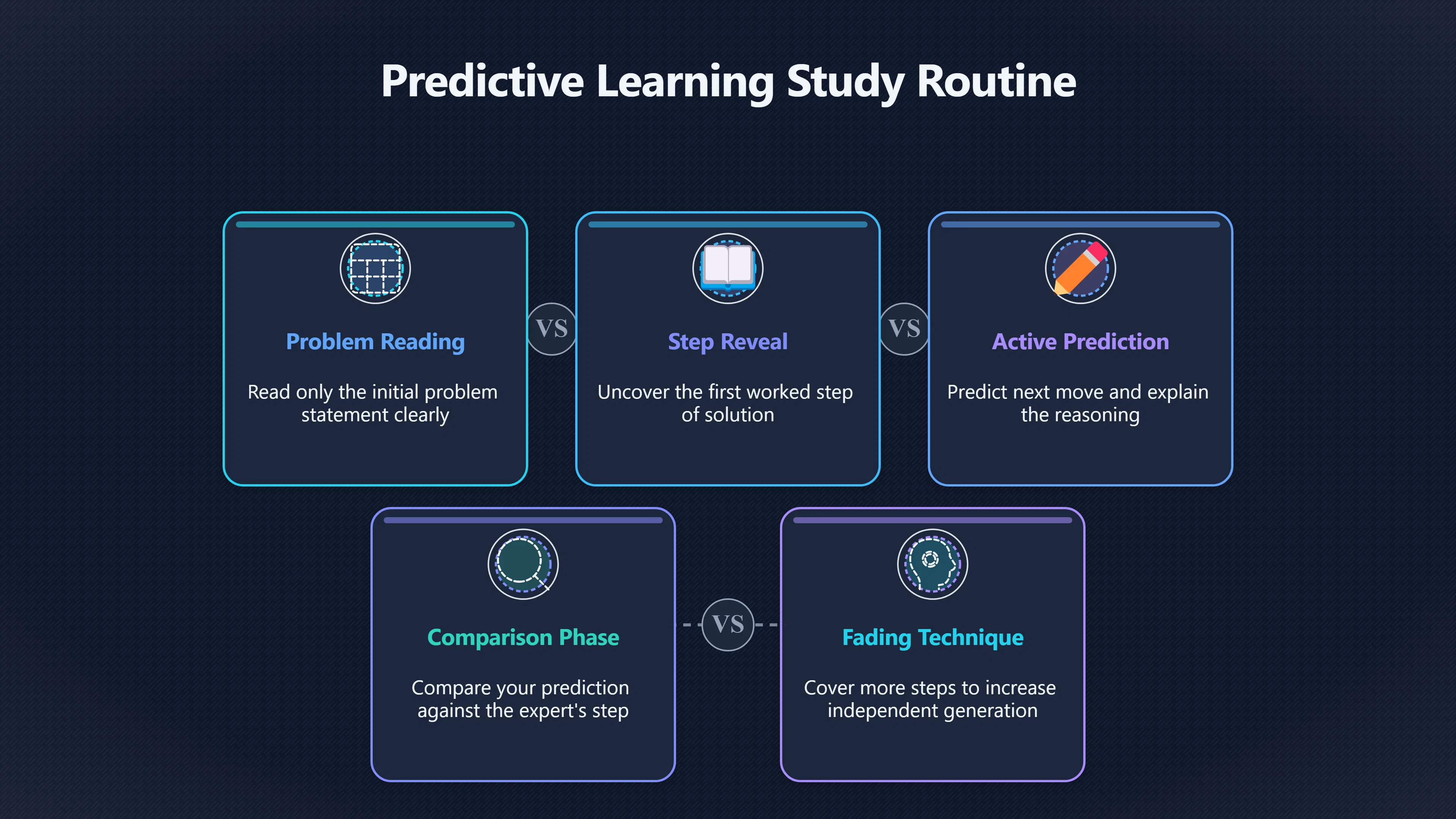
One effective sequence is:
- Read only the problem statement.
- Reveal the first worked step.
- Cover the next step.
- Predict what should happen and briefly explain why.
- Reveal the actual step.
- Compare your reasoning with the expert’s.
- Continue until the solution is complete.
The explanation need only be one or two sentences. Long written justifications are unnecessary if they become so burdensome that they interrupt learning.
As your confidence grows, increase the challenge by covering several solution steps at once before making a prediction. Eventually, transition to faded worked examples, where progressively fewer steps are shown and more of the solution must be generated independently—a progression that has consistently been found to support movement from studying examples towards independent problem solving. [mr barton maths+2Evaluation and Assessment]mrbartonmaths.comFading out and Promptsmr barton mathsEffects of Self-Explanation Prompts and Fading Worked-Out…by A Renkl · 2003 · Cited by 737 — Research indicates that exp…
Common mistakes that reduce the benefit
Several habits weaken the value of prediction.
Reading too quickly. If you reveal the next step immediately after asking yourself the question, you never force retrieval.
Predicting only the final answer. Most learning comes from selecting the next operation, not guessing the destination.
Treating incorrect predictions as failure. Prediction research suggests that errors followed by immediate feedback can strengthen later learning because they create opportunities for surprise and correction rather than passive acceptance. [PMC]pmc.ncbi.nlm.nih.govPMCPredicting as a learning strategyNIHby G Brod · 2021 · Cited by 77 — This article attempts to delineate the procedural and mechanistic characteristics of predicting…
Copying expert wording. Focus on reproducing the reasoning in your own words instead of memorising the presentation.
Ignoring confidence. Correct predictions made with very low confidence often deserve as much review as incorrect ones because they indicate unstable understanding.
From recognising solutions to generating them
The value of predicting the next step lies in changing your role. Instead of watching an expert solve a problem, you repeatedly attempt to become the expert for one decision at a time.
Each pause asks a focused analytical question: “Given everything available so far, what should happen next, and why?” Over many examples, those repeated micro-decisions gradually replace hindsight with genuine problem-solving skill. Rather than merely recognising correct solutions after seeing them, you become increasingly able to generate them before they appear.
Amazon book picks
Further Reading
Books and field guides related to Why solutions look easier after you see them. Use these as the next step if you want deeper reading beyond the article.
A Mind for Numbers
Shows how to learn from worked examples without passive recognition.
eBay marketplace picks
Marketplace Samples
Live-tested eBay searches with available results related to this page.


Endnotes
-
Source: pmc.ncbi.nlm.nih.gov
Title: PMCPredicting as a learning strategy
Link: https://pmc.ncbi.nlm.nih.gov/articles/PMC8642250/Source snippet
NIHby G Brod · 2021 · Cited by 77 — This article attempts to delineate the procedural and mechanistic characteristics of predicting...
-
Source: assess.ucr.edu
Title: atkinsonderryrenklwortham 2000
Link: https://assess.ucr.edu/sites/default/files/2019-02/atkinsonderryrenklwortham_2000.pdfSource snippet
Evaluation and AssessmentInstructional Principles from the Worked Examples Researchby RK Atkinson · Cited by 1993 — Anticipative reasoner...
-
Source: mrbartonmaths.com
Title: Fading out and [Prompts]({{ ‘prompts/’ | relative_url }})
Link: https://mrbartonmaths.com/resourcesnew/8.%20Research/Making%20the%20most%20of%20examples/Fading%20out%20and%20Prompts.pdfSource snippet
mr barton mathsEffects of Self-Explanation Prompts and Fading Worked-Out...by A Renkl · 2003 · Cited by 737 — Research indicates that exp...
-
Source: tll.mit.edu
Title: Teaching + Learning Lab Worked Examples | Teaching + Learning Lab
Link: https://tll.mit.edu/teaching-resources/how-people-learn/worked-examples/Source snippet
Teaching + Learning LabWorked Examples | Teaching + Learning Lab - MITWorked examples are step-by-step illustrations of the process requi...
-
Source: newsletter.jamieleeclark.com
Title: worked examples
Link: https://newsletter.jamieleeclark.com/p/worked-examplesSource snippet
Examples: Reduce Cognitive Load and Accelerate...A worked example is a step-by-step demonstration of how to solve a problem or complete...
-
Source: mrbartonmaths.com
Link: https://mrbartonmaths.com/resourcesnew/8.%20Research/Explicit%20Instruction/Worked%20examples%20with%20mistakes.pdfSource snippet
LEARNING FROM WORKED EXAMPLESby CS GROSSE · Cited by 51 — The following research questions were addressed: (1) Does the presentation of i...
Additional References
-
Source: researchgate.net
Link: https://www.researchgate.net/publication/233663444_The_effect_of_self-explanation_on_robust_learning -
Source: tipsforteachers.co.uk
Link: https://tipsforteachers.co.uk/research/ -
Source: cambridge.org
Link: https://www.cambridge.org/core/books/learning-as-a-generative-activity/learning-by-selfexplaining/53D84D98390BE4C5C96C50371961018CSource snippet
For example, students may read a lesson on how the human...Read more...
-
Source: educationendowmentfoundation.org.uk
Title: supporting pupils with worked examples
Link: https://educationendowmentfoundation.org.uk/news/supporting-pupils-with-worked-examplesSource snippet
20 Jun 2022 — Bob Pritchard, our Science content specialist, explains how to maximise the impact of using worked examples in science teac...
-
Source: 3starlearningexperiences.wordpress.com
Title: designing winning worked examples 3 explanation effects
Link: https://3starlearningexperiences.wordpress.com/2021/07/13/designing-winning-worked-examples-3-explanation-effects/Source snippet
From studying examples to solving problems: Fading worked-out solution steps helps learning.Read more...
-
Source: ethz.ch
Link: https://ethz.ch/content/dam/ethz/special-interest/gess/ifv/professur-lehr-und-lernforschung/publikationen-stern/Schalk%20Roelle%20Saalbach%20Berthold%20Stern%20%20Renkl%20online%20first%20-%20Providing%20worked%20example%20multiple%20principles.pdfSource snippet
Providing Worked Examples for Learning Multiple Principlesby L Schalk · Cited by 27 — As process measures, we assessed subjective fluency...
-
Source: researchschool.org.uk
Title: modelling and worked examples
Link: https://researchschool.org.uk/durrington/news/modelling-and-worked-examplesSource snippet
Durrington Research...24 Oct 2019 — This article explores the importance worked examples as a modelling technique and some of the suppor...
-
Source: learningscientists.org
Link: https://www.learningscientists.org/blog/2024/1/25-1Source snippet
Worked Examples: An Effective Tool for Math Learning25 Jan 2024 — Worked examples, paired with traditional problem-solving, have been fou...
-
Source: elementsoflearning.home.blog
Title: enhancing worked examples with self explanation
Link: https://elementsoflearning.home.blog/2022/09/29/enhancing-worked-examples-with-self-explanation/Source snippet
The 'worked-example effect' is a cognitive load strategy which can be used to...Read more...
-
Source: files.eric.ed.gov
Link: https://files.eric.ed.gov/fulltext/ED566953.pdfSource snippet
Booth, Kelly Mby JL Booth · 2015 · Cited by 54 — Laboratory research has demonstrated that studying worked examples improves students' ab...
Topic Tree