Within Retrieval
Do You Know It, or Just Know It Looks Familiar?
Practice tests can improve judgement about what is truly secure by replacing a feeling of knowing with recall evidence.
On this page
- Why predictions after restudy are often overconfident
- How retrieval gives better evidence about learning
- How to rate confidence after recall
Page outline Jump by section
Introduction
Practice tests do more than strengthen memory. They also provide evidence about what you genuinely know, making them one of the best opportunities to improve metacognition—the ability to judge the state of your own knowledge accurately enough to choose the right next step. The crucial question after a practice test is not simply “What score did I get?” but “What does this performance tell me about what I can reliably recall, explain and apply?” Research consistently shows that predictions made after retrieval attempts are better calibrated than predictions made after rereading because recall reveals the actual state of learning instead of relying on a feeling of familiarity.[Taylor & Francis Online+2SUNY Research Connect]tandfonline.comTaylor & Francis OnlineTesting and metacognition: retrieval practise effects on…However, research primarily focussed on retrieval prac…
 Within retrieval practice, these metacognitive checks are valuable because they reduce overconfidence, expose hidden weaknesses and guide more efficient study decisions. Rather than treating a practice test as the end of learning, they turn it into a diagnostic tool.
Do You Know It, or Just Know It Looks Familiar?
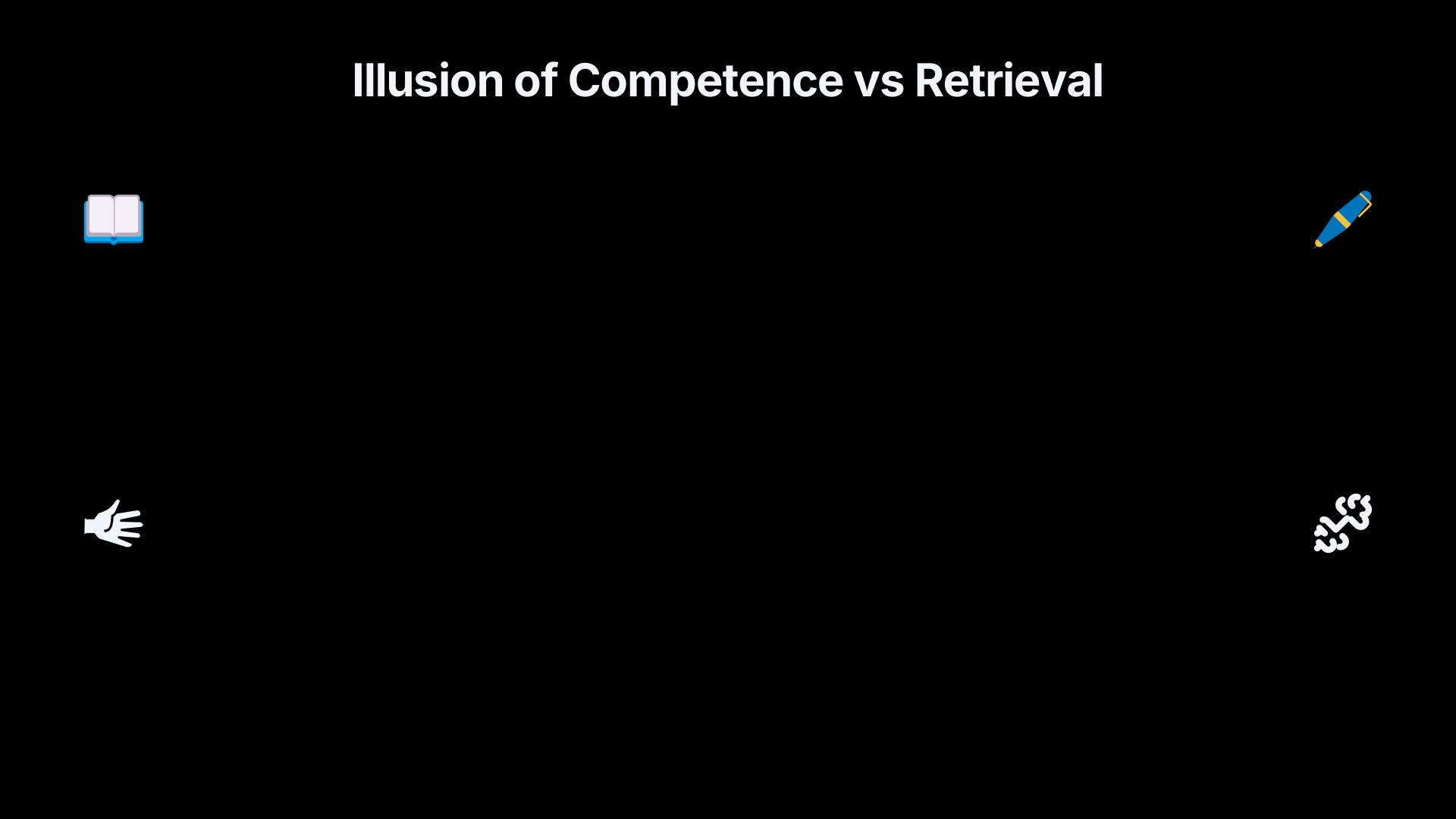
Many learners mistake recognition for understanding. Seeing a familiar definition or recognising the correct answer in notes often produces a convincing feeling of knowing, even when the information cannot be recalled independently. This “illusion of competence” has been documented repeatedly in research on learning and metamemory. Familiarity is informative, but it is a poor substitute for successful retrieval when predicting future performance.[Columbia University+2PMC]columbia.eduColumbia UniversityMetacognitive Judgments and Control of Studyby J Metcalfe · Cited by 634 — In a recent article, Dunlosky and Lipko (20…
A completed practice test changes the situation. Instead of asking how familiar the material feels, it provides direct evidence:
- Which answers came immediately without guessing?
- Which required long pauses or partial reconstruction?
- Which were confidently wrong?
- Which could be recalled but not fully explained?
- Which disappeared entirely without prompts?
These observations are far more diagnostic than impressions formed while reading notes because they are based on performance rather than appearance.
Why Predictions After Restudy Are Often Overconfident
Restudying creates fluent processing. The material becomes easier to read, key terms seem obvious and explanations feel clear while they remain visible. Unfortunately, processing fluency is often mistaken for durable learning.
Researchers studying judgments of learning have shown that people frequently predict high future performance immediately after rereading, even when later recall proves much weaker than expected. Learners often rely on cues such as ease of reading, familiarity or confidence while studying instead of cues that genuinely predict future memory.[tauberlab.com+2Columbia University]tauberlab.comTCU Memory & Aging LabDunlosky, J., & Tauber, S. K. (2014). Understanding people's metacognitive judgments: An isomechanism framework and…
Practice tests interrupt this illusion because they replace subjective impressions with observable evidence. If retrieval is incomplete or slow, that difficulty becomes information rather than merely an unpleasant experience. Robert and Elizabeth Bjork have described this broader principle through the idea of “desirable difficulties”: experiences that feel harder during learning can produce stronger long-term retention and more realistic self-evaluation.[Bjork Learning and Forgetting Lab]bjorklab.psych.ucla.edurobert a bjork publicationsBjork Learning and Forgetting LabRobert A. Bjork – PublicationsBjork, R. A., & Bjork, E. L. (2019). The myth that blocking one's study or…
Importantly, difficulty alone is not the goal. The value comes from difficulty revealing what has actually been learned.
How Retrieval Gives Better Evidence About Learning
A retrieval attempt produces several signals that learners can use when judging their understanding. These signals are largely unavailable during passive review.
Research suggests that people naturally incorporate multiple sources of evidence after retrieval, including whether the answer was correct, how confident they were during recall and how easily the answer came to mind. Together these cues produce more accurate judgments about future remembering than restudying alone.[Frontiers]frontiersin.orgFrontiersRetrieval Practice Facilitates Judgments of Learning…by X Chen · 2019 · Cited by 9 — Retrieval practice allows people to base…
After each practice question, consider three separate pieces of evidence:
Recall success. Could the answer be produced without looking?
Retrieval quality. Was the answer complete, precise and well explained, or only partially reconstructed?
Retrieval effort. Did the answer appear quickly or only after extended searching?
These dimensions matter because identical scores can hide very different states of learning. Two learners may both answer correctly, but one retrieves immediately while the other reconstructs the answer slowly from fragments. The first is generally better positioned for later retention.
Equally important are incorrect answers given with high confidence. Although they reveal misconceptions, they also provide valuable learning opportunities because learners often pay greater attention when surprised by confident errors, increasing the chance of correcting them after feedback.[Wikipedia]WikipediaHypercorrection (psychologyHypercorrection (psychology

How to Rate Confidence After Recall
Confidence ratings become useful only when they are attached to completed retrieval attempts rather than predictions made beforehand.
A practical scale might look like this:
- Very high confidence: recalled immediately, explained accurately and could apply the idea in a new example.
- Moderate confidence: recalled correctly but with hesitation or missing details.
- Low confidence: answer required guessing, prompting or reconstruction.
- No confidence: unable to retrieve without consulting the material.
The important habit is calibration rather than optimism. Accurate confidence ratings help identify material that genuinely requires additional retrieval practice instead of encouraging unnecessary review of already secure topics.
Research on retrieval-based monitoring shows that confidence judgments become more accurate after testing because learners have access to better diagnostic cues than after passive study.[Taylor & Francis Online+2Frontiers]tandfonline.comTaylor & Francis OnlineTesting and metacognition: retrieval practise effects on…However, research primarily focussed on retrieval prac…
Turning Metacognitive Judgments into Better Study Decisions
Monitoring only improves learning if it changes what happens next. In the classic framework of metacognition, monitoring and control are linked processes: learners evaluate their knowledge, then regulate subsequent study accordingly.[PMC]pmc.ncbi.nlm.nih.govBeyond the Prompt: Investigating Retrieval-Based Monitoring…by M Wu · 2025 — Metacognitive monitoring involves the evaluation of an…
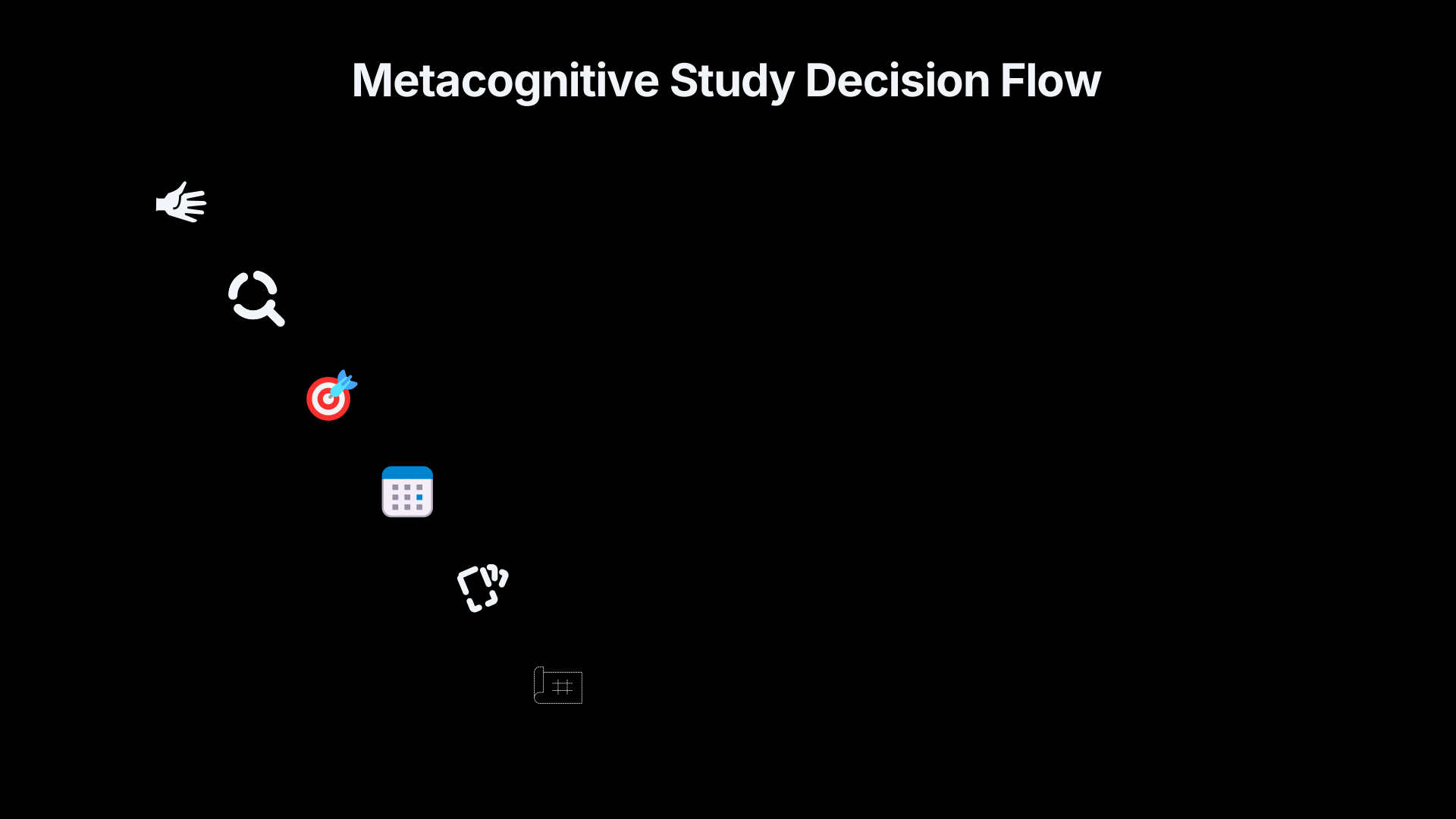
After reviewing a practice test, useful decisions include:
- Prioritising concepts that were forgotten entirely over those recalled confidently.
- Revisiting explanations rather than isolated facts when answers lacked reasoning.
- Scheduling another retrieval session instead of immediately rereading.
- Mixing weak and strong topics to verify that improvement transfers beyond immediate repetition.
- Retesting corrected misconceptions after a delay rather than assuming that reading the correct answer has fixed them.
This approach prevents wasted effort. Instead of studying everything equally, learners allocate attention according to evidence gathered from retrieval.
Common Mistakes When Checking Your Own Learning
Several habits weaken the value of metacognitive checks.
Equating correct recognition with mastery. Choosing the correct option in multiple-choice questions may conceal weak independent recall.
Ignoring retrieval effort. A correct answer produced only after prolonged searching often needs further practice even if technically correct.
Treating confidence as proof. High confidence can accompany both correct knowledge and deeply held misconceptions.
Checking immediately after feedback. Confidence measured seconds after reading the correct answer is inflated by short-term familiarity rather than durable learning.
Using a single practice test as the final verdict. Stable knowledge is demonstrated through successful retrieval across multiple occasions, ideally with spacing between attempts.
Recognising these patterns helps learners interpret practice test performance more realistically.
From Feeling Certain to Having Evidence
The central benefit of metacognitive checks after practice tests is a shift in the basis of self-evaluation. Instead of asking whether information feels familiar, learners ask whether they could retrieve it accurately, explain it clearly and apply it without assistance.
That change may seem small, but it fundamentally improves self-regulated learning. Retrieval provides evidence about memory, confidence ratings refine that evidence, and calibrated judgments guide the next study decision. Over time, learners become not only better at remembering information but also better at recognising what they genuinely know and where further thinking is still required.[Taylor & Francis Online+2PMC]tandfonline.comTaylor & Francis OnlineTesting and metacognition: retrieval practise effects on…However, research primarily focussed on retrieval prac…
Amazon book picks
Further Reading
Books and field guides related to Do You Know It, or Just Know It Looks Familiar?. Use these as the next step if you want deeper reading beyond the article.
Make It Stick
Explains why retrieval practice improves both learning and metacognitive accuracy, directly matching the article's focus.
Powerful Teaching
Focuses extensively on retrieval practice, feedback, and judging learning accurately.
How We Learn
Covers retrieval, memory illusions, and practical study strategies that reinforce the page's themes.
Small Teaching
Includes retrieval practice and low-stakes testing as tools for improving learning and self-assessment.
eBay marketplace picks
Marketplace Samples
Example marketplace items related to this page. Use the search link to explore similar finds on eBay.



Endnotes
1.
Source: researchconnect.suny.edu
Link:https://researchconnect.suny.edu/en/publications/retrieval-practice-facilitates-judgments-of-learning-through-mult/
Source snippet
SUNY Research ConnectRetrieval practice facilitates judgments of learning through...The results of both experiments showed that the corr...
2.
Source: pmc.ncbi.nlm.nih.gov
Link:https://pmc.ncbi.nlm.nih.gov/articles/PMC2836879/
Source snippet
of Learning are Influenced by Memory for Past Testby B Finn · 2008 · Cited by 208 — While metacognitive monitoring is fairly accurate in...
3.
Source: columbia.edu
Link:https://www.columbia.edu/cu/psychology/metcalfe/PDFs/Metcalfe2009.pdf
Source snippet
Columbia UniversityMetacognitive Judgments and Control of Studyby J Metcalfe · Cited by 634 — In a recent article, Dunlosky and Lipko (20...
4.
Source: tauberlab.com
Link:https://www.tauberlab.com/Research/publications
Source snippet
TCU Memory & Aging LabDunlosky, J., & Tauber, S. K. (2014). Understanding people's metacognitive judgments: An isomechanism framework and...
5.
Source: Wikipedia
Title: Hypercorrection (psychology)
Link:https://en.wikipedia.org/wiki/Hypercorrection_%28psychology%29
6.
Source: pmc.ncbi.nlm.nih.gov
Link:https://pmc.ncbi.nlm.nih.gov/articles/PMC12387543/
Source snippet
Beyond the Prompt: Investigating Retrieval-Based Monitoring...by M Wu · 2025 — Metacognitive monitoring involves the evaluation of an...
7.
Source: tandfonline.com
Link:https://www.tandfonline.com/doi/full/10.1080/09658211.2018.1506481
Source snippet
Taylor & Francis OnlineTesting and metacognition: retrieval practise effects on...However, research primarily focussed on retrieval prac...
8.
Source: bjorklab.psych.ucla.edu
Title: robert a bjork publications
Link:https://bjorklab.psych.ucla.edu/robert-a-bjork-publications/
Source snippet
Bjork Learning and Forgetting LabRobert A. Bjork – PublicationsBjork, R. A., & Bjork, E. L. (2019). The myth that blocking one's study or...
9.
Source: frontiersin.org
Link:https://www.frontiersin.org/journals/psychology/articles/10.3389/fpsyg.2019.00987/full
Source snippet
FrontiersRetrieval Practice Facilitates Judgments of Learning...by X Chen · 2019 · Cited by 9 — Retrieval practice allows people to base...
Additional References
10.
Source: researchgate.net
Link:https://www.researchgate.net/publication/343927243_A_metacognitive_retrieval_practice_intervention_to_improve_undergraduates%27_monitoring_and_control_processes_and_use_of_performance_feedback_for_classroom_learning
Source snippet
nts' metacognitive monitoring of retrieval practice performance feedback and...Read more...
11.
Source: my.chartered.college
Title: using evidence based practices that support metacognition
Link:https://my.chartered.college/impact_article/using-evidence-based-practices-that-support-metacognition/
Source snippet
evidence-based practices that support metacognitionFeb 26, 2024 — The aim of this article is to investigate the efficacy of integrating r...
12.
Source: sites.socsci.uci.edu
Title: NelsonDunloskyGrafNarens PsychScience 1994
Link:https://sites.socsci.uci.edu/~lnarens/1994/NelsonDunloskyGrafNarens_PsychScience_1994.pdf
Source snippet
Articleby TO Nelson · Cited by 387 — Metacognitive Judgments and Multitnal Learning consisted of restudy-test trials in which a fixed sub...
13.
Source: youtube.com
Title: What Is Metacognition? Steps to Boost Learning in 10 Minutes
Link:https://www.youtube.com/watch?v=qYtklihV7KA
Source snippet
Overcoming Illusions of Competence, Dr. Elizabeth Bjork is highly relevant because it features Dr. Elizabeth Bjork explaining how passive...
14.
Source: structural-learning.com
Title: metacognitive monitoring fixing student
Link:https://www.structural-learning.com/post/metacognitive-monitoring-fixing-student
Source snippet
Metacognitive Monitoring: Fixing Learner Overconfidence4 Mar 2026 — Dunlosky and colleagues compare common study techniques and show why...
15.
Source: psychologyinaction.org
Link:https://www.psychologyinaction.org/2022-11-16-thinking-about-thinking-how-metacognition-can-help-your-grades/
Source snippet
ods like rereading or highlighting course materials...
16.
Source: learninglab.psych.purdue.edu
Title: 2009 Karpicke JEPGeneral
Link:https://learninglab.psych.purdue.edu/downloads/2009/2009_Karpicke_JEPGeneral.pdf
Source snippet
Control and Strategy Selection: Deciding to...by JD Karpicke · Cited by 508 — The present research investigated the interrelationships a...
17.
Source: assets.markallengroup.com
Title: 7 Metacognition References
Link:https://assets.markallengroup.com/article-images/246064/7-MetacognitionReferences.pdf
Source snippet
(2019) Testing and metacognition: Retrieval practise effects on metacognitive monitoring in learning from text. Memory...
18.
Source: youtube.com
Title: Overcoming Illusions of Competence, Dr. Elizabeth Bjork
Link:https://www.youtube.com/watch?v=a6brY4se_WM
Source snippet
2 Metacognition Mastery: You Think You Understand, But You Don't...
19.
Source: opus.bibliothek.uni-augsburg.de
Link:https://opus.bibliothek.uni-augsburg.de/opus4/files/104239/104239.pdf
Source snippet
monitoring via strategies and judgmentsby M Händel · 2023 · Cited by 8 — Abstract: Metacognitive monitoring is conceptualized as a situat...
Topic Tree