Within Job Offers
Why the Manager May Matter Most
The person setting priorities, feedback and expectations can change the same role from energising to exhausting.
On this page
- How managers shape autonomy and priorities
- Questions that test feedback and support
- Warning signs in success measures and communication
Page outline Jump by section
Introduction
When comparing job offers, it is easy to focus on salary, title or benefits because they are visible and easy to compare. Yet one of the strongest influences on whether a job becomes rewarding or draining is often the person you report to. Your manager decides which work is most important, how success is measured, how mistakes are handled, how much autonomy you receive, and whether development conversations are genuine or merely procedural.
 For that reason, accepting a job offer is partly accepting a working relationship. Even an attractive role can become frustrating under a manager who provides unclear priorities, inconsistent feedback or little support. Conversely, a demanding role can become an excellent career move when led by a manager who creates trust, removes obstacles and develops people. Research consistently shows that managers have a substantial influence on engagement, wellbeing and performance.[Gallup.com]gallup.comHow to Improve Employee Engagement in the WorkplaceFebruary 21, 2020 — Learn how to improve employee engagement. Discover the true drivers of engagement, the best survey questions and team…
Why the manager may matter more than the job description
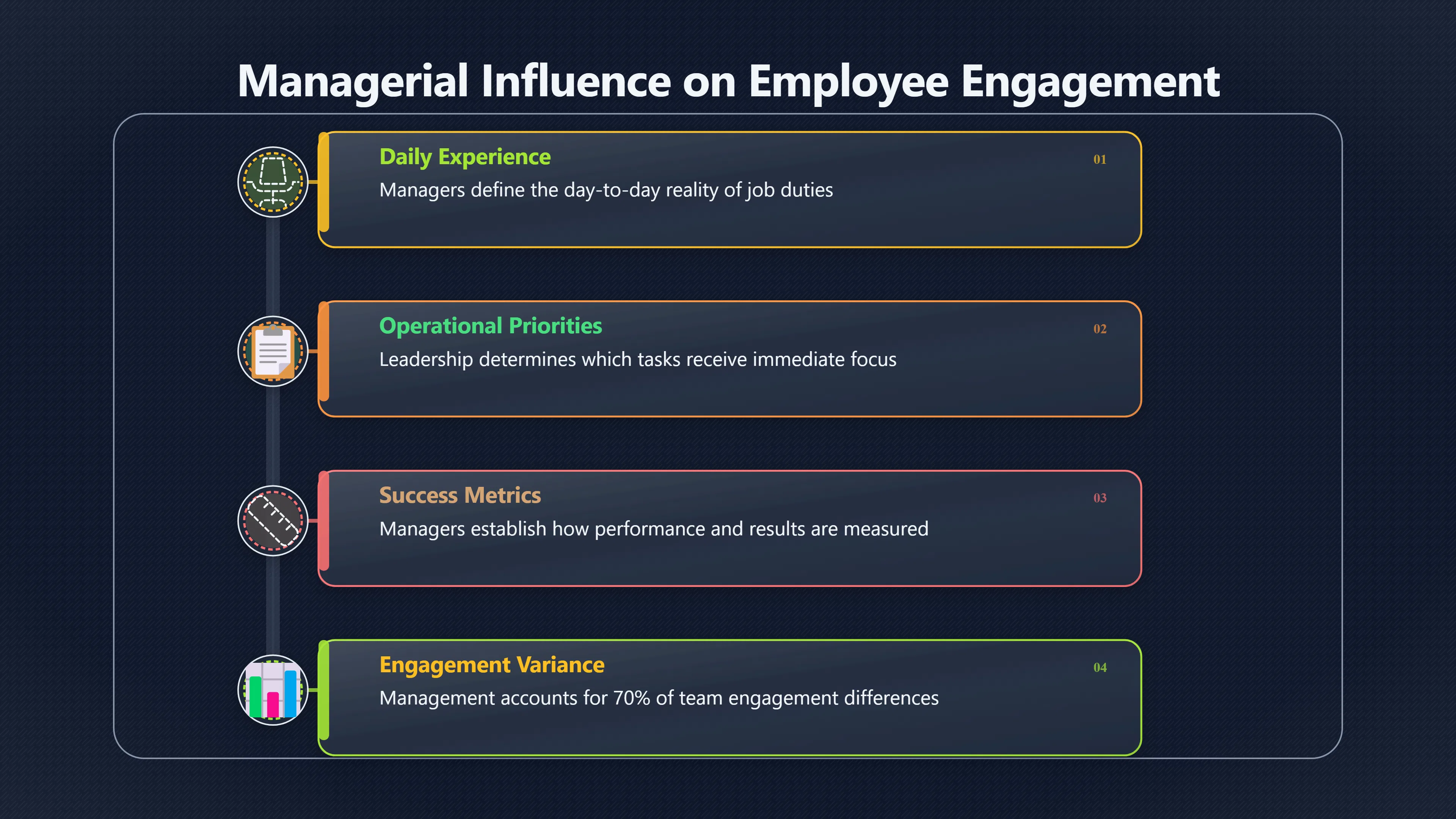
Job descriptions describe responsibilities. Managers define the day-to-day experience of carrying them out.
Two people hired into identical roles can have dramatically different experiences because their managers differ in how they:
- prioritise competing demands;
- delegate authority;
- provide coaching and feedback;
- respond to mistakes;
- recognise good work;
- protect employees from unnecessary interruptions;
- advocate for resources and career opportunities.
This helps explain why organisations with similar pay and benefits can produce very different employee experiences. Gallup’s long-running workplace research argues that managers account for around 70% of the variation in employee engagement between teams, highlighting how much immediate leadership shapes working life.[Gallup.com]gallup.comHow to Improve Employee Engagement in the WorkplaceFebruary 21, 2020 — Learn how to improve employee engagement. Discover the true drivers of engagement, the best survey questions and team…
Research on workplace wellbeing points in the same direction. Employees consistently identify supportive leadership, meaningful feedback, appropriate autonomy and manageable demands as important resources that improve satisfaction and reduce the risk of burnout.[Frontiers]frontiersin.orgFrontiers Exploring Well-being at Work—An Interview Study on HowFrontiersExploring Well-being at Work—An Interview Study on How…August 2, 2021 — by S Zutavern · 2021 · Cited by 21 — Motivational des…
How managers shape autonomy and priorities
One of the first questions to ask is not simply, “Will I have autonomy?” but, “How does this manager decide when to give it?”
Good managers usually combine clear expectations with freedom over execution. They define outcomes while allowing employees to exercise judgement appropriate to their experience. Poor managers often create the opposite combination: vague objectives coupled with constant intervention.
Useful signs of healthy management include:
- Clear explanations of what success looks like.
- Priorities that are reviewed openly when circumstances change.
- Authority matching responsibility.
- Coaching rather than constant monitoring.
- Willingness to explain the reasoning behind decisions.
Warning signs include:
- Constantly shifting priorities without explanation.
- Approval required for routine decisions.
- Ambiguous ownership of work.
- Frequent urgency without clear business reasons.
- Success measured differently from week to week.
Studies of motivation repeatedly find that autonomy supports engagement when combined with competence, meaningful work and supportive relationships rather than existing in isolation. Simply being “left alone” is not enough if expectations are unclear or support disappears when problems arise.[Frontiers]frontiersin.orgFrontiers Exploring Well-being at Work—An Interview Study on HowFrontiersExploring Well-being at Work—An Interview Study on How…August 2, 2021 — by S Zutavern · 2021 · Cited by 21 — Motivational des…
Questions that test feedback and support
Interviews often focus on whether you can do the job. They are also an opportunity to understand how the manager manages.
Questions that frequently reveal useful information include:
- “How do you define success for someone in this role during the first six months?”
- “How often do you have one-to-one meetings with your team?”
- “Can you describe someone who has done particularly well in this position?”
- “What usually distinguishes high performers from average performers?”
- “Can you tell me about a recent piece of difficult feedback you gave someone?”
- “How do you help people recover when projects do not go as planned?”
- “How are priorities handled when several urgent requests arrive at once?”
The answers matter as much as the content.
Managers who naturally discuss coaching, learning, collaboration and clear expectations often describe concrete examples. Managers who repeatedly return to vague statements such as “I just expect people to get on with it” or “Everyone should know what to do” may reveal a less structured approach to support.
Pay attention to whether the interviewer speaks about developing people or merely evaluating them. A manager who only discusses performance ratings may be signalling a culture focused on judgement rather than improvement.
Warning signs in success measures and communication
Many management problems appear long before an employee joins. The challenge is noticing them.
Potential warning signs include:
- Unclear success measures. Different interviewers give conflicting descriptions of priorities.
- Constant emphasis on “firefighting”. Every project is described as urgent or chaotic.
- Blame-focused language. Previous employees are repeatedly criticised without discussion of organisational learning.
- Defensive answers. Reasonable questions about workload or expectations are treated as signs of weak commitment.
- Avoidance of specifics. The manager cannot describe recent examples of successful onboarding, promotion or development.
- Poor communication during recruitment. Frequent unexplained delays, inconsistent information or repeated last-minute changes may reflect broader management habits.
None of these signs proves that a manager is ineffective. However, several appearing together deserve careful attention because they suggest patterns rather than isolated incidents.
Read behaviour, not just promises
Interviewers often describe themselves as supportive, collaborative or empowering. Those words have little value unless accompanied by evidence.
Look instead for observable behaviours.
For example:
ClaimBetter evidence”We value feedback.”The manager explains the structure of one-to-ones, reviews and coaching conversations.”We trust our people.”Employees make meaningful decisions without unnecessary approval layers.”We invest in development.”Examples of recent promotions, mentoring or funded learning are readily available.”We encourage ownership.”The manager explains how responsibility increases as employees gain experience.
Specific examples are usually more informative than polished leadership language.
Looking beyond the hiring manager
The hiring manager matters most, but they also operate within a wider system.
Useful additional perspectives include:
- Future teammates.
- Cross-functional colleagues.
- Employees who recently joined.
- Employees who have remained with the team for several years.
If several people independently describe similar patterns—such as regular coaching, stable priorities or frequent last-minute changes—the consistency itself becomes useful evidence.
It is also worth asking how long the manager has been in the role, how frequently the team changes, and whether recent departures reflect promotions or unwanted turnover. These questions help distinguish temporary disruption from recurring management problems.
A practical way to weigh manager quality
Rather than reducing manager quality to a simple impression, evaluate several separate dimensions.
Consider scoring evidence for:
- Clarity: Do you understand how success will be judged?
- Support: Is coaching described concretely rather than vaguely?
- Autonomy: Will responsibility be matched with decision-making authority?
- Consistency: Do different interviewers tell the same story?
- Development: Can the manager point to real examples of helping people grow?
- Communication: Were expectations and recruitment interactions organised and transparent?
This approach reduces the risk of making a decision based solely on personal chemistry during one interview. A manager may be personable yet unclear, or reserved yet highly effective. Focusing on observable management practices produces a more reliable assessment than relying on intuition alone.
Ultimately, a job offer is not only an agreement about pay and responsibilities. It is an agreement about who will define priorities, interpret performance and influence your professional development. Evaluating that relationship carefully is often one of the highest-value parts of comparing competing offers.
eBay marketplace picks
Marketplace Samples
Example marketplace items related to this page. Use the search link to explore similar finds on eBay.



Endnotes
1.
Source: gallup.com
Title: How to Improve Employee Engagement in the Workplace
Link:https://www.gallup.com/workplace/285674/improve-employee-engagement-workplace.aspx
Source snippet
February 21, 2020 — Learn how to improve employee engagement. Discover the true drivers of engagement, the best survey questions and team...
Published: February 21, 2020
2.
Source: frontiersin.org
Title: Frontiers Exploring Well-being at Work—An Interview Study on How
Link:https://www.frontiersin.org/journals/psychology/articles/10.3389/fpsyg.2021.688219/full
Source snippet
FrontiersExploring Well-being at Work—An Interview Study on How...August 2, 2021 — by S Zutavern · 2021 · Cited by 21 — Motivational des...
Published: August 2, 2021
Additional References
3.
Source: researchgate.net
Link:https://www.researchgate.net/publication/321194858_Managing_employee_well-being_A_qualitative_study_exploring_job_and_personal_resources_of_at-risk_employees
Source snippet
(PDF) Managing employee well-being: A qualitative study...21 Nov 2017 — To investigate the experience of job and personal resources from...
4.
Source: uk.indeed.com
Link:https://uk.indeed.com/career-advice/interviewing/employee-relations-manager-interview-questions
Source snippet
indeed.com10 employee relations manager interview questions and...Learn about possible employee relations manager interview questions yo...
5.
Source: startup.jobs
Link:https://startup.jobs/interview-questions/employee-experience-manager
Source snippet
Understand the required skills and qualifications, anticipate the questions you may be asked, and study...Read more...
6.
Source: oakwoodinternational.com
Title: people management interview questions
Link:https://www.oakwoodinternational.com/interview/people-management-interview-questions
Source snippet
Top 25 People Management Interview Questions and Answers13 Jun 2026 — The most important skills for People Managers include communication...
7.
Source: coursera.org
Title: management interview questions
Link:https://www.coursera.org/articles/management-interview-questions
Source snippet
15 Common Management Interview Questions and How to...20 May 2025 — Explore 15 common management interview questions with insights on ho...
Published: May 2025
8.
Source: pmc.ncbi.nlm.nih.gov
Link:https://pmc.ncbi.nlm.nih.gov/articles/PMC11352056/
Source snippet
Job Performance: The Critical Roles of Well-Being...by Y Yang · 2024 · Cited by 95 — This empirical study investigated the associations...
9.
Source: arxiv.org
Title: arXiv Motivation and Autonomy in Global Software Development: An Empirical Study
Link:https://arxiv.org/abs/2009.11603
10.
Source: youtube.com
Title: How to Evaluate Your Future Boss in a Job Interview
Link:https://www.youtube.com/watch?v=W2ri5XUYBmU
Source snippet
Questions to Ask Your Future Boss in the Interview...
11.
Source: youtube.com
Title: How to Spot a BAD Boss in a Job Interview
Link:https://www.youtube.com/watch?v=HtaqXx_3pNs
Source snippet
Questions to Ask Your Future Boss's Manager in an Interview...
12.
Source: youtube.com
Title: Questions to Ask Your Future Boss in the Interview
Link:https://www.youtube.com/watch?v=nqk3tBliFYM
Source snippet
How to spot a bad boss during interviews...
Topic Tree