Within Teach It
Why Simple Ideas Stop Feeling Simple
People often feel they understand simple things until they have to explain the mechanism step by step.
On this page
- What the illusion of explanatory depth means
- Why everyday mechanisms expose false confidence
- How plain English explanation punctures the illusion
Page outline Jump by section
Introduction
Many of the ideas that feel most familiar are the ones we understand least well. The illusion of explanatory depth is the tendency to believe we understand how something works until we are asked to explain it step by step. A bicycle, a zipper, a toilet, a refrigerator, or even a simple economic idea can seem completely obvious—right up to the moment someone asks, “Exactly what happens next?” That question often exposes missing links in our mental model rather than a lack of intelligence. Research shows that this gap between perceived and actual understanding is especially strong for explanations of causal mechanisms, making it highly relevant to anyone trying to improve their thinking through plain-English explanation.[PMC]pmc.ncbi.nlm.nih.govby L Rozenblit · 2002 · Cited by 1504 — We argue here that people's limited knowledge and their misleading intuitive epistemology comb…

What the illusion of explanatory depth means
The illusion of explanatory depth (often abbreviated to IOED) was identified by cognitive scientists Leonid Rozenblit and Frank Keil. Their experiments showed that people consistently rated their understanding of everyday devices and mechanisms highly before attempting an explanation, then reduced those ratings after trying to explain how the same objects actually worked. The explanation itself—not simply being tested—revealed the limits of their knowledge.[PMC]pmc.ncbi.nlm.nih.govby L Rozenblit · 2002 · Cited by 1504 — We argue here that people's limited knowledge and their misleading intuitive epistemology comb…
A crucial feature of the illusion is that it concerns explanatory knowledge, not simply remembering facts. Someone may correctly know that bicycles use chains, toilets flush with water, or inflation raises prices. Those facts can all be true while the person remains unable to describe the causal sequence connecting one event to another.
This distinguishes explanatory understanding from other kinds of knowledge. Research has found much weaker overconfidence for remembering facts, recounting stories, or describing procedures than for explaining how systems actually work.[PMC]pmc.ncbi.nlm.nih.govby L Rozenblit · 2002 · Cited by 1504 — We argue here that people's limited knowledge and their misleading intuitive epistemology comb…
Why everyday mechanisms expose false confidence
Everyday objects create a perfect environment for false confidence because they are familiar without being fully visible.
You operate a zipper hundreds of times without seeing how its teeth interlock. You flush a toilet without observing the pressure changes, valves and water trap. You steer a bicycle without consciously understanding why leaning causes the wheels to stabilise. Daily success creates the feeling that understanding exists even when only the surface behaviour is known.[PMC]pmc.ncbi.nlm.nih.govby L Rozenblit · 2002 · Cited by 1504 — We argue here that people's limited knowledge and their misleading intuitive epistemology comb…
Several features of ordinary life strengthen the illusion:
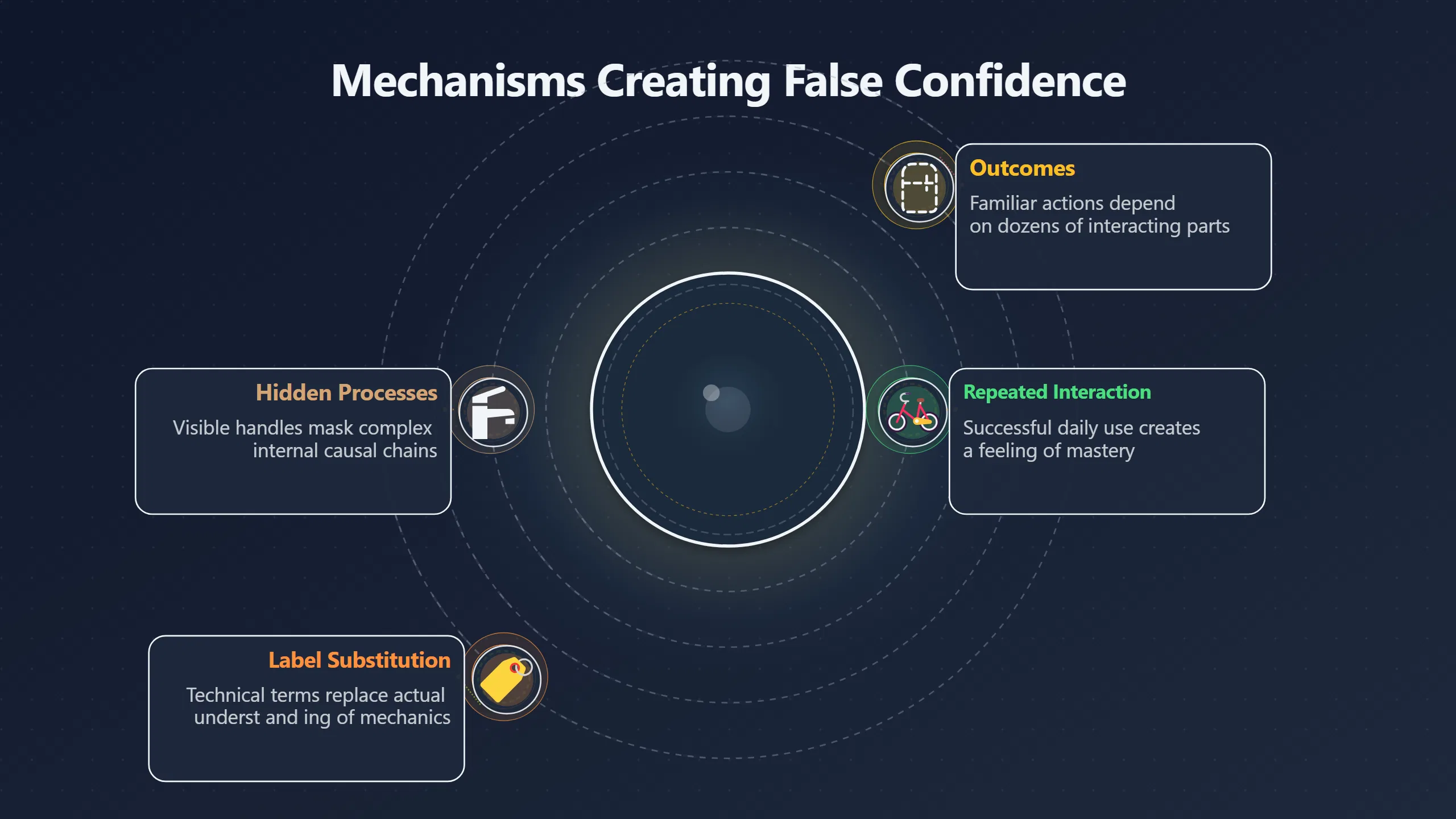
- Repeated use feels like understanding. Successful interaction is mistaken for knowledge of the underlying mechanism.
- Visible parts hide invisible processes. People see handles, pedals and buttons but not the causal chain beneath them.
- Simple outcomes conceal complex systems. A familiar action may depend on dozens of interacting components.
- Language substitutes for explanation. Knowing labels such as “pressure”, “electricity” or “memory” can create the impression that the mechanism itself has been understood.[PMC+2Jorge Arango]pmc.ncbi.nlm.nih.govby L Rozenblit · 2002 · Cited by 1504 — We argue here that people's limited knowledge and their misleading intuitive epistemology comb…
This explains why people are often surprised by how difficult apparently simple questions become:
- How does a bicycle stay balanced?
- Why does a refrigerator remove heat instead of simply producing cold?
- What prevents toilet gases from entering the house after flushing?
- How does a cylinder lock distinguish the correct key?
Many people can describe what these objects do but struggle to explain why each step follows from the previous one.[PMC]pmc.ncbi.nlm.nih.govby L Rozenblit · 2002 · Cited by 1504 — We argue here that people's limited knowledge and their misleading intuitive epistemology comb…
Why explanation changes your confidence
The important discovery is not merely that people explain poorly. It is that attempting an explanation changes their self-assessment.
In the original experiments, participants first estimated how well they understood an object. They then produced a detailed explanation before rating themselves again. Confidence consistently dropped after the explanation attempt, but rose somewhat again after participants read an expert explanation. This pattern suggests the exercise improves calibration rather than simply making people less confident.[PMC]pmc.ncbi.nlm.nih.govby L Rozenblit · 2002 · Cited by 1504 — We argue here that people's limited knowledge and their misleading intuitive epistemology comb…
The act of explaining forces several hidden questions into the open:
- Which component causes the next event?
- What assumption have I skipped?
- Where does energy, force or information actually come from?
- What would happen if one part were removed?
Each unanswered question reveals a genuine gap rather than creating one.
How plain-English explanation punctures the illusion
Within plain-English teaching, the illusion of explanatory depth becomes a practical diagnostic tool.
Specialist vocabulary often compresses several causal steps into a single word. When those terms are removed, the explanation must stand on the underlying mechanism instead of technical shorthand.
Consider the difference between these two explanations:
- “Inflation is caused by excess demand.”
- “When many buyers compete for limited goods, sellers discover they can raise prices without losing enough customers. Those higher prices spread because firms also face higher costs and changing expectations.”
The second explanation is imperfect but exposes whether the speaker understands the sequence rather than merely recognising terminology.
A useful plain-English explanation usually answers questions such as:
- What starts the process?
- What changes first?
- What changes next?
- Why does each step follow?
- Under what conditions would this explanation fail?
If any answer depends on phrases like “it just happens”, “that’s how it works”, or repeated technical labels, the illusion has probably been uncovered rather than solved.
Why the illusion persists
The illusion is surprisingly persistent because much of human knowledge is distributed across other people.
In everyday life, we rarely need complete explanations ourselves. We rely on mechanics, engineers, doctors, electricians and countless other specialists. This division of cognitive labour is efficient, but it can blur the distinction between knowledge available to society and knowledge stored in our own minds. Because we know an explanation exists somewhere, we can mistakenly feel as though we possess it ourselves.[PMC+2JSaw]pmc.ncbi.nlm.nih.govby L Rozenblit · 2002 · Cited by 1504 — We argue here that people's limited knowledge and their misleading intuitive epistemology comb…
Modern technology can amplify this effect. Search engines and online information make explanations instantly accessible, but easy access is not the same as internal understanding. Being able to retrieve an answer later can inflate present confidence about what one actually knows.[JSaw]jsaw.lib.lehigh.eduStrength and Persistence of the Illusion of Explanatory Depthby J Wilson — These findings led Rozenblit and Keil (2002) to conclude t…
Why this matters for better thinking
The illusion of explanatory depth is not simply an interesting laboratory finding. It affects learning, judgement and reasoning.
Someone who mistakes familiarity for understanding is more likely to stop asking questions too early, overlook hidden assumptions and become overconfident in discussions about everyday systems. By contrast, regularly translating ideas into plain English provides immediate feedback about the quality of one’s thinking.
The goal is not to memorise longer explanations. It is to develop more accurate self-knowledge. Knowing precisely where your explanation breaks is often more valuable than feeling certain that it is complete.
For anyone using plain-English teaching as a thinking test, that moment of hesitation is not failure. It is evidence that the illusion has ended and genuine learning can begin.[PMC+2Douglas Wise]pmc.ncbi.nlm.nih.govby L Rozenblit · 2002 · Cited by 1504 — We argue here that people's limited knowledge and their misleading intuitive epistemology comb…
eBay marketplace picks
Marketplace Samples
Live-tested eBay searches with available results related to this page.




Endnotes
1.
Source: pmc.ncbi.nlm.nih.gov
Link:https://pmc.ncbi.nlm.nih.gov/articles/PMC3062901/
Source snippet
by L Rozenblit · 2002 · Cited by 1504 — We argue here that people's limited knowledge and their misleading intuitive epistemology comb...
2.
Source: jsaw.lib.lehigh.edu
Link:https://jsaw.lib.lehigh.edu/campbell/Wilson.pdf
Source snippet
Strength and Persistence of the Illusion of Explanatory Depthby J Wilson — These findings led Rozenblit and Keil (2002) to conclude t...
3.
Source: jarango.com
Title: the illusion of explanatory depth
Link:https://jarango.com/2019/02/06/the-illusion-of-explanatory-depth/
Source snippet
Jorge ArangoThe Illusion of Explanatory Depth6 Feb 2019 — In a 2002 paper, Rozenblit and Keil explained that most of us think we know how...
4.
Source: douglaswise.co.uk
Title: illusion explanatory depth
Link:https://www.douglaswise.co.uk/blog/illusion-explanatory-depth
Source snippet
The Illusion of Explanatory Depth4 Feb 2021 — The 'illusion of explanatory depth' is a cognitive bias that leads people to believe that t...
5.
Source: Wikipedia
Title: Illusion of explanatory depth
Link:https://en.wikipedia.org/wiki/Illusion_of_explanatory_depth
Source snippet
Illusion of explanatory depthThe illusion of explanatory depth (IOED) is cognitive bias or an illusion where people tend to believe th...
Additional References
6.
Source: thedecisionlab.com
Link:https://thedecisionlab.com/biases/the-illusion-of-explanatory-depth
Source snippet
The Illusion of Explanatory DepthThe illusion of explanatory depth (IOED) describes our belief that we understand more about the world th...
7.
Source: youtube.com
Title: The Illusion of Understanding: Phil Fernbach at TEDx Golden Gate Park
Link:https://www.youtube.com/watch?v=2SlbsnaSNNM
Source snippet
V. Humility and human cognition. Part 4: The illusion of explanatory depth (Prof. Frank Keil)...
8.
Source: edge.org
Title: response detail
Link:https://www.edge.org/response-detail/27117
Source snippet
The Illusion of Explanatory DepthThis powerful but inaccurate feeling of knowing is what Leonid Rozenblit and Frank Keil in 2002 termed...
9.
Source: youtube.com
Title: Dan Ariely on the Illusion of Explanatory Depth
Link:https://www.youtube.com/watch?v=By7cQ4fxmjs
Source snippet
You Don't Know Anything - The Illusion of Explanatory Depth - FutureIQ...
10.
Source: philpapers.org
Title: Phil Papersan illusion of explanatory depth
Link:https://philpapers.org/rec/ROZTML
Source snippet
We demonstrate the illusion...Read more...
11.
Source: youtube.com
Link:https://www.youtube.com/watch?v=yDJuCWUC5P8
12.
Source: youtube.com
Link:https://www.youtube.com/watch?v=Y_skmB3ZcTc
13.
Source: youtube.com
Title: You Don’t Know Anything
Link:https://www.youtube.com/watch?v=_ak0k7GNCjM
14.
Source: youtube.com
Link:https://www.youtube.com/watch?v=JDNQichoqPE
Source snippet
Dan Ariely on the Illusion of Explanatory Depth...
Topic Tree