Within Pressure
Why changing your mind can feel unsafe
Admitting error becomes harder when revision feels like public loss, professional embarrassment, or betrayal of a group.
On this page
- How pride and reputation raise the cost of revision
- Why public commitments harden weak conclusions
- Ways to make correction less humiliating
Page outline Jump by section
Introduction
Changing your mind is often presented as a purely intellectual exercise: examine the evidence, update your beliefs, and move on. In practice, it rarely feels that simple. Revising a view can threaten reputation, professional credibility, friendships, political identity or social standing. When admitting error feels like admitting weakness, the emotional cost of being wrong can outweigh the intellectual benefit of being right. Research on identity-protective cognition, social status and humiliation suggests that resistance to evidence is frequently driven less by ignorance than by the perceived social consequences of changing position.[SSRN]papers.ssrn.comidentity-affirming rather than identity-threatening. Effectively… It demands in addition the protection of the science communication…
 For anyone seeking to improve analytical thinking, this matters because the obstacle is often not a lack of information but a feeling of danger. If changing your mind seems likely to bring embarrassment, exclusion or loss of status, reasoning can quietly shift from asking “What is true?” to asking “What can I safely admit?”
How pride and reputation raise the cost of revision
People live within networks where opinions communicate more than beliefs. They also signal competence, loyalty, confidence and reliability. In many situations, admitting a mistake risks being interpreted not merely as correcting one fact but as revealing poor judgement.
The cost varies by context:
- A manager fears appearing incompetent after supporting a failed strategy.
- A scientist worries about professional reputation after publicly defending a hypothesis.
- A politician fears accusations of inconsistency.
- A member of a close-knit community worries that accepting contrary evidence could look like disloyalty.
These concerns are often rational from a social perspective. Human beings depend on reputation for trust, influence and cooperation. The result is that evidence becomes entangled with status.
Researchers studying identity-protective cognition argue that people selectively evaluate evidence in ways that protect membership within valued groups. On polarised issues, individuals with greater analytical ability are not necessarily less biased. Instead, they may become better at constructing arguments that defend their group’s position because the social penalty for disagreement outweighs the personal benefit of accuracy.[SSRN]papers.ssrn.comidentity-affirming rather than identity-threatening. Effectively… It demands in addition the protection of the science communication…
This helps explain why intelligent people can sincerely resist strong evidence. Their reasoning is not simply serving truth-seeking; it is simultaneously protecting relationships, identity and social standing.
Why public commitments harden weak conclusions
A belief expressed privately is easier to revise than one announced before an audience.
Public commitments create several additional pressures.
First, they become part of a person’s public identity. Others begin to associate them with a particular position, making later revision more conspicuous.
Second, consistency itself has social value. Reliable people are generally expected to keep their word. Unfortunately, this desirable norm can spill over into situations where changing one’s mind would actually demonstrate intellectual honesty.
Third, public disagreement often invites competition rather than inquiry. Once people have defended a position in debates, meetings or online discussions, admitting error may feel like handing victory to an opponent rather than improving understanding.
This is especially visible on social media, where old statements remain searchable and corrections are highly visible. A mistaken prediction that might once have faded from memory can instead become permanent evidence against someone’s competence. Public visibility therefore increases the emotional stakes of revision.
The consequence is that weak conclusions may become more firmly defended after they have been publicly declared than they were before any evidence was presented.
Humiliation changes the psychology of evidence
Humiliation differs from simple embarrassment.
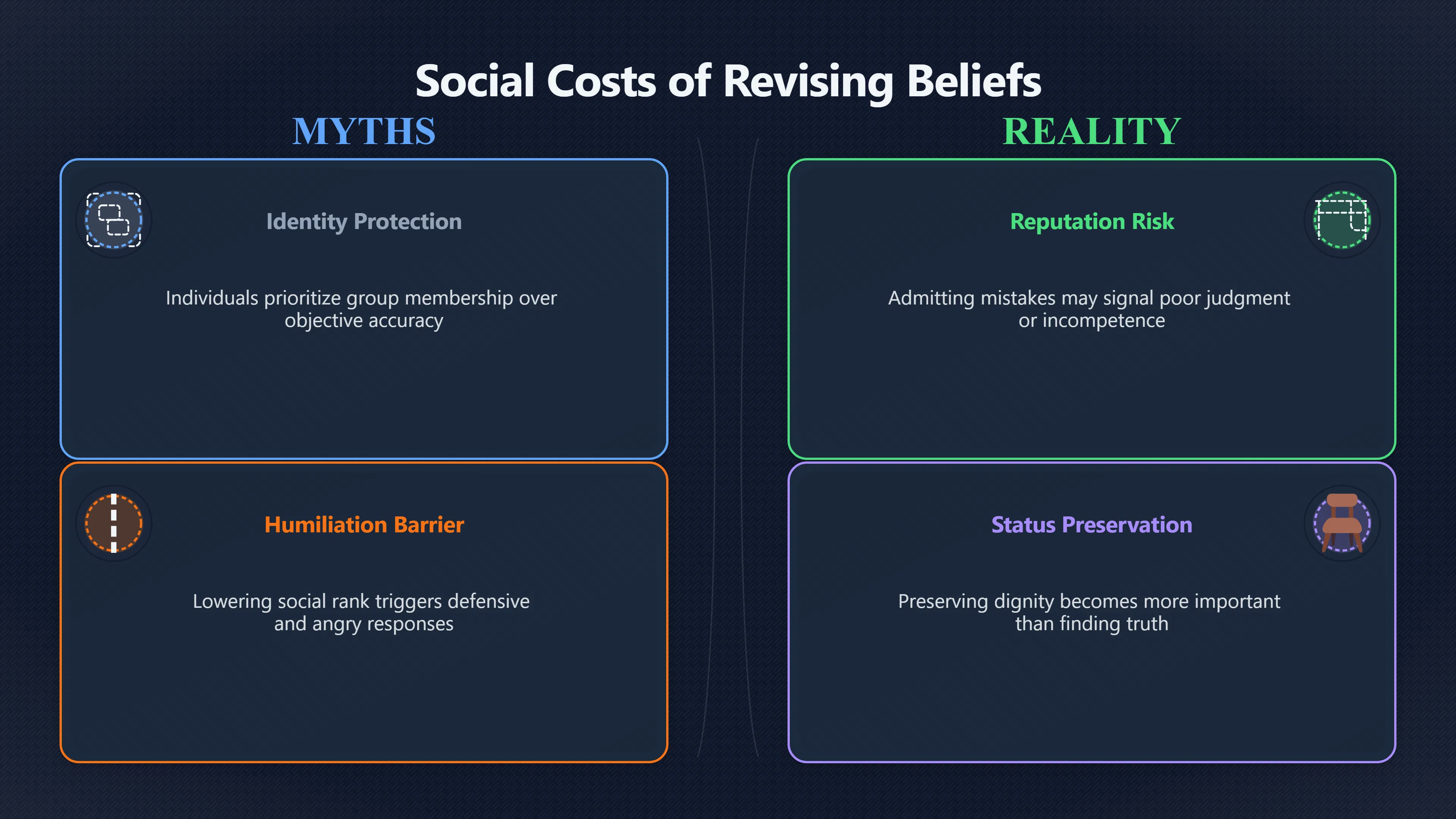
Embarrassment is usually temporary and concerns a specific mistake. Humiliation involves a perceived lowering of social rank or dignity in front of others. It carries a stronger sense that one’s value or status has been damaged. Psychological research links humiliation with defensive responses, anger, withdrawal and heightened sensitivity to further criticism.[PMC]pmc.ncbi.nlm.nih.govLosing trust in the world: Humiliation and its consequencesby P Leask · 2013 · Cited by 74 — I argue that psychotherapists risk pathol…
When correction is experienced as humiliation, several shifts in thinking become more likely:
- criticism is interpreted as personal attack rather than informational feedback;
- counter-evidence is scrutinised much more harshly than supporting evidence;
- neutral observers are seen as taking sides;
- admitting uncertainty feels increasingly unsafe;
- preserving dignity becomes a higher priority than discovering accuracy.
Under these conditions, reasoning serves emotional self-protection.
This helps explain why direct factual correction sometimes produces surprisingly little change. The information itself may be convincing, but accepting it carries a social meaning that feels intolerable.

Status threats inside groups
Groups often reward loyalty more visibly than independent judgement.
Whether the setting is political, religious, professional or organisational, members quickly learn which opinions earn respect and which create friction. When disagreement threatens acceptance, individuals may privately recognise problems while publicly defending the prevailing view.
Identity-protective cognition research suggests that this process is not necessarily conscious deception. Instead, people naturally find identity-consistent evidence more persuasive and identity-threatening evidence easier to dismiss. The motivation is to avoid social costs rather than simply to avoid truth.[SSRN]papers.ssrn.comidentity-affirming rather than identity-threatening. Effectively… It demands in addition the protection of the science communication…
This produces a subtle paradox.
The stronger the community, the more valuable membership becomes.
The more valuable membership becomes, the greater the psychological incentive to avoid beliefs that could jeopardise it.
Consequently, groups with strong internal trust can also become environments where changing one’s mind becomes unusually difficult.
Why experts are not immune
Professional expertise creates additional status pressures.
Experts invest years developing specialised knowledge and public credibility. Admitting mistakes may therefore appear more expensive than it does for novices.
Academic researchers, executives, physicians and technical specialists all face incentives that can unintentionally discourage revision:
- previous publications or presentations become part of professional identity;
- career advancement may reward confidence more visibly than uncertainty;
- competitors may exploit visible mistakes;
- followers or clients often expect certainty.
Ironically, expertise increases both the capacity to evaluate evidence and the reputational cost of abandoning previous conclusions.
The healthiest professional cultures therefore distinguish between incompetence and updating. In science, for example, theories are expected to change as better evidence emerges. Although individuals may still experience reputational concerns, the ideal remains that revision reflects progress rather than failure.
Ways to make correction less humiliating
Because status threats distort reasoning, improving analytical thinking requires reducing the emotional cost of being wrong.
Several practical approaches help.
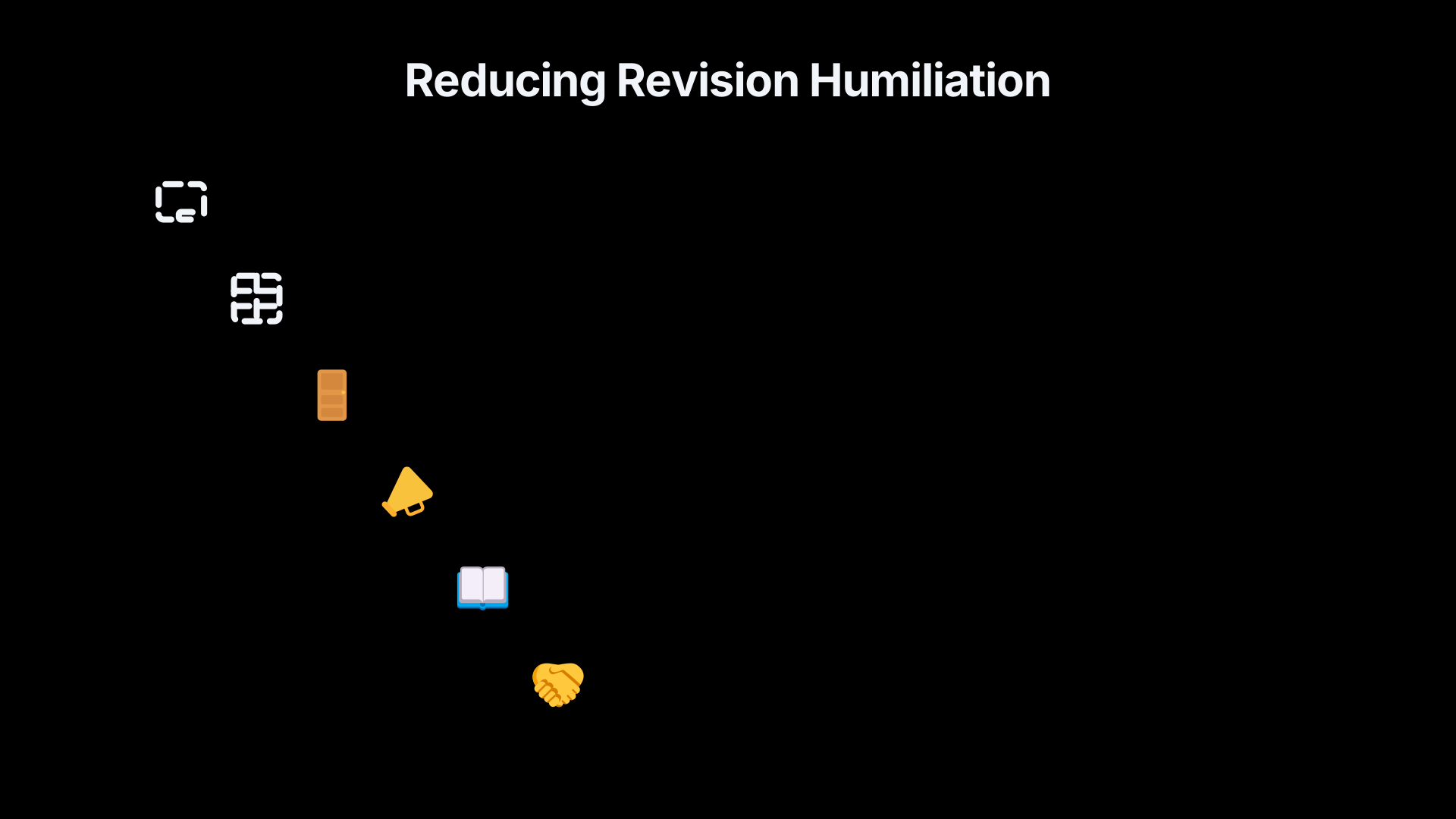
Normalise revision rather than celebrate certainty. Teams that praise careful updating instead of unwavering confidence reduce the status penalty attached to correction.
Separate identity from ideas. Viewing beliefs as working models rather than personal possessions makes revision less threatening.
Correct privately before publicly when appropriate. People are often more receptive when they can reconsider without immediate audience pressure.
Reward intellectual honesty explicitly. Leaders who openly acknowledge their own changed views create permission for others to do likewise.
Frame updates as learning. Saying “the evidence has improved” or “I have more information now” emphasises progress rather than defeat.
Avoid triumphal correction. Publicly shaming people for mistakes may produce compliance, but it frequently increases defensiveness and future resistance. Preserving dignity often makes genuine belief change more likely. Research on science communication similarly argues that reducing identity-threatening social meanings can improve acceptance of evidence more effectively than simply presenting more facts.[SSRN]papers.ssrn.comidentity-affirming rather than identity-threatening. Effectively… It demands in addition the protection of the science communication…
A practical habit for better reasoning
One useful mental exercise is to ask not only, “What evidence would change my mind?” but also, “What would I lose socially if I changed my mind?”
The second question often reveals hidden pressures that logical analysis alone misses.
Possible answers include:
- respect from colleagues;
- consistency with earlier statements;
- acceptance within a valued group;
- authority or expertise;
- pride in past decisions.
Once these pressures are recognised, they become easier to manage deliberately instead of allowing them to shape judgement unnoticed.
Analytical thinking improves not because emotion disappears, but because social threats become visible enough that they no longer silently determine which conclusions feel psychologically acceptable.
Amazon book picks
Further Reading
Books and field guides related to Why changing your mind can feel unsafe. Use these as the next step if you want deeper reading beyond the article.
Mistakes Were Made (but Not by Me)
Explains why admitting error feels psychologically threatening.
eBay marketplace picks
Marketplace Samples
Example marketplace items related to this page. Use the search link to explore similar finds on eBay.




Endnotes
1.
Source: papers.ssrn.com
Link:https://papers.ssrn.com/sol3/papers.cfm?abstract_id=2973067
Source snippet
identity-affirming rather than identity-threatening. Effectively... It demands in addition the protection of the science communication...
2.
Source: pmc.ncbi.nlm.nih.gov
Link:https://pmc.ncbi.nlm.nih.gov/articles/PMC4560131/
Source snippet
Losing trust in the world: Humiliation and its consequencesby P Leask · 2013 · Cited by 74 — I argue that psychotherapists risk pathol...
3.
Source: informalscience.org
Link:https://informalscience.org/identity/dan-kahan/
Source snippet
Identity | Dan KahanAt that point, you have to reevaluate what you thought was going on when people were forming these identity-expressiv...
Additional References
4.
Source: researchgate.net
Link:https://www.researchgate.net/publication/352297543_The_role_of_emotions_and_identity-protection_cognition_when_processing_misinformation
Source snippet
The Role of Emotions and Identity-Protection Cognition...26 Feb 2026 — We hypothesize that dependent on an individual's attitudes, anger...
5.
Source: fondationdescartes.org
Link:https://www.fondationdescartes.org/en/2020/06/les-idees-fausses-les-fausses-informations-et-la-logique-du-raisonnement-pour-proteger-son-identite/
Source snippet
False ideas, fake information, and the logic of identity-...Kahan therefore believes that scientific communication should be depoliticiz...
6.
Source: culturalcognition.net
Link:https://www.culturalcognition.net/browse-papers/misconceptions-misinformation-and-the-logic-of-identity-prot.html
Source snippet
The Cultural Cognition ProjectMisconceptions, Misinformation, and the Logic of Identity...An interdisciplinary research initiative at Ya...
7.
Source: facebook.com
Title: Studies show facts rarely shift beliefs—especially when
Link:https://www.facebook.com/philstarlife/posts/studies-show-facts-rarely-shift-beliefsespecially-when-fear-shame-or-pride-stand/1299017768910480/
Source snippet
threats to our identity. We also do the same... When there's no immediate threat to our understanding of the world, we change our belief...
8.
Source: psychologytoday.com
Title: the anatomy of public humiliation at work
Link:https://www.psychologytoday.com/us/blog/the-human-equation/202406/the-anatomy-of-public-humiliation-at-work
Source snippet
The Psychology of Public Humiliation10 Jun 2024 — In the age of social media, the potential for a humiliating event to spread far beyond...
9.
Source: youtube.com
Title: Identity-Protective Cognition: Why We Ignore Facts That Threaten Our Identity
Link:https://www.youtube.com/watch?v=7t9L8mpo2NM
Source snippet
Why you think you're right — even if you're wrong | Julia Galef...
10.
Source: youtube.com
Title: THINK AGAIN by Adam Grant | Core Message
Link:https://www.youtube.com/watch?v=G14dayqCfK8
Source snippet
Dan Kahan: How cultural values shape beliefs and perceptions of risk...
11.
Source: scispace.com
Link:https://scispace.com/pdf/misconceptions-misinformation-and-the-logic-of-identity-mpc3ka7t6o.pdf
Source snippet
Misconceptions, Misinformation, and the Logic of Identity-...“Ordinary science intelligence”: a sci- ence-comprehension measure for stud...
12.
Source: youtube.com
Title: Why you think you’re right — even if you’re wrong | Julia Galef
Link:https://www.youtube.com/watch?v=A0Yw0pO-rqU
Source snippet
Think Again: Adam Grant...
13.
Source: youtube.com
Title: Think Again: Adam Grant
Link:https://www.youtube.com/watch?v=CbqqIYTHuwM
Source snippet
THINK AGAIN by Adam Grant | Core Message...
Topic Tree