Within Transfer
Can Bias Training Survive Real Life?
Debiasing training is most promising when learners practise, get feedback and later face problems that are not neatly labelled.
On this page
- What short debiasing interventions have shown
- Why feedback beats passive awareness
- Limits of bias reduction claims
Page outline Jump by section
Introduction
Most debiasing programmes succeed at one thing: teaching people to recognise a named bias immediately after a lesson. The more difficult question is whether that learning survives outside the classroom, when nobody labels the problem as “confirmation bias” or “anchoring”. Research suggests that some short interventions—particularly interactive games and carefully designed training videos—can produce measurable improvements that transfer to new judgement tasks. However, the strongest evidence comes from programmes that make learners practise decisions, receive immediate feedback, and later face unannounced problems rather than textbook examples. The overall picture is cautiously optimistic: transfer is possible, but it is neither automatic nor universal, and claims that a single intervention permanently eliminates bias are not supported by the evidence.[PubMed]pubmed.ncbi.nlm.nih.govDebiasing Training Improves Decision Making in the Fieldby AL Sellier · 2019 · Cited by 182 — The results provide promising evidenc…

What short debiasing interventions have shown
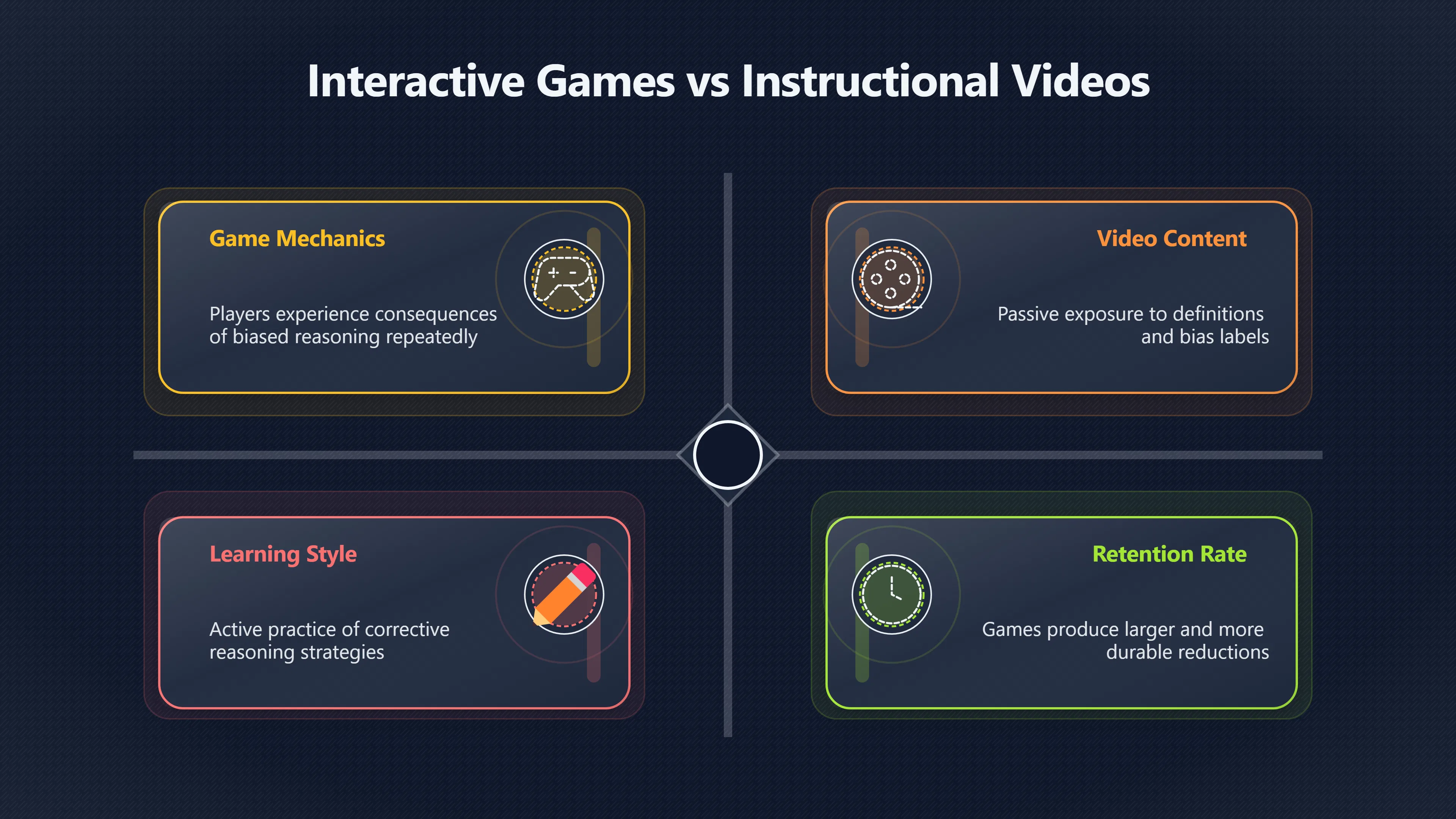
One of the best-known programmes was developed by researchers including Carey Morewedge and colleagues. Participants completed either an interactive computer game or an instructional video that taught several cognitive biases relevant to intelligence analysis, including confirmation bias, the bias blind spot and the fundamental attribution error. Unlike many earlier studies, participants were tested not only immediately afterwards but again weeks later using different bias tasks.
The results were encouraging. Both formats reduced susceptibility to several biases immediately after training, and some improvements remained after follow-up testing. However, the interactive game consistently produced larger and more durable reductions than the instructional video. Rather than simply defining biases, the game placed players in situations where they repeatedly made judgements, experienced the consequences of biased reasoning and practised corrective strategies.[Sage Journals+2Medical Xpress]journals.sagepub.comSage JournalsImproved Decision Making With a Single Training…by CK Morewedge · 2015 · Cited by 589 — Participants received a single tr…
The important feature was not entertainment for its own sake. The game repeatedly elicited the very biases it aimed to reduce, then explained what had happened and allowed players to try again. This combination of experience, explanation and corrective practice appears more effective than passive exposure to definitions alone.[BYU ScholarsArchive]scholarsarchive.byu.eduBYU ScholarsArchiveMitigation of Cognitive Bias with a Serious Gameby NE Dunbar · 2017 · Cited by 31 — We conducted two studies to examin…
Perhaps the strongest evidence for transfer came later when researchers tested whether the training influenced decisions in a setting where participants were not expecting a bias exercise. Graduate students received confirmation-bias training before or after analysing an unannounced business case modelled on the decision preceding the Space Shuttle Challenger disaster. Those who had received training were significantly less likely to adopt the inferior, hypothesis-confirming solution and instead generated more evidence that challenged their initial assumptions. Because participants were not explicitly reminded about confirmation bias during the exercise, the study provides unusually strong evidence that debiasing can influence real judgement rather than only laboratory test performance.[PubMed]pubmed.ncbi.nlm.nih.govDebiasing Training Improves Decision Making in the Fieldby AL Sellier · 2019 · Cited by 182 — The results provide promising evidenc…
Why feedback beats passive awareness
Simply learning that cognitive biases exist rarely changes behaviour by itself. Many people readily acknowledge that confirmation bias or overconfidence affect human judgement while continuing to believe that they themselves are relatively immune—a phenomenon known as the bias blind spot.
Interactive interventions attempt to overcome this problem by making people experience their own errors. Instead of presenting a lecture, they require decisions, expose mistakes, explain why those mistakes occurred and immediately encourage another attempt. This creates several learning advantages:
- learners receive personalised evidence that they are susceptible to bias;
- corrective strategies are practised rather than merely described;
- feedback arrives immediately after the mistaken judgement;
- repeated examples encourage abstraction of a general reasoning strategy rather than memorisation of one example.
Studies comparing serious games with equivalent instructional videos suggest that this active learning process helps explain why games often outperform passive formats, even when both communicate similar information.[BYU ScholarsArchive+2Sage Journals]scholarsarchive.byu.eduBYU ScholarsArchiveMitigation of Cognitive Bias with a Serious Gameby NE Dunbar · 2017 · Cited by 31 — We conducted two studies to examin…
The same principle appears in broader educational research: transfer improves when learners repeatedly apply an idea across varied situations instead of only recognising it in the original teaching context. Debiasing interventions that embed feedback inside realistic decisions therefore align well with what is already known about transfer of learning.[BYU ScholarsArchive]scholarsarchive.byu.eduBYU ScholarsArchiveMitigation of Cognitive Bias with a Serious Gameby NE Dunbar · 2017 · Cited by 31 — We conducted two studies to examin…

Can games teach judgement beyond laboratory examples?
A related line of research concerns misinformation rather than traditional decision biases. The online game Bad News asks players to create misleading content themselves, exposing them to weakened examples of manipulation techniques such as emotional language, conspiracy narratives and impersonation. The intervention draws on psychological inoculation theory: practising recognition of misleading techniques before encountering them in real life may increase resistance later.
Experimental studies have found that people who played the game became better at identifying common misinformation techniques in novel examples presented afterwards. Replication studies with control groups generally support these improvements, although the measured effects are typically modest rather than dramatic. The evidence suggests that the intervention teaches recognition of manipulation strategies rather than broad scepticism towards all information.[Nature+2PMC]nature.comwrong: the correction of misinformation…Read more…
This illustrates an important distinction about transfer. Successful interventions often teach deeper patterns—for example, recognising emotional manipulation or searching for disconfirming evidence—rather than memorising individual false claims. When later examples differ in content but use the same underlying strategy, learners have a greater chance of recognising the problem.[sdmlab.psychol.cam.ac.uk]sdmlab.psychol.cam.ac.ukBad News Game | Social Decision-Making LabThe Bad News Game is a multiple award-winning fake news intervention aimed at building psycholo…
Why transfer remains difficult
Although the evidence is stronger than many people assume, important limitations remain.
First, most studies measure transfer over weeks or months rather than years. Long-term maintenance probably requires repeated use, refresher training or continued application.
Second, improvements are rarely complete. Participants still display biases after training; they simply do so less often or less strongly. Debiasing reduces vulnerability rather than producing perfectly rational judgement.[Sage Journals]journals.sagepub.comSage JournalsImproved Decision Making With a Single Training…by CK Morewedge · 2015 · Cited by 589 — Participants received a single tr…
Third, many interventions target specific families of biases. A programme that improves resistance to confirmation bias does not necessarily reduce every other cognitive bias. Researchers increasingly distinguish between teaching a small number of broadly useful reasoning habits—such as actively searching for contradictory evidence—and attempting to eliminate an extensive catalogue of biases.[Sage Journals]journals.sagepub.comSage JournalsImproved Decision Making With a Single Training…by CK Morewedge · 2015 · Cited by 589 — Participants received a single tr…
Finally, real-world decisions involve competing pressures that laboratory studies cannot fully reproduce. Time constraints, organisational incentives, emotional investment and group dynamics all encourage biased reasoning. Training can improve individual judgement, but it does not remove structural sources of poor decisions. Even the developers of successful interventions argue that training should complement better decision processes rather than replace them.[Católica-Lisbon SBE]clsbe.lisboa.ucp.pt2016 paper carey morewedgeCatólica-Lisbon SBEDebiasing DecisionsSeptember 11, 2015 — by CK Morewedge · 2015 · Cited by 591 — underlying structural causes of biased…
What the evidence means for improving analytical thinking
The strongest debiasing interventions do not rely on raising awareness alone. Instead, they repeatedly place learners into situations where biased reasoning feels natural, provide immediate feedback, explain the underlying mistake and require another attempt under slightly different conditions.
The studies showing the clearest transfer also avoid obvious classroom cues. Learners are later confronted with unfamiliar cases where no one announces which bias is relevant, making success depend on recognising the underlying reasoning problem for themselves. That makes these findings particularly relevant to analytical thinking in everyday life, where mistakes rarely arrive with helpful labels.
Current evidence therefore supports a measured conclusion. Short games and videos can improve judgement beyond their original teaching examples, especially when they include active practice and personalised feedback. Yet transfer is partial, context-dependent and strengthened by continued application rather than guaranteed by a single exposure.[PMC+3PubMed+3Sage Journals]pubmed.ncbi.nlm.nih.govDebiasing Training Improves Decision Making in the Fieldby AL Sellier · 2019 · Cited by 182 — The results provide promising evidenc…
Amazon book picks
Further Reading
Books and field guides related to Can Bias Training Survive Real Life?. Use these as the next step if you want deeper reading beyond the article.
Thinking, Fast and Slow
Introduces many biases that debiasing training attempts to reduce or manage.
Noise
Explains why awareness alone is insufficient and why structured judgement processes matter.
The Scout Mindset
Focuses on motivated reasoning, belief updating, and habits that make bias reduction more durable.
Nudge
Shows how environments and choice architecture can reduce predictable judgement errors in real settings.
eBay marketplace picks
Marketplace Samples
Live-tested eBay searches with available results related to this page.

Top pick
critical thinking game
Open a targeted eBay search for items related to this topic.
Browse eBay
Related search
critical thinking card game
Open a targeted eBay search for items related to this topic.
Browse eBay

Related search
bias memorabilia
Open a targeted eBay search for items related to this topic.
Browse eBayEndnotes
1.
Source: scholarsarchive.byu.edu
Link:https://scholarsarchive.byu.edu/facpub/5661/
Source snippet
BYU ScholarsArchiveMitigation of Cognitive Bias with a Serious Gameby NE Dunbar · 2017 · Cited by 31 — We conducted two studies to examin...
2.
Source: nature.com
Link:https://www.nature.com/articles/s41599
Source snippet
wrong: the correction of misinformation...Read more...
3.
Source: pmc.ncbi.nlm.nih.gov
Link:https://pmc.ncbi.nlm.nih.gov/articles/PMC6952868/
Source snippet
Good News about Bad News: Gamified Inoculation Boosts...by M Basol · 2020 · Cited by 577 — A recent example is the Bad News game, an...
4.
Source: sdmlab.psychol.cam.ac.uk
Link:https://www.sdmlab.psychol.cam.ac.uk/research/bad-news-game
Source snippet
Bad News Game | Social Decision-Making LabThe Bad News Game is a multiple award-winning fake news intervention aimed at building psycholo...
5.
Source: inoculation.science
Title: Science Inoculation Science
Link:https://inoculation.science/inoculation-games/
Source snippet
Interactive GamesSo far, we've launched three different games, each of which covers a different domain of misinform...
6.
Source: clsbe.lisboa.ucp.pt
Title: 2016 paper carey morewedge
Link:https://clsbe.lisboa.ucp.pt/system/files/assets/files/2016-paper-carey-morewedge.pdf
Source snippet
Católica-Lisbon SBEDebiasing DecisionsSeptember 11, 2015 — by CK Morewedge · 2015 · Cited by 591 — underlying structural causes of biased...
Published: September 11, 2015
7.
Source: pubmed.ncbi.nlm.nih.gov
Link:https://pubmed.ncbi.nlm.nih.gov/31347444/
Source snippet
Debiasing Training Improves Decision Making in the Fieldby AL Sellier · 2019 · Cited by 182 — The results provide promising evidenc...
8.
Source: journals.sagepub.com
Link:https://journals.sagepub.com/doi/abs/10.1177/2372732215600886
Source snippet
Sage JournalsImproved Decision Making With a Single Training...by CK Morewedge · 2015 · Cited by 589 — Participants received a single tr...
9.
Source: medicalxpress.com
Link:https://medicalxpress.com/news/2016-03-video-games-decision-making.html
Source snippet
Medical XpressVideo games can improve decision-makingMar 11, 2016 — Watching the video reduced the biases by about 25% immediately and 19...
10.
Source: pmc.ncbi.nlm.nih.gov
Link:https://pmc.ncbi.nlm.nih.gov/articles/PMC12660316/
Source snippet
training reduces confirmation bias in national risk...by BH van Voss · 2025 — By contrast, the impact of cognitive biases, including con...
Additional References
11.
Source: crestresearch.ac.uk
Link:https://crestresearch.ac.uk/download/4459/10-11_csr16_henderson.pdf
Source snippet
THE DISINFORMATION GAMEto inoculation theory by creating 'fake news games'. Most commonly, these... from conspiracy theories such as 'Pi...
12.
Source: open.bu.edu
Link:https://open.bu.edu/bitstreams/ca1e2cad-1a96-43ae-9793-02b2ee7a04f7/download
13.
Source: researchgate.net
Title: 333160617 Debiasing Training Improves Decision Making in the Field
Link:https://www.researchgate.net/publication/333160617_Debiasing_Training_Improves_Decision_Making_in_the_Field
Source snippet
Debiasing Training Improves Decision Making in the Field23 Jul 2019 — The results provide promising evidence that debiasing training effe...
14.
Source: marketing.wharton.upenn.edu
Title: 01.06.2020 Morewedge Carey PAPER DebiasingTransferstotheField
Link:https://marketing.wharton.upenn.edu/wp-content/uploads/2019/12/01.06.2020-Morewedge-Carey-PAPER-DebiasingTransferstotheField.pdf
Source snippet
Training Improves Decision Making in the Fieldby AL Sellier · 2019 · Cited by 188 — The results provide promising evidence that debiasing...
15.
Source: scispace.com
Link:https://scispace.com/pdf/debiasing-training-improves-decision-making-in-the-field-2f9r4t5fj9.pdf
Source snippet
ty of players to exhibit confirmation bias, bias blind spot, and correspondence...Read more...
16.
Source: researchgate.net
Link:https://www.researchgate.net/publication/281206303_Debiasing_Decisions_Improved_Decision_Making_With_a_Single_Training_Intervention
Source snippet
tched an instructional video, which addressed biases critical to intelligence...Read more...
17.
Source: academia.edu
Link:https://www.academia.edu/17107751/Debiasing_Decisions_Improved_Decision_Making_With_a_Single_Training_Intervention
Source snippet
bad options (Bhargava & engagement of effortful System 2 processes.... Immediate debiasing effects of training interventions (a game or...
18.
Source: psychologicalscience.org
Title: debiasing your decisions
Link:https://www.psychologicalscience.org/news/minds-business/debiasing-your-decisions.html
Source snippet
7 Aug 2019 — A study in Psychological Science suggests that even a single session of game-based debiasing training can help improve decis...
19.
Source: academia.edu
Link:https://www.academia.edu/11290821/Missing_A_Serious_Game_for_the_Mitigation_of_Cognitive_Biases
Source snippet
a computer game provide an effective mechanism for training adults to...
20.
Source: api.repository.cam.ac.uk
Link:https://api.repository.cam.ac.uk/server/api/core/bitstreams/a1b6beb6-d854-4865-90e8-8d0b3d49dcbe/content
Source snippet
cam.ac.ukLong-Term Effectiveness of Inoculation Against...by R Maertens · Cited by 480 — example of active inoculation in the context of...
Topic Tree