Within Health Claims
When Supplement Claims Outrun the Evidence
Supplement labels often sound scientific, but the real test is whether human studies show meaningful benefits and tracked harms.
On this page
- What the label is actually promising
- Human evidence versus plausible mechanisms
- Safety, interactions, and hidden tradeoffs
Page outline Jump by section
Introduction
Dietary supplements are often marketed with language that sounds precise and scientific: they may “support immunity”, “promote healthy sleep”, “boost energy”, or “maintain cognitive function”. These statements can create the impression that meaningful health benefits have already been demonstrated. In reality, the evidence behind many supplement claims ranges from strong to highly uncertain, depending on the ingredient, the health outcome, and the quality of the research.
 Developing better analytical thinking means separating what is biologically plausible from what has actually been shown in people. A supplement may influence a laboratory measurement, affect a biological pathway, or work in animals without producing a clinically important benefit in everyday human use. The key question is not whether a mechanism sounds convincing, but whether well-conducted human studies show that people experience worthwhile benefits that outweigh the risks. Official guidance from the US National Institutes of Health (NIH), the US Food and Drug Administration (FDA), and consumer protection agencies consistently emphasises that many supplements require more high-quality research before strong benefit claims can be justified. Office of Dietary Supplements+2U.S. Food and Drug Administration[ods.od.nih.gov]ods.od.nih.govLearn about their label information, effectiveness, safety, risk, quality,Office of Dietary SupplementsDietary Supplements: What You Need to Know - Consumer4 Jan 2023 — Important things to know about dietary sup…
What the label is actually promising
Many supplement labels avoid direct disease-treatment claims while still implying meaningful health improvements. Understanding this distinction is one of the simplest ways to become a more critical reader.
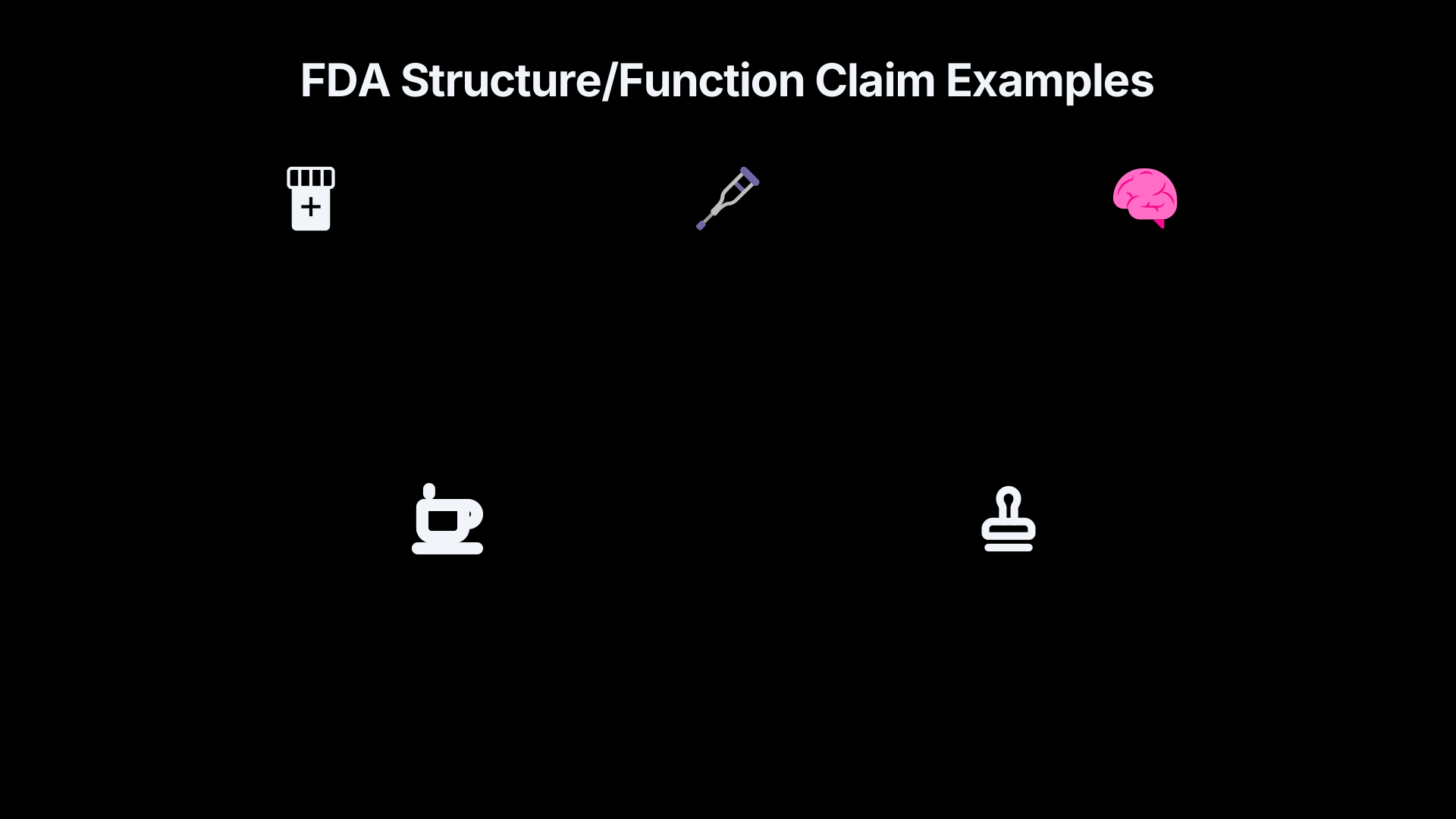
In the United States, many supplements use what are known as structure/function claims. These describe supporting normal bodily functions rather than treating disease. Examples include statements such as:
- “Supports immune health”
- “Helps maintain healthy joints”
- “Promotes relaxation”
- “Supports cognitive function”
These statements differ legally from claims that a product treats arthritis, prevents Alzheimer’s disease, or cures insomnia. Structure/function claims do not require pre-market approval from the FDA, provided they meet legal requirements, and they must carry a disclaimer stating that the FDA has not evaluated the claim and that the product is not intended to diagnose, treat, cure, or prevent disease.[U.S. Food and Drug Administration]fda.govquestions and answers dietary supplementsFood and Drug AdministrationQuestions and Answers on Dietary Supplements21 Feb 2024 — These three types of claims are not approved by FDA…
For consumers, however, the practical distinction is often blurred. Someone reading “supports memory” may reasonably infer that the supplement has been shown to improve memory in meaningful ways, even if the supporting evidence consists only of preliminary studies or indirect biological reasoning.
This illustrates an important analytical lesson: the wording of a claim often communicates more certainty than the underlying evidence actually provides.
Human evidence versus plausible mechanisms
A common mistake is assuming that a plausible mechanism automatically predicts clinical benefit.
Researchers often discover that a vitamin, mineral, or plant compound affects a biological pathway. Laboratory experiments may show antioxidant activity, changes in inflammatory markers, or hormone-related effects. These findings are valuable because they generate hypotheses.
They do not establish that people become healthier.
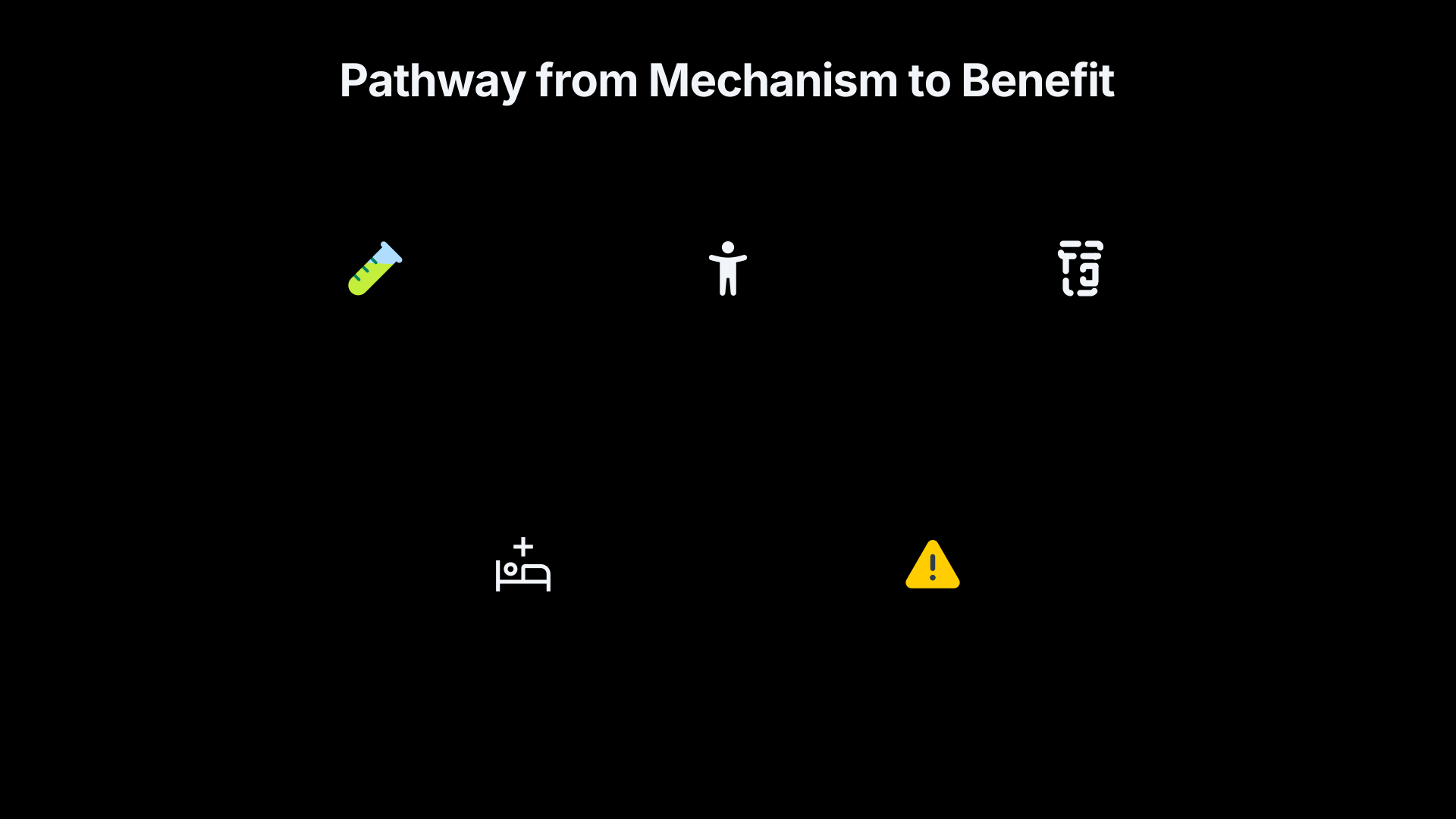
Several steps separate a promising mechanism from a reliable health intervention:
- The ingredient reaches the relevant tissues in humans.
- The dose used commercially matches the dose studied.
- The biological effect translates into a meaningful health outcome.
- Benefits consistently outweigh harms.
Many supplements fail somewhere along this chain.
For example, reducing a blood marker associated with inflammation does not necessarily reduce pain or disability. Increasing antioxidant activity does not automatically lower the risk of cancer or heart disease. Raising testosterone-related laboratory values does not necessarily improve strength, fertility, or wellbeing.
Randomised controlled trials (RCTs) are therefore generally considered the strongest way to test whether a supplement actually improves health outcomes in people. Systematic reviews, which evaluate all relevant studies rather than a single positive trial, provide an even stronger overview when the underlying studies are of good quality.[Federal Trade Commission+2Federal Trade Commission]ftc.govFederal Trade CommissionHealth Products Compliance Guidance20 Dec 2022 — The FTC Act doesn't require pre-market approval of health claims…
Why evidence gaps persist
The absence of convincing evidence does not necessarily mean a supplement is ineffective. Often, it means the necessary research has not been completed or is not sufficiently reliable.
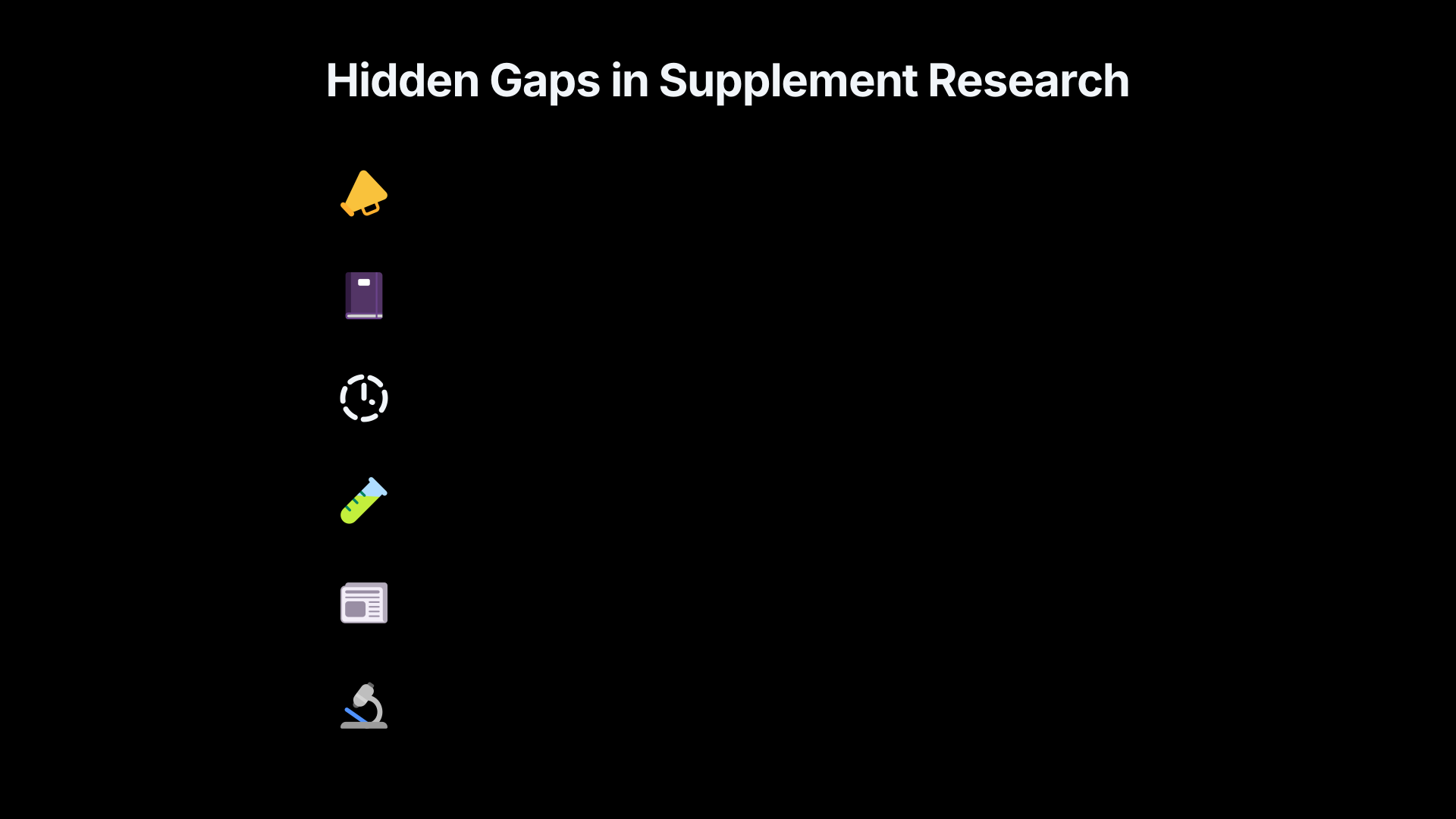
Several recurring problems limit confidence in supplement research:
- Small studies. Trials involving only a few dozen participants can easily produce unstable or exaggerated estimates.
- Short follow-up. A study lasting four weeks may not reveal whether benefits persist or whether delayed harms appear.
- Surrogate outcomes. Researchers may measure changes in blood tests instead of outcomes that matter to patients, such as fewer fractures, improved sleep quality, or reduced illness.
- Publication bias. Positive findings are more likely to be published than negative ones.
- Industry sponsorship. Commercial funding does not invalidate research, but it makes careful examination of study design and reporting especially important.
- Poor replication. A single encouraging study is much less persuasive if independent researchers cannot reproduce the findings.
These limitations explain why initial enthusiasm for some supplements often weakens as more comprehensive evidence accumulates.
When evidence is genuinely strong
Analytical scepticism is not the same as assuming every supplement is ineffective.
Some supplements have substantial evidence for specific populations or clearly defined medical situations. Examples include:
- folic acid before and during early pregnancy to reduce neural tube defects;
- calcium and vitamin D for certain people at risk of deficiency or bone loss;
- the AREDS eye vitamin formulation for slowing progression of particular forms of age-related macular degeneration.
These examples share important characteristics. The target population is clearly defined, the outcomes are clinically meaningful, and the recommendations are supported by multiple human studies rather than isolated laboratory findings. They are not evidence that supplements generally work, but examples showing that good evidence can exist when appropriate research has been conducted.[Office of Dietary Supplements]ods.od.nih.govLearn about their label information, effectiveness, safety, risk, quality,Office of Dietary SupplementsDietary Supplements: What You Need to Know - Consumer4 Jan 2023 — Important things to know about dietary sup…
Safety, interactions, and hidden trade-offs
The evidence gap concerns harms as well as benefits.
Many consumers assume that products sold without prescription are inherently safe, especially when labelled “natural”. Yet natural substances can produce powerful biological effects, interact with medicines, or cause problems at high doses.
Potential concerns include:
- interactions with blood-thinning medicines, antidepressants, diabetes medication, or immunosuppressants;
- increased bleeding risk before surgery;
- liver injury associated with some herbal products;
- contamination, inaccurate ingredient amounts, or undeclared pharmaceutical substances in some products;
- adverse effects from combining multiple supplements with similar ingredients.
Safety research often lags behind marketing. Rare adverse effects may only become apparent after widespread public use, particularly because pre-market evidence requirements for supplements differ from those for prescription medicines in many jurisdictions. NIH guidance also notes that pregnant women, children, and people with chronic illnesses require particular caution because safety evidence may be limited.[Office of Dietary Supplements]ods.od.nih.govLearn about their label information, effectiveness, safety, risk, quality,Office of Dietary SupplementsDietary Supplements: What You Need to Know - Consumer4 Jan 2023 — Important things to know about dietary sup…
Questions that expose weak claims
Rather than asking whether a supplement “works”, analytical thinking asks more precise questions.
A useful checklist includes:
- Who was studied? Healthy adults, older people, athletes, or patients with a diagnosed condition?
- Compared with what? Placebo, another treatment, or no treatment?
- What outcome improved? A laboratory marker or something that noticeably changed daily life?
- How large was the benefit? Statistically significant differences may still be too small to matter clinically.
- Has the result been replicated? One positive trial rarely settles the question.
- Were harms measured carefully? Benefits should always be considered alongside adverse effects and drug interactions.
These questions shift attention away from persuasive marketing language and towards the actual strength of the evidence.
Why scientific language can mislead
Supplement advertising frequently uses terms that sound impressive without communicating much about evidence quality.
Phrases such as “clinically tested”, “doctor formulated”, “research-backed”, or “contains scientifically studied ingredients” may all be technically true while conveying an exaggerated impression of effectiveness.
For example:
- a product may contain an ingredient that has been studied, even if the marketed dose differs substantially from the research dose;
- “clinically tested” may refer to a small, uncontrolled, or unpublished study;
- individual ingredients may have evidence, while the final combination has never been evaluated.
Consumer protection authorities emphasise that health advertising should be supported by competent and reliable scientific evidence and should not imply stronger support than actually exists. The strongest health benefit claims generally require robust human clinical evidence, with the quality of studies being more important than their number.[Federal Trade Commission+2Federal Trade Commission]ftc.govFederal Trade CommissionHealth Products Compliance Guidance20 Dec 2022 — The FTC Act doesn't require pre-market approval of health claims…
A better way to evaluate supplement claims
The central analytical lesson is simple: distinguish possibility from demonstrated benefit.
Mechanistic research asks whether something could work. Human clinical research asks whether it does work under real-world conditions. Marketing often compresses these two stages into a single persuasive story.
A scientifically literate reader resists that shortcut. Instead of accepting confident promises at face value, they look for evidence from well-designed human studies, consider whether the reported benefits are meaningful, examine what harms were tracked, and recognise when uncertainty remains. The evidence gap is not a reason to dismiss every supplement, but it is a reason to demand stronger proof before accepting broad claims about prevention, energy, immunity, sleep, hormones, or long-term health.
Amazon book picks
Further Reading
Books and field guides related to When Supplement Claims Outrun the Evidence. Use these as the next step if you want deeper reading beyond the article.
Do You Believe in Magic?
Directly addresses supplement evidence, safety, regulation, and misleading health promises.
Bad Science
Helps readers spot weak evidence, plausible mechanisms, and marketing-driven health claims.
Bad Pharma
Broadens the page into evidence quality, industry incentives, trial reporting, and health marketing.
Snake Oil Science
Explains placebo effects, weak trials, and why many complementary health claims fail.
eBay marketplace picks
Marketplace Samples
Example marketplace items related to this page. Use the search link to explore similar finds on eBay.


Endnotes
1.
Source: ods.od.nih.gov
Title: Learn about their label information, effectiveness, safety, risk, quality,
Link:https://ods.od.nih.gov/factsheets/WYNTK-Consumer/
Source snippet
Office of Dietary SupplementsDietary Supplements: What You Need to Know - Consumer4 Jan 2023 — Important things to know about dietary sup...
2.
Source: fda.gov
Title: questions and answers dietary supplements
Link:https://www.fda.gov/food/information-consumers-using-dietary-supplements/questions-and-answers-dietary-supplements
Source snippet
Food and Drug AdministrationQuestions and Answers on Dietary Supplements21 Feb 2024 — These three types of claims are not approved by FDA...
3.
Source: fda.gov
Title: structurefunction claims
Link:https://www.fda.gov/food/nutrition-food-labeling-and-critical-foods/structurefunction-claims
Source snippet
Food and Drug AdministrationStructure/Function Claims28 Mar 2024 — Structure/function claims may describe the role of a nutrient or dieta...
4.
Source: ods.od.nih.gov
Link:https://ods.od.nih.gov/
Source snippet
of Dietary Supplements (ODS) - NIHThe ODS Probiotics Fact Sheet for Consumers has been updated. It provides essential information on the...
5.
Source: pmc.ncbi.nlm.nih.gov
Link:https://pmc.ncbi.nlm.nih.gov/articles/PMC12921729/
Source snippet
by CI Niculaș · 2026 — The extracted data were organized into five main themes: pharmacist responsibility and malpractice, food supple...
6.
Source: ftc.gov
Link:https://www.ftc.gov/business-guidance/resources/health-products-compliance-guidance
Source snippet
Federal Trade CommissionHealth Products Compliance Guidance20 Dec 2022 — The FTC Act doesn't require pre-market approval of [health claims]({{ 'health-claims/' | relative_url }})...
7.
Source: ftc.gov
Link:https://www.ftc.gov/system/files/documents/plain-language/bus09-dietary-supplements-advertising-guide-industry.pdf
Source snippet
Federal Trade CommissionDietary Supplements: An Advertising Guide for IndustryThe FTC has primary responsibility for claims in advertisin...
8.
Source: ftc.gov
Title: announces new business guidance marketers sellers health products
Link:https://www.ftc.gov/news-events/news/press-releases/2022/12/ftc-announces-new-business-guidance-marketers-sellers-health-products
Source snippet
Federal Trade CommissionFTC Announces New Business Guidance for Marketers...20 Dec 2022 — Since that guide was issued, the FTC has broug...
Additional References
9.
Source: intracen.org
Link:https://www.intracen.org/file/claimsguidepdf
Source snippet
CLAIM STATEMENTS FOR NATURAL PRODUCTSDietary supplement labels may bear statements that describe the role of a nutrient or dietary ingred...
10.
Source: reputable.health
Link:https://reputable.health/compliance-made-easy-your-guide-to-ftc-and-fda-rules/
Source snippet
Compliance Made Easy: Your Guide to FTC and FDA RulesAdvertisers must have solid evidence for all claims before running an ad, usually in...
11.
Source: intertek.com
Link:https://www.intertek.com/form/webinars-the-new-ftc-health-products-compliance-guide-emea/
Source snippet
The New FTC Health Products Compliance GuideThe guidance is a compilation of lessons learned from over 200 FTC cases involving false or m...
12.
Source: kelleydrye.com
Link:https://www.kelleydrye.com/viewpoints/blogs/ad-law-access/misguided-the-ftc-attempts-to-redefine-the-law-with-its-health-products-compliance-guidance
Source snippet
Misguided: The FTC Attempts to Redefine…21 Dec 2022 — Yesterday, the FTC's Bureau of Consumer Protection released its Health Products Com...
13.
Source: haynesboone.com
Link:https://www.haynesboone.com/news/alerts/ftc-warns-nearly-700-advertisers-about-proper-substantiation-and-endorsement-practices
Source snippet
FTC Warns Nearly 700 Advertisers About Proper...14 Apr 2023 — Make express or implied claims that a product will cure, mitigate, or trea...
14.
Source: crnusa.org
Title: crn ftc randomized clinical trials not required most supplements
Link:https://www.crnusa.org/newsroom/crn-ftc-randomized-clinical-trials-not-required-most-supplements
Source snippet
CRN to FTC: Randomized Clinical Trials Not Required...Sep 25, 2023 — There is no legal requirement that a company possess randomized, co...
15.
Source: cooley.com
Title: 2023 03 02 ftc revises health products compliance guidance
Link:https://www.cooley.com/news/insight/2023/2023-03-02-ftc-revises-health-products-compliance-guidance
Source snippet
FTC Revises Health Products Compliance Guidance2 Mar 2023 — The FTC's revised guidance applies to advertising for any health-related prod...
16.
Source: insideprivacy.com
Title: ftc issues new guidance regarding health products
Link:https://www.insideprivacy.com/health-privacy/ftc-issues-new-guidance-regarding-health-products/
Source snippet
9 Jan 2023 — The updated guidance states that the amount, type, or strength of support of evidence for the claim must be accurate (e.g...
17.
Source: influenceflow.io
Title: health product marketing compliance strategies a complete 2026 guide
Link:https://influenceflow.io/resources/health-product-marketing-compliance-strategies-a-complete-2026-guide/
Source snippet
Learn FTC/FDA regulations, claim substantiation, and digital marketing best practices...
18.
Source: tandfonline.com
Link:https://www.tandfonline.com/doi/full/10.1080/15502783.2025.2534128
Source snippet
Full article: “Common questions and misconceptions about...by J Antonio · 2025 · Cited by 3 — In summary, contrary to some media claims...
Topic Tree