Within Humility
Why Some Beliefs Resist Revision
People can be intellectually humble in general while still becoming defensive about beliefs tied to identity or moral commitment.
On this page
- Peripheral beliefs versus identity linked beliefs
- Why central commitments update more slowly
- How to notice defensiveness before it steers reasoning
Page outline Jump by section
Introduction
Most people can be open-minded about many everyday opinions while remaining surprisingly resistant to changing a small number of deeply held beliefs. The difference is not simply how much evidence supports a belief. It is often about what the belief represents. When a claim becomes connected to personal identity, moral values, trusted communities or a sense of purpose, revising it can feel less like correcting an error and more like losing part of oneself. Intellectual humility is especially valuable in these situations because it separates the question “Is this belief true?” from “What does changing my mind say about me?” Research on intellectual humility, motivated reasoning and identity-protective cognition consistently suggests that people are more willing to update beliefs when doing so does not threaten their social identity or self-concept.[PMC+2John Templeton Foundation]pmc.ncbi.nlm.nih.govPMCPredictors and consequences of intellectual humilityby T Porter · 2022 · Cited by 359 — Intellectual humility involves acknowledging the limitations of one's knowledge and that one's bel…
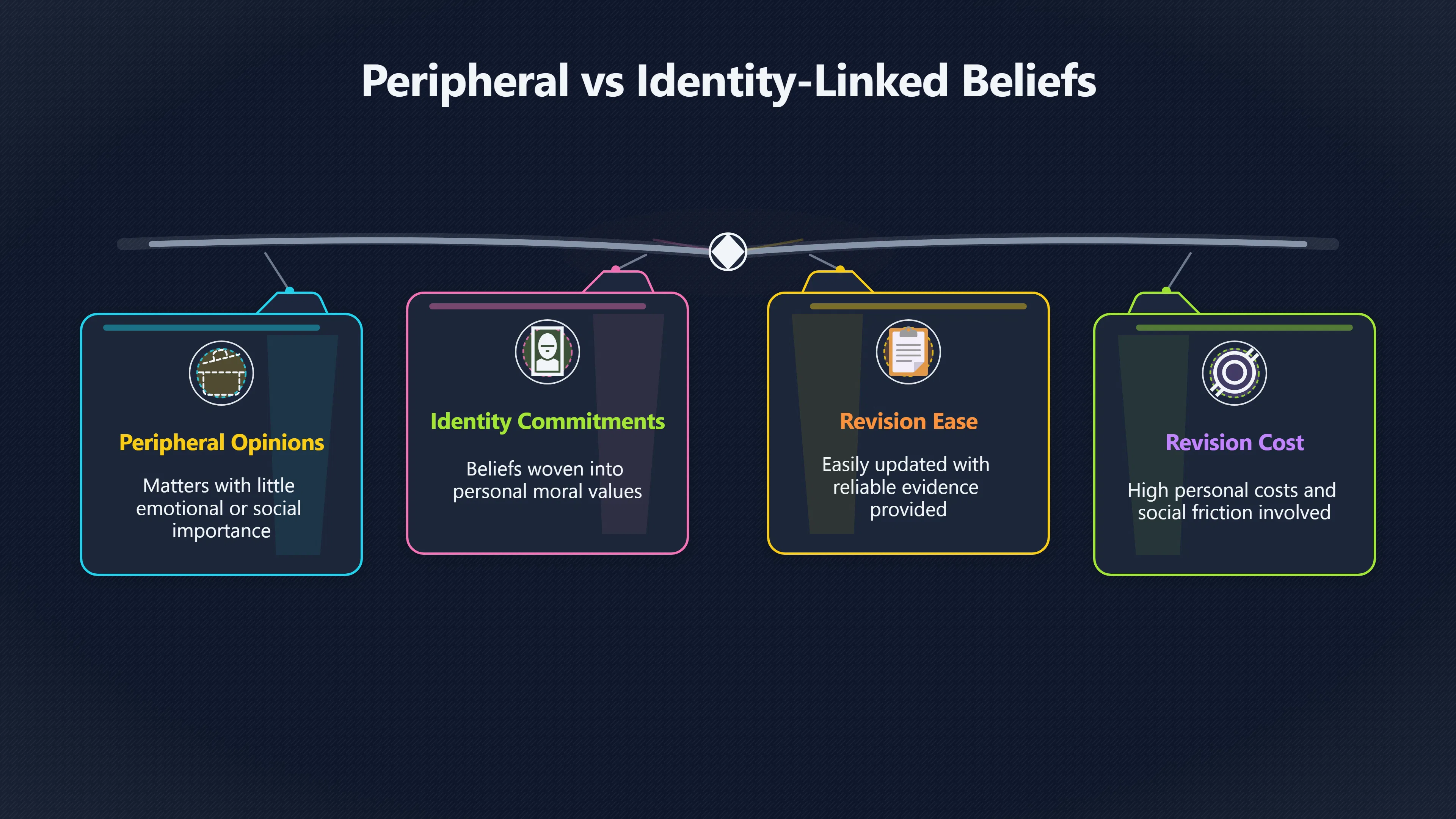
Peripheral Beliefs Versus Identity-Linked Beliefs
Not all beliefs occupy the same place in a person’s mental world.
Peripheral beliefs tend to concern matters with little emotional or social importance. You might easily revise an opinion about the quickest route to work, the best way to prepare a meal or the release date of a film after seeing reliable evidence. Little else changes when those beliefs change.
Identity-linked beliefs are different. They are woven into answers to questions such as:
- Who am I?
- Which people are “my” people?[dukespace.lib.duke.edu]dukespace.lib.duke.eduFour studies examined intellectual humility-the degree to which people recognize that their beliefs might be wrong. Using a new Intellect…
- Which authorities do I trust?
- What kind of moral person do I believe myself to be?
Changing these beliefs may imply admitting that a trusted group was mistaken, acknowledging that a long-held cause was flawed or accepting that previous decisions rested on false assumptions. Because the personal costs appear much larger, evidence alone often has less influence than people expect.[SSRN]papers.ssrn.comMisconceptions, Misinformation, and the Logic of Identity-…by DM Kahan · 2017 · Cited by 593 — The incidence and impact of misconc…
Importantly, this does not mean identity-linked beliefs are necessarily false. Many central commitments are well supported by evidence. The point is that beliefs connected to identity tend to be processed differently from beliefs that carry few personal consequences.
Why Central Commitments Update More Slowly
Resistance to updating is usually not caused by a single psychological bias. Several mechanisms often reinforce one another.
Identity protection changes how evidence feels
Research on identity-protective cognition argues that people often evaluate information in ways that preserve membership within valued groups. Rather than consciously deciding to ignore evidence, they may find supportive evidence more convincing, scrutinise contradictory evidence more aggressively or trust sources associated with their own community more readily.[SSRN+2informalscience.org]papers.ssrn.comMisconceptions, Misinformation, and the Logic of Identity-…by DM Kahan · 2017 · Cited by 593 — The incidence and impact of misconc…
This helps explain why intelligent, well-informed people sometimes become more polarised rather than converging on shared conclusions.
Moral commitments create additional resistance
Beliefs tied to moral convictions often become difficult to revise because changing them appears to involve compromising one’s character rather than merely updating factual knowledge.
For example, if someone interprets a disagreement as a challenge to whether they are compassionate, responsible or loyal, the discussion quickly becomes about identity instead of evidence. Defensive reasoning becomes more likely because protecting self-respect feels more urgent than evaluating competing claims.
Social relationships raise the stakes
Beliefs rarely exist in isolation. They are often reinforced by families, professional communities, religious organisations, political groups or friendship networks.
Changing one’s mind can therefore involve practical social costs:
- disappointing respected mentors
- creating conflict within close relationships
- losing status within a community
- becoming uncertain about where one belongs
These costs can make even careful thinkers hesitate before reconsidering central assumptions.

Confidence and identity are not the same
A common misunderstanding is that strong confidence necessarily prevents intellectual humility.
In reality, people may hold very confident beliefs while remaining able to specify what evidence would change their minds. The greater obstacle is often not confidence itself but identity fusion—the point at which disagreement feels like a personal attack rather than an opportunity to learn. Research on intellectual humility consistently distinguishes confidence from the willingness to acknowledge one’s own fallibility.[PMC+2John Templeton Foundation]pmc.ncbi.nlm.nih.govPMCPredictors and consequences of intellectual humilityby T Porter · 2022 · Cited by 359 — Intellectual humility involves acknowledging the limitations of one's knowledge and that one's bel…
Why Better Evidence Alone Often Fails
Many discussions assume that disagreement exists because one side lacks information. Although this is sometimes true, it is often incomplete.
Studies of motivated reasoning suggest that people actively interpret information through existing beliefs and goals rather than simply absorbing facts. Evidence that supports existing commitments may receive relatively little scrutiny, while contradictory evidence is examined for flaws, alternative explanations or reasons to dismiss the source.[Taylor & Francis Online+2Springer]tandfonline.comReasoning differently about information supportingTaylor & Francis OnlineThe skeptical import of motivated reasoning: a closer look…by M van Doorn · 2024 · Cited by 16 — Central to man…
This helps explain why simply providing additional facts frequently produces disappointing results when beliefs are closely tied to identity.
It also explains why debates sometimes become increasingly emotional despite increasing amounts of evidence: participants are not merely evaluating information but protecting different understandings of themselves and the groups they trust.
How to Notice Defensiveness Before It Steers Reasoning
The most useful skill is not eliminating defensiveness entirely. It is recognising it early enough that it does not quietly take control of judgement.
Several signals commonly indicate that identity may be driving reasoning:
- You feel personally criticised before identifying exactly what factual claim is being challenged.
- You become much more interested in finding weaknesses in opposing evidence than in evaluating your own assumptions.
- You dismiss a source primarily because it belongs to an opposing group without first considering its actual evidence.
- You notice an unusually strong emotional reaction—anger, embarrassment or anxiety—before you have finished examining the argument.
- You find yourself thinking, “People like us don’t believe that,” rather than asking whether the claim itself is accurate.
None of these signs proves that your conclusion is wrong. They simply indicate that identity concerns may be influencing how evidence is being processed.
Practising Intellectual Humility Without Losing Conviction
Recognising identity-linked beliefs does not require treating every opinion as equally credible or abandoning firmly supported conclusions.
Instead, intellectual humility encourages habits that reduce unnecessary defensiveness:[drcharlesmrusso.substack.com]drcharlesmrusso.substack.comintellectual humilityCharles M. Russo - The Critical ThinkerIntellectual humility (IH) doesn't mean weak thinking; it means robust thinking: recognizing that…
- Separate the evidence from the person. Critiquing a claim does not automatically require judging the character of the person making it.
- Ask what evidence would genuinely change your mind before entering a disagreement. If no conceivable evidence exists, the issue is probably functioning more as an identity commitment than an empirical belief.
- Distinguish loyalty from accuracy. Supporting a community does not require defending every claim associated with it.
- Notice emotional reactions as information rather than instructions. Feeling threatened may signal that identity is involved, not that the opposing evidence is necessarily false.
- Remember previous occasions when changing your mind improved your understanding. Viewing revision as learning rather than defeat reduces the psychological cost of updating.
Recent research also suggests that intellectual humility is associated with better discernment between accurate and inaccurate information rather than indiscriminate scepticism, reinforcing the idea that humility improves evidence evaluation instead of weakening conviction.[Advances.in]advances.inIntellectual humility is associated with greater misinformation…by T Prike · 2024 · Cited by 15 — Intellectual humility is associated…
The Practical Lesson
The beliefs that resist revision most strongly are usually those that answer questions about identity, belonging and moral commitment rather than those supported by the greatest amount of evidence. Recognising this distinction helps explain why thoughtful people can remain remarkably flexible in some areas while becoming unexpectedly defensive in others.
Intellectual humility does not ask people to detach from every deeply held commitment. It asks them to recognise when protecting an identity has quietly become more important than evaluating evidence. That awareness makes it easier to revise beliefs when reality genuinely demands it while still holding well-supported convictions with justified confidence.
Amazon book picks
Further Reading
Books and field guides related to Why Some Beliefs Resist Revision. Use these as the next step if you want deeper reading beyond the article.
Mistakes Were Made (but Not by Me)
Explains motivated reasoning and self-justification.
eBay marketplace picks
Marketplace Samples
Example marketplace items related to this page. Use the search link to explore similar finds on eBay.


Endnotes
1.
Source: pmc.ncbi.nlm.nih.gov
Title: PMCPredictors and consequences of intellectual humility
Link:https://pmc.ncbi.nlm.nih.gov/articles/PMC9244574/
Source snippet
by T Porter · 2022 · Cited by 359 — Intellectual humility involves acknowledging the limitations of one's knowledge and that one's bel...
2.
Source: templeton.org
Link:https://www.templeton.org/discoveries/intellectual-humility
Source snippet
John Templeton FoundationIntellectual HumilityIntellectual humility is a mindset that guides our intellectual conduct. In particular, it...
3.
Source: papers.ssrn.com
Link:https://papers.ssrn.com/sol3/papers.cfm?abstract_id=2973067
Source snippet
Misconceptions, Misinformation, and the Logic of Identity-...by DM Kahan · 2017 · Cited by 593 — The incidence and impact of misconc...
4.
Source: informalscience.org
Link:https://informalscience.org/identity/dan-kahan/
Source snippet
Identity | Dan KahanDan Kahan's identity-related work has focused on “identity protective cognition”, which refers to the tendency of ind...
5.
Source: link.springer.com
Link:https://link.springer.com/article/10.1007/s11109-024-09999-7
Source snippet
to Distinguish Motivated Reasoning from Bayesian...by AT Little · 2025 · Cited by 23 — Bayesian updating multiplies prior beliefs by the...
6.
Source: advances.in
Link:https://advances.in/psychology/10.56296/aip00025/
Source snippet
Intellectual humility is associated with greater misinformation...by T Prike · 2024 · Cited by 15 — Intellectual humility is associated...
7.
Source: templeton.org
Link:https://www.templeton.org/grant/[metacognition
Source snippet
etermines confidence and intellectual humility and that this is important for...Read more...
8.
Source: papers.ssrn.com
Link:https://papers.ssrn.com/sol3/papers.cfm?abstract_id=2182588
Source snippet
ssrn.comIdeology, Motivated Reasoning, and Cognitive Reflectionby DM Kahan · 2012 · Cited by 2133 — This paper describes a study of three...
9.
Source: link.springer.com
Link:https://link.springer.com/chapter/10.1007/978-3-031-24271
Source snippet
Reasoning and Risk Governance - Springer Natureby M Beck · 2023 · Cited by 8 — When the goal in motivated reasoning is identity protectio...
10.
Source: dukespace.lib.duke.edu
Link:https://dukespace.lib.duke.edu/dspace/handle/10161/23967
Source snippet
Four studies examined intellectual humility-the degree to which people recognize that their beliefs might be wrong. Using a new Intellect...
11.
Source: tandfonline.com
Title: Reasoning differently about information supporting
Link:https://www.tandfonline.com/doi/full/10.1080/13546783.2023.2276975
Source snippet
Taylor & Francis OnlineThe skeptical import of motivated reasoning: a closer look...by M van Doorn · 2024 · Cited by 16 — Central to man...
12.
Source: pmc.ncbi.nlm.nih.gov
Link:https://pmc.ncbi.nlm.nih.gov/articles/PMC11393549/
Source snippet
of misinformation as motivational and cognitive...by Y Zhou · 2024 · Cited by 23 — While some distinguish misinformation and disinformat...
13.
Source: pmc.ncbi.nlm.nih.gov
Link:https://pmc.ncbi.nlm.nih.gov/articles/PMC10913374/
Source snippet
Cognition in Cooperation - PMC - NIHby S Fiedler · 2023 · Cited by 16 — We explain why beliefs play such an essential role in cooperation...
14.
Source: pmc.ncbi.nlm.nih.gov
Link:https://pmc.ncbi.nlm.nih.gov/articles/PMC12873188/
Source snippet
by M Kossowska · 2026 — This preregistered study investigates the neural mechanisms underlying resistance to belief change among indiv...
15.
Source: drcharlesmrusso.substack.com
Title: intellectual humility
Link:https://drcharlesmrusso.substack.com/p/intellectual-humility
Source snippet
Charles M. Russo - The Critical ThinkerIntellectual humility (IH) doesn't mean weak thinking; it means robust thinking: recognizing that...
16.
Source: psychologytoday.com
Title: motivated reasoning
Link:https://www.psychologytoday.com/us/basics/motivated-reasoning
Source snippet
Nov 13, 2025 — Motivated reasoning can function to reduce cognitive dissonance. Why do people believe in conspiracy theories? Created wit...
17.
Source: Wikipedia
Title: Motivated reasoning
Link:https://en.wikipedia.org/wiki/Motivated_reasoning
Source snippet
Motivated reasoningMotivated reasoning is the mental process through which individuals access, construct, and evaluate their beliefs i...
Additional References
18.
Source: researchgate.net
Link:https://www.researchgate.net/publication/352297543_The_role_of_emotions_and_identity-protection_cognition_when_processing_misinformation
Source snippet
The Role of Emotions and Identity-Protection Cognition...26 Feb 2026 — In this study, we investigate the role of emotions in identity-pr...
19.
Source: researchgate.net
Link:https://www.researchgate.net/publication/279680482_Ideology_Motivated_Reasoning_and_Cognitive_Reflection
Source snippet
Ideology, Motivated Reasoning, and Cognitive ReflectionThis paper describes a study of three of them: the predominance of heuristic-drive...
20.
Source: fondationdescartes.org
Link:https://www.fondationdescartes.org/en/2020/06/les-idees-fausses-les-fausses-informations-et-la-logique-du-raisonnement-pour-proteger-son-identite/
Source snippet
False ideas, fake information, and the logic of identity-...This 2017 article is a preparatory work proposed by social scientist Dan Kah...
21.
Source: cipp.ug.edu.pl
Link:https://cipp.ug.edu.pl/Intellectual-humility-an-old-problem-in-a-new-psychological-perspective%2C136534%2C0%2C2.html
Source snippet
humility: an old problem in a new psychological...by W Bąk · Cited by 31 — Intellectual humility, as a less natural tendency, correlates...
22.
Source: culturalcognition.net
Title: The Cultural Cognition Project Motivated reasoning & its cognates
Link:https://www.culturalcognition.net/blog/2013/5/15/motivated-reasoning-its-cognates.html
Source snippet
The Cultural Cognition ProjectMotivated reasoning & its cognates - Cultural Cognition of...15 May 2013 — Identity-protective cognition...
Published: May 2013
23.
Source: cambridge.org
Title: identityprotective reasoning an epistemic and political defense
Link:https://www.cambridge.org/core/services/aop-cambridge-core/content/view/5C62B4A3FC3F564ADE86BA5B7C5EF2BE/S1742360025000176a.pdf/identityprotective_reasoning_an_epistemic_and_political_defense.pdf
Source snippet
Identity-protective reasoning: an epistemic and political...by C Flores · 2025 · Cited by 6 — Against this view, I argue that identity-p...
24.
Source: researchgate.net
Link:https://www.researchgate.net/publication/317999685_Misconceptions_Misinformation_and_the_Logic_of_Identity-Protective_Cognition
Source snippet
nition selectively to defend beliefs aligned with their identities and worldviews...
25.
Source: facebook.com
Link:https://www.facebook.com/chasehughesofficial/posts/how-is-a-belief-tied-to-someones-identity-in-a-way-that-makes-it-uncomfortable-w/618885013395267/
Source snippet
d why people might resist ideas that challenge their core...Read more...
26.
Source: greatergood.berkeley.edu
Title: what does intellectual humility look like
Link:https://greatergood.berkeley.edu/article/item/what_does_intellectual_humility_look_like
Source snippet
Does Intellectual Humility Look Like?3 Nov 2021 — Intellectual humility involves understanding that we can't fully trust our beliefs and...
27.
Source: bps.org.uk
Title: why intellectual humility matters
Link:https://www.bps.org.uk/psychologist/why-intellectual-humility-matters
Source snippet
28 Jul 2022 — Being intellectually humble comes with a willingness to accept that changing your mind is sometimes the right thing to d...
Topic Tree