Within Online Claims
Big Claims Need Bigger Evidence
Small pieces of evidence can support modest observations, but broad accusations need stronger, more independent support.
On this page
- What proportionate evidence means
- Why anecdotes, photos, and single witnesses have limits
- How to scale confidence to the support available
Page outline Jump by section
Introduction
Good reasoning depends not only on whether there is evidence, but on whether the evidence is strong enough for the size of the claim being made. A small observation can justify a cautious conclusion, while a sweeping accusation or extraordinary assertion requires much broader, more reliable support. This is one of the most important habits for evaluating news, social media posts and online debates: match your confidence to the evidence, rather than to how confidently the claim is presented.
 Many reasoning errors arise because this proportionality is ignored. A dramatic headline may rest on a single anecdote, while a careful scientific conclusion may be supported by years of independent studies. Learning to distinguish between these situations helps prevent both gullibility and excessive scepticism.
What Proportionate Evidence Means
The amount and quality of evidence needed should increase with the scope and certainty of the claim.
For example:
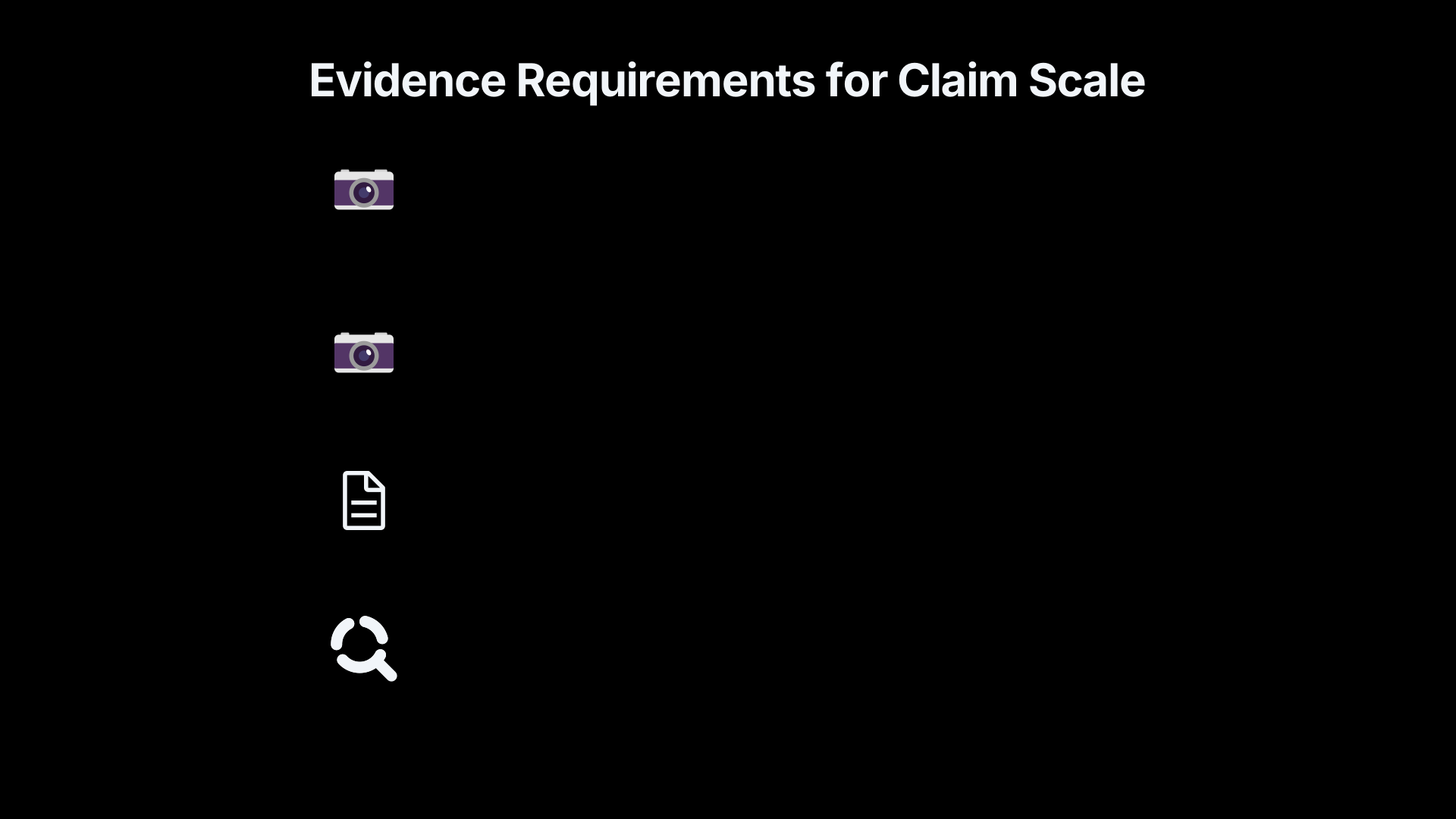
- A single photograph may support the modest claim that someone captured an unusual image.
- Several independent witnesses, video footage and official records might support the claim that an event occurred at a particular place and time.
- Demonstrating that a government deliberately organised a nationwide conspiracy would require a much larger body of mutually reinforcing evidence, because the claim is broader, more complex and has many more opportunities for alternative explanations.
The key question is not simply, “Is there evidence?” but, “Is this evidence sufficient for this specific conclusion?”
A useful mental habit is to ask whether the conclusion says more than the evidence actually establishes. If it does, confidence should be reduced until stronger support appears.
Why Bigger Claims Need Bigger Evidence
Larger claims place a heavier burden on the available evidence because they make stronger predictions and rule out more competing explanations.
Suppose someone says:
- “I saw smoke over the hill.”
- “The entire forest is on fire.”
- “The fire was deliberately started by a criminal organisation.”
Each statement requires progressively stronger evidence. Observing smoke may justify the first statement. The second needs broader observation, perhaps satellite images or multiple reports. The third introduces intent and organised action, demanding investigative evidence rather than visual observation alone.
This principle has long appeared in philosophy and science. It is often summarised by the phrase “extraordinary claims require extraordinary evidence”, popularised by Carl Sagan, although similar ideas can be traced back much earlier, including to the philosopher David Hume and the mathematician Pierre-Simon Laplace. The central idea is not that unusual claims are automatically false, but that claims which conflict with well-established evidence require correspondingly stronger support before confidence is warranted.[PMC]pmc.ncbi.nlm.nih.govPMCExtraordinary Claims Require Extraordinary Evidenceby PE Tressoldi · 2011 · Cited by 121 — “Extraordinary claims require extraordinary evidence” was a phrase made popular by Carl Sagan…
Importantly, researchers have also cautioned against treating this principle as a licence to dismiss genuinely novel discoveries. Strong evidence should increase confidence regardless of whether the conclusion is surprising. The goal is proportionality, not automatic rejection of new ideas.[ResearchGate]researchgate.net309305745 Do Extraordinary Claims Require Extraordinary EvidenceDo Extraordinary Claims Require Extraordinary Evidence?3 May 2026 — In 1979 astronomer Carl Sagan popularized the aphorism “e…
Why Anecdotes, Photos and Single Witnesses Have Limits
Many [online claims](/online-claims/) rely on evidence that is genuine but incomplete.
Anecdotes
Personal experiences can show that something happened to one individual. They are much weaker evidence for claims about how common something is or whether one event caused another.
For example, one person’s experience after taking a medicine cannot establish that the medicine always causes that effect. It may be an important clue worth investigating, but not a final answer.
Photographs
A photograph demonstrates that a scene existed in front of a camera at one moment. It usually cannot establish:
- what happened immediately before or after;
- where the image was taken unless independently verified;
- why the people involved acted as they did; or
- whether the image has been cropped or presented without context.
A real image can therefore support a modest factual observation while being insufficient for broader interpretations.
Single Witnesses
Eyewitness testimony is valuable, especially when given promptly and independently. However, memory is imperfect, perception is limited, and people only observe part of an event.
A lone witness may provide credible evidence that deserves investigation. A large accusation based solely on one account, however, normally requires corroboration from documents, recordings, physical evidence or additional independent witnesses before strong conclusions are justified.
Scale Confidence Instead of Choosing Between Belief and Disbelief
People often treat claims as either accepted or rejected. Better reasoning uses a spectrum of confidence.
Instead of asking, “Do I believe this?”, ask:
- What does the current evidence justify?
- How certain should I be?
- What additional evidence would change my mind?
For example:
Evidence availableReasonable confidenceOne anonymous social media postVery low confidence in broad conclusionsMultiple independent reports with consistent detailsModerate confidence that the reported event occurredIndependent investigations, original documents and corroborating evidenceHigh confidence in well-defined claimsExtensive independent replication over timeVery high confidence, while remaining open to future revision
Confidence should grow gradually as stronger evidence accumulates rather than jumping immediately from uncertainty to certainty.
Common Ways Claim Size Becomes Inflated
Online discussions frequently expand modest evidence into much larger conclusions.
Examples include:
- From one example to a general rule. One incident becomes “this always happens.”
- From correlation to causation. Two events occurring together become proof that one caused the other.
- From uncertainty to certainty. Preliminary findings are reported as settled facts.
- From isolated wrongdoing to universal guilt. One person’s actions become evidence against an entire organisation or group.
- From unanswered questions to affirmative claims. Lack of an immediate explanation becomes “proof” of a preferred explanation.
Each step increases the size of the claim without necessarily increasing the quality of the supporting evidence.
A Practical Habit for Reading News
When encountering a striking headline, match the evidence to the conclusion before deciding how confident to be.
Ask yourself:
- Exactly what is being claimed?
- How broad is that claim?
- What evidence is actually presented?
- Could the same evidence support a smaller, more cautious conclusion?
- What additional independent evidence would be needed before accepting the larger claim?
Often the evidence supports a narrower statement than the headline suggests. Recognising this difference allows you to remain open-minded without becoming either credulous or dismissive.
The Main Takeaway
Strong thinking is not about demanding impossible proof for every statement, nor about accepting dramatic claims on thin evidence. It is about keeping confidence proportional to the available support.
Small pieces of evidence can justify modest observations. Broad accusations, sweeping explanations and claims that overturn well-established knowledge require broader, more independent and more reliable evidence. Matching evidence strength to claim size helps prevent both overconfidence and unwarranted scepticism, making judgments more accurate as new information becomes available.
Amazon book picks
Further Reading
Books and field guides related to Big Claims Need Bigger Evidence. Use these as the next step if you want deeper reading beyond the article.
Bad Science
Demonstrates how to distinguish strong evidence from anecdotes, hype, and unsupported assertions.
The Demon-Haunted World
Rating: 4.5/5 from 43 Google Books ratings
Explains why extraordinary claims require proportionately strong evidence and promotes scientific skepticism.
Thinking, Fast and Slow
Helps readers understand cognitive biases that lead to overconfidence from weak evidence.
Calling Bullshit
Directly teaches how to evaluate evidence strength and avoid being persuaded by weak support.
eBay marketplace picks
Marketplace Samples
Live-tested eBay searches with available results related to this page.


Endnotes
1.
Source: pmc.ncbi.nlm.nih.gov
Title: PMCExtraordinary Claims Require Extraordinary Evidence
Link:https://pmc.ncbi.nlm.nih.gov/articles/PMC3114207/
Source snippet
by PE Tressoldi · 2011 · Cited by 121 — “Extraordinary claims require extraordinary evidence” was a phrase made popular by Carl Sagan...
2.
Source: researchgate.net
Title: 309305745 Do Extraordinary Claims Require Extraordinary Evidence
Link:https://www.researchgate.net/publication/309305745_Do_Extraordinary_Claims_Require_Extraordinary_Evidence
Source snippet
Do Extraordinary Claims Require Extraordinary Evidence?3 May 2026 — In 1979 astronomer Carl Sagan popularized the aphorism “e...
Published: May 2026
3.
Source: Wikipedia
Title: Extraordinary claims require extraordinary evidence
Link:https://en.wikipedia.org/wiki/Extraordinary_claims_require_extraordinary_evidence
Source snippet
Extraordinary claims require extraordinary evidence"Extraordinary claims require extraordinary evidence" (sometimes shortened to ECREE...
Additional References
4.
Source: medium.com
Link:https://medium.com/%40tpoi/extraordinary-claims-are-no-big-deal-4d8474c611e7
Source snippet
Extraordinary claims (are no big deal) | by Timothée PoisotReading “Extraordinary claims require extraordinary evidence” in a review ofte...
5.
Source: cs.rice.edu
Link:https://www.cs.rice.edu/~vardi/merger/Mittal-on-Extraordinaryclaisms1109.pdf
Source snippet
claims & ordinary evidenceCarl Sagan's phrase “extraordinary claims require extraordinary evidence”, has been applied many times to the p...
6.
Source: orca.cardiff.ac.uk
Title: ORCAExtraordinary claims, extraordinary evidence?
Link:https://orca.cardiff.ac.uk/id/eprint/143844/1/Morey.%20Extraordinary%20Claims%2C%20Extraordinary%20evidence.pub.pdf
Source snippet
A discussionby RM Shiffrin · 2021 · Cited by 8 — Carl Sagan is reported to have said. “extraordinary claims require extraordinary evidenc...
7.
Source: reddit.com
Link:https://www.reddit.com/r/DebateReligion/comments/vyke05/correcting_a_popular_misconception_extraordinary/
Source snippet
Correcting a Popular Misconception: "extraordinary claims...Correcting Apologetic Propaganda: Yes, Extraordinary Claims DO Require Extra...
8.
Source: youtube.com
Title: William Lane Craig Gives an Extraordinary Answer to an Ordinary Objection
Link:https://www.youtube.com/watch?v=fbKkpnlot5I
Source snippet
Notebookin' w/ Mindy #7 (The Toolkit of the Mind: Mastering Critical Thinking)...
9.
Source: youtube.com
Link:https://www.youtube.com/watch?v=XR-u2As8BJI
Source snippet
But is he right? Like the show? Help it grow...
10.
Source: youtube.com
Title: Evaluating Evidence: Crash Course Navigating Digital Information #6
Link:https://www.youtube.com/watch?v=hxhbOvR2TGk
Source snippet
William Lane Craig Gives an Extraordinary Answer to an Ordinary Objection...
11.
Source: youtube.com
Title: Evaluating a Source’s Reasoning and Evidence | Reading | Khan Academy
Link:https://www.youtube.com/watch?v=S_xwx7BcqBw
Source snippet
Deductive vs Inductive Reasoning - Valid & Sound vs Strong & Cogent...
12.
Source: youtube.com
Title: Deductive vs Inductive Reasoning
Link:https://www.youtube.com/watch?v=35g3miDZ4-Q
Source snippet
Evaluating Evidence: Crash Course Navigating Digital Information #6...
13.
Source: youtube.com
Title: Notebookin’ w/ Mindy #7 (The Toolkit of the Mind: Mastering Critical Thinking)
Link:https://www.youtube.com/watch?v=F86pXtsiAgQ
Topic Tree