Within Teaching
Feedback That Teaches Better Judgement
Useful feedback names the strength of the reasoning route, not only whether the final answer was correct.
On this page
- Why right or wrong marking is too thin
- Feedback on claims, evidence, and uncertainty
- Rubrics that reward reasoning quality
Page outline Jump by section
Introduction
Improving analytical skill depends on more than telling learners whether they reached the correct answer. The most useful feedback explains why a line of reasoning was strong, weak or incomplete, so that the learner can apply the same judgement in a different situation. This shifts feedback from simple evaluation (“correct” or “incorrect”) to guidance about claims, evidence, assumptions, alternatives and uncertainty. Research on formative feedback consistently finds that feedback is most effective when it helps learners understand how to improve their thinking, not merely how to fix a single response.[Frontiers]frontiersin.orgFor this reason, scholars have been working on developing modelsFrontiersA Review of Feedback Models and Theories: Descriptions…December 31, 2021 — by AA Lipnevich · 2021 · Cited by 401 — The posit…
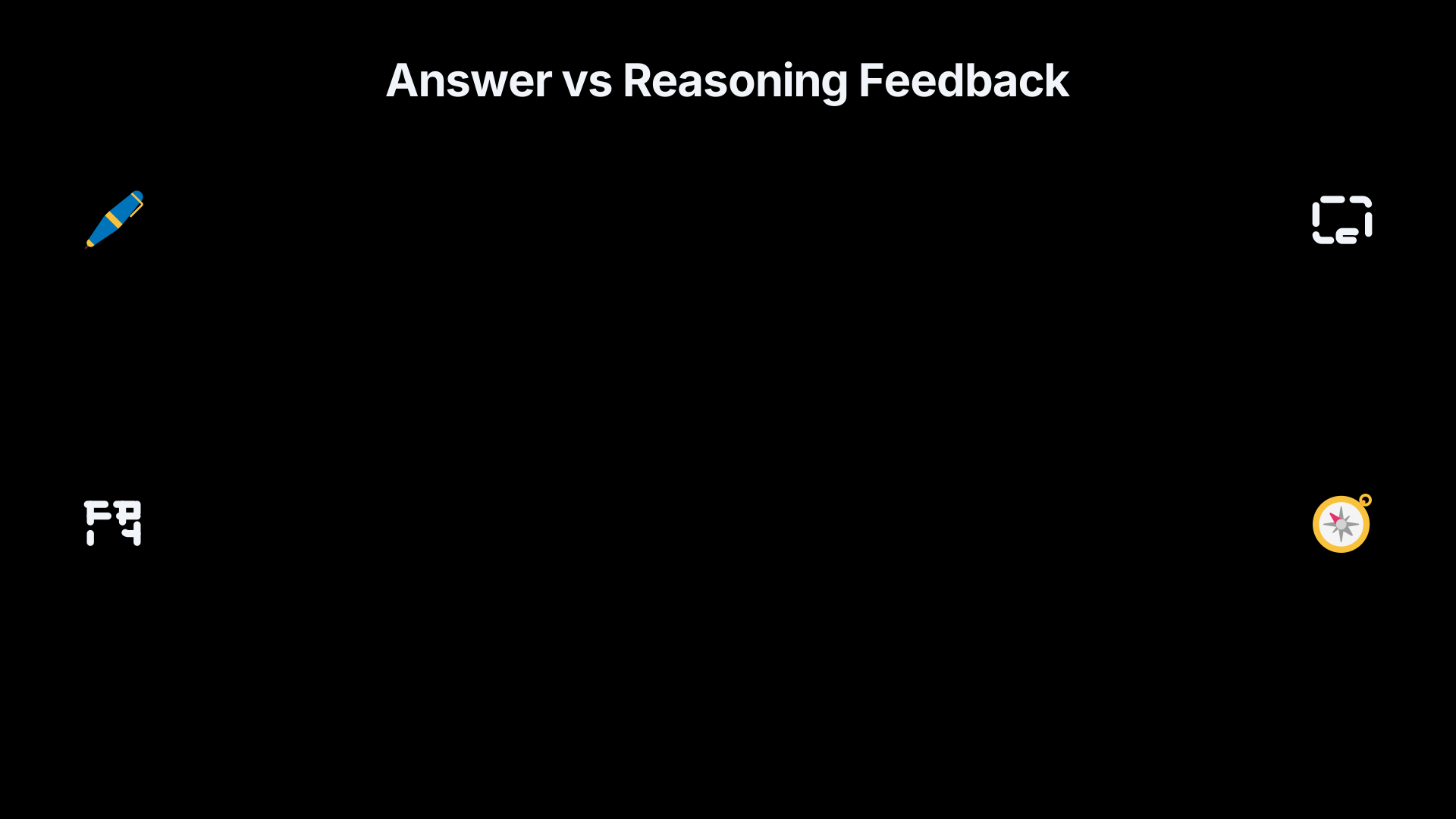 Within explicit teaching of thinking skills, reasoning-focused feedback is the mechanism that makes judgement visible. It tells learners not only what happened, but what kind of thinking produced the outcome.
Why right-or-wrong marking is too thin
A mark or model answer can indicate whether a learner reached the expected conclusion, but it often conceals the quality of the reasoning that produced it. Two learners may arrive at the same answer through very different processes: one by carefully weighing evidence, another by guessing or following an unreliable shortcut. Equally, a thoughtful argument can produce the wrong conclusion because of incomplete information rather than poor reasoning.
When assessment rewards only final answers, learners naturally optimise for answer production instead of analytical judgement. They become less likely to:
- explain why evidence supports a conclusion;
- consider alternative explanations;
- identify assumptions;
- express appropriate uncertainty; or
- reflect on what would change their mind.
Educational researchers have long argued that formative feedback should modify the learner’s thinking, not simply verify correctness. Reviews of feedback theory similarly conclude that effective feedback provides information that helps learners close the gap between current reasoning and desired reasoning rather than merely reporting success or failure.[myweb.fsu.edu]myweb.fsu.edushute 2007 fFocus on Formative Feedbackby VJ Shute · 2007 · Cited by 474 — Formative feedback represents information communicated to the learner that…
This distinction becomes particularly important in disciplines where multiple defensible answers exist, including history, law, medicine, engineering and public policy. In these fields, reasoning quality often matters more than arriving at one predetermined conclusion.
Feedback on claims, evidence and uncertainty
Reasoning-focused feedback works because it comments on the components of judgement rather than the outcome alone.
Claims
Feedback should identify whether the central claim follows logically from the available information.
Instead of:
“Your conclusion is wrong.”
A reasoning-focused version might be:
“Your conclusion goes beyond what your evidence currently supports.”
The learner receives information about the relationship between conclusion and evidence rather than simply being told the answer.
Evidence
Strong analytical feedback discusses the quality and use of evidence.
Useful comments include observations such as:
- the strongest evidence was ignored;
- one source was treated as more reliable than it deserved;
- contradictory evidence was not addressed;
- evidence was described but not interpreted;
- examples were anecdotal rather than representative.
Such feedback teaches learners to inspect how evidence functions within an argument instead of merely collecting more facts.
Reasoning process
Good feedback also highlights the reasoning pathway itself.
For example:
- “You considered two competing explanations before deciding.”
- “You ruled out alternatives too quickly.”
- “Your assumptions remained implicit.”
- “You identified an important limitation in the data.”
Notice that these comments describe thinking behaviours that can transfer into future problems.
Uncertainty
Analytical judgement rarely involves complete certainty. Learners therefore benefit from feedback on how they expressed confidence.
Examples include:
- recognising when evidence justifies only a tentative conclusion;
- distinguishing speculation from inference;
- identifying missing information;
- stating what additional evidence would strengthen confidence.
Research on feedback consistently emphasises that high-quality feedback is specific, explanatory and directed towards improvement rather than simple evaluation.[myweb.fsu.edu]myweb.fsu.edushute 2007 fFocus on Formative Feedbackby VJ Shute · 2007 · Cited by 474 — Formative feedback represents information communicated to the learner that…

Feedback should recognise strong reasoning as well as errors
Many feedback systems focus almost exclusively on mistakes. While correction is important, learners also need to understand which reasoning strategies they should repeat.
Comments such as these reinforce productive habits:
- “You tested your first explanation against competing possibilities.”
- “You distinguished observation from interpretation.”
- “You recognised uncertainty rather than overstating confidence.”
- “You changed your position when stronger evidence appeared.”
This differs from general praise like “Good work.”
General praise identifies success without identifying its cause. Process-oriented feedback instead identifies the thinking behaviour responsible for success, making it easier for learners to reproduce that behaviour elsewhere.
This principle aligns with broader feedback models that distinguish information about task completion from information about the processes and self-regulation underlying performance.[Frontiers]frontiersin.orgFor this reason, scholars have been working on developing modelsFrontiersA Review of Feedback Models and Theories: Descriptions…December 31, 2021 — by AA Lipnevich · 2021 · Cited by 401 — The posit…
Rubrics that reward reasoning quality
One practical way to embed reasoning feedback is through assessment rubrics that separate reasoning quality from answer accuracy.
A reasoning rubric might evaluate:
DimensionHigh-quality reasoning looks likeClaimClear, proportionate to available evidenceEvidenceRelevant, reliable and accurately interpretedAlternative explanationsSerious competing explanations consideredAssumptionsExplicitly identified where importantLogicConclusions follow from premises without major gapsUncertaintyAppropriate confidence and acknowledgement of limitations
Such rubrics communicate that analytical skill is not a hidden expectation but an observable performance.
They also improve consistency between teaching and assessment. If classrooms encourage questioning and evidence evaluation but examinations reward only memorised answers, learners receive conflicting signals. Explicit reasoning criteria reduce this mismatch.
Practical examples of reasoning feedback
Consider a history assignment asking why an empire declined.
Answer-focused feedback[arxiv.org]arxiv.orgSource details in endnotes.
“Incorrect. Economic factors were more important.”
Reasoning-focused feedback[pure.tue.nl]pure.tue.nlfeedback: a learning theory perspective1 Jan 2013 — Shute (2008), reasoning from cognitivism, indicated that the extent of feedback's ef…
“You relied mainly on political evidence while giving little attention to economic sources. Your conclusion therefore reflects only part of the available evidence. Consider whether incorporating trade data would change your judgement.”
The second comment teaches a reasoning strategy that applies beyond the immediate topic.
Similarly, in science:
Answer-focused
“Hypothesis rejected.”
Reasoning-focused
“You interpreted correlation as evidence of causation. What alternative explanations could account for the same pattern?”
Or in business:
Answer-focused
“Recommendation not convincing.”
Reasoning-focused
“You identified the operational problem clearly, but your recommendation assumes customer demand will remain constant without presenting supporting evidence.”
In each case, feedback targets transferable judgement rather than isolated correctness.

Common implementation mistakes
Institutions attempting to improve analytical skills often weaken feedback by making it too general or too evaluative.
Frequent problems include:
- Explaining the answer without discussing the reasoning. Learners know the solution but not how to think differently next time.
- Commenting only on weaknesses. Strong reasoning habits remain invisible and therefore less likely to be repeated.
- Giving excessive corrections at once. Too many comments overwhelm learners and reduce actionability.
- Focusing on personal qualities. Statements like “You’re smart” or “You’re not analytical enough” provide little guidance compared with comments on observable reasoning behaviours.
- Separating feedback from revision. Feedback becomes more valuable when learners immediately apply it to a revised argument or decision.
Research reviews emphasise that feedback is most effective when it is specific, credible, actionable and clearly connected to subsequent improvement rather than functioning as a final judgement after learning has ended.[myweb.fsu.edu+2Frontiers]myweb.fsu.edushute 2007 fFocus on Formative Feedbackby VJ Shute · 2007 · Cited by 474 — Formative feedback represents information communicated to the learner that…
Why reasoning feedback transfers better than answer feedback
The ultimate goal of teaching thinking explicitly is transfer: using good judgement in situations that differ from the original lesson.
Answer-focused feedback transfers poorly because it is tied to one problem.
Reasoning-focused feedback transfers more readily because it identifies generalisable habits of thought, including weighing evidence, questioning assumptions, comparing explanations and calibrating confidence. These habits can be recognised across disciplines even when the subject matter changes completely.
Recent work on automated educational feedback illustrates the same principle. Researchers have shown that systems relying only on answer correctness can miss flawed reasoning that happens to produce the right answer, leading to proposals for assessment approaches that evaluate reasoning quality separately from correctness.[arXiv]arxiv.orgOpen source on arxiv.org.
Making reasoning visible therefore changes what learners attend to. Instead of asking only, “Did I get it right?”, they begin asking, “What made this judgement strong, weak or uncertain?” That shift is one of the most direct ways feedback contributes to lasting improvements in analytical thinking.
Amazon book picks
Further Reading
Books and field guides related to Feedback That Teaches Better Judgement. Use these as the next step if you want deeper reading beyond the article.
Embedded Formative Assessment
Directly addresses formative feedback that improves reasoning.
eBay marketplace picks
Marketplace Samples
Example marketplace items related to this page. Use the search link to explore similar finds on eBay.




Endnotes
1.
Source: myweb.fsu.edu
Title: shute 2007 f
Link:https://myweb.fsu.edu/vshute/pdf/shute%202007_f.pdf
Source snippet
Focus on Formative Feedbackby VJ Shute · 2007 · Cited by 474 — Formative feedback represents information communicated to the learner that...
2.
Source: arxiv.org
Link:https://arxiv.org/abs/2606.23205
3.
Source: frontiersin.org
Title: For this reason, scholars have been working on developing models
Link:https://www.frontiersin.org/journals/education/articles/10.3389/feduc.2021.720195/full
Source snippet
FrontiersA Review of Feedback Models and Theories: Descriptions...December 31, 2021 — by AA Lipnevich · 2021 · Cited by 401 — The posit...
Published: December 31, 2021
Additional References
4.
Source: researchgate.net
Link:https://www.researchgate.net/publication/220017728_Focus_on_Formative_Feedback
Source snippet
(PDF) Focus on Formative FeedbackThis paper reviews the corpus of research on feedback, with a particular focus on formative feedback—def...
5.
Source: mededmentor.org
Link:https://mededmentor.org/theory-database/theory-index/feedback-to-enhance-learning/
Source snippet
Feedback to Enhance LearningThe theory of Using Feedback to Enhance Learning was developed by Valerie J. Shute, focusing on the importanc...
6.
Source: improvingteaching.co.uk
Title: the evidence on feedback a decision tree
Link:https://improvingteaching.co.uk/2017/10/22/the-evidence-on-feedback-a-decision-tree/
Source snippet
The evidence on feedback: a decision tree22 Oct 2017 — The decision tree poses critical questions based on the evidence; doctors combine...
7.
Source: tandfonline.com
Link:https://www.tandfonline.com/doi/full/10.1080/02619768.2024.2338841
Source snippet
Fostering student teachers' research-based knowledge of...by T Bock · 2024 · Cited by 23 — A four-week intervention programme that aimed...
8.
Source: youtube.com
Link:https://www.youtube.com/watch?v=tPETnmqWlTw
Source snippet
Dylan William unpacks formative assessment...
9.
Source: youtube.com
Title: What Feedback Should Do (That AI Can’t)
Link:https://www.youtube.com/watch?v=QzIpcg0oC0w
Source snippet
Delivering feedback that moves learning forward for secondary learners...
10.
Source: files.eric.ed.gov
Link:https://files.eric.ed.gov/fulltext/ED615988.pdf
Source snippet
ERICGuidance Report TEACHER FEEDBACK TO IMPROVE PUPIL...by J Collin · 2021 · Cited by 18 — This guidance is applicable to primary school...
11.
Source: youtube.com
Title: Dylan Wiliam: Feedback on learning
Link:https://www.youtube.com/watch?v=n7Ox5aoZ4ww
Source snippet
Using SLS Features to Nurture 21CC Critical Adaptive and Inventive Thinking CAIT in Students v2...
12.
Source: pure.tue.nl
Link:https://pure.tue.nl/ws/files/3752656/42228237280279.pdf
Source snippet
feedback: a learning theory perspective1 Jan 2013 — Shute (2008), reasoning from cognitivism, indicated that the extent of feedback's ef...
13.
Source: journal.liacore.org
Link:https://journal.liacore.org/jecep/article/download/143/78
Source snippet
Role of Feedback in Early Childhood Developmentby LMAZ Puad · 2025 — This systematic review analyzes the role of feedback in shaping cogn...
Topic Tree