Within Three Parts
Can mapping an argument expose bad reasoning?
Argument maps make hidden assumptions, weak links and unanswered objections easier to see before a conclusion hardens.
On this page
- What an argument map makes visible
- How to map claims, reasons and objections
- Common mistakes when maps feel cleaner than the thinking
Page outline Jump by section
Introduction
Argument mapping is a practical way to test your own conclusions before you become committed to them. Instead of asking only, “What do I believe?”, it asks, “Exactly what reasons support this conclusion, what assumptions connect those reasons to it, and what would count against it?” By forcing reasoning into a visible structure, an argument map exposes hidden assumptions, unsupported leaps and neglected objections that are easy to miss when reasoning remains informal. Research on argument mapping suggests that learning to represent arguments visually can improve critical-thinking performance more effectively than many traditional discussion-based approaches, particularly because it makes reasoning explicit and open to evaluation.[Wikipedia+2eCampusOntario Pressbooks]WikipediaArgument mapArgument map
 Within metacognition—the ability to monitor and regulate your own thinking—argument mapping is valuable because it shifts attention from defending a conclusion to inspecting the reasoning that produced it. The goal is not to prove yourself wrong, but to discover whether your conclusion survives careful examination.
What an argument map makes visible
Many reasoning errors survive because they remain hidden inside vague language. A statement such as “This policy will improve productivity” sounds complete until someone asks why, what evidence supports it, and what assumptions connect the evidence to the conclusion.
An argument map separates these pieces into distinct claims and shows how they relate. A typical map makes visible:
- The main conclusion you are trying to justify.
- Supporting reasons that argue for that conclusion.
- Evidence supporting each reason.
- Intermediate conclusions, where one claim supports another before reaching the final conclusion.
- Objections that weaken either the conclusion or one of its supporting reasons.
- Rebuttals that answer those objections.
- Hidden assumptions, sometimes called warrants, that explain why particular evidence should support a conclusion.[Wikipedia+2CIRIS]WikipediaArgument mapArgument map
Once these elements appear separately, weaknesses become easier to identify. A conclusion may rest on only one weak reason. Several reasons may actually depend on the same unsupported assumption. An objection may undermine the entire chain instead of merely attacking a minor point.
This visibility is the main advantage of mapping. The map does not improve the reasoning automatically; it simply makes the quality of the reasoning easier to judge.
How to map claims, reasons and objections
Argument mapping works best when it starts from a concrete conclusion rather than a general topic.
A useful sequence is:
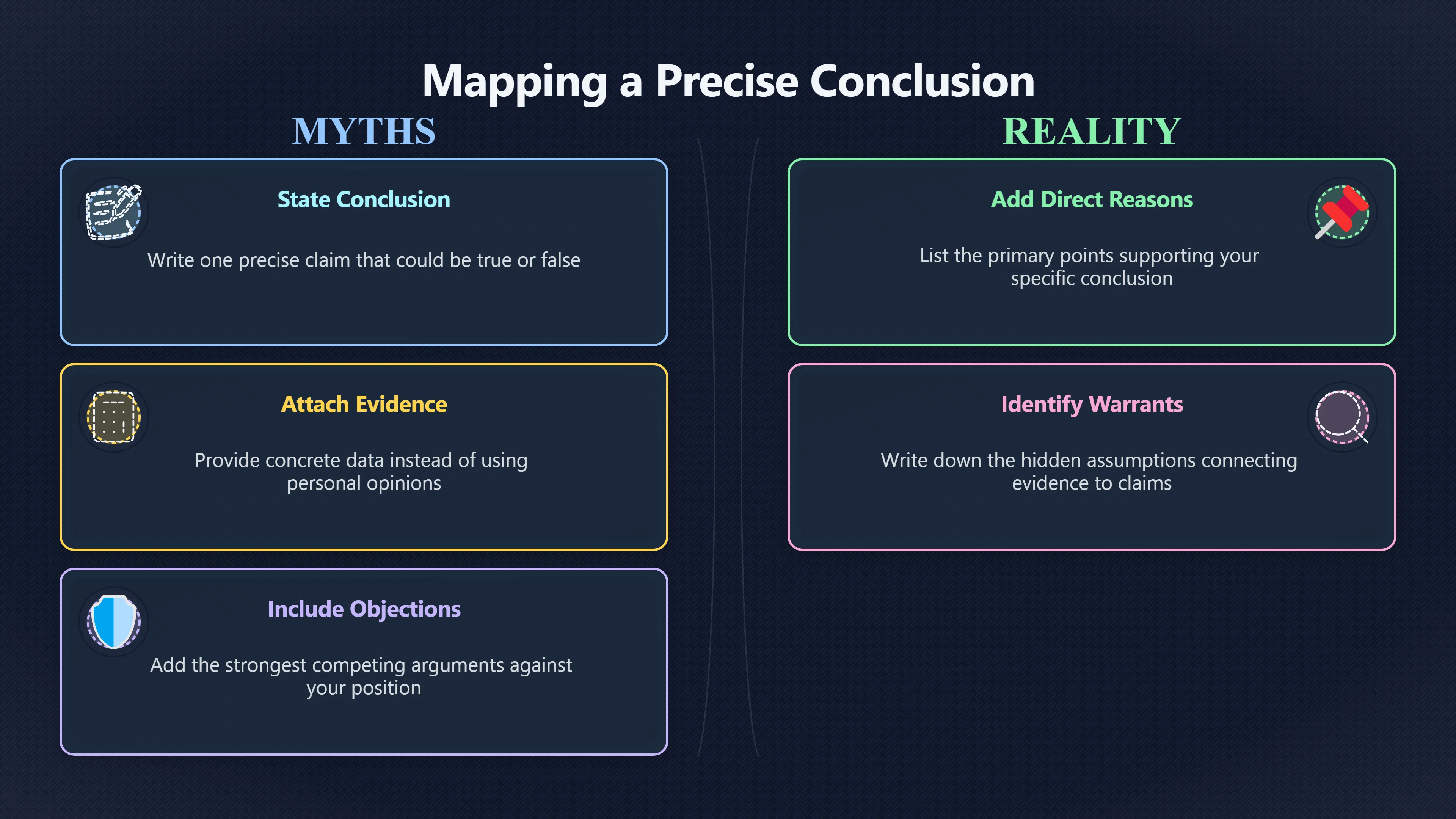
- Write one precise conclusion. Make it a claim that could be true or false rather than a broad subject.
- Add the direct reasons that support the conclusion.
- Attach evidence beneath each reason instead of treating opinion as evidence.
- Identify the hidden assumption connecting each reason to the conclusion. Ask, “Why does this evidence actually support my claim?”
- Add the strongest objections, not merely weak criticisms that are easy to dismiss.

- Evaluate whether the objections defeat the argument or whether stronger evidence or qualifications are needed. CIRIS+2Purdue OWL
For example:
Conclusion: I should accept this new job.
Reasons:
- It offers higher pay.
- It provides better career development.
- The organisation appears financially stable.
Each reason then needs evidence. “Higher pay” becomes an employment contract rather than a rumour. “Career development” becomes promotion history or training opportunities. “Financial stability” becomes audited reports or other reliable indicators.
The map should also include objections:
- The commute is significantly longer.
- The role has greater uncertainty.
- The salary increase may not compensate for higher living costs.
Rather than weakening the exercise, these objections improve it. A conclusion that survives serious objections is generally more reliable than one tested only against friendly evidence.
Hidden assumptions are often the weakest links
One of the most valuable features of argument mapping is exposing warrants—the assumptions that connect reasons to conclusions.
Suppose someone argues:
- Exercise improves memory.
- Therefore everyone should exercise before every examination.
The hidden assumption is that findings about memory improvement automatically justify a universal recommendation for every individual and situation.
Once the assumption is written down, it becomes easier to evaluate. Questions immediately arise:
- How large is the effect?
- Does it apply equally to everyone?
- Does timing matter?
- Are there exceptions?
The reasoning has not necessarily failed, but the map reveals where scrutiny belongs.
The Toulmin model of argumentation explicitly distinguishes between evidence (grounds), the claim being defended, and the warrant that authorises the move from one to the other. It also encourages adding qualifiers, which acknowledge uncertainty, and rebuttals, which identify circumstances where the conclusion may not hold. Purdue OWL
Why objections strengthen rather than weaken your thinking
People often avoid writing objections because they fear it will undermine their own position. In practice, the opposite is usually true.
A well-tested conclusion has already faced the strongest competing explanations before action is taken. This mirrors practices used in law, intelligence analysis and scientific reasoning, where competing hypotheses are deliberately examined rather than ignored. Argument visualisation tools are designed to represent both supporting and opposing arguments because evaluation depends on understanding both sides of the reasoning network. Sage Journals+2OUP Academic
A useful discipline is to ask:
- What would someone intelligent who disagrees with me say?
- Which objection would genuinely make me reconsider?
- What evidence, if discovered tomorrow, would change my mind?
If these questions cannot be answered, the conclusion may be more emotionally committed than analytically justified.
Common mistakes when maps feel cleaner than the thinking
A tidy-looking map does not guarantee sound reasoning. Several common mistakes can make a weak argument appear stronger than it is.
Confusing evidence with reasons. Saying “Experts agree” is not the same as presenting the evidence on which the experts rely.
Leaving assumptions invisible. A map that omits warrants may appear complete while hiding its weakest step.
Using multiple versions of the same reason. Several boxes may repeat essentially identical evidence, creating an illusion of independent support.
Ignoring uncertainty. Conclusions are often stronger when qualified appropriately. Absolute claims frequently require stronger evidence than available.
Adding token objections. Including only weak counterarguments gives a false impression of fairness. The strongest opposing case is usually the most informative test.
Treating maps as advocacy rather than diagnosis. The purpose is not to produce the most persuasive picture but the most accurate representation of the reasoning.
Recent analyses also note that argument maps work better for some forms of reasoning than others. Straightforward evidential arguments often map clearly, whereas analogy, equivocation and some mathematical or reductio arguments can require additional interpretation beyond simple box-and-arrow structures. Springer
Turning argument mapping into a metacognitive habit
[The greatest value of argument mapping comes before important decisions, not afterwards.](#endnote-8 “
Source snippet
Mapping - by Dr. Charles M. Russo, PhDBy placing propositions in nodes and connecting them with arrows denoting support or objection, pra")...
A simple routine is:
- State your conclusion before collecting more reasons.
- Map only the claims that actually support it.
- Search deliberately for evidence that weakens your preferred conclusion.
- Ask whether every arrow in the map represents a justified inference.
- Revise the conclusion if the structure changes.
This transforms mapping from a note-taking technique into a metacognitive tool. Instead of asking whether your argument looks convincing, you ask whether every step genuinely deserves confidence.
Used consistently, argument mapping helps separate confidence from justification. Conclusions become less dependent on intuition or verbal fluency and more dependent on whether the underlying structure can withstand careful inspection. That shift—from defending beliefs to testing them—is one of the central habits of strong analytical thinking.
eBay marketplace picks
Marketplace Samples
Example marketplace items related to this page. Use the search link to explore similar finds on eBay.

Endnotes
1.
Source: Wikipedia
Title: Argument map
Link:https://en.wikipedia.org/wiki/Argument_map
2.
Source: ecampusontario.pressbooks.pub
Link:https://ecampusontario.pressbooks.pub/criticalthinking1234/chapter/introduction/
Source snippet
(See Figure 1, for an example...Read more...
4.
Source: owl.purdue.edu
Title: OWLToulmin Argument
Link:https://owl.purdue.edu/owl/general_writing/academic_writing/historical_perspectives_on_argumentation/toulmin_argument.html
Source snippet
Purdue OWLToulmin Argument - Purdue OWLToulmin, the Toulmin method is a style of argumentation that breaks arguments down into six compon...
5.
Source: academic.oup.com
Link:https://academic.oup.com/lpr/article-pdf/6/1-4/119/2852962/mgm033.pdf
Source snippet
OUP AcademicVisualization tools, argumentation schemes and expert...by D Walton · 2007 · Cited by 41 — This paper is on argumentation sc...
6.
Source: link.springer.com
Link:https://link.springer.com/article/10.1007/s10503-023-09626-5
Source snippet
Some Benefits and Limitations of Modern Argument Map...18 Jan 2024 — Argument maps represent some arguments more effectively tha...
7.
Source: journals.sagepub.com
Title: AAC 181003
Link:https://journals.sagepub.com/doi/10.3233/AAC-181003
Source snippet
Critical questions can be invoked from a menu by clicking on an argument...Read more...
8.
Source: drcharlesmrusso.substack.com
Title: argument mapping
Link:https://drcharlesmrusso.substack.com/p/argument-mapping
Source snippet
Mapping - by Dr. Charles M. Russo, PhDBy placing propositions in nodes and connecting them with arrows denoting support or objection, pra...
9.
Source: oreilly.com
Title: Argument Mapping
Link:https://www.oreilly.com/library/view/an-introduction-to/9780470195093/OEBPS/c11.htm
Source snippet
An Introduction to Critical Thinking...In an argument map, arrows link premises to their conclusions. Here is a simple one with only one...
10.
Source: figma.com
Link:https://www.figma.com/templates/argument-mapping/
Source snippet
Argument Mapping | Free Template | FigJamAn argument map is a box-and-line flowchart that helps you develop any argument. These maps star...
11.
Source: mindonmap.com
Title: argument mapping
Link:https://www.mindonmap.com/blog/argument-mapping/
Source snippet
Furthermore, this map reveals the argument's unseen composition, displaying how to lift the support claim.Read more...
12.
Source: logiccheck.net
Title: introducing argument mapping
Link:https://www.logiccheck.net/post/introducing-argument-mapping
Source snippet
9 Jul 2020 — I'll walk you through how argument mapping works and begin to apply mapping principles to often heated, but perfectly reason...
Additional References
13.
Source: researchgate.net
Link:https://www.researchgate.net/figure/Toulmins-Elements-of-Argumentation_fig1_355685971
Source snippet
Toulmin's Elements of ArgumentationToulmin's model of argumentation, there are six interrelated elements which include a claim, data (evi...
14.
Source: researchgate.net
Link:https://www.researchgate.net/publication/228188551_Visualization_Tools_Argumentation_Schemes_and_Expert_Opinion_Evidence_in_Law
Source snippet
(PDF) Visualization Tools, Argumentation Schemes and...9 Feb 2026 — The visualization of argumentation schemes is illustrated using a ne...
15.
Source: researchgate.net
Link:https://www.researchgate.net/publication/395551953_A_Toulmin_Model_Analysis_of_Student_Argumentation_on_Artificial_Intelligence
Source snippet
(PDF) A Toulmin Model Analysis of Student Argumentation...9 Sept 2025 — This study examines the structure of student argumentation on ar...
16.
Source: gsis.scholasticahq.com
Link:https://gsis.scholasticahq.com/article/125995-argument-mapping-in-intelligence-analysis.pdf
Source snippet
od called argument mapping—to structure argu- ments in reasons and premises, plac...Read more...
17.
Source: psychologytoday.com
Title: improving critical thinking through argument mapping
Link:https://www.psychologytoday.com/gb/blog/thoughts-thinking/201811/improving-critical-thinking-through-argument-mapping
Source snippet
9 Nov 2018 — To clarify, an argument map is a visual representation of a logically structured network of reasoning, in which the argument...
18.
Source: damiantgordon.com
Link:https://www.damiantgordon.com/EducationalModels/CriticalThinking/ArgumentMaps/CriticalThinking-ArgumentMaps-Details.pdf
Source snippet
aying out claims, reasons, objections...Read more...
19.
Source: thetenuretrack.com
Title: Mapping Your Legal Arguments
Link:https://www.thetenuretrack.com/p/mapping-your-legal-arguments
Source snippet
by Etienne Toussaint31 May 2025 — This mapping reveals how different types of evidence and reasoning work together to support the central...
Published: May 2025
20.
Source: youtube.com
Link:http://www.youtube.com/watch?v=rUM2X66gcME
Source snippet
"Argument mapping" critical thinking conclusion reason Argument Mapping 2 - The Reason Conclusion Relationship UW-Stevens Point, Critical...
21.
Source: pt.slideshare.net
Title: lecture 2 arguments
Link:https://pt.slideshare.net/slideshow/lecture-2-arguments/71065736?nway-content_model=D
Source snippet
2 arguments | PPTXThe Toulmin Model insists that we consider the argument of our opposition in constructing our own argument. 20. 1. Clai...
22.
Source: youtube.com
Title: Argument Mapping: Understanding and Making Arguments w/ Nate Otey
Link:http://www.youtube.com/watch?v=kGgLlip_lvc
Source snippet
10.28 - Arguments and Hidden Assumptions...
Topic Tree