Within Teaching
Why Students Need to See Thinking First
Learners reason better when teachers make invisible expert thinking visible before asking for independent analysis.
On this page
- What a reasoning move looks like
- Teacher think alouds and worked examples
- Fading prompts without removing support
Page outline Jump by section
Introduction
Good analysis is difficult to imitate when the mental steps behind it remain invisible. Novices often see an expert produce a strong answer, but they do not see the sequence of decisions, checks and revisions that led there. Modelling reasoning moves before asking learners to analyse independently addresses this problem by making expert thinking visible. Rather than presenting only a finished solution, teachers reveal how they identify evidence, test assumptions, consider alternatives and monitor their own thinking. Research across cognitive science, metacognition and instructional design shows that this combination of explicit modelling, worked examples and gradually reduced support is especially effective for beginners because it reduces unnecessary cognitive load while building reusable reasoning strategies.[Taylor & Francis Online+2EEF]tandfonline.comTaylor & Francis OnlineThe effect of worked examples on learning solution steps…by O Chen · 2023 · Cited by 59 — The worked example ef…
 Within explicit teaching of thinking skills, modelling is the bridge between explanation and independent performance. It gives learners a way to imitate the reasoning process rather than merely copying the final answer.
What a reasoning move looks like
A reasoning move is a deliberate mental action that advances an analysis. Unlike a subject fact, it is transferable across many contexts. For example, a historian, scientist and business analyst may all use the same reasoning moves even though they work with different evidence.
Common reasoning moves include:
- Identifying the central claim before judging it.
- Separating observation from interpretation.
- Asking what evidence supports each conclusion.
- Looking for alternative explanations.
- Testing whether a conclusion still holds if one assumption changes.
- Deciding which evidence deserves the greatest weight.
- Recognising uncertainty instead of forcing premature certainty.
When experts perform these actions silently, learners often assume good analysts simply “know the answer”. Live modelling corrects that misconception by showing that expert judgement is built from many small, observable decisions rather than intuition alone. Think-aloud techniques are specifically designed to externalise these otherwise hidden cognitive processes. Support for Early Career Teachers+2newzealandcurriculum.tahurangi.education.govt.nz[support-for-early-career-teachers.education.gov.uk]support-for-early-career-teachers.education.gov.ukSupport for Early Career Teachers TheoryIt is when a teacher narrates their thoughts…
A useful distinction is between explaining and modelling. Explaining tells students what a strategy is. Modelling demonstrates the strategy while it is actually being used. The latter exposes uncertainty, revision and decision-making that are normally invisible.
Why teacher think-alouds work
A think-aloud is a live demonstration of reasoning in which the teacher verbalises the decisions normally kept internal. Instead of saying only, “This source is unreliable,” the teacher narrates the evaluation process:
“This statistic initially looks convincing, but I notice it comes from an interested organisation. Before accepting it, I want to know who collected the data and whether another source reaches the same conclusion.”
That narration shows not only the conclusion but also the questions that generated it.
Research on metacognitive instruction consistently recommends making planning, monitoring and evaluation explicit rather than assuming learners will discover these habits independently. The Education Endowment Foundation similarly argues that think-alouds help pupils acquire a toolkit of strategies by observing expert decision-making in action.[EEF+2EEF]educationendowmentfoundation.org.ukeef blog the what why when and how of using a think aloud in mathsEEFThe what, why, when and how of using a 'Think Aloud'…22 Feb 2022 — Providing a Think Aloud model helps pupils to develop a toolkit of…
Effective think-alouds usually include several features:
- Purposeful pauses. The teacher stops to explain why a choice is being made.
- Visible uncertainty. Experts demonstrate that changing one’s mind in response to evidence is normal.
- Attention to mistakes. Incorrect paths are acknowledged and corrected rather than hidden.
- Reasoning vocabulary. Terms such as “assumption”, “evidence”, “counter-example” and “confidence” become attached to concrete examples rather than abstract definitions.
One common mistake is over-performing expertise by presenting flawless reasoning. Learners often benefit more when teachers model how experts recover from uncertainty or recognise an initial misconception than when every step appears effortless. This aligns with work distinguishing perfect “expert models” from “coping models”, where learners observe realistic problem-solving rather than idealised performance.[ERIC]files.eric.ed.govThey also model howERICExpert and Coping Models in Writing Instruction and LiteracyJune 29, 2021 — by ZA Traga Philippakos · 2021 · Cited by 22 — Teachers t…
Why worked examples improve early analytical learning
Worked examples extend modelling by providing complete demonstrations that learners can study before attempting similar tasks themselves. Instead of solving every problem from scratch, novices first examine how an expert approached one.
Cognitive Load Theory explains why this matters. Beginners possess limited working memory and relatively undeveloped mental frameworks for organising information. If they must simultaneously understand new concepts and invent solution strategies, much of their mental effort is consumed by searching for what to do next rather than understanding why particular decisions make sense. Worked examples reduce this unnecessary search, allowing learners to focus on the underlying reasoning.[Taylor & Francis Online+2UK]tandfonline.comTaylor & Francis OnlineThe effect of worked examples on learning solution steps…by O Chen · 2023 · Cited by 59 — The worked example ef…
A worked analytical example is most valuable when it explains decisions, not merely outcomes. For instance, after each reasoning step, annotations might answer questions such as:
- Why was this evidence selected?
- Why was this alternative rejected?
- What assumption is being tested?
- What would weaken this conclusion?
Research also shows that prompting learners to generate brief self-explanations while studying worked examples improves understanding because they actively connect each step to the underlying principle rather than passively reading the solution.[Wikipedia]WikipediaWorked-example effectWorked-example effect
Fading prompts without removing support
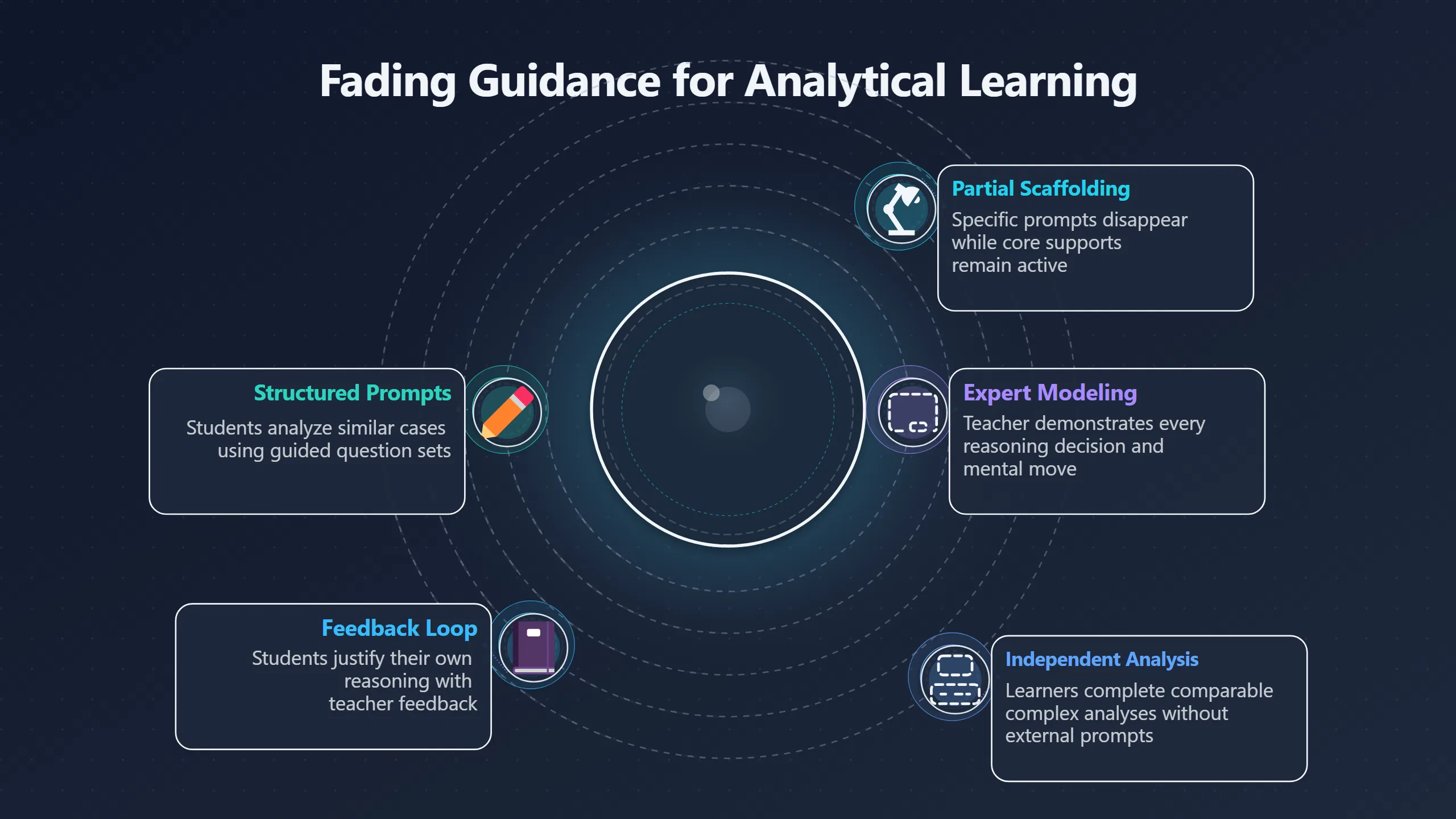
The objective is not permanent dependence on teacher modelling but gradual independence. Educational research refers to this as fading guidance.
A typical progression might look like this:
- The teacher models every reasoning decision.
- Students analyse a similar case using structured prompts.
- Some prompts disappear while others remain.
- Students justify their own reasoning with occasional feedback.
- Students complete comparable analyses independently.
The critical idea is that support decreases only after learners have developed enough understanding to benefit from greater independence. Removing guidance too early often overloads novices, while maintaining detailed guidance for advanced learners can become inefficient.
This balance is reflected in the expertise reversal effect. Instructional methods that strongly benefit beginners—including detailed worked examples—may become unnecessary or even counterproductive once learners have built sufficiently rich mental models. At that stage, increasingly open-ended analytical tasks encourage further growth.[UK+2mr barton maths]uky.eduKalyuga2007 Article ExpertiseReversalEffectAndItsIUKExpertise Reversal Effect and Its Implications for Learner-…by S Kalyuga · 2007 · Cited by 1568 — This paper reviews recent empirica…
Adaptive fading, where support is reduced according to learner progress rather than a fixed schedule, has shown advantages over both immediate independence and rigidly timed withdrawal of guidance.[ResearchGate]researchgate.netThe expertise reversal effect and worked examples in…These partially solved problems could be seen as faded worked example…
What effective modelling sounds like
Strong modelling focuses on reasoning rather than performance. Compare two approaches:
Weak modelling
“This is the correct answer because these are the strongest sources.”
Students learn the conclusion but not how it was reached.
Strong modelling
“I’m comparing these sources before deciding. One contains recent primary evidence, while another repeats earlier reports without adding new information. I’m giving greater weight to the first because it directly supports the claim. Before I commit, I’ll check whether an alternative explanation also fits the evidence.”
Here the reasoning moves become visible:
- comparing evidence,
- weighing reliability,
- checking alternatives,
- delaying commitment until sufficient evidence exists.
The learner can now imitate the process even when facing an entirely different topic.

Common implementation mistakes
Simply asking students to “think critically” is rarely enough if they have never observed critical thinking being performed. Several implementation problems repeatedly reduce the effectiveness of modelling.
Showing only polished answers. Finished products hide the reasoning process learners most need to observe.
Explaining instead of demonstrating. Talking about evaluation is less effective than evaluating a real example in front of students.
Removing scaffolding too quickly. Beginners often appear capable while following a demonstration but struggle when supports disappear abruptly. Gradual fading is generally more successful.[mr barton maths]mrbartonmaths.comThe Expertise Reversal Effectfading out procedure was superior to an abrupt switch from worked examples to problems. The advantage of reducing guidance with increases…
Overloading demonstrations. Long think-alouds that verbalise every possible thought can overwhelm learners. Effective models concentrate on the most important reasoning decisions rather than narrating every detail.[Research Schools Network]researchschool.org.ukmastering modellingResearch Schools NetworkMastering Modelling | Durrington Research School25 Jan 2019 — Effective modelling should enable students to refle…
Ignoring disciplinary differences. Historians, scientists, mathematicians and literary critics all evaluate evidence differently. The reasoning moves should therefore reflect authentic practice within the discipline instead of presenting generic critical-thinking advice.[EEF]educationendowmentfoundation.org.ukeef blog the student as apprentice the power of the think aloudEEFThe student as apprentice: the power of the "think aloud"24 Jan 2024 — Chloe Butlin, our literacy specialist, explains how “think alou…
The lasting value of making thinking visible
The central benefit of modelling reasoning before independent analysis is that it converts expert judgement from something mysterious into something learnable. Students begin to recognise that strong analysis is built from identifiable moves—questioning evidence, testing assumptions, comparing explanations and revising conclusions—not from innate talent.
Once these moves become familiar through repeated modelling, supported practice and carefully faded guidance, learners are better prepared to perform them independently across new problems and new subject areas. Rather than memorising isolated procedures, they develop habits of reasoning that can transfer beyond the original lesson because they understand not only what experts conclude, but how experts think.
Amazon book picks
Further Reading
Books and field guides related to Why Students Need to See Thinking First. Use these as the next step if you want deeper reading beyond the article.
Making Thinking Visible
Directly supports making reasoning visible before expecting independent student performance.
Visible Learning and the Science of How We Learn
Covers modelling, feedback, cognitive load, and how learners acquire strategies.
How Learning Works
Explains practice, feedback, prior knowledge, and metacognition as foundations for modelling reasoning.
Teach Like a Champion 3.0
Includes concrete instructional techniques for modelling, questioning, checking understanding, and guided practice.
eBay marketplace picks
Marketplace Samples
Live-tested eBay searches with available results related to this page.

Top pick
critical thinking game
Open a targeted eBay search for items related to this topic.
Browse eBay

Related search
need memorabilia
Open a targeted eBay search for items related to this topic.
Browse eBay
Endnotes
1.
Source: educationendowmentfoundation.org.uk
Title: eef blog the what why when and how of using a think aloud in maths
Link:https://educationendowmentfoundation.org.uk/news/eef-blog-the-what-why-when-and-how-of-using-a-think-aloud-in-maths
Source snippet
EEFThe what, why, when and how of using a 'Think Aloud'…22 Feb 2022 — Providing a Think Aloud model helps pupils to develop a toolkit of...
2.
Source: newzealandcurriculum.tahurangi.education.govt.nz
Title: Model thinking aloud
Link:https://newzealandcurriculum.tahurangi.education.govt.nz/model-thinking-aloud/5637219640.p
Source snippet
By verbalising his or her thoughts, a teacher can model the strategies they use to understand...Read more...
3.
Source: educationendowmentfoundation.org.uk
Title: eef blog the student as apprentice the power of the think aloud
Link:https://educationendowmentfoundation.org.uk/news/eef-blog-the-student-as-apprentice-the-power-of-the-think-aloud
Source snippet
EEFThe student as apprentice: the power of the "think aloud"24 Jan 2024 — Chloe Butlin, our literacy specialist, explains how “think alou...
4.
Source: files.eric.ed.gov
Title: They also model how
Link:https://files.eric.ed.gov/fulltext/EJ1303499.pdf
Source snippet
ERICExpert and Coping Models in Writing Instruction and LiteracyJune 29, 2021 — by ZA Traga Philippakos · 2021 · Cited by 22 — Teachers t...
Published: June 29, 2021
5.
Source: researchgate.net
Link:https://www.researchgate.net/publication/304677724_Learning_From_K-5_Teachers_Who_Think_Aloud
Source snippet
(PDF) Learning From K-5 Teachers Who Think AloudThe overarching objective of this study was to explore how to better prepare early career...
6.
Source: Wikipedia
Title: Worked-example effect
Link:https://en.wikipedia.org/wiki/Worked-example_effect
7.
Source: researchgate.net
Link:https://www.researchgate.net/publication/226748784_The_expertise_reversal_effect_and_worked_examples_in_tutored_problem_solving
Source snippet
The expertise reversal effect and worked examples in...These partially solved problems could be seen as faded worked example...
8.
Source: researchgate.net
Link:https://www.researchgate.net/publication/48829036_The_Expertise_Reversal_Effect
Source snippet
(PDF) The Expertise Reversal EffectIn this article, we review the empirical literature on the interaction between instructional technique...
9.
Source: tandfonline.com
Link:https://www.tandfonline.com/doi/full/10.1080/01443410.2023.2273762
Source snippet
Taylor & Francis OnlineThe effect of worked examples on learning solution steps...by O Chen · 2023 · Cited by 59 — The worked example ef...
10.
Source: uky.edu
Title: Kalyuga2007 Article ExpertiseReversalEffectAndItsI
Link:https://www.uky.edu/~gmswan3/EDC608/Kalyuga2007_Article_ExpertiseReversalEffectAndItsI.pdf
Source snippet
UKExpertise Reversal Effect and Its Implications for Learner-...by S Kalyuga · 2007 · Cited by 1568 — This paper reviews recent empirica...
11.
Source: support-for-early-career-teachers.education.gov.uk
Title: Support for Early Career Teachers Theory
Link:https://support-for-early-career-teachers.education.gov.uk/teach-first/year-1-what-makes-classroom-practice-effective/spring-week-2-ect-theory/
Source snippet
It is when a teacher narrates their thoughts...
12.
Source: mrbartonmaths.com
Title: The Expertise Reversal Effect
Link:https://mrbartonmaths.com/resourcesnew/8.%20Research/Explicit%20Instruction/The%20Expertise%20Reversal%20Effect.pdf
Source snippet
fading out procedure was superior to an abrupt switch from worked examples to problems. The advantage of reducing guidance with increases...
13.
Source: researchschool.org.uk
Title: mastering modelling
Link:https://researchschool.org.uk/durrington/news/mastering-modelling
Source snippet
Research Schools NetworkMastering Modelling | Durrington Research School25 Jan 2019 — Effective modelling should enable students to refle...
14.
Source: researchschool.org.uk
Title: live modelling with think aloud
Link:https://researchschool.org.uk/shottonhall/news/live-modelling-with-think-aloud
Source snippet
Research Schools NetworkLive Modelling with Think-Aloud | Shotton Hall...28 Nov 2024 — Live modelling, or “thinking out loud” as you dem...
15.
Source: researchschool.org.uk
Title: making thinking visible using think aloud in reading
Link:https://researchschool.org.uk/north-london/news/making-thinking-visible-using-think-aloud-in-reading
Source snippet
Think aloud is a form of modelling in which teachers verbalise the thinking that accompanies reading...
16.
Source: tandfonline.com
Link:https://www.tandfonline.com/doi/abs/10.1080/19388071.2023.2267608
Source snippet
Making Thinking Explicit: A Skill Continuum of Preservice...by SM Pratt · 2025 · Cited by 4 — The present study presents a Skill Continu...
17.
Source: aare.edu.au
Link:https://www.aare.edu.au/data/publications/2003/teo03389.pdf
Source snippet
Metacognitive Intervention Strategy and Word Problem...A modified Artzt and Armour-Thomas' framework (1992) was used to analyse the stud...
18.
Source: education.nsw.gov.au
Link:https://education.nsw.gov.au/content/dam/main-education/documents/teaching-and-learning/curriculum/explicit-teaching/explicit-teaching-modelling-technique-guide.pdf
Source snippet
technique guideThe teacher models the thinking process, strategies and steps required for a learning task. The teacher makes links to p...
Additional References
19.
Source: redesignu.org
Link:https://www.redesignu.org/wp-content/uploads/2021/03/Instruction_-Explicit-Skill-Strategy-Instruction_reDesign.pdf
Source snippet
EXPLICIT SKILL & STRATEGY INSTRUCTION | reDesignCASE STUDY: WHAT DOES IT LOOK LIKE? Metacognitive Modeling via a Think Aloud: Clarissa Gr...
20.
Source: youtube.com
Link:https://www.youtube.com/watch?v=17Iia-2yYW4
Source snippet
Using a 'Think Aloud' to support pupils' problem-solvingDuring a 'Think Aloud', teachers narrate their thought processes to demonstrate h...
21.
Source: edutopia.org
Title: The Think-Aloud Strategy: An Oldie But Goodie It’s the old apprentice model
Link:https://www.edutopia.org/blog/think-aloud-strategy-oldie-but-goodie-elena-aguilar
Source snippet
Early childhood teachers can use these strategies and questions to unobtrusively guide students to develop metacognition.Read more...
22.
Source: eduaide.ai
Title: worked examples manage cognitive load and simplify complex concepts
Link:https://www.eduaide.ai/blog/worked-examples-manage-cognitive-load-and-simplify-complex-concepts
Source snippet
Worked Examples: Manage Cognitive Load and Simplify...Feb 13, 2025 — Expertise Reversal Effect: Worked examples are most beneficial for...
23.
Source: scribd.com
Title: P Sweller Ayres Kalyuga Chandler 2003 Expertise Reversal Effect
Link:https://www.scribd.com/document/346225871/P-Sweller-Ayres-Kalyuga-Chandler-2003-Expertise-Reversal-Effect
Source snippet
(P) (Sweller, Ayres, Kalyuga, Chandler, 2003) Expertise...The expertise reversal effect challenges the one-size-fits-all approach by dem...
24.
Source: structural-learning.com
Title: reading comprehension strategies in the classroom
Link:https://www.structural-learning.com/post/reading-comprehension-strategies-in-the-classroom
Source snippet
30 Apr 2026 — Explicit instruction of a repertoire of comprehension strategies significantly enhances learners' understanding · Fostering...
25.
Source: cambridge.org
Link:https://www.cambridge.org/core/books/cambridge-handbook-of-expertise-and-expert-performance/cognitive-load-and-expertise-reversal/03F656FD334F23214426ACB4118FEBF9
Source snippet
ative deterioration in expert learning performance under some...Read more...
26.
Source: eprints.soton.ac.uk
Title: Final JLI TA with ET video perspectives paper
Link:https://eprints.soton.ac.uk/452176/1/Final_JLI_TA_with_ET_video_perspectives_paper.pdf
Source snippet
the affordances of think-aloud elicited by two...by N McIntyre · 2022 · Cited by 32 — In all, the study sets out to investigate how thes...
27.
Source: oxford-review.com
Title: what is the expertise reversal effect
Link:https://oxford-review.com/what-is-the-expertise-reversal-effect/
Source snippet
When novices are learning they don't have a mental framework or schema about the subject.Read more...
28.
Source: my.chartered.college
Link:https://my.chartered.college/impact_article/expertise-reversal-effect-and-its-instructional-implications/
Source snippet
Reversal Effect and its Instructional ImplicationsSep 12, 2018 — The expertise reversal effect suggests that learning materials and tasks...
Topic Tree