Within Humility
How Confident Should You Really Be?
Good judgement improves when confidence is scaled to the quality, independence and directness of the evidence behind a claim.
On this page
- Why confidence should have a size
- Evidence types that deserve different weight
- Common signs of overconfidence and underconfidence
Page outline Jump by section
Introduction
Good judgement does not require perfect certainty. It requires matching your level of confidence to the strength of the evidence available. That means being highly confident when multiple, independent, direct sources point to the same conclusion, moderately confident when the evidence is suggestive but incomplete, and cautious when the evidence is weak, indirect or conflicting. This ability—often called confidence calibration—is one of the practical foundations of intellectual humility. It allows you to act before certainty while avoiding both unwarranted certainty and unnecessary hesitation. Research across psychology, decision science and medicine consistently finds that people often miscalibrate their confidence, becoming either more certain or less certain than the evidence justifies.[PMC+2The American Journal of Medicine]pmc.ncbi.nlm.nih.govPMCAn Experimental Study of Overconfidence Biases in Young DecisionThis strong alignment supports the notion that overconfidence is associated with poorer…
 Rather than asking, “Am I confident?”, a better question is, “How much confidence does this evidence deserve?” That shift changes confidence from a personality trait into a judgement that can be adjusted as evidence improves or weakens.
Why confidence should have a size
Confidence is not an all-or-nothing state. It is better understood as a scale. The ideal is for your certainty to increase or decrease in proportion to the reliability, independence and relevance of the evidence supporting a claim.
A useful way to think about this is that confidence should earn its way upwards. Every increase in confidence should be backed by something concrete, such as an additional independent source, a stronger method, direct observation instead of inference, or repeated successful predictions.
Calibration researchers define good judgement as a close match between expressed confidence and actual accuracy. If someone says they are 80% confident across many comparable judgements, roughly 80% of those judgements should eventually prove correct. Perfect calibration is difficult, but it is a practical target because it reduces predictable errors in decision-making.[Wiley Online Library+2American Psychological Association]onlinelibrary.wiley.comWiley Online LibraryCalibration Feedback With the Practical Scoring Rule Does…by M Martin · 2025 · Cited by 1 — We examined the effect…
This perspective also explains why intellectual humility is not the same as constant doubt. A calibrated thinker may express very high confidence when the evidence genuinely warrants it. Humility lies in allowing confidence to track evidence rather than identity, emotion or social pressure.
Evidence types that deserve different weight
Not all evidence deserves equal confidence. Good judgement depends on recognising which forms of evidence should move your confidence substantially and which should only nudge it.
Evidence characteristicAppropriate effect on confidenceMultiple independent sources reaching the same conclusionLarge increaseDirect measurements or observationsLarger increase than indirect inferenceEvidence replicated across different settingsLarger increaseSingle anecdote or personal experienceSmall increaseClaims from interested parties with incentives to persuadeLimited increase until independently verifiedEvidence that conflicts across high-quality sourcesReduced confidence until resolved
Several practical questions help determine how much weight evidence deserves:
- How direct is it? Seeing something measured directly is generally stronger than relying on several layers of interpretation.
- How independent is it? Ten reports that all originate from the same source do not provide ten independent pieces of evidence.
- How consistent is it? Agreement across unrelated studies or observers usually deserves more confidence than isolated findings.
- How well has it survived attempts to disprove it? Claims repeatedly tested without being overturned deserve greater confidence than claims that have never faced serious scrutiny.
In evidence-based medicine, frameworks such as GRADE distinguish between stronger and weaker evidence by considering study design, consistency, directness and risk of bias. Although developed for healthcare, the underlying principle applies broadly: confidence should reflect evidence quality, not simply evidence quantity.[ResearchGate]researchgate.netCalibrate your confidence in research findings: A tutorial on…April 24, 2020 — 24 Apr 2020 — This article provides an acce…
Common signs of overconfidence and underconfidence
Poor calibration can fail in two directions. Most discussions focus on overconfidence, but excessive caution also reduces judgement quality.
Overconfidence
Overconfidence appears when certainty grows faster than the evidence supports. Research distinguishes several forms, including overestimating one’s performance, believing one performs better than others, or expressing unwarranted precision about uncertain conclusions.[P.J. Healy]healy.econ.ohio-state.eduMoore Healy Trouble With OverconfidenceThe Trouble With Overconfidence - P.J. HealyJune 30, 2008 — by DA Moore · 2008 · Cited by 3885 — Experimental evidence shows that re…
Common warning signs include:
- Speaking in absolutes despite limited evidence.
- Treating confidence itself as proof.
- Ignoring missing information because existing evidence feels persuasive.
- Becoming resistant to updating after new contradictory evidence appears.
- Confusing expertise in one area with expertise in another.
Studies also suggest that overconfidence is often fuelled by neglecting what is unknown. People naturally pay attention to the evidence they possess while overlooking information they have not yet sought or may never have encountered.[ResearchGate]researchgate.netKnown Unknowns: A Critical Determinant of Confidence…We propose that an important determinant of judged confidence is the…

Underconfidence
Underconfidence receives less attention but can also impair thinking. Someone may hesitate to act despite strong, consistent evidence or repeatedly discount their own well-supported conclusions.
Signs include:
- Demanding impossible levels of certainty before deciding.
- Giving weak evidence and strong evidence nearly identical confidence.
- Constantly reopening settled questions without new information.
- Assuming every disagreement means the evidence is evenly balanced.
Research on calibration shows that different tasks can produce different patterns. Difficult tasks often encourage overconfidence about performance, while easier tasks sometimes produce underestimation. The goal is therefore not maximum caution but accurate calibration.[P.J. Healy]healy.econ.ohio-state.eduMoore Healy Trouble With OverconfidenceThe Trouble With Overconfidence - P.J. HealyJune 30, 2008 — by DA Moore · 2008 · Cited by 3885 — Experimental evidence shows that re…
A practical way to scale confidence
Instead of thinking in vague terms such as “certain” or “unsure”, deliberately tie confidence to identifiable properties of the evidence.
One practical framework is:
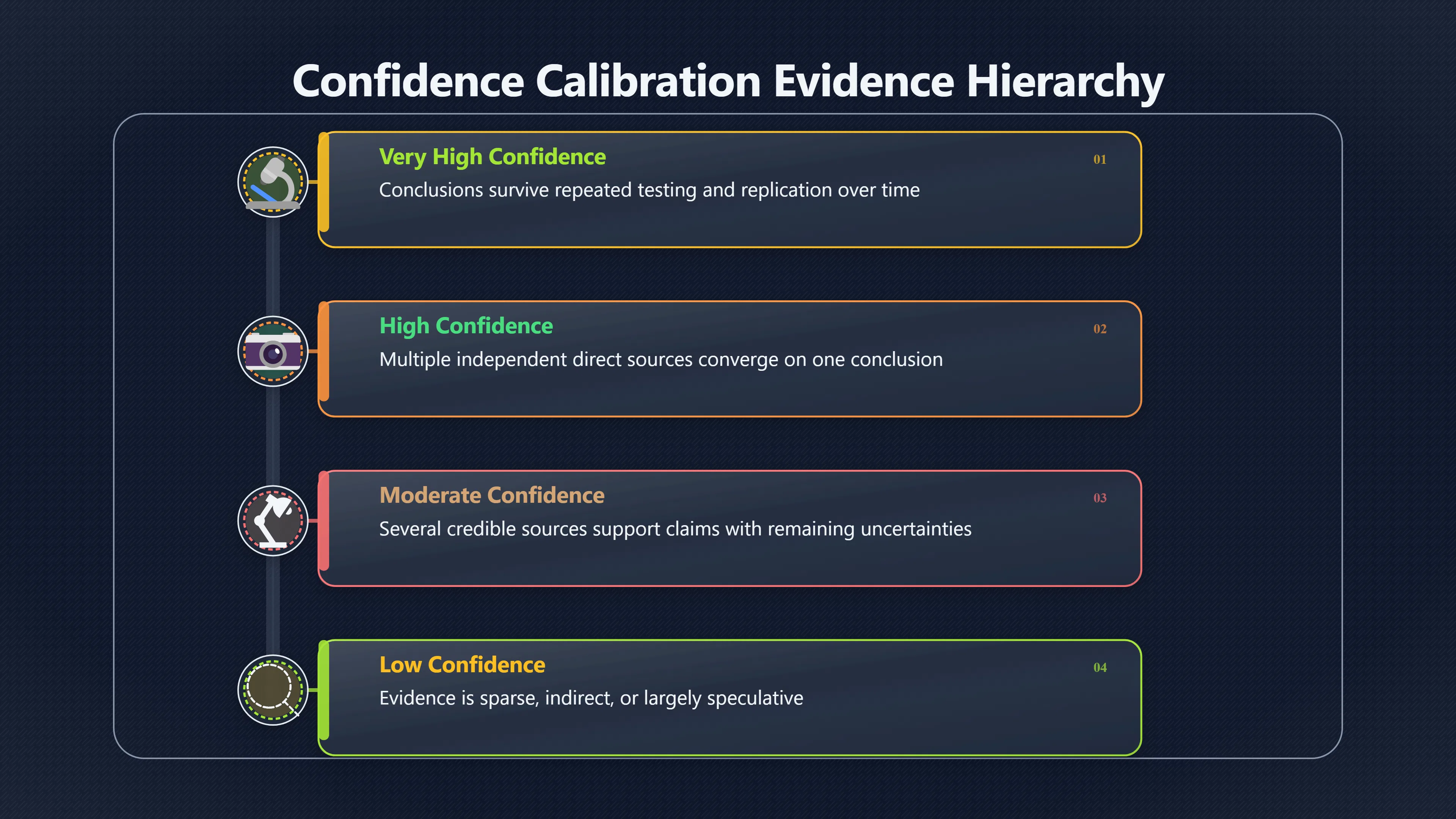
- Low confidence: evidence is sparse, indirect, unverified or largely speculative.
- Moderate confidence: several credible sources support the claim, but important uncertainties remain.
- High confidence: multiple independent, direct and consistent sources converge, and plausible alternatives have been carefully examined.
- Very high confidence: conclusions have repeatedly survived testing, prediction and replication over time.
The precise percentages matter less than consistency. The important habit is explaining why your confidence sits where it does.
For example:
- “I’m only slightly confident because this relies on a single witness.”
- “I’m reasonably confident because three independent studies reached similar conclusions.”
- “I’m highly confident because direct measurements have been replicated by different groups.”
These explanations make confidence transparent and easier to revise when new evidence appears.
Updating confidence as evidence changes
Calibration is dynamic rather than fixed. New evidence should change confidence by an amount proportional to its quality.
A single weak study should rarely overturn years of consistent evidence. Equally, one well-designed experiment may substantially change confidence if previous evidence was weak or uncertain. The key is avoiding two common mistakes:
- refusing to update because changing your mind feels like admitting failure; or
- swinging from certainty to certainty whenever a new claim appears.
Intellectual humility encourages gradual adjustment rather than dramatic reversals. Confidence should move because the evidence has changed—not because the conversation, headlines or social environment have changed.
Research linking intellectual humility with metacognitive calibration suggests that people who better recognise the limits of their own knowledge tend to produce confidence judgements that more closely match their actual performance, reducing systematic overconfidence.[Taylor & Francis Online]tandfonline.comTwo studies examined whether Intellectual Humility moderates the Dunning-Kruger Effect – the tendency of those with little relative…
Confidence is a judgement, not an identity
One of the most useful distinctions is between believing strongly because the evidence is strong and believing strongly because the belief has become part of your identity.
Confidence grounded in evidence can rise or fall without threatening self-worth. Identity-based confidence resists revision because changing the belief feels personally costly.
This distinction supports the broader aim of intellectual humility. You do not need to become less decisive. Instead, become more deliberate about why you are decisive. The strongest thinkers are not those who always sound certain; they are those whose certainty consistently expands and contracts in proportion to the quality, independence and directness of the evidence before them.
Amazon book picks
Further Reading
Books and field guides related to How Confident Should You Really Be?. Use these as the next step if you want deeper reading beyond the article.
Superforecasting
Directly models matching confidence to evidence and updating views as facts change.
The Scout Mindset
Encourages truth-seeking, calibrated belief, and separating confidence from ego.
How to Measure Anything
Shows how uncertainty can be reduced, measured, and expressed more clearly.
eBay marketplace picks
Marketplace Samples
Example marketplace items related to this page. Use the search link to explore similar finds on eBay.




Endnotes
1.
Source: pmc.ncbi.nlm.nih.gov
Title: PMCAn Experimental Study of Overconfidence Biases in Young Decision
Link:https://pmc.ncbi.nlm.nih.gov/articles/PMC12730000/
Source snippet
This strong alignment supports the notion that overconfidence is associated with poorer...
2.
Source: onlinelibrary.wiley.com
Link:https://onlinelibrary.wiley.com/doi/full/10.1002/ffo2.199
Source snippet
Wiley Online LibraryCalibration [Feedback]({{ 'feedback/' | relative_url }}) With the Practical Scoring Rule Does...by M Martin · 2025 · Cited by 1 — We examined the effect...
3.
Source: researchgate.net
Link:https://www.researchgate.net/publication/340889782_Calibrate_your_confidence_in_research_findings_A_tutorial_on_improving_research_methods_and_practices
Source snippet
Calibrate your confidence in research findings: A tutorial on...April 24, 2020 — 24 Apr 2020 — This article provides an acce...
Published: April 24, 2020
4.
Source: healy.econ.ohio-state.edu
Title: Moore Healy Trouble With Overconfidence
Link:https://healy.econ.ohio-state.edu/papers/Moore_Healy-TroubleWithOverconfidence.pdf
Source snippet
The Trouble With Overconfidence - P.J. HealyJune 30, 2008 — by DA Moore · 2008 · Cited by 3885 — Experimental evidence shows that re...
Published: June 30, 2008
5.
Source: researchgate.net
Link:https://www.researchgate.net/publication/322365394_Known_Unknowns_A_Critical_Determinant_of_Confidence_and_Calibration
Source snippet
Known Unknowns: A Critical Determinant of Confidence...We propose that an important determinant of judged confidence is the...
6.
Source: researchgate.net
Link:https://www.researchgate.net/publication/383853185_The_effect_of_calibration_training_on_the_calibration_of_intelligence_analysts%27_judgments
Source snippet
y comparing the miscalibration and bias of their judgments...Read more...
7.
Source: researchgate.net
Link:https://www.researchgate.net/publication/386057594_Individual_differences_in_overconfidence_A_new_measurement_approach
Source snippet
retest design compared to the other overconfidence measures (i.e., cognitive and numeracy...
8.
Source: researchgate.net
Link:https://www.researchgate.net/publication/398820406_Academic_Attainment_Intellectual_Humility_and_Self-Confidence_Unpacking_the_Dunning-Kruger_Paradox_in_Higher_Education
Source snippet
Unpacking the Dunning–Kruger Paradox in Higher Education21 Dec 2025 — Yet accumulating evidence suggests that advanced study can cultivat...
9.
Source: amjmed.com
Link:https://www.amjmed.com/article/S0002-9343%2808%2900152-6/fulltext
Source snippet
The American Journal of MedicineOverconfidence in Clinical Decision Makingby P Croskerry · 2008 · Cited by 400 — Importantly, overconfide...
10.
Source: tandfonline.com
Link:https://www.tandfonline.com/doi/abs/10.1080/17439760.2021.1975155
Source snippet
Two studies examined whether Intellectual Humility moderates the Dunning-Kruger Effect – the tendency of those with little relative...
11.
Source: apa.org
Link:https://www.apa.org/pubs/journals/features/xap-10-3-156.pdf
Source snippet
American Psychological AssociationConfidence–Accuracy Calibration in Absolute and Relative...by N Weber · 2004 · Cited by 207 — Confiden...
12.
Source: pmc.ncbi.nlm.nih.gov
Link:https://pmc.ncbi.nlm.nih.gov/articles/PMC10535625/
Source snippet
humility: an old problem in a new psychological...by W Bąk · 2021 · Cited by 29 — The concept of intellectual humility is relatively new...
13.
Source: pmc.ncbi.nlm.nih.gov
Link:https://pmc.ncbi.nlm.nih.gov/articles/PMC12101119/
Source snippet
a Measure of Confidence to a Measure of the Level of...by D Defays · 2025 · Cited by 1 — Various mathematical models of confidence calib...
Additional References
14.
Source: funblocks.net
Link:https://www.funblocks.net/thinking-matters/classic-mental-models/epistemic-humility
Source snippet
Epistemic HumilityEpistemic Humility is a mental model characterized by recognizing the limits of one's knowledge and being open to revis...
15.
Source: marketing.wharton.upenn.edu
Link:https://marketing.wharton.upenn.edu/wp-content/uploads/2015/04/WALTERS-DANIELS-JMP.pdf
Source snippet
Marketing DepartmentKnown Unknowns: A Critical Determinant of Confidence...by DJ Walters · Cited by 94 — We propose that an important de...
16.
Source: semanticscholar.org
Link:https://www.semanticscholar.org/paper/Overconfident-and-unaware%3A-Intellectual-humility-of-Leman-Kurinec/1e8f011d424048105b9a37ccda95862953933dca
Source snippet
Intellectual humility and the calibration of metacognitionIs intellectual humility related to more accuracy and less overconfidence? · Ps...
17.
Source: novakkevin.medium.com
Link:https://novakkevin.medium.com/the-confidence-calibration-problem-why-self-assessment-fails-us-at-the-worst-possible-moments-87a6cd9ec11d
Source snippet
Confidence Calibration Problem: Why Self-Assessment...The core insight is deceptively simple: the skills required to produce excellent w...
18.
Source: ejmste.com
Link:https://www.ejmste.com/download/whats-about-the-calibration-between-confidence-and-accuracy-findings-in-probabilistic-problems-from-7780.pdf
Source snippet
What's about the Calibration between Confidence and...by M Agus · 2019 · Cited by 9 — The purpose of this research is to investigate the...
19.
Source: youtube.com
Link:https://www.youtube.com/watch?v=eq6SCQNQNsc
Source snippet
Overconfidence Bias | Psychology of Decision-MakingOverconfidence bias occurs when people believe they are more accurate, skilled, or inf...
20.
Source: verywellmind.com
Link:https://www.verywellmind.com/overconfidence-bias-8707133
Source snippet
It can lead to poor decisions and risky behavior. Here's why it happens, and what...
21.
Source: frontiersin.org
Link:https://www.frontiersin.org/journals/psychology/articles/10.3389/fpsyg.2022.939949/full
Source snippet
Two Concepts of Belief Strength: Epistemic Confidence and Identity...There are two distinct psychological features to which “strong beli...
22.
Source: medium.com
Link:https://medium.com/%40vplevris/the-dunning-kruger-effect-why-we-think-were-smarter-than-we-are-85ae4ca86929
Source snippet
es with [practice]({{ 'practice/' | relative_url }}) and evidence, not just self-belief. · Seek...Read more...
23.
Source: philosophyetc.net
Title: Epistemic Calibration Bias and Blame-Aversion
Link:https://www.philosophyetc.net/2021/01/epistemic-calibration-bias-and-blame.html
Source snippet
Philosophy, et ceteraJanuary 18, 2021 — The ideal is to be epistemically well-calibrated: to have just the degree of confidence in an imp...
Published: January 18, 2021
Topic Tree