Within Feedback
Why Confident Mistakes Can Teach More
Being confidently wrong can be useful when corrective feedback clearly shows the gap between belief and reality.
On this page
- What makes an error memorable
- Why correction matters more than embarrassment
- How to capture high confidence misses
Page outline Jump by section
Introduction
Being confidently wrong can be one of the most powerful learning experiences—but only if the mistake is followed by clear, accurate correction. Simply making errors does not reliably improve thinking. What matters is the comparison between what you strongly believed and what reality demonstrates instead. This comparison creates a distinctive learning signal that helps people update knowledge, recalibrate confidence, and remember the correct answer more effectively in the future. Research in cognitive psychology has repeatedly found that errors made with high confidence are often corrected more successfully than hesitant mistakes once learners receive immediate, specific feedback.[PubMed]pubmed.ncbi.nlm.nih.govLearning from Errorsby J Metcalfe · 2017 · Cited by 848 — Experimental investigations indicate that errorful learning followed by c…
 Within a broader feedback loop for better judgement, high-confidence errors deserve special attention because they reveal where our mental models diverge most sharply from reality. Rather than treating these moments as embarrassing failures, they can be viewed as high-value opportunities to refine beliefs and improve future decisions.
What makes a high-confidence error so memorable?
The surprising finding from decades of experimental research is that confident mistakes often leave a stronger learning trace than uncertain ones. Researchers refer to this as the hypercorrection effect: after receiving corrective feedback, people are more likely to remember the right answer when their original incorrect response was given with high confidence than when they were only guessing.[PubMed]pubmed.ncbi.nlm.nih.govErrors committed with high confidence are hypercorrectedby B Butterfield · 2001 · Cited by 334 — This state of affairs implies that…
At first glance, this seems counterintuitive. Strongly held beliefs might appear harder to replace than weak ones. Instead, the opposite frequently occurs because the correction violates a confident expectation. The unexpected feedback captures attention and encourages deeper processing.
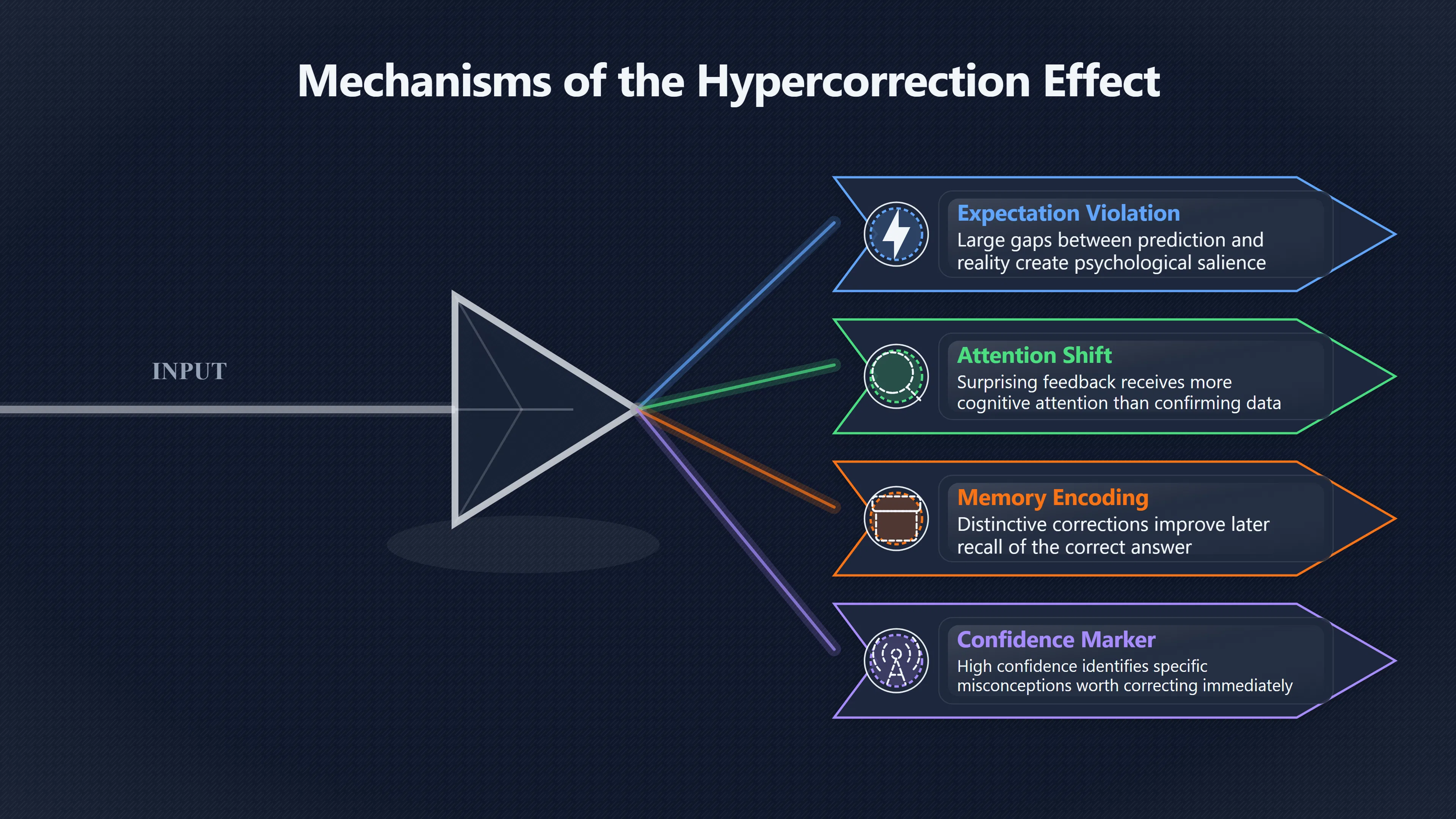
Several mechanisms appear to contribute:
- Expectation violation. Discovering that a strongly held belief is false creates a large gap between prediction and reality, making the correction more psychologically salient.[PubMed]pubmed.ncbi.nlm.nih.govPub Med Surprising feedback improves later memorySurprising feedback improves later memory - PubMed - NIHby LK Fazio · 2009 · Cited by 203 — The hypercorrection effect is the findi…
- Greater attention to corrective information. Experiments suggest that surprising feedback receives more cognitive attention than feedback confirming existing beliefs, improving later recall.[PubMed]pubmed.ncbi.nlm.nih.govPub Med Surprising feedback improves later memorySurprising feedback improves later memory - PubMed - NIHby LK Fazio · 2009 · Cited by 203 — The hypercorrection effect is the findi…
- Improved memory encoding. Because the correction is distinctive, learners often remember both the mistake and its replacement more effectively than after low-confidence errors.[PMC]pmc.ncbi.nlm.nih.govPMCSurprising feedback improves later memoryNIHby LK Fazio · 2009 · Cited by 203 — The hypercorrection effect is the finding that high-confidence errors are more likely to be…
The important implication is that confidence itself is not the problem. Unchecked confidence is. Once paired with accurate feedback, confidence can become a marker pointing towards misconceptions worth correcting.
Why correction matters more than embarrassment
The educational value of confident mistakes comes from corrective information, not from the emotional discomfort of being wrong.
Janet Metcalfe’s review of research concludes that errorful learning benefits memory when learners receive the correct answer after making the mistake. Without correction, repeated errors simply reinforce inaccurate knowledge.[PubMed]pubmed.ncbi.nlm.nih.govLearning from Errorsby J Metcalfe · 2017 · Cited by 848 — Experimental investigations indicate that errorful learning followed by c…
This distinction matters because many people incorrectly assume that failure automatically produces growth. In reality:
- An uncorrected mistake teaches very little.
- Delayed or ambiguous feedback weakens learning.
- Incorrect feedback can strengthen false beliefs.
- Immediate, accurate correction tied directly to the mistaken belief produces the strongest learning signal.[PubMed]pubmed.ncbi.nlm.nih.govLearning from Errorsby J Metcalfe · 2017 · Cited by 848 — Experimental investigations indicate that errorful learning followed by c…
Research also challenges the idea that embarrassment is the active ingredient. While discovering an error may produce surprise or discomfort, these emotions do not themselves improve judgement. Learning improves because attention shifts towards information that resolves the conflict between expectation and reality.[ResearchGate]researchgate.netThe correction of errors committed with high confidenceThe explanation that is tested here, in two experiments, is that after…
This is why productive learning environments encourage admitting uncertainty and examining mistakes rather than hiding them. The goal is to maximise correction, not humiliation.
High-confidence misses reveal hidden assumptions
A confident error usually signals more than an incorrect fact. It often exposes an underlying assumption that has become invisible through familiarity.
For example:
- A manager confidently predicts a product launch will finish on schedule because previous projects did. The delay reveals an unexamined assumption that supplier behaviour has not changed.
- A medical trainee confidently identifies the wrong diagnosis because a familiar symptom dominates attention. Feedback reveals an overlooked distinguishing feature.
- A forecaster confidently assigns a 90% probability to an event that fails to occur. The outcome exposes overconfidence in the forecasting model rather than simply one incorrect prediction.
In each case, the valuable lesson is not merely “I was wrong.” It is “What reasoning produced this confident belief?”
Corrective feedback therefore works best when it explains the gap between the original reasoning and the correct interpretation, rather than merely providing the right answer.[PubMed]pubmed.ncbi.nlm.nih.govLearning from Errorsby J Metcalfe · 2017 · Cited by 848 — Experimental investigations indicate that errorful learning followed by c…
How to capture high-confidence misses
People often forget both their original confidence and their reasoning after learning the outcome. Hindsight bias makes incorrect predictions seem less surprising than they actually were. Capturing confident errors before feedback arrives preserves the evidence needed for genuine learning.
A practical approach is to record three elements before checking the answer or observing the outcome:
- The prediction or answer. State it clearly enough that it can later be judged correct or incorrect.
- Your confidence level. A numerical estimate, such as 80% or 95%, is more informative than saying “fairly sure.”
- The reasoning. Write down the assumptions or evidence supporting the judgement.
After receiving feedback, record:[researchgate.net]researchgate.netThe correction of errors committed with high confidenceThe explanation that is tested here, in two experiments, is that after…
- What actually happened.
- Which assumption failed.
- Whether confidence should change next time in similar situations.
Over time, this creates a personal database of calibration errors rather than a collection of isolated mistakes. Patterns begin to emerge: recurring blind spots, overused heuristics, or situations where confidence consistently exceeds accuracy.
Limits and misunderstandings
The evidence for learning from confident mistakes should not be interpreted too broadly.[researchgate.net]researchgate.net308394659 Learning from ErrorsLearning from Errors | Request PDFDrawing on the results of prior experimental studies, Metcalfe (2017) suggested that learners' error ge…
First, the hypercorrection effect has been demonstrated most consistently in controlled learning tasks involving factual knowledge and immediate corrective feedback. Real-world decisions often involve delayed outcomes, incomplete information, and ambiguous causes, making learning more difficult.[Annual Reviews]annualreviews.orgAnnual ReviewsLearning from Errorsby J Metcalfe · 2017 · Cited by 848 — The hypercorrection effect persists over a week, but high confide…
Second, the effect does not imply that people should deliberately cultivate overconfidence. Excessive confidence can still lead to poor decisions, unnecessary risk, and resistance to evidence before correction occurs. The benefit appears only when reliable feedback closes the loop.
Third, even successful correction may not permanently eliminate misconceptions. Research indicates that corrected high-confidence errors can reappear over longer delays unless the new knowledge is reinforced through retrieval and repeated application.[Annual Reviews]annualreviews.orgAnnual ReviewsLearning from Errorsby J Metcalfe · 2017 · Cited by 848 — The hypercorrection effect persists over a week, but high confide…
Turning confident mistakes into better judgement
The broader lesson for improving analytical thinking is not to avoid confident mistakes at all costs, but to design learning systems that expose and correct them.
Research on feedback interventions shows that feedback is most effective when it directs attention towards the task and the information needed to improve, rather than towards personal evaluation or social comparison. Some forms of feedback even reduce performance when they trigger defensiveness instead of analysis.[mr barton maths]mrbartonmaths.commr barton mathsThe Effects of Feedback Interventions on Performanceby A DeNisi · 1996 · Cited by 10312 — Since the beginning of the centu…
For judgement improvement, this suggests a simple principle: treat every high-confidence miss as a calibration opportunity. Record what you believed, compare it with reality, understand why the belief failed, and revisit similar judgements later. The value lies not in the mistake itself, but in the carefully documented contrast between expectation and evidence that follows.
Amazon book picks
Further Reading
Books and field guides related to Why Confident Mistakes Can Teach More. Use these as the next step if you want deeper reading beyond the article.
eBay marketplace picks
Marketplace Samples
Example marketplace items related to this page. Use the search link to explore similar finds on eBay.



Endnotes
1.
Source: pmc.ncbi.nlm.nih.gov
Title: PMCPeople’s Hypercorrection of High Confidence Errors
Link:https://pmc.ncbi.nlm.nih.gov/articles/PMC3079415/
Source snippet
nih.govPeople's Hypercorrection of High Confidence Errors - PMC - NIHby J Metcalfe · 2011 · Cited by 120 — The hypercorrection effect ref...
2.
Source: researchgate.net
Link:https://www.researchgate.net/publication/226571304_The_correction_of_errors_committed_with_high_confidence
Source snippet
The correction of errors committed with high confidenceThe explanation that is tested here, in two experiments, is that after...
3.
Source: pmc.ncbi.nlm.nih.gov
Title: PMCSurprising feedback improves later memory
Link:https://pmc.ncbi.nlm.nih.gov/articles/PMC4036076/
Source snippet
NIHby LK Fazio · 2009 · Cited by 203 — The hypercorrection effect is the finding that high-confidence errors are more likely to be...
4.
Source: researchgate.net
Title: 308394659 Learning from Errors
Link:https://www.researchgate.net/publication/308394659_Learning_from_Errors
Source snippet
Learning from Errors | Request PDFDrawing on the results of prior experimental studies, Metcalfe (2017) suggested that learners' error ge...
5.
Source: pmc.ncbi.nlm.nih.gov
Title: PMCThe hypercorrection effect in younger and older adults
Link:https://pmc.ncbi.nlm.nih.gov/articles/PMC3604148/
Source snippet
hypercorrection effect in younger and older adults - PMCby TS Eich · 2012 · Cited by 33 — The hypercorrection effect, which refers to the...
6.
Source: pmc.ncbi.nlm.nih.gov
Title: PMCMeta-Analysis: Audit & Feedback Features Impact
Link:https://pmc.ncbi.nlm.nih.gov/articles/PMC4170834/
Source snippet
NIHby SJ Hysong · 2009 · Cited by 395 — In their meta-analytic test of FIT, Kluger and DeNisi found several feedback characteristic...
7.
Source: researchgate.net
Link:https://www.researchgate.net/publication/232458848_The_Effects_of_Feedback_Interventions_on_Performance_A_Historical_Review_a_Meta-Analysis_and_a_Preliminary_Feedback_Intervention_Theory
Source snippet
(PDF) The Effects of Feedback Interventions on Performance24 Oct 2025 — Kluger and DeNisi (1996) proposed a theoretical framework that fe...
8.
Source: researchgate.net
Title: 11641193 Errors Committed with High Confidence Are Hypercorrected
Link:https://www.researchgate.net/publication/11641193_Errors_Committed_with_High_Confidence_Are_Hypercorrected
Source snippet
Errors Committed With High Confidence Are Hypercorrected9 Oct 2025 — The relation between people's confidence in the accuracy of an erron...
9.
Source: researchgate.net
Link:https://www.researchgate.net/publication/50224829_People%27s_Hypercorrection_of_High-Confidence_Errors_Did_They_Know_It_All_Along
Source snippet
(PDF) People's Hypercorrection of High-Confidence ErrorsOct 9, 2025 — Additionally, as the confidence in an error increases, learning fro...
10.
Source: pubmed.ncbi.nlm.nih.gov
Link:https://pubmed.ncbi.nlm.nih.gov/27648988/
Source snippet
Learning from Errorsby J Metcalfe · 2017 · Cited by 848 — Experimental investigations indicate that errorful learning followed by c...
11.
Source: pubmed.ncbi.nlm.nih.gov
Link:https://pubmed.ncbi.nlm.nih.gov/11713883/
Source snippet
Errors committed with high confidence are hypercorrectedby B Butterfield · 2001 · Cited by 334 — This state of affairs implies that...
12.
Source: pubmed.ncbi.nlm.nih.gov
Title: Pub Med Surprising feedback improves later memory
Link:https://pubmed.ncbi.nlm.nih.gov/19145015/
Source snippet
Surprising feedback improves later memory - PubMed - NIHby LK Fazio · 2009 · Cited by 203 — The hypercorrection effect is the findi...
13.
Source: annualreviews.org
Link:https://www.annualreviews.org/content/journals/10.1146/annurev-psych-010416-044022
Source snippet
Annual ReviewsLearning from Errorsby J Metcalfe · 2017 · Cited by 848 — The hypercorrection effect persists over a week, but high confide...
14.
Source: mrbartonmaths.com
Link:https://mrbartonmaths.com/resourcesnew/8.%20Research/Marking%20and%20Feedback/The%20effects%20of%20feedback%20interventions.pdf
Source snippet
mr barton mathsThe Effects of Feedback Interventions on Performanceby A DeNisi · 1996 · Cited by 10312 — Since the beginning of the centu...
15.
Source: Wikipedia
Link:https://en.wikipedia.org/wiki/Hypercorrection
Source snippet
HypercorrectionHypercorrection is the nonstandard use of language that results from the overapplication of a perceived rule of languag...
Additional References
16.
Source: reddit.com
Link:https://www.reddit.com/r/linguistics/comments/bsiarb/any_fun_hypercorrection_stories/
Source snippet
Any fun hypercorrection stories?: r/linguisticsA hypercorrection is a non-standard use of language that results from the over-applicatio...
17.
Source: semanticscholar.org
Link:https://www.semanticscholar.org/paper/Learning-from-Errors-Metcalfe/709d6bd0a1260b98143336bcccb92e9a58c94c1d
Source snippet
Learning from ErrorsHypercorrection of high confidence errors: Prior [testing]({{ 'testing/' | relative_url }}) both enhances delayed performance and blocks the return of t...
18.
Source: tipsforteachers.co.uk
Link:https://tipsforteachers.co.uk/the-role-of-confidence-in-learning/
Source snippet
The role of confidence in learningThe Hypercorrection Effect increases learning by helping us overcome our overconfidence, interrupt conf...
19.
Source: semanticscholar.org
Link:https://www.semanticscholar.org/paper/Errors-committed-with-high-confidence-are-Butterfield-Metcalfe/cdbafcb94ae5bffc88b4aaf202cd7098a28c9473
Source snippet
· B. Butterfield, J. Metcalfe · Published in Journal of Experimental… 1 November 2001 · Psychology.Read more...
Published: November 2001
20.
Source: researchschool.org.uk
Title: the hypercorrection effect spaced practice and remote learning
Link:https://researchschool.org.uk/durrington/news/the-hypercorrection-effect-spaced-practice-and-remote-learning
Source snippet
Research Schools NetworkThe hypercorrection effect, spaced… | Durrington...Jan 3, 2021 — The hypercorrection effect persists for about a...
21.
Source: innerdrive.co.uk
Link:https://www.innerdrive.co.uk/blog/hypercorrection-effect/
Source snippet
out something, then get corrected through feedback, we are more likely to...
22.
Source: columbia.edu
Title: Learning from errorsAnnual ReviewMetcalfe2016
Link:https://www.columbia.edu/cu/psychology/metcalfe/PDFs/Learning%20from%20errorsAnnual%20ReviewMetcalfe2016.pdf
Source snippet
Learning from Errorsby J Metcalfe · 2017 · Cited by 848 — The hypercorrection effect persists over a week, but high confidence errors return...
23.
Source: tipsforteachers.co.uk
Link:https://tipsforteachers.co.uk/research-the-effects-of-feedback-interventions-on-performance/
Source snippet
Research: The Effects of Feedback Interventions on...The meta-analysis provided some support that FIs were more effective with a goal-se...
24.
Source: semanticscholar.org
Link:https://www.semanticscholar.org/paper/Feedback-Interventions-Kluger-Denisi/e88e1bbc6fe71815546ab1483fd5a29260390bde
Source snippet
[PDF] Feedback Interventions1 Jun 1998 — Feedback Interventions · A. Kluger, A. Denisi · Published 1 June 1998 · Psychology · Current Dir...
Published: June 1998
25.
Source: structural-learning.com
Title: hypercorrection effect teachers guide
Link:https://www.structural-learning.com/post/hypercorrection-effect-teachers-guide
Source snippet
The Hypercorrection Effect: A Teacher's GuideDec 29, 2025 — The hypercorrection effect shows confident errors are more easily corrected t...
Topic Tree