Within Causation
Does Short Sleep Cause Risk, or Signal It?
Sleep and mortality claims need timing, pathways, and rival explanations before a correlation becomes credible advice.
On this page
- Why sleep duration is not automatically a cause
- Illness, stress, work, and measurement as rivals
- What a plausible sleep mechanism would predict
Page outline Jump by section
Introduction
Headlines often claim that “sleeping less increases your risk of dying”, but the mechanism test asks a more demanding question: if short sleep truly causes earlier death, what biological pathways should connect the two, and are those pathways a better explanation than the alternatives? Observational studies consistently find that people reporting very short sleep, and often very long sleep, have higher mortality rates. However, an association is not enough to justify advice. Illness can reduce or extend sleep, chronic stress can disrupt it, shift work can alter both sleep and health, and self-reported sleep is often imprecise. The strongest conclusion is therefore more nuanced than many headlines suggest: inadequate sleep is biologically plausible as a contributor to disease, but mortality associations must be interpreted alongside competing explanations and evidence from studies designed to test causation.[PMC+2PMC]pmc.ncbi.nlm.nih.govSleep Duration and All-Cause Mortality: A Systematic Review…by FP Cappuccio · 2010 · Cited by 2672 — Both short and long duration o…
Why sleep duration is not automatically a cause
Large prospective studies have repeatedly found a relationship between habitual sleep duration and all-cause mortality, often described as a U-shaped curve: people reporting both very short and very long sleep appear to have higher death rates than those sleeping around seven to eight hours. Meta-analyses involving more than a million participants have confirmed that this pattern is remarkably consistent across many populations.[PMC+2AHA Journals]pmc.ncbi.nlm.nih.govSleep Duration and All-Cause Mortality: A Systematic Review…by FP Cappuccio · 2010 · Cited by 2672 — Both short and long duration o…
Yet consistency alone does not establish causation. A mechanism test asks whether changing sleep duration itself would change mortality risk. That requires separating sleep from everything that accompanies it.
Several rival explanations deserve serious consideration:
- Reverse causation. Undiagnosed heart disease, cancer, neurodegenerative disease, depression, chronic pain and inflammatory illnesses can alter sleep years before diagnosis. In this case, poor health causes unusual sleep patterns rather than the reverse.
- Confounding. Socioeconomic disadvantage, smoking, obesity, alcohol use, mental illness, stressful work, and shift schedules all influence both sleep and long-term health.
- Measurement error. Most large studies rely on people estimating their usual sleep duration. Self-reported sleep often differs substantially from objectively measured sleep, making apparent dose-response relationships less reliable.
- Selection effects. Individuals who consistently sleep unusually long may represent a population already burdened by chronic disease, disability or frailty rather than a group harmed by sleep itself.[PMC+2PMC]pmc.ncbi.nlm.nih.govPMCSleep duration and all-cause mortality: a critical reviewby LM Kurina · 2013 · Cited by 215 — A robust association exists between sleep duration and mortality risk; specifically, that mortali…
These alternatives matter because they predict many of the same statistical patterns as a genuine causal effect.
Illness, stress, work and measurement as rival explanations
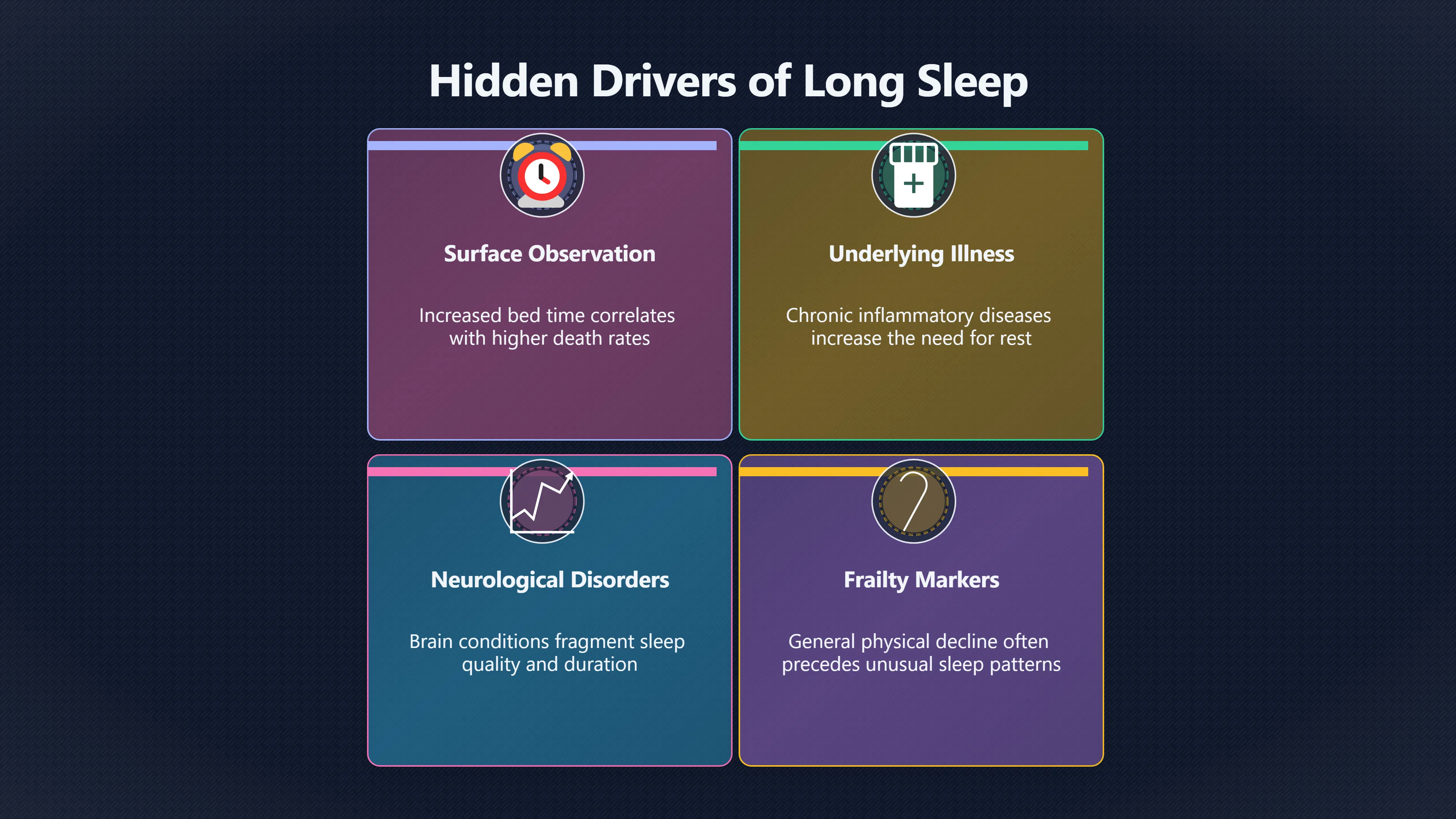
Long sleep illustrates why mechanism testing is essential. If simply sleeping longer damaged the body, researchers would expect a reasonably direct biological pathway explaining why nine or ten hours in bed causes increased mortality across diverse diseases. Evidence for such a pathway remains weak.
Instead, long sleep frequently accompanies conditions such as chronic inflammatory disease, neurological disorders, depression, obstructive sleep apnoea, medication effects or general frailty. These conditions may increase the need for sleep, fragment sleep quality, or increase time spent in bed without increasing restorative sleep. Under this explanation, long sleep functions mainly as a marker of poor health rather than its cause. Critical reviews have argued that reverse causation and residual confounding may explain much of the observed association.[PMC]pmc.ncbi.nlm.nih.govPMCSleep duration and all-cause mortality: a critical reviewby LM Kurina · 2013 · Cited by 215 — A robust association exists between sleep duration and mortality risk; specifically, that mortali…
Short sleep presents a stronger causal case, but rival explanations remain important. Modern lifestyles that produce chronic sleep restriction often include long working hours, irregular schedules, psychological stress, shift work and unhealthy behaviours. Any of these may independently increase cardiovascular risk.
Measurement adds another complication. Someone reporting “five hours of sleep” may actually spend seven hours in bed with frequent awakenings, while another person objectively sleeping six hours may feel fully rested. Sleep quality, timing and regularity may therefore matter as much as duration alone. Recent objective studies suggest that irregular sleep schedules can predict mortality independently of average sleep length, indicating that duration alone may be an incomplete exposure variable.[OUP Academic]academic.oup.comOUP AcademicSleep regularity is a stronger predictor of mortality risk than…by DP Windred · 2024 · Cited by 297 — Abnormally short and…

What a plausible sleep mechanism would predict
A convincing causal mechanism should generate predictions that extend beyond a statistical association.
For short sleep, several biologically plausible pathways exist. Experimental sleep restriction can produce measurable changes in:
- blood pressure regulation;
- glucose metabolism and insulin sensitivity;
- appetite-regulating hormones;
- inflammatory signalling;
- immune function;
- sympathetic nervous system activity.
These changes provide credible routes through which chronic sleep deprivation could contribute to cardiovascular disease, diabetes and related illnesses over many years. If these mechanisms are genuinely causal, populations experiencing sustained sleep deprivation should eventually show higher rates of diseases linked to these pathways, even after careful adjustment for confounding.[PMC]pmc.ncbi.nlm.nih.govSleep Duration and All-Cause Mortality: A Systematic Review…by FP Cappuccio · 2010 · Cited by 2672 — Both short and long duration o…
The mechanism test therefore makes predictions beyond mortality itself. Intermediate outcomes—such as hypertension, impaired glucose control or increased inflammatory markers—should also appear, and interventions that successfully improve chronic sleep should eventually reduce at least some downstream disease risk if sleep is an important causal factor.
For long sleep, the mechanism test is less convincing. Proposed biological explanations remain comparatively speculative, whereas explanations based on underlying illness naturally predict why prolonged sleep correlates with many different causes of death.
What newer causal methods add
Researchers increasingly use Mendelian randomisation, which exploits naturally occurring genetic variants associated with sleep traits to reduce confounding and reverse causation.
These studies paint a more nuanced picture than observational research alone. Evidence increasingly supports a causal contribution of genetically predicted short sleep to several cardiovascular and metabolic outcomes, although effect sizes are generally modest and not every disease shows consistent results. By contrast, evidence that genetically predicted long sleep directly causes poor health is considerably weaker. In many analyses, the observational association between long sleep and mortality is stronger than the corresponding genetic evidence, supporting the idea that long sleep often signals underlying illness rather than causing it.[PMC+2PMC]pmc.ncbi.nlm.nih.govAssociations between sleep duration and cardiovascular…by S Wang · 2022 · Cited by 80 — Equitable quality reviews showed that both…
Even these studies have limitations. Mendelian randomisation depends on assumptions about genetic instruments and cannot fully replace randomised intervention studies. Nevertheless, it strengthens the case that the causal story differs for short and long sleep.
Applying the mechanism test to health headlines
When a headline claims that “people who sleep fewer than six hours are more likely to die”, analytical thinking asks a sequence of questions rather than accepting the recommendation immediately.
- Is there a biologically plausible pathway linking chronic sleep restriction to disease? For short sleep, several well-supported pathways exist.
- Could illness or another factor have changed sleep before affecting mortality? This is especially plausible for long sleep.
- Were important confounders measured and adjusted for? Lifestyle, socioeconomic factors and existing health conditions matter greatly.
- Do studies using stronger causal designs support the same conclusion? Genetic and other causal-inference approaches provide useful cross-checks.
- Would changing sleep duration alone reasonably be expected to change outcomes? This is the practical question behind any public-health advice.
Seen through the mechanism test, the evidence supports neither extreme scepticism nor unquestioning acceptance. Chronic sleep deprivation has credible biological pathways that make a causal contribution to disease plausible. At the same time, mortality statistics alone cannot establish that every observed association reflects a direct effect of sleep itself. Especially for long sleep, the safest interpretation is often that unusual sleep duration may be an important signal of underlying health rather than the primary cause of poor outcomes.[PMC+3PMC+3PMC]pmc.ncbi.nlm.nih.govPMCSleep duration and all-cause mortality: a critical reviewby LM Kurina · 2013 · Cited by 215 — A robust association exists between sleep duration and mortality risk; specifically, that mortali…
Amazon book picks
Further Reading
Books and field guides related to Does Short Sleep Cause Risk, or Signal It?. Use these as the next step if you want deeper reading beyond the article.
Why We Sleep
Explains sleep biology, health outcomes, and the evidence behind claims about sleep and disease.
The Sleep Solution
Covers sleep disorders, sleep duration, and separating common myths from evidence.
Sleep Smarter
Focuses on sleep habits and mechanisms linking sleep quality with overall health.
The Sleep Revolution
Provides accessible context on why sleep matters while encouraging critical reflection on modern lifestyle factors.
eBay marketplace picks
Marketplace Samples
Example marketplace items related to this page. Use the search link to explore similar finds on eBay.


Endnotes
1.
Source: pmc.ncbi.nlm.nih.gov
Link:https://pmc.ncbi.nlm.nih.gov/articles/PMC2864873/
Source snippet
Sleep Duration and All-Cause Mortality: A Systematic Review...by FP Cappuccio · 2010 · Cited by 2672 — Both short and long duration o...
2.
Source: pmc.ncbi.nlm.nih.gov
Title: PMCSleep duration and all-cause mortality: a critical review
Link:https://pmc.ncbi.nlm.nih.gov/articles/PMC3660511/
Source snippet
by LM Kurina · 2013 · Cited by 215 — A robust association exists between sleep duration and mortality risk; specifically, that mortali...
3.
Source: pmc.ncbi.nlm.nih.gov
Link:https://pmc.ncbi.nlm.nih.gov/articles/PMC12795056/
Source snippet
the causal connections between sleep duration...by Z Wang · 2026 · Cited by 3 — This systematic review, inclusive of a meta-analysis of...
4.
Source: pmc.ncbi.nlm.nih.gov
Title: PMCSleep duration and risk of all-cause mortality
Link:https://pmc.ncbi.nlm.nih.gov/articles/PMC6998920/
Source snippet
duration and risk of all-cause mortality - PMC - NIHby HA García-Perdomo · 2018 · Cited by 89 — We found a probable association of long s...
5.
Source: academic.oup.com
Link:https://academic.oup.com/sleep/article/47/1/zsad253/7280269
Source snippet
OUP AcademicSleep regularity is a stronger predictor of mortality risk than...by DP Windred · 2024 · Cited by 297 — Abnormally short and...
6.
Source: pmc.ncbi.nlm.nih.gov
Link:https://pmc.ncbi.nlm.nih.gov/articles/PMC9403140/
Source snippet
Associations between sleep duration and cardiovascular...by S Wang · 2022 · Cited by 80 — Equitable quality reviews showed that both...
7.
Source: ahajournals.org
Link:https://www.ahajournals.org/doi/10.1161/jaha.117.005947
Source snippet
Relationship of Sleep Duration With All‐Cause Mortality...by J Yin · 2017 · Cited by 839 — Our findings indicate that both short and lon...
Additional References
8.
Source: nature.com
Title: While a previous systematic review indicated that
Link:https://www.nature.com/articles/srep21480
Source snippet
Nighttime sleep duration, 24-hour sleep duration and risk...by X Shen · 2016 · Cited by 181 — These data suggest that sleep durati...
9.
Source: 2minutemedicine.com
Title: association of sleep duration with all cause mortality in east asian adults
Link:https://www.2minutemedicine.com/association-of-sleep-duration-with-all-cause-mortality-in-east-asian-adults/
Source snippet
Association of sleep duration with all-cause mortality in...Sep 8, 2021 — Long sleep duration was also associated with an increased canc...
10.
Source: fightaging.org
Title: a genome wide genetic association study of sleep duration and longevity
Link:https://www.fightaging.org/archives/2024/03/a-genome-wide-genetic-association-study-of-sleep-duration-and-longevity/
Source snippet
A Genome-Wide Genetic Association Study of Sleep...Mar 4, 2024 — Researchers here use Mendelian randomization to attempt to better under...
11.
Source: journals.lww.com
Title: causal relationship between distinct sleep.56.aspx
Link:https://journals.lww.com/md-journal/fulltext/2025/05300/causal_relationship_between_distinct_sleep.56.aspx
Source snippet
relationship between distinct sleep characteristics...by C Jiang · 2025 · Cited by 1 — Our study identified a significant association bet...
12.
Source: researchgate.net
Link:https://www.researchgate.net/publication/396461752_Causal_association_between_sleep_duration_daytime_napping_sleep_disorders_and_ischemic_heart_disease_A_systematic_review_and_meta-analysis_of_Mendelian_randomization_studies
Source snippet
(PDF) Causal association between sleep duration, daytime...Mar 14, 2026 — Numerous studies have established a significant correlation be...
13.
Source: youtube.com
Link:https://www.youtube.com/watch?v=4Wx-a3Qh37w
Source snippet
Dr. Matt Walker: The Biology of Sleep & Your Unique Sleep Needs | Huberman Lab Guest Series...
14.
Source: youtube.com
Link:https://www.youtube.com/watch?v=-OBCwiPPfEU
Source snippet
Causation vs. Association - Causal Inference...
15.
Source: nature.com
Link:https://www.nature.com/articles/s41598-024-83693-w
Source snippet
Mendelian randomization study of sleep traits and risk...by O Dimopoulou · 2025 · Cited by 2 — This study provides little to no evidence...
16.
Source: youtube.com
Title: Correlation vs Causation (Statistics)
Link:https://www.youtube.com/watch?v=Tg6e2Y3IEUk
Source snippet
Sleep duration all cause mortality statistics correlation causation Excess deaths 2025 Dr. John Campbell...
17.
Source: papers.ssrn.com
Link:https://papers.ssrn.com/sol3/Delivery.cfm/1f80ffe0-057f-4c37-9415-acde98f171f4-MECA.pdf?abstractid=6624621&mirid=1
Source snippet
Bidirectional Two-Sample Mendelian Randomization StudyWe therefore performed a bidirectional two-sample Mendelian randomization (MR) stud...
Topic Tree
Follow this branch
Parent topic
Causation Does the Evidence Show a Cause?Related pages 5
- App Scores Does the App Raise Scores, or Track Motivation?
- Berkeley Data When the Combined Data Tells the Wrong Story
- Fair Tests Why Randomised Trials Make Causal Claims Stronger
- Hidden Causes When a Third Factor Creates the Pattern
- Onboarding Bias Did Onboarding Help, or Did Motivated Customers Join?