Within Critical Thinking
Why Smart People Still Need Thinking Habits
Critical-thinking skills matter most when dispositions like truth-seeking, open-mindedness, and systematicity make people use them.
On this page
- The difference between ability and willingness
- Seven dispositions that support better judgement
- Negative habits that make sharp reasoning unreliable
Page outline Jump by section
Introduction
Critical thinking is often described as a set of skills: analysing arguments, evaluating evidence, recognising assumptions, and drawing justified conclusions. Yet those skills only improve judgement when people are willing to use them, especially when doing so is uncomfortable or inconvenient. A person may know how to detect weak evidence but still ignore it if it challenges a cherished belief, threatens their status, or requires admitting a mistake. Research on critical thinking has therefore distinguished between ability and disposition: the habits of mind that determine whether critical-thinking skills are actually put into practice.[ERIC]files.eric.ed.govFacione, Peter A. TITLE. Critical Thinking: A Statement of Expert Consensus for Purposes of Educational Assessment and. Instruction. Rese…
 This distinction matters because many real-world failures of judgement are not caused by an absence of reasoning ability. They arise when capable people stop asking difficult questions, become overconfident, search only for confirming evidence, or rush to conclusions. Purposeful judgement therefore depends on cultivating thinking habits that consistently direct attention towards evidence, fairness, and self-correction rather than towards comfort or certainty.[Insight Assessment]insightassessment.comInsight AssessmentCritical Thinking: What It Is and Why It CountsHow do you define "critical thinking"? How do you use it in your day to…
The difference between ability and willingness
Knowing how to think critically is not the same as choosing to think critically.
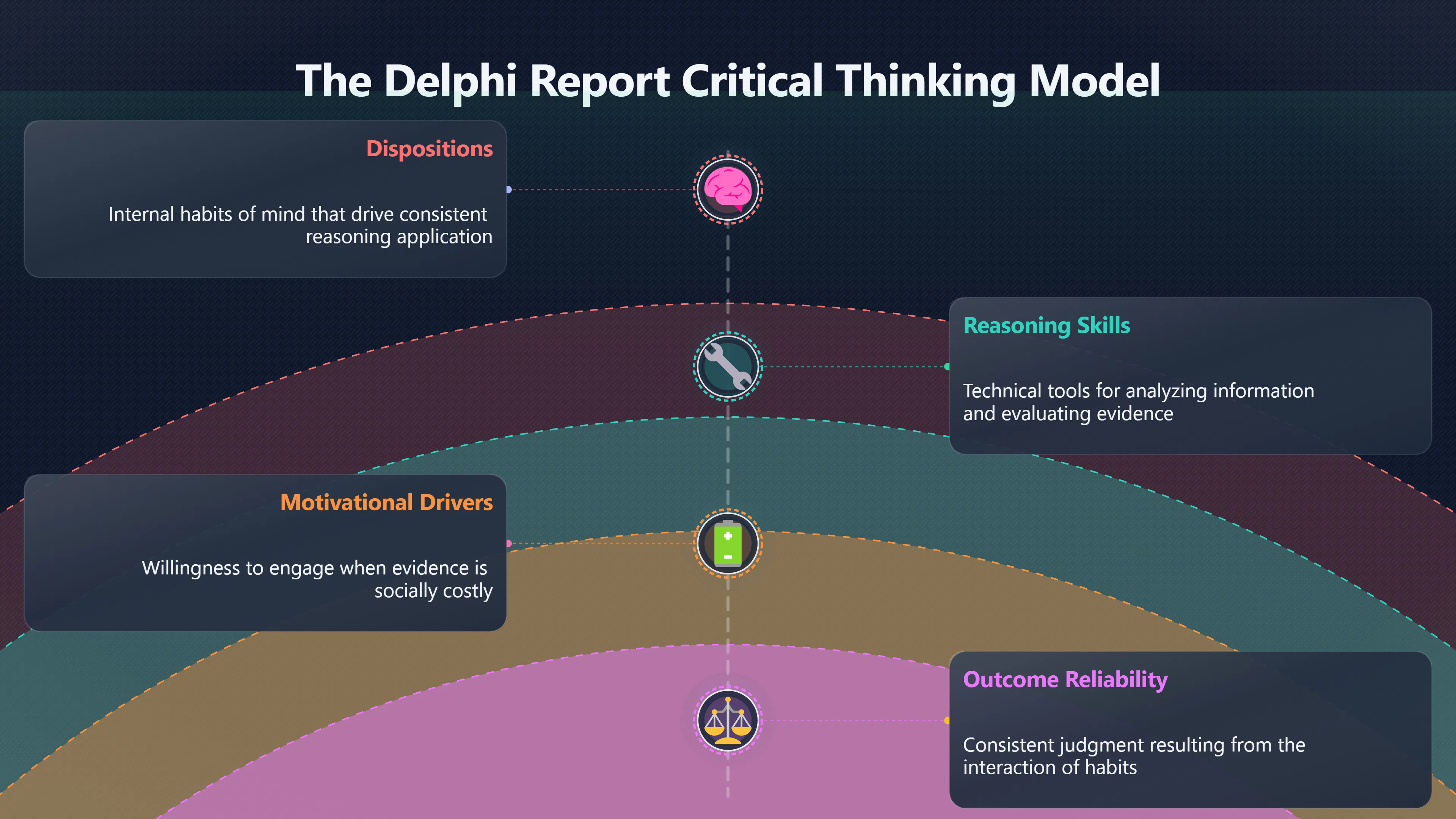
The expert consensus behind the Delphi Report describes critical thinking as both a collection of cognitive skills and a corresponding “critical spirit” or disposition. In practice, these two components reinforce one another. Skills provide the tools for analysing information, while dispositions determine whether those tools are used carefully, consistently, and honestly.[ERIC]files.eric.ed.govFacione, Peter A. TITLE. Critical Thinking: A Statement of Expert Consensus for Purposes of Educational Assessment and. Instruction. Rese…
Consider two people reading a controversial health claim. Both understand how to assess evidence. One immediately accepts information that supports existing beliefs without checking sources. The other deliberately looks for contrary evidence, considers alternative explanations, and is prepared to revise an opinion if stronger evidence appears. Their reasoning ability may be similar, but their dispositions lead to very different outcomes.
This explains why educational researchers increasingly treat critical thinking as partly motivational. The question is not only Can this person evaluate evidence? but also Will they do so when it is inconvenient, emotionally uncomfortable, or socially costly? Studies of critical-thinking disposition repeatedly find that willingness to engage with evidence predicts whether reasoning skills are consistently applied in academic, professional, and clinical settings.[ResearchGate+2PubMed]researchgate.netResearchGate(PDF) The Disposition Toward Critical Thinking24 Dec 2025 — This essay presents a researchbased expert consensus definition o…
Seven dispositions that support better judgement
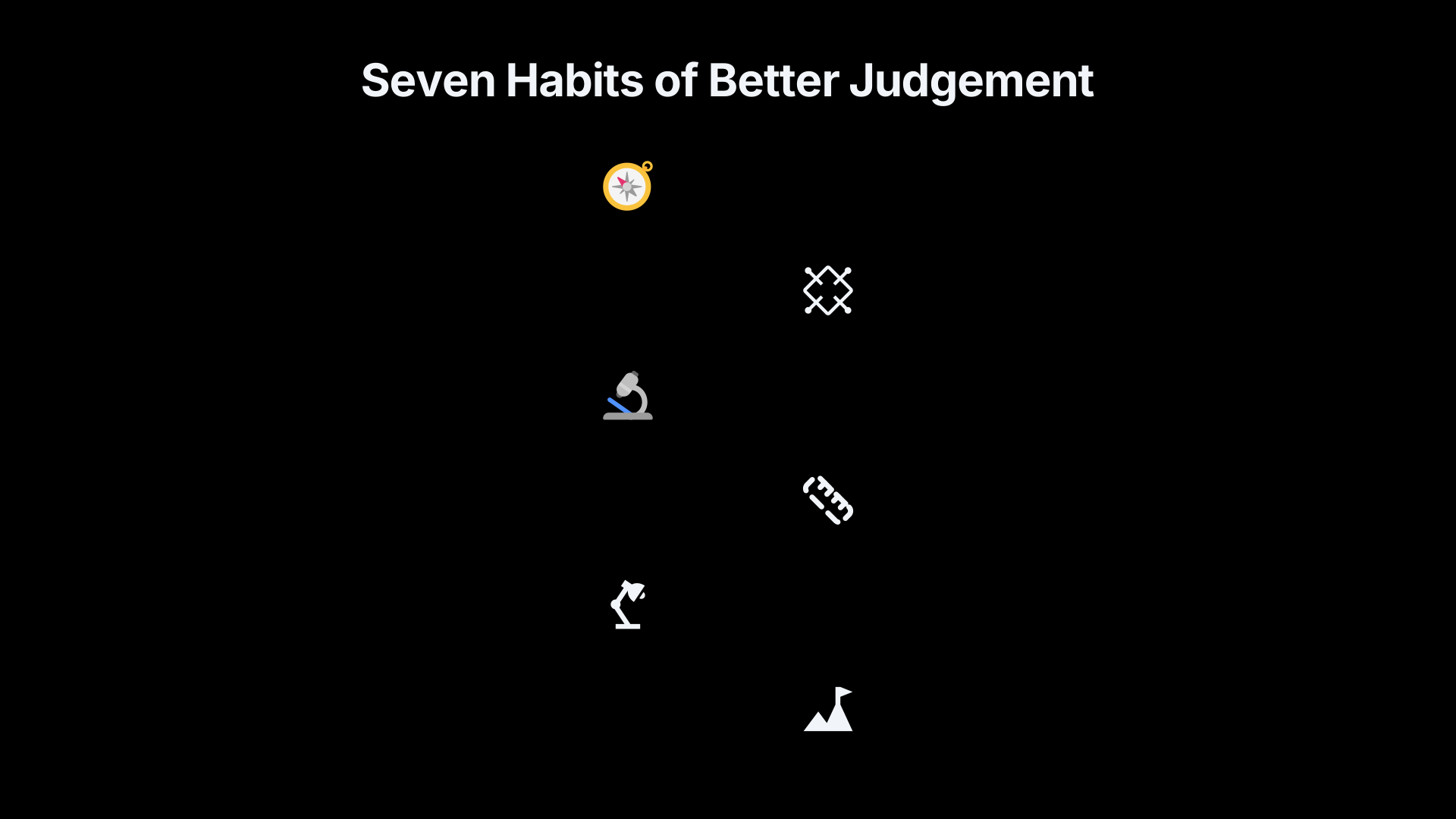
The Delphi project and subsequent work on the California Critical Thinking Disposition Inventory identified seven broad habits that characterise people who regularly use critical-thinking skills well. These are not fixed personality traits but patterns of behaviour that can be encouraged through education and deliberate practice.[PubMed]pubmed.ncbi.nlm.nih.govCritical thinking disposition as a measure of competent…by NC Facione · 1994 · Cited by 1288 — Delphi Report's consensus definit…
- Truth-seeking. A commitment to following evidence wherever it leads rather than defending existing opinions. Truth-seeking requires asking difficult questions, examining contrary evidence, and preferring accuracy over being right.
- Open-mindedness. A willingness to consider alternative viewpoints fairly, including arguments that conflict with one’s own beliefs. Open-mindedness does not require accepting every idea equally; it requires evaluating competing ideas by their evidence.
- Analyticity. Looking for reasons, recognising potential weaknesses in arguments, and anticipating possible problems before reaching conclusions instead of relying on intuition alone.
- Systematicity. Approaching problems in an organised and methodical way. Rather than jumping between ideas, systematic thinkers gather information, compare alternatives, and work through evidence step by step.
- Critical-thinking self-confidence. Confidence in one’s ability to reason carefully without confusing confidence with certainty. This encourages independent judgement while remaining open to correction.
- Inquisitiveness. Intellectual curiosity that motivates learning beyond immediate practical necessity. Curious people actively seek understanding instead of stopping once a minimally acceptable answer appears.
- Cognitive maturity. Recognition that complex problems rarely have perfectly simple answers. Mature thinkers tolerate uncertainty, understand that reasonable disagreement is possible, and proportion conclusions to the available evidence.[journals.healio.com+2PubMed]journals.healio.comCritical Thinking Disposition as a Measureby NC Facione · 1994 · Cited by 1288 — Seven CT dispositional subscales were created: inquisiti…
These dispositions complement one another. Open-mindedness without analyticity may lead to entertaining every claim equally. Analyticity without truth-seeking may become sophisticated rationalisation. Systematicity without inquisitiveness can become rigid procedure. Reliable judgement emerges from their interaction rather than from any single habit.
Why uncomfortable evidence is the real test
Many reasoning tasks are straightforward when evidence supports existing beliefs. Dispositions become most important when evidence points elsewhere.
Truth-seeking often requires admitting previous mistakes. Open-mindedness may require giving serious attention to ideas associated with rival groups or unpopular viewpoints. Cognitive maturity demands accepting that some questions remain uncertain even after careful investigation.
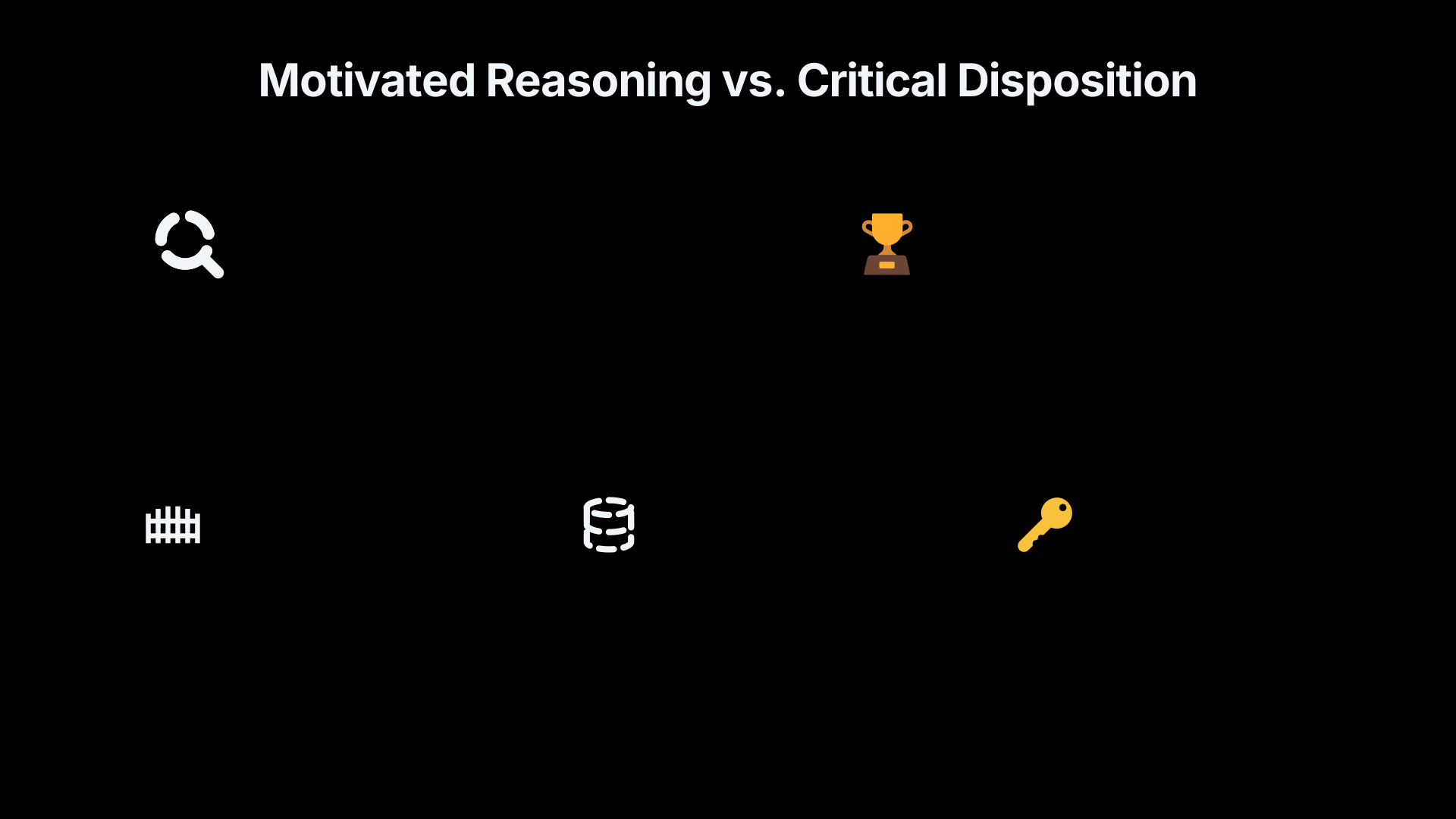
These moments expose the difference between genuine critical thinking and motivated reasoning. Motivated reasoning occurs when people unconsciously use their intelligence to defend preferred conclusions instead of evaluating evidence impartially. Research in psychology consistently shows that higher reasoning ability alone does not eliminate this tendency. In some situations, more knowledgeable people become better at constructing arguments for conclusions they already favour rather than becoming more objective. Strong critical-thinking dispositions help interrupt that process by redirecting attention towards evidence instead of identity or emotion.[Insight Assessment]insightassessment.comInsight AssessmentCritical Thinking: What It Is and Why It CountsHow do you define "critical thinking"? How do you use it in your day to…
In professional environments, this matters because many costly errors develop gradually rather than through obvious mistakes. Teams that encourage questioning assumptions, inviting criticism, and revisiting decisions are often more reliable than equally skilled teams that discourage dissent.
Negative habits that make sharp reasoning unreliable
High intelligence can coexist with poor judgement when unhelpful thinking habits dominate. Several dispositions consistently undermine the practical value of reasoning skills.
- Confirmation seeking. Looking mainly for evidence that supports existing beliefs while ignoring conflicting information.
- Overconfidence. Assuming initial conclusions are probably correct without checking competing explanations.
- Defensive reasoning. Treating disagreement as a personal attack rather than an opportunity to improve understanding.
- Premature closure. Ending investigation once an acceptable explanation appears instead of asking whether better evidence exists.
- Intellectual laziness. Relying on shortcuts, slogans, or authority when careful evaluation would be possible.
- Status protection. Refusing to revise beliefs because changing one’s mind feels like losing credibility.
- Selective scepticism. Demanding extremely high standards of evidence only for claims one dislikes while accepting weaker evidence for preferred conclusions.
These habits reduce the reliability of otherwise capable thinkers because they distort when and how reasoning skills are applied. They also reinforce one another: overconfidence encourages premature closure, which reduces curiosity and weakens systematic investigation.
Building dispositions through everyday practice
Unlike isolated reasoning techniques, dispositions develop through repeated behaviour across many situations.
Educational research suggests that critical-thinking habits strengthen when learners repeatedly justify conclusions with evidence, compare competing explanations, reflect on mistakes, and receive feedback on their reasoning rather than simply their answers. Regular exposure to respectful disagreement also helps normalise revising beliefs without treating revision as failure.[Insight Assessment]insightassessment.comInsight AssessmentCritical Thinking: What It Is and Why It CountsHow do you define "critical thinking"? How do you use it in your day to…
Individuals can encourage these habits by adopting simple routines:
- Ask, “What evidence would change my mind?”
- Deliberately seek one credible argument against an initial conclusion.
- Separate confidence from certainty by estimating how strong the evidence actually is.
- Explain conclusions step by step rather than relying on intuition alone.
- Treat changing one’s mind as evidence of learning rather than inconsistency.
- Review important decisions afterwards to identify which assumptions proved correct and which did not.
These practices reinforce dispositions because they reward the process of careful judgement instead of merely rewarding correct outcomes.
Why thinking habits matter more than isolated skills
Critical-thinking skills provide the machinery of good judgement, but dispositions determine whether that machinery is switched on when it matters most. The person who habitually seeks truth, welcomes legitimate criticism, works systematically, and accepts uncertainty is more likely to use reasoning well under pressure than someone with equal technical ability but weaker intellectual habits.
For that reason, improving critical thinking is not simply a matter of learning analytical techniques. It also requires cultivating habits that keep those techniques active in the face of bias, emotion, social pressure, and uncertainty. Purposeful judgement depends on both knowing how to think and consistently choosing to think that way.
Amazon book picks
Further Reading
Books and field guides related to Why Smart People Still Need Thinking Habits. Use these as the next step if you want deeper reading beyond the article.
Mistakes Were Made (but Not by Me)
Explains why good thinkers still avoid self-correction.
eBay marketplace picks
Marketplace Samples
Example marketplace items related to this page. Use the search link to explore similar finds on eBay.


Endnotes
1.
Source: researchgate.net
Link:https://www.researchgate.net/publication/252896581_The_Disposition_Toward_Critical_Thinking_Its_Character_Measurement_and_Relationship_to_Critical_Thinking_Skill
Source snippet
ResearchGate(PDF) The Disposition Toward Critical Thinking24 Dec 2025 — This essay presents a researchbased expert consensus definition o...
2.
Source: journals.healio.com
Link:https://journals.healio.com/doi/pdf/10.3928/0148-4834-19941001-05
Source snippet
Critical Thinking Disposition as a Measureby NC Facione · 1994 · Cited by 1288 — Seven CT dispositional subscales were created: inquisiti...
3.
Source: researchgate.net
Link:https://www.researchgate.net/publication/241897896_The_Disposition_Toward_Critical_Thinking_1
Source snippet
ss, weaknesses in systematicity and opposition to truth-seeking.Read more...
4.
Source: researchgate.net
Title: Faciones critical thinking model fig1 338297753
Link:https://www.researchgate.net/figure/Faciones-critical-thinking-model_fig1_338297753
Source snippet
Facione's critical thinking modelAccording to Facione (2000), critical thinking skills should be listed in ascending order, ranging from...
5.
Source: researchgate.net
Title: 251303244 Critical Thinking What It Is and Why It Counts
Link:https://www.researchgate.net/publication/251303244_Critical_Thinking_What_It_Is_and_Why_It_Counts
Source snippet
(PDF) Critical Thinking: What It Is and Why It CountsPDF | On Jan 1, 2015, Peter A. Facione published Critical Thinking: What It Is and W...
6.
Source: youtube.com
Title: Ep. 124
Link:https://www.youtube.com/watch?v=g0Sg0ZiBcaM
Source snippet
Habits of Mind - Art Costa Describes the Habits of Mind...
7.
Source: youtube.com
Title: Habits of Mind
Link:https://www.youtube.com/watch?v=OT0vXFP_RYI
Source snippet
The Habits of Mind Show: Dr. Bena Kallick on Thinking About Your Thinking...
8.
Source: files.eric.ed.gov
Link:https://files.eric.ed.gov/fulltext/ED315423.pdf
Source snippet
Facione, Peter A. TITLE. Critical Thinking: A Statement of Expert Consensus for Purposes of Educational Assessment and. Instruction. Rese...
9.
Source: pubmed.ncbi.nlm.nih.gov
Link:https://pubmed.ncbi.nlm.nih.gov/7799093/
Source snippet
Critical thinking disposition as a measure of competent...by NC Facione · 1994 · Cited by 1288 — Delphi Report's consensus definit...
10.
Source: insightassessment.com
Link:https://insightassessment.com/iaresource/critical-thinking-what-it-is-and-why-it-counts/
Source snippet
Insight AssessmentCritical Thinking: What It Is and Why It CountsHow do you define "critical thinking"? How do you use it in your day to...
11.
Source: pmc.ncbi.nlm.nih.gov
Link:https://pmc.ncbi.nlm.nih.gov/articles/PMC12963237/
Source snippet
comprehensive influence of critical thinking disposition...by F Wei · 2026 — It consists of 7 scales, measuring the 7 traits of critical...
Additional References
12.
Source: merriam-webster.com
Link:https://www.merriam-webster.com/dictionary/critical
Source snippet
CRITICAL Definition & Meaning1. a: inclined to criticize severely and unfavorably Don't be so critical. This is just a first attempt. Th...
13.
Source: measuredreasons.com
Link:https://measuredreasons.com/consultant/peter-a-facione-phd/
Source snippet
Peter A. Facione, PhDDr. Peter Facione, Principal of Measured Reasons LLC and CEO of Insight Assessment, has devoted over 40 years to adv...
14.
Source: allamericanspeakers.com
Link:https://www.allamericanspeakers.com/celebritytalentbios/Peter%2BFacione/5907
Source snippet
ublications including essays, books, articles, case studies, and [testing]({{ 'testing/' | relative_url }})...Read more...
15.
Source: philpapers.org
Link:https://philpapers.org/rec/FACCTF-3
Source snippet
olvement with critical thinking, its definition...Read more...
16.
Source: damiantgordon.com
Link:https://www.damiantgordon.com/EducationalModels/CriticalThinking/Facione/CriticalThinking-Facione-Details.pdf
Source snippet
his work, especially the Delphi Report (1990).Read more...
17.
Source: Wikipedia
Title: Francis P. Facione
Link:https://en.wikipedia.org/wiki/Francis_P._Facione
Source snippet
Francis P. FacioneFrancis Peter Facione (February 8, 1940 – June 14, 2019) was the Presiding Bishop of the Old Roman Catholic Church i...
Published: February 8, 1940
18.
Source: independent.academia.edu
Title: Peter Facione
Link:https://independent.academia.edu/PeterFacione
Source snippet
A Facione - Independent ResearcherPeter A Facione: 1483 Followers, 24 Following, 185 Research papers. Research interests: Decision Making...
19.
Source: youtube.com
Title: Why Smart People Make Bad Decisions
Link:https://www.youtube.com/watch?v=NYAz_5xHwR0
Source snippet
"Critical thinking dispositions" OR "critical spirit" How Can I Resist a Critical Spirit?...
20.
Source: scirp.org
Title: Facione, P
Link:https://www.scirp.org/reference/referencespapers?referenceid=465429
Source snippet
A. (1990). Critical thinking A statement of expert...This article reports on the design, implementation and evaluation of a WebQuest tea...
21.
Source: youtube.com
Title: Critical Thinking: Skills and Dispositions
Link:https://www.youtube.com/watch?v=DHQH93RM6S8
Source snippet
Ep. 124 - Cognitive Energy and Critical Thinking with Dr. Christopher Dwyer...
Topic Tree