Within Sharper Thinking
Are You Solving the Right Problem?
Many weak conclusions begin with a poorly defined problem, so the first skill is knowing exactly what question you are answering.
On this page
- Define the real question
- Separate symptoms from causes
- Choose the right problem type
Page outline Jump by section
Introduction
Problem framing is the thinking step that happens before you start collecting evidence, building an argument or choosing a solution. It asks a simple but often neglected question: “What problem am I actually trying to solve?” That matters because a clever answer to the wrong question can still produce a bad decision. Research and practice in decision analysis, problem structuring, root-cause work and organisational judgement all point to the same mechanism: the frame determines what evidence you look for, which causes you treat as relevant, which options you consider, and what counts as success.[PubsOnline+2Cambridge University Press & Assessment]pubsonline.informs.orgWhat's the Problem? An Introduction to Problem Structuring MethodsNew problem structuring methods (PSMs) provide decision maker…
The practical skill is not to find one perfect wording of the problem immediately. It is to pause long enough to test whether the first wording is too narrow, too solution-shaped, too symptom-focused or too vague. Good framing turns “we need to fix this” into a clearer judgement task: what is happening, who is affected, what outcome would count as improvement, what kind of problem is this, and what must be understood before reasoning can safely begin.
Why the First Frame Quietly Controls the Whole Answer
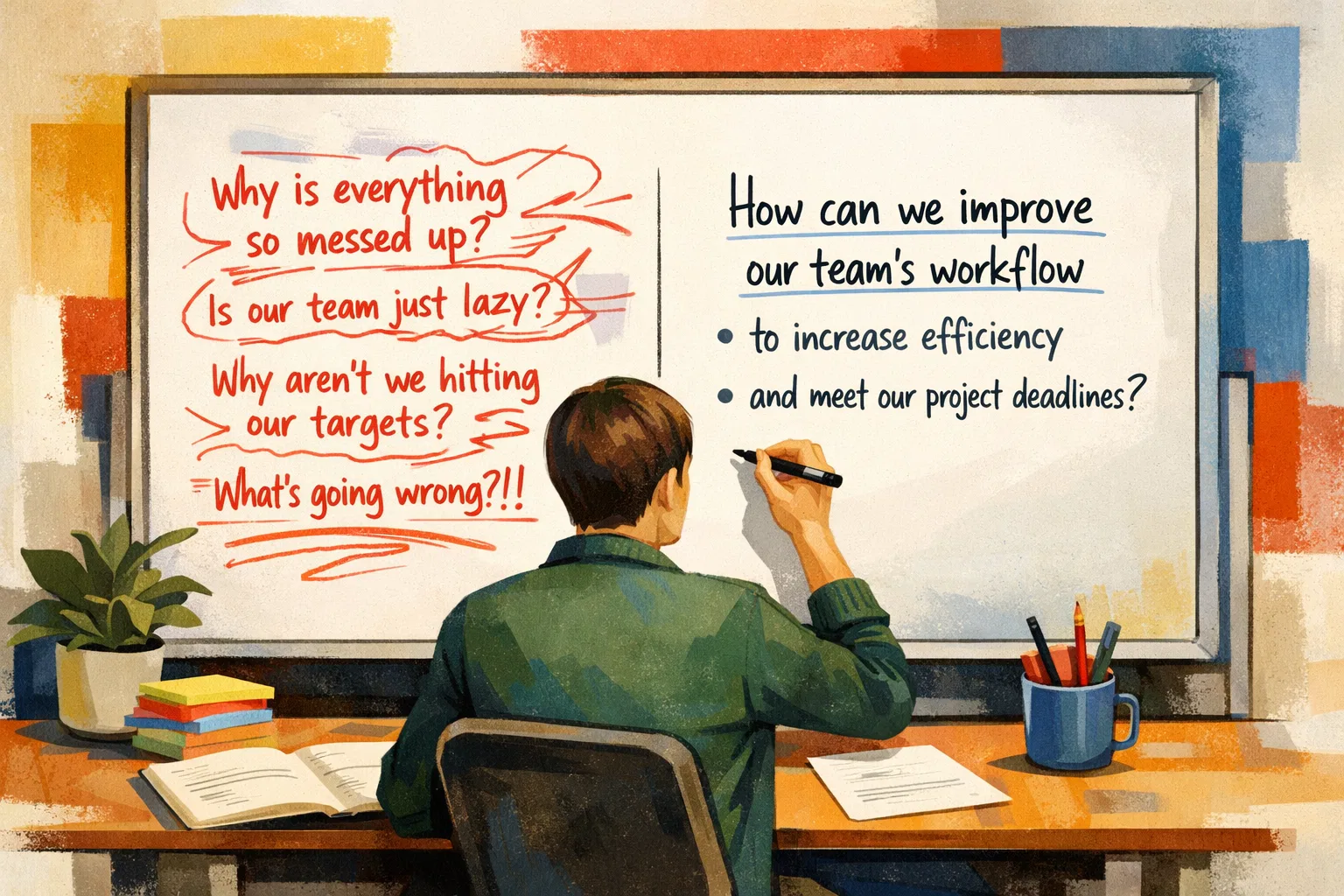
A problem frame is a boundary. It decides what belongs inside the analysis and what is treated as background noise. If the frame is “sales are down because marketing is weak”, the mind starts looking for marketing fixes. If the frame is “repeat customers are not returning”, the same situation may point to product quality, pricing, onboarding, support or mismatched expectations. The facts have not changed, but the search space has.
This is why experienced problem solvers often treat framing as a separate stage rather than as a preamble. Problem structuring methods in operational research were developed partly because traditional analytical techniques are often strong once a problem is well defined, but much weaker when the real difficulty is deciding what the problem is in the first place. These methods are especially useful when there are multiple stakeholders, conflicting priorities, uncertainty and no obvious single metric of success.[PubsOnline]pubsonline.informs.orgWhat's the Problem? An Introduction to Problem Structuring MethodsNew problem structuring methods (PSMs) provide decision maker…
A poor frame usually fails in one of four ways:
- It smuggles in a solution. “How do we automate this?” assumes automation is the answer before the problem has been understood.
- It names a symptom as the problem. “The team is missing deadlines” may be visible, but the underlying issue could be unclear priorities, unrealistic estimates, dependency delays or decision bottlenecks.
- It is too broad to reason about. “How do we improve performance?” gives no clear boundary, evidence need or success criterion.
- It uses the wrong problem type. A complicated technical fault, a human coordination issue and a contested policy dilemma require different reasoning methods.
The point is not to delay action indefinitely. It is to prevent premature certainty. In decision-quality thinking, a “proper frame” is one of the basic requirements of a good decision because it shapes the alternatives, information and trade-offs that follow.[Decision Professionals]decisionprofessionals.comDecision ProfessionalsDecision QualityThis framework proposed captures the quality of decisions, with the evidence that all decisions sha…
Define the Real Question
The fastest way to improve a problem frame is to turn a loose concern into a specific question. A concern says, “This is bad.” A useful question says, “What must be understood or decided next?” That shift matters because reasoning needs a target.
A strong problem question usually contains five elements:
- The current condition: what is happening now?
- The desired condition: what would be better?
- The gap: what is the difference between the two?
- The affected people or system: who or what is experiencing the gap?
- The decision need: what choice, explanation or judgement depends on the answer?
For example, “Our meetings are unproductive” is a complaint. A better frame might be: “Why are project meetings failing to produce clear decisions, and what meeting format would reduce rework without slowing coordination?” This wording does not solve the problem, but it improves the reasoning path. It identifies the visible failure, the desired improvement, the likely decision area and the trade-off: reducing rework without adding drag.
This also protects against false clarity. In organisational decision-making, Kahneman, Lovallo and Sibony argued that leaders can often detect bias in other people’s recommendations more easily than in their own thinking, which is why structured questions and checklists are useful before major decisions. Their checklist approach asks whether alternatives have been properly explored, whether the right information has been gathered and whether the numbers are grounded rather than merely persuasive.[Harvard Business Review]hbr.orgHarvard Business Review The Big Idea: Before You Make That Big Decision…Harvard Business Review The Big Idea: Before You Make That Big Decision…
A practical framing test is to ask: “If I answered this question well, would it actually help me decide what to do?” If the answer is no, the question is probably not yet the real question. It may be too abstract, too emotional, too broad or too detached from the decision that has to be made.

Separate Symptoms from Causes
Many weak conclusions begin by treating the most visible problem as the deepest problem. Symptoms are what attract attention: delays, complaints, errors, churn, conflict, cost overruns, low marks, poor health indicators, falling engagement. Causes are the mechanisms that produce those symptoms. Framing improves when you keep the two separate long enough to avoid fixing the surface while leaving the generator untouched.
Root-cause techniques such as the Five Whys are popular because they force this pause. The method repeatedly asks why a problem occurred until the analysis moves from the visible event towards a more basic process, design or system condition. Public-sector and healthcare improvement guides describe it as a simple way to uncover not only delivery glitches but also organisational or team-process issues.[NHS England]england.nhs.ukEngland Five whysEngland Five whys
Used well, this is not a ritual of literally asking “why” five times. It is a discipline of not stopping at the first plausible explanation. Consider a student who says, “I am bad at essays.” That frame is vague and identity-based. A symptom-cause separation might reveal several different problems:
- the student does not understand the question;
- the student understands the topic but cannot structure an argument;
- the student has evidence but weak paragraph control;
- the student starts too late and cannot revise;
- the student is trying to sound academic rather than answer directly.
Each cause suggests a different remedy. More reading helps only one of them. A template helps another. Earlier drafting helps another. Without framing, “improve essays” becomes an unfocused effort; with framing, the student can reason about the actual bottleneck.
There is a caution, though. Root-cause language can create false confidence if people force a complex situation into a single cause. Some problems have interacting causes, feedback loops or contested interpretations. In those cases, “the root cause” may be less useful than “the most actionable cause we can test next”. Recent work on causal-mechanism information suggests that even when people are shown causal pathways, they may still prefer interventions that fix visible symptoms rather than indirect interventions aimed at deeper causes. That makes symptom-cause separation a behavioural challenge, not just an information problem.[arXiv]arxiv.orgOpen source on arxiv.org.
Choose the Right Problem Type
Not every problem should be framed in the same way. A major source of bad reasoning is using the method that suits one problem type on a different kind of problem. Before reasoning, ask what sort of difficulty you are facing.
A useful distinction is between clear, complicated, complex and wicked problems. The labels vary across frameworks, but the underlying point is consistent: the relationship between cause, evidence, action and success is not the same in every situation.
Clear problems have known rules and repeatable procedures. If a password reset fails because the email address is wrong, the problem is not philosophically deep; the right frame is procedural.
Complicated problems require expertise, diagnosis or calculation, but the problem can still be defined with reasonable clarity. A bridge design, a tax calculation or a technical fault may be hard, but specialists can usually agree what kind of problem it is and what evidence matters.
Complex problems involve adaptation, feedback and uncertainty. A team morale issue, a product adoption problem or a classroom behaviour pattern may not have one stable cause. The right frame may be experimental: what small intervention could reveal how the system responds?
Wicked problems are harder still. Rittel and Webber’s classic account of wicked problems argued that many social-policy problems do not have definitive formulations, final stopping rules or solutions that can be judged simply true or false. Later reviews have emphasised that wickedness often comes from value conflict, social pluralism, political disagreement and uncertainty about both the problem and the solution.[Springer+2Vlaams Instituut voor de Zee]link.springer.comOpen source on springer.com.
This distinction changes the implementation. If the problem is clear, do not overcomplicate it with workshops and abstract debate. If it is complicated, get expertise and define the variables. If it is complex, use probes, feedback and learning. If it is wicked, expect disagreement about values as well as facts, and frame the work as navigation rather than final solution.
The Cynefin framework is often used for this kind of sense-making because it separates contexts where cause and effect are obvious or discoverable from contexts where they emerge only through interaction and experiment. Its practical lesson for problem framing is simple: before asking “What is the answer?”, ask “What kind of situation am I in?”[PMC]pmc.ncbi.nlm.nih.govOpen source on nih.gov.

Reframe Before You Commit
Reframing means deliberately restating the problem from different angles before you settle on one. This is not wordplay. It is a way of discovering whether your first frame has trapped you inside a narrow solution path.
Thomas Wedell-Wedellsborg’s work on reframing, summarised in Harvard Business Review, argues that organisations are often better at solving problems than at identifying the right problems. His research with executives found that many leaders recognised weakness in problem diagnosis, and he recommends practices such as bringing in outsiders, writing down different definitions, asking what is missing, considering multiple categories and looking at positive exceptions.[Harvard Business Review]hbr.orgOpen source on hbr.org.
Positive exceptions are especially useful. If the problem is “customers do not complete onboarding”, ask where onboarding does work. Which users succeed? Which team has fewer failures? Which period had better results? A frame based only on failure can lead to generalised blame; a frame that compares failure with success can reveal conditions that already solve part of the problem.
Try reframing across four angles:
- People: Who experiences this as a problem, and who does not?
- Time: When did it begin, and when is it absent?
- System: What upstream conditions make it more likely?
- Value: What trade-off are we actually trying to manage?
For example, “people keep ignoring the new process” can be reframed as “the process is hard to use”, “the incentive structure rewards the old behaviour”, “managers are sending mixed signals” or “the new process solves a reporting problem but creates a frontline workload problem”. Each frame invites different evidence. That is exactly why reframing belongs before reasoning: once the argument starts, people become attached to the first version they are defending.
Make Assumptions Visible
Every problem frame contains assumptions. Some are harmless; others determine the whole analysis. “We need more staff” may assume the workload is genuinely too high, current work is necessary, tasks are evenly distributed, automation cannot help, and demand will continue. Any one of those assumptions might be wrong.
Structured analytic techniques used in intelligence analysis treat assumption-checking as a formal step because hidden assumptions can quietly support an entire judgement. A key assumptions check asks analysts to identify the premises they have accepted as true and test how the assessment would change if those premises were weak or false.[Department of Statistics]stat.berkeley.eduOpen source on berkeley.edu.
The same practice works in ordinary reasoning. Before analysing, write three sentences:
- “This problem matters because…”[hbr.org]hbr.orgdo you understand the problem youre trying to solvedo you understand the problem youre trying to solve
- “I am assuming that…”
- “The answer would change if…”
These prompts force the frame into the open. They also reduce the risk of arguing from a hidden conclusion. If someone frames a workplace problem as “low accountability”, they may be assuming that people know what is expected, have the resources to do it, and face no conflicting priorities. If those assumptions fail, accountability may be the wrong frame.
Assumption-checking is most valuable when the stakes are high, the issue is emotionally charged, the evidence is incomplete or the first explanation feels obvious. The aim is not to doubt everything. It is to identify the few premises that, if wrong, would make the reasoning collapse.

A Practical Framing Routine
Problem framing does not need to be slow. For everyday analytical work, a five-minute routine can prevent many wrong turns.
Start by writing the problem in one sentence. Then rewrite it in a way that removes any built-in solution. “How do we get everyone back to the office?” becomes “What work outcomes are worse under the current attendance pattern, and what arrangement would improve them?” The second version may still lead to office attendance, but it no longer assumes the answer.
Next, separate observation from interpretation. “The client is difficult” becomes “The client has requested three scope changes after sign-off.” The observation is easier to test and less likely to become a personality judgement.
Then ask what kind of problem it is. Is this a rule-based task, an expert diagnosis, a complex adaptive issue or a value conflict? This determines whether the next step should be applying a known procedure, consulting expertise, running a small experiment or clarifying trade-offs among stakeholders.
Finally, define the decision the reasoning must support. Are you trying to explain what happened, predict what may happen, choose between options, design an intervention or decide whether a claim is credible? These are different tasks. A good explanation does not automatically produce a good intervention; a good prediction does not automatically settle what should be valued.
A compact version looks like this:
- Name the gap: What is happening, and what should be happening instead?
- Remove the assumed solution: Have I framed the problem as a preferred fix?
- Separate symptom and cause: What is visible, and what might be generating it?
- Classify the problem type: Clear, complicated, complex or wicked?
- State the decision need: What will this reasoning help me decide?
- Expose assumptions: What must be true for this frame to hold?
- Try one rival frame: What is another plausible way to define the same situation?
This routine is useful because it turns framing from a vague ideal into an implementation habit. It does not require perfect knowledge. It simply improves the starting line.
Common Framing Traps
The most dangerous framing errors are attractive because they feel efficient. They make the problem seem smaller, clearer or more controllable than it is.
The solution-first trap appears when the question starts with an answer: “How do we use artificial intelligence for this?”, “How do we cut headcount?”, “How do we make people comply?” A better frame asks what outcome is needed and what constraints matter before naming the tool.
The blame frame turns a system problem into a character judgement. “People are careless” may hide unclear instructions, poor interface design, time pressure or conflicting goals. Sometimes behaviour is the issue, but framing it as blame too early narrows the evidence.
The metric trap treats what is easy to measure as the real problem. “Increase page views” may ignore whether the right readers are arriving, whether they trust the content, or whether visits produce the intended outcome. A metric is a signal, not automatically the problem.
The false binary frames the issue as a choice between two options when the real task is to generate better alternatives. Decision-quality frameworks place emphasis on feasible and diverse alternatives because a decision cannot be better than the best option being considered.[Decision Professionals]decisionprofessionals.comDecision ProfessionalsDecision QualityThis framework proposed captures the quality of decisions, with the evidence that all decisions sha…
The over-wicked trap is the opposite error: treating a solvable subproblem as if it were an enormous social dilemma. Some parts of a wicked problem can still be made concrete. Climate policy is wicked; replacing inefficient boilers in a public building is a more bounded technical and procurement problem. Good framing often means carving a tractable decision out of a messy situation without pretending the wider mess has disappeared.
What Good Framing Changes
Good problem framing changes the quality of later reasoning in three ways.
First, it improves evidence selection. Instead of gathering information broadly and hoping a conclusion emerges, you know what evidence would distinguish between possible causes, options or interpretations. That saves effort and reduces cherry-picking.
Second, it improves disagreement. Many arguments persist because people are answering different questions while assuming they are debating the same one. One person is asking whether a proposal is ethical, another whether it is affordable, another whether it is legal, and another whether it will work. Framing makes those differences visible before they harden into conflict.
Third, it improves action. A framed problem is easier to test, assign, sequence and review. “Improve communication” is hard to implement. “Reduce preventable handover errors between the evening and morning teams” is concrete enough to investigate, intervene and measure.
The skill is therefore not merely intellectual. It is practical. Before reasoning begins, framing decides whether thought will be aimed at the right target. A person who learns to pause, define the real question, separate symptoms from causes and choose the right problem type has already improved the odds that their later analysis will matter.
Amazon book picks
Further Reading
Books and field guides related to Are You Solving the Right Problem?. Use these as the next step if you want deeper reading beyond the article.
What's Your Problem?
Directly addresses solving the right problem, reframing, and avoiding premature assumptions.
Bulletproof Problem Solving
Provides structured approaches for defining and analyzing complex problems.
Thinking in Systems
Helps readers distinguish symptoms from underlying system causes and frame problems more effectively.
eBay marketplace picks
Marketplace Samples
Example marketplace items related to this page. Use the search link to explore similar finds on eBay.


Endnotes
1.
Source: resolve.cambridge.org
Link:https://resolve.cambridge.org/core/services/aop-cambridge-core/content/view/8149F167B139F1E92A443B496CCC2B60/9780511611308c3_p32-56_CBO.pdf/the-foundations-of-decision-analysis-revisited.pdf
Source snippet
Cambridge University Press & Assessment3 The Foundations of Decision Analysis RevisitedA high quality decision has a proper frame, a sele...
2.
Source: england.nhs.uk
Title: England Five whys
Link:https://www.england.nhs.uk/improvement-hub/wp-content/uploads/sites/44/2015/08/learning-handbook-five-whys.pdf
3.
Source: arxiv.org
Link:https://arxiv.org/abs/2601.20010
4.
Source: link.springer.com
Link:https://link.springer.com/article/10.1007/BF01405730
5.
Source: pmc.ncbi.nlm.nih.gov
Link:https://pmc.ncbi.nlm.nih.gov/articles/PMC5694547/
6.
Source: pubsonline.informs.org
Link:https://pubsonline.informs.org/doi/10.1287/inte.26.6.117
Source snippet
What's the Problem? An Introduction to Problem Structuring MethodsNew problem structuring methods (PSMs) provide decision maker...
7.
Source: pubmed.ncbi.nlm.nih.gov
Link:https://pubmed.ncbi.nlm.nih.gov/21714386/
Source snippet
These questions help leaders examine whether a team has explored...Read more...
8.
Source: decisionprofessionals.com
Link:https://www.decisionprofessionals.com/who-we-are/decision-quality
Source snippet
Decision ProfessionalsDecision QualityThis framework proposed captures the quality of decisions, with the evidence that all decisions sha...
9.
Source: hbr.org
Title: Harvard Business Review The Big Idea: Before You Make That Big Decision…
Link:https://hbr.org/2011/06/the-big-idea-before-you-make-that-big-decision
10.
Source: vliz.be
Link:https://www.vliz.be/imisdocs/publications/413862.pdf
11.
Source: complexsystemsframeworks.ca
Link:https://www.complexsystemsframeworks.ca/framework/cynefin/
12.
Source: hbr.org
Link:https://hbr.org/2017/01/are-you-solving-the-right-problems
13.
Source: stat.berkeley.edu
Link:https://www.stat.berkeley.edu/~aldous/157/Papers/Tradecraft%20Primer-apr09.pdf
14.
Source: asana.com
Title: problem framing
Link:https://asana.com/resources/problem-framing
15.
Source: tulip.co
Title: five whys
Link:https://tulip.co/blog/five-whys/
16.
Source: activecollab.com
Title: problem framing
Link:https://activecollab.com/blog/project-management/problem-framing
17.
Source: corporatefinanceinstitute.com
Title: problem framing
Link:https://corporatefinanceinstitute.com/resources/strategy/problem-framing/
18.
Source: execed.hkubs.hku.hk
Title: Harvard Business Review Before You Make That Big Decision
Link:https://execed.hkubs.hku.hk/wp-content/uploads/2023/04/Harvard-Business-Review-Before-You-Make-That-Big-Decision.pdf
19.
Source: Wikipedia
Title: Problem structuring methods
Link:https://en.wikipedia.org/wiki/Problem_structuring_methods
20.
Source: Wikipedia
Title: Cynefin framework
Link:https://en.wikipedia.org/wiki/Cynefin_framework
21.
Source: thecynefin.co
Link:https://thecynefin.co/about-us/about-cynefin-framework/?srsltid=AfmBOopoml2umUUQvb4u2Yts-tbOfbNQjLl5wi1_25g8QswAeoW1BhQt
22.
Source: pubsonline.informs.org
Link:https://pubsonline.informs.org/doi/10.1287/orsc.2024.19134
23.
Source: pubsonline.informs.org
Link:https://pubsonline.informs.org/doi/pdf/10.1287/educ.1053.0015?download=true
24.
Source: hbr.org
Link:https://hbr.org/2012/09/are-you-solving-the-right-problem
25.
Source: hbr.org
Title: do you understand the problem youre trying to solve
Link:https://hbr.org/podcast/2024/04/do-you-understand-the-problem-youre-trying-to-solve
26.
Source: hbr.org
Link:https://hbr.org/2024/01/to-solve-a-tough-problem-reframe-it
27.
Source: mural.co
Title: problem framing
Link:https://www.mural.co/blog/problem-framing
28.
Source: fullclarity.co.uk
Title: Problem framing
Link:https://fullclarity.co.uk/services/research-and-define/problem-framing/
Additional References
29.
Source: tandfonline.com
Link:https://www.tandfonline.com/doi/full/10.1057/palgrave.jors.2602193
Source snippet
Taylor & Francis OnlineProblem structuring methods: new directions in a problematic worldProblem structuring methods (PSMs) are a collect...
30.
Source: oecd.org
Link:https://www.oecd.org/content/dam/oecd/en/publications/reports/2017/06/adaptive-problem-solving_1a70411c/90fde2f4-en.pdf
31.
Source: oecd.org
Link:https://www.oecd.org/en/publications/the-assessment-frameworks-for-cycle-2-of-the-programme-for-the-international-assessment-of-adult-competencies_4bc2342d-en/full-report/component-7.html
32.
Source: oecd.org
Link:https://www.oecd.org/content/dam/oecd/en/topics/policy-issues/future-of-education-and-skills/learning-compass-constructs/Problem%20solving.pdf
33.
Source: oecd.org
Link:https://www.oecd.org/content/dam/oecd/en/publications/reports/2017/04/the-nature-of-problem-solving_g1g787cf/9789264273955-en.pdf
34.
Source: youtube.com
Title: What is Problem Framing? The Key to Strategic Decisions
Link:https://www.youtube.com/watch?v=CX3HeinRBtY
Source snippet
Introduction to Problem Structuring Methods (PSMs) from Operational Research...
35.
Source: cms.gov
Link:https://www.cms.gov/medicare/provider-enrollment-and-certification/qapi/downloads/fivewhys.pdf
36.
Source: researchgate.net
Link:https://www.researchgate.net/publication/51453002_Before_you_make_that_big_decision
37.
Source: researchgate.net
Link:https://www.researchgate.net/publication/337154064_Structured_Analytic_Techniques_Taxonomy_and_Technique_Selection_for_Information_and_Intelligence_Analysis_Practitioners
38.
Source: eworkorders.com
Link:https://eworkorders.com/cmms-industry-articles-eworkorders/root-cause-analysis-5-whys/
Topic Tree