Within Causation
Does the App Raise Scores, or Track Motivation?
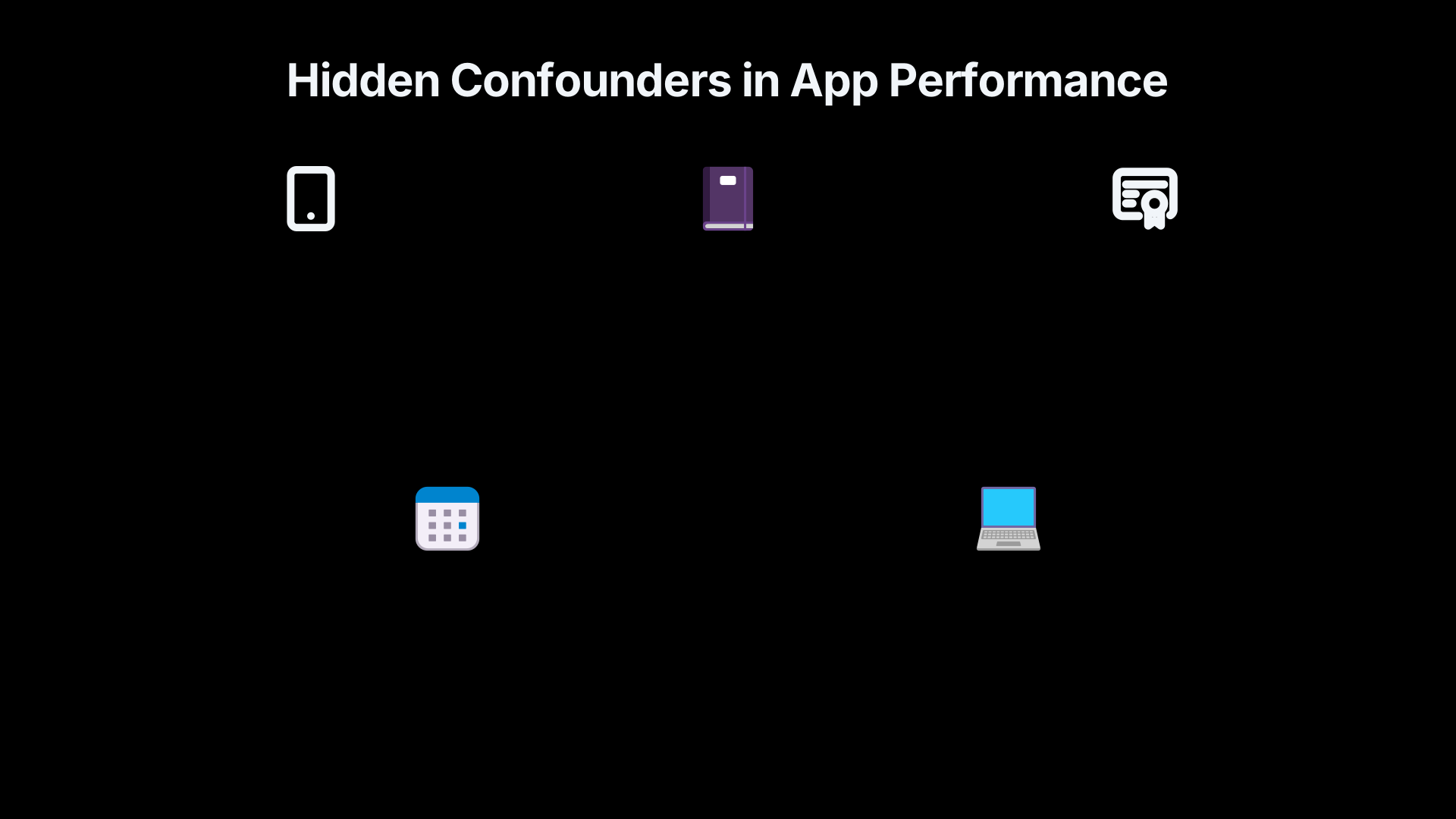
Higher scores among revision app users may reflect study habits and motivation as much as the app itself.
On this page
- The difference between app use and app effect
- Confounders in student performance data
- What stronger education evidence would compare
Page outline Jump by section
Introduction
Students who use revision apps often achieve higher exam scores than students who do not. At first glance, this seems to show that the app improves learning. However, this is a classic example of why analytical thinking distinguishes correlation from causation. The students who voluntarily download, configure and consistently use revision tools may already differ from other students in important ways. They may be more motivated, more organised, more interested in high achievement, or have stronger study habits before they ever open the app. Unless those differences are accounted for, higher scores among app users cannot automatically be credited to the software itself. Research on educational technology repeatedly highlights this challenge, while also showing that some app features—such as spaced repetition and retrieval practice—can genuinely improve learning when tested under stronger research designs. Journal of Learning Analytics+2bera-journals.onlinelibrary.wiley.com[learning-analytics.info]learning-analytics.infoAssessment & Evaluation in Higher Education…Read more…
The difference between app use and app effect
Imagine a school finds that pupils using a revision app score 10% higher on average than those who do not. That observation alone answers only one question: who uses the app? It does not answer the more important question: what would have happened if the same pupils had not used it?
The distinction matters because educational technology is rarely assigned at random. Students usually choose whether to install an app, how often to use it, and whether to continue after the novelty wears off. Those decisions are themselves influenced by characteristics that also affect academic performance.
A motivated student is more likely to:
- begin revision earlier;
- complete optional homework;
- seek extra resources;
- persist when topics become difficult; and
- use a revision app consistently.
Each of these behaviours can raise examination performance independently of the app. If motivation explains both app use and higher marks, motivation becomes a confounding factor rather than the app being the sole cause of better results. This is precisely the kind of selection bias that causal inference seeks to identify and control. Journal of Learning Analytics+2University of Colorado Boulder[learning-analytics.info]learning-analytics.infoAssessment & Evaluation in Higher Education…Read more…
Why motivation is such a powerful confounder
Motivation is difficult to observe directly, yet it influences almost every stage of learning. Students who are intrinsically motivated often study more frequently, monitor their own understanding, ask for feedback, and revise over longer periods rather than relying on last-minute cramming. Those same students are also more likely to experiment with new educational tools.
This creates a misleading pattern:
- App use increases because motivated students seek effective resources.
- Exam scores increase because motivated students study more effectively overall.
- The app appears responsible, even if much of the advantage comes from the students themselves.
The same issue appears in many educational settings. Students who attend optional revision sessions, visit office hours or complete practice quizzes usually outperform their peers, but attendance itself may simply indicate stronger engagement rather than being the entire reason for improved outcomes. Without careful comparison, it is impossible to separate the effect of the intervention from the characteristics of the students choosing it.[Journal of Learning Analytics+2PMC]learning-analytics.infoAssessment & Evaluation in Higher Education…Read more…
Confounders in student performance data
Motivation is only one possible explanation. Several other factors may create the appearance that a revision app is highly effective.
Prior attainment. Students who already perform well may adopt sophisticated study tools earlier than others.
Self-regulated learning. Learners who routinely plan study sessions, monitor progress and review mistakes often use educational apps more consistently.
Time spent studying. App users may simply spend more total time revising, regardless of whether the app itself is especially effective.
Socioeconomic factors. Access to reliable devices, internet connections and quiet study environments can influence both app usage and examination results.
Teacher encouragement. Schools or teachers who actively recommend particular revision platforms may also provide better overall academic support.
These variables can overlap, making simple comparisons between users and non-users increasingly unreliable. Learning analytics researchers have repeatedly warned that observational educational data can easily confuse engagement with intervention effects if these competing explanations are ignored.[Journal of Learning Analytics]learning-analytics.infoAssessment & Evaluation in Higher Education…Read more…
When higher scores may genuinely reflect app benefits
Recognising confounding does not mean revision apps are ineffective. Many incorporate learning techniques with strong independent evidence.
One widely supported example is spaced repetition, where material is reviewed at increasing intervals instead of repeatedly in one sitting. Another is retrieval practice, where learners actively recall information through testing rather than simply rereading notes. Both approaches have extensive cognitive psychology evidence supporting improved long-term retention.
If a revision app successfully encourages students to use these evidence-based techniques more consistently than they otherwise would, then the app can have a genuine causal effect. In that case, the mechanism is not “using an app” in itself, but the learning behaviours the app promotes. Studies evaluating spaced-repetition systems have found improved knowledge retention and examination performance under controlled or quasi-experimental conditions, although results vary by subject, implementation and learner population.[PMC+2ResearchGate]pmc.ncbi.nlm.nih.govImplementation of a spaced-repetition approach to enhance…by K Vagha · 2025 · Cited by 5 — In conclusion, this study highlights the…
This distinction illustrates an important analytical habit: instead of asking whether technology works, ask which specific features change learning behaviour and through what mechanism.
What stronger education evidence would compare
The strongest evidence tries to estimate what would have happened if otherwise similar students had revised differently.
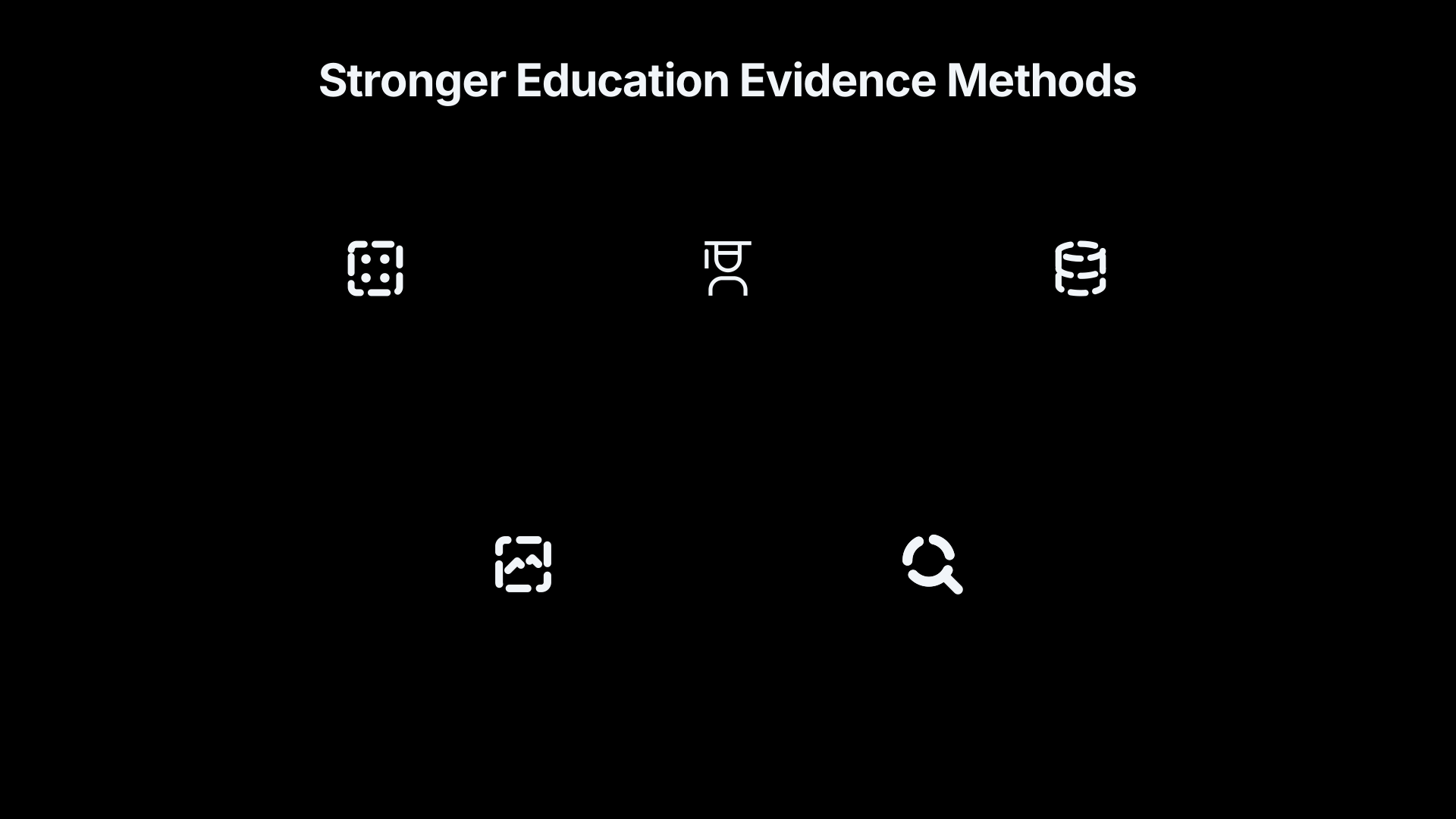
Several research designs are more convincing than simple observational comparisons.
- Randomised controlled trials, where students are randomly assigned to use an app or an alternative revision method.
- Quasi-experiments, where naturally occurring differences approximate random assignment.
- Matched comparison studies, where researchers compare students with similar prior attainment, motivation and background characteristics.
- Longitudinal studies, which measure performance before and after introducing the app while accounting for earlier achievement.
Even these methods have limitations, but they substantially reduce the risk of attributing existing differences between students to the technology itself. Modern educational and causal inference research increasingly emphasises these approaches because straightforward comparisons of users and non-users often exaggerate intervention effects. Journal of Learning Analytics+2Life Sciences Education[learning-analytics.info]learning-analytics.infoAssessment & Evaluation in Higher Education…Read more…
A practical way to interpret claims about revision apps
When you encounter claims such as “students using this revision app scored 15% higher”, treat them as the beginning of an investigation rather than the end.
Ask questions such as:
- Were students randomly assigned to use the app?
- Did users already have higher grades before using it?
- Were motivation and study time measured?
- Which learning techniques does the app actually encourage?
- Would equally motivated students using another revision method achieve similar results?
These questions move attention from surface correlations towards causal explanations.
The broader lesson for analytical thinking
Revision apps provide a useful illustration of a wider principle in reasoning. High-performing people are often early adopters of productive tools, making the tools appear more powerful than they really are. Sometimes the tool genuinely improves outcomes; sometimes it mainly attracts people who would have performed well anyway.
Better analytical thinking requires separating who chooses an intervention from what the intervention actually changes. Only by identifying and testing rival explanations—especially motivation, prior ability and study habits—can we judge whether a revision app truly raises scores or merely tracks the kinds of students most likely to succeed.
Amazon book picks
Further Reading
Books and field guides related to Does the App Raise Scores, or Track Motivation?. Use these as the next step if you want deeper reading beyond the article.
Make It Stick
Provides evidence-based explanations of learning methods such as retrieval practice that are discussed in the article.
The Art of Statistics
Explains how to interpret educational data, confounding variables, and causal claims.
How to Lie with Statistics
Shows how misleading conclusions can arise from observational data and poor statistical reasoning.
Naked Statistics
Builds intuition about evidence, comparisons, and interpreting claims about educational outcomes.
eBay marketplace picks
Marketplace Samples
Example marketplace items related to this page. Use the search link to explore similar finds on eBay.



Endnotes
1.
Source: learning-analytics.info
Link:https://learning-analytics.info/index.php/JLA/article/view/7577
Source snippet
Assessment & Evaluation in Higher Education...Read more...
2.
Source: bera-journals.onlinelibrary.wiley.com
Link:https://bera-journals.onlinelibrary.wiley.com/doi/10.1111/bjet.13116
Source snippet
The effectiveness of technology‐supported personalised...by L Major · 2021 · Cited by 394 — This meta-analysis examines the impact of st...
3.
Source: pmc.ncbi.nlm.nih.gov
Link:https://pmc.ncbi.nlm.nih.gov/articles/PMC12343689/
Source snippet
Implementation of a spaced-repetition approach to enhance...by K Vagha · 2025 · Cited by 5 — In conclusion, this study highlights the...
4.
Source: colorado.edu
Link:https://www.colorado.edu/education/sites/default/files/attached-files/Briggs_Causal%20Inference%20and%20the%20Heckman%20Model.pdf
Source snippet
To the...Read more...
5.
Source: pmc.ncbi.nlm.nih.gov
Title: PMCSelection Effects and Prevention Program Outcomes
Link:https://pmc.ncbi.nlm.nih.gov/articles/PMC3760982/
Source snippet
Effects and Prevention Program Outcomes - PMCby LG Hill · 2013 · Cited by 32 — Nonexperimental studies that use statistical control may i...
6.
Source: researchgate.net
Link:https://www.researchgate.net/publication/290511665_Spaced_Repetition_Promotes_Efficient_and_Effective_Learning_Policy_Implications_for_Instruction
Source snippet
Spaced Repetition Promotes Efficient and Effective LearningSpaced review or practice enhances diverse forms of learning, incl...
7.
Source: strong.io
Link:https://www.strong.io/blog/causal-inference-methods-a-survey
Source snippet
out controlled experiments...
8.
Source: youtube.com
Title: Spaced repetition in learning theory
Link:https://www.youtube.com/watch?v=cVf38y07cfk
Source snippet
Selection Bias...
9.
Source: youtube.com
Title: Selection Bias
Link:https://www.youtube.com/watch?v=dJaHpN2L_C4
Source snippet
What is Self Selection Bias?...
10.
Source: lifescied.org
Link:https://www.lifescied.org/doi/10.1187/cbe.25
Source snippet
Life Sciences EducationToward Causal Inferences in Discipline-Based...2 Jan 2026 — This paper overviews a quasi-experimental approach, t...
11.
Source: stratfordjournalpublishers.org
Link:https://stratfordjournalpublishers.org/journals/index.php/journal-of-education/article/download/1712/2254/5498
Source snippet
Their inherent flexibility allows...Read m...
12.
Source: pmc.ncbi.nlm.nih.gov
Link:https://pmc.ncbi.nlm.nih.gov/articles/PMC12040101/
Source snippet
factors influencing educational technology adoption in...by J Feng · 2025 · Cited by 93 — This study systematically reviewed literature...
13.
Source: wol.iza.org
Link:https://wol.iza.org/articles/machine-learning-for-causal-inference-in-economics/long
Source snippet
learning for causal inference in economicsby A Strittmatter · 2025 · Cited by 5 — Discover how machine learning can help to uncover causa...
Additional References
14.
Source: arxiv.org
Link:https://arxiv.org/abs/2312.15042
Source snippet
Have Learning Analytics Dashboards Lived Up to the Hype? A Systematic Review of Impact on Students' Achievement, Motivation, Partici...
15.
Source: arxiv.org
Link:https://arxiv.org/abs/2210.04552
Source snippet
Intrinsic motivation, Need for cognition, Grit, Growth Mindset and Academic Achievement in High School Students: Latent Profiles and...
16.
Source: aera.net
Link:https://www.aera.net/portals/38/docs/causal%20effects.pdf
Source snippet
(11th and 12th grades) than friends' academic achievement also reduced potential selection bias. By...Read more...
17.
Source: ijcsrr.org
Link:https://ijcsrr.org/wp-content/uploads/2025/07/43-1707-2025.pdf
Source snippet
ce-based clarity regarding the role of study habits in shaping academic outcomes.Read more...
18.
Source: youtube.com
Title: Clinical Research and Statistics
Link:https://www.youtube.com/watch?v=DmyBTe6NKuo
Source snippet
Selection bias in education study habits motivation confounding What is Selection Bias | Explained in 2 min Productivity Guy...
19.
Source: educationendowmentfoundation.org.uk
Title: effectiveness of edtech reflections from new review
Link:https://educationendowmentfoundation.org.uk/news/effectiveness-of-edtech-reflections-from-new-review
Source snippet
Harnessing the potential of EdTech: a new review10 Jul 2025 — Our Research Manager, Isabel Kempner, explores some of the key takeaways fr...
20.
Source: discovery.ucl.ac.uk
Title: Outhwaite Educational apps and learning AAM
Link:https://discovery.ucl.ac.uk/10173200/1/Outhwaite_Educational%20apps%20and%20learning_AAM.pdf
Source snippet
Apps and Learning: Current Evidence on...by L Outhwaite · 2023 · Cited by 9 — These maths apps were identified through a previous system...
21.
Source: methods.sagepub.com
Title: propensity score methods and applications
Link:https://methods.sagepub.com/book/mono/preview/propensity-score-methods-and-applications.pdf
Source snippet
Score Methods and ApplicationsSelection bias typically occurs when observed (measured) covariates or hidden (unmea- sured) covariates are...
22.
Source: selfdeterminationtheory.org
Title: 2024 DavidWeinstein TechInClass
Link:https://selfdeterminationtheory.org/wp-content/uploads/2024/06/2024_DavidWeinstein_TechInClass.pdf
Source snippet
A motivational approach to teachers' technology useby L David · 2024 · Cited by 17 — With effective use of technology, students become mo...
23.
Source: eprints.whiterose.ac.uk
Link:https://eprints.whiterose.ac.uk/id/eprint/234521/1/29_01_10125-73656.pdf
Source snippet
effectiveness of app-based and classroom-...by B González-Fernández · 2025 · Cited by 1 — The present study aims to shed light on this i...
Topic Tree