Within Active Learning
Can You Explain It Without Looking?
Closing the source and reconstructing ideas from memory exposes the gap between familiar-looking notes and usable knowledge.
On this page
- Why rereading feels easier than recall
- A simple close book recall routine
- How to correct gaps without overstudying
Page outline Jump by section
Introduction
One of the quickest ways to discover whether you genuinely understand an idea is to close the book, hide your notes, and explain it from memory. This simple habit replaces the comforting feeling of recognition with the harder but more useful test of retrieval. Within active learning, close-book recall is valuable not because it feels efficient, but because it exposes the difference between information that merely looks familiar and knowledge that is available when you need to think, solve problems, or make decisions. Research on retrieval practice consistently shows that attempting to recall information strengthens long-term learning more effectively than repeatedly rereading it, while also revealing misunderstandings that passive review often conceals.[psychnet.wustl.edu]psychnet.wustl.eduRoediger Karpicke 2006 PPSThe Power of Testing Memoryby HL Roediger III · Cited by 3302 — The experiment involves three phases— study, retrieval practice, and fina…
Why rereading feels easier than recall
Rereading creates a powerful illusion. On the second or third pass through a page, the material feels increasingly clear because the brain recognises words, sentences and diagrams it has seen before. That sense of ease is called processing fluency. Unfortunately, fluent reading is not reliable evidence that the knowledge can be retrieved later or applied in a different situation.[Structural Learning]structural-learning.comfluency illusions students think they knowStructural LearningFluency Illusions: Why Students Think They Know More29 Dec 2025 — Fluency illusions cause students to overestimate the…
Close-book recall deliberately removes that fluency. Once the notes disappear, the learner must reconstruct the idea without external support. If the explanation falls apart, that is not failure—it is accurate feedback. The exercise measures what is stored in memory rather than what is visible on the page.
This distinction matters because analytical thinking depends on retrieval rather than recognition. When evaluating an argument, diagnosing a problem or explaining a concept to someone else, there are no highlighted notes available. The relevant ideas must be recalled, organised and connected in real time.
Classic experiments by Henry Roediger and Jeffrey Karpicke demonstrated this difference. Students who repeatedly studied passages often performed well immediately afterwards, but those who spent more time recalling the material retained substantially more after a delay. The act of retrieval functioned as part of learning, not merely as an assessment of learning.[psychnet.wustl.edu]psychnet.wustl.eduRoediger Karpicke 2006 PPSThe Power of Testing Memoryby HL Roediger III · Cited by 3302 — The experiment involves three phases— study, retrieval practice, and fina…
A simple close-book recall routine
The goal is not to reproduce every sentence perfectly. The goal is to reconstruct the important ideas from memory, identify what is missing, then repair only those gaps.
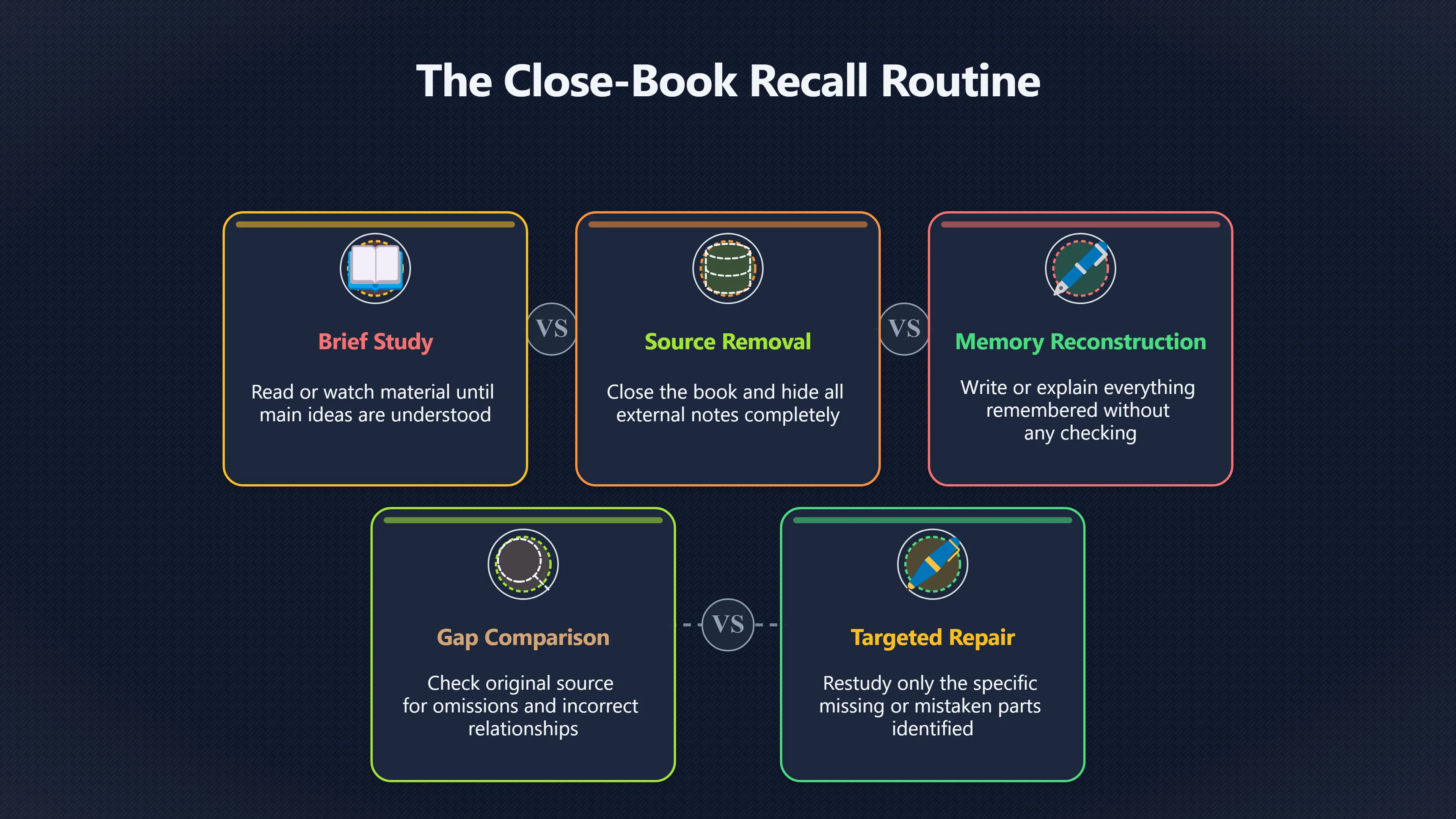
A practical routine looks like this:
- Study briefly. Read or watch the material until you understand its main ideas.
- Remove the source completely. Close the book, minimise the document or put the notes away.
- Reconstruct from memory. Write, sketch or explain aloud everything you remember without checking.
- Compare with the original. Look for omissions, incorrect relationships and inaccurate details rather than small wording differences.
- Repair the gaps. Restudy only the missing or mistaken parts.
- Repeat later. Return after several hours or days and perform another close-book recall rather than another uninterrupted reread.
Notice that most of the time is spent attempting retrieval, not reviewing. The comparison stage is essential because it prevents errors from becoming permanent while keeping review tightly focused.
For conceptual material, a useful prompt is, “Could I teach this to someone with no notes?” For analytical subjects, ask, “Could I explain why this method works and when it would fail?” These questions require reconstruction instead of recognition.
What successful recall actually tells you
Being able to retrieve an idea without looking demonstrates more than memorisation.
It suggests that you can:
- identify the central concepts without prompts;
- organise ideas into a coherent explanation;
- distinguish important points from supporting detail;
- recognise where your understanding becomes uncertain.
Equally important is what unsuccessful recall reveals. Learners often discover that they remember definitions but cannot explain relationships, recall examples but not underlying principles, or remember conclusions without the reasoning that produced them. These are precisely the weaknesses that passive review tends to hide.
Because retrieval exposes these weaknesses, it improves calibration—the match between confidence and actual understanding. Studies of student learning repeatedly show that learners tend to overestimate their mastery after rereading but judge their knowledge more accurately after attempting retrieval.[ResearchGate]researchgate.netDo students practise retrieval when they study on their own?Repeated testing enhances learning more than repeated reading, wh…
How to correct gaps without overstudying
The purpose of close-book recall is not to create endless testing. It is to make review efficient.
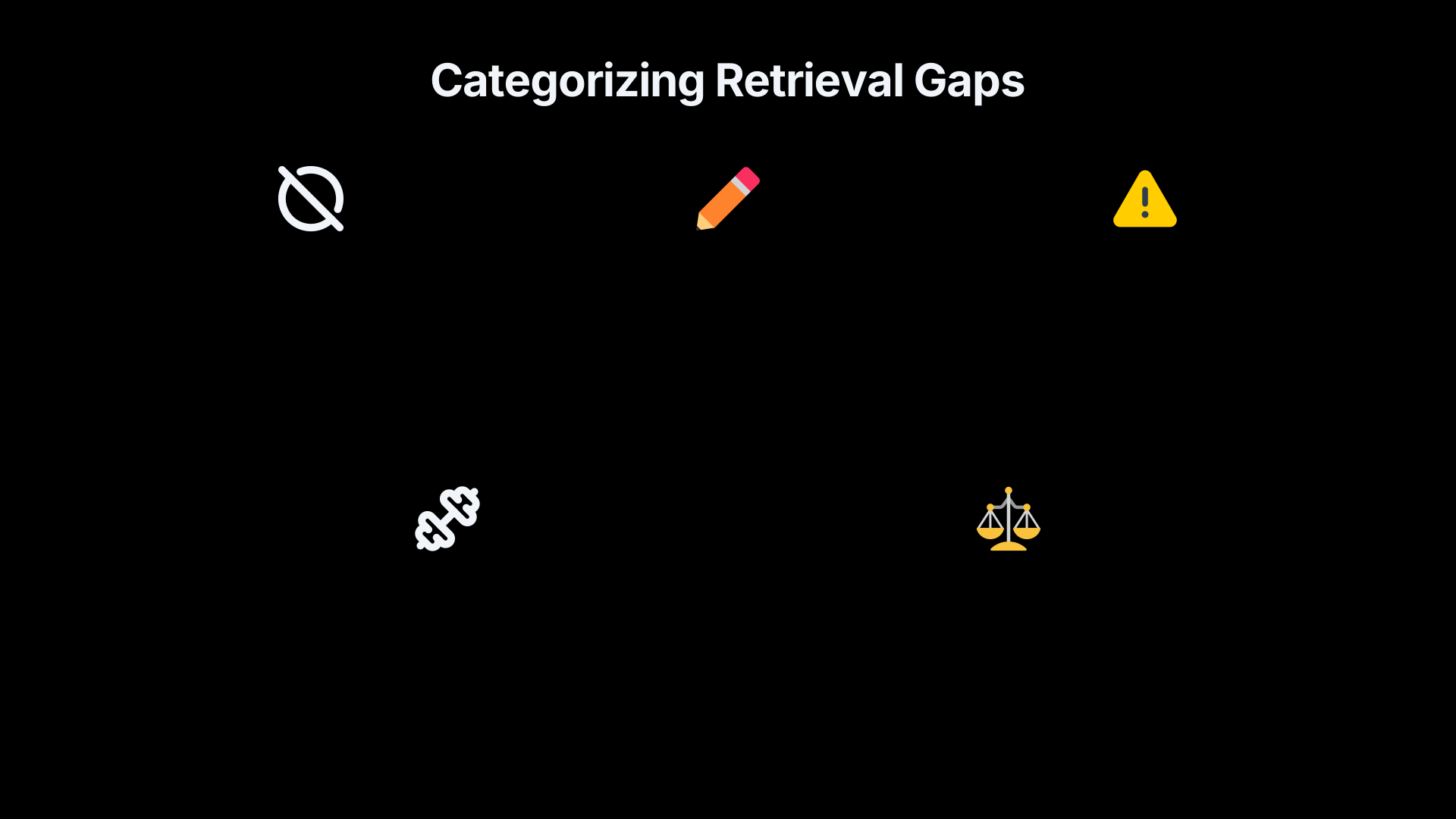
When comparing your reconstruction with the source, separate mistakes into three categories:
- Missing ideas: concepts you forgot entirely.
- Incomplete explanations: ideas you remembered but could not fully explain.
- Misconceptions: explanations that were confidently wrong.
Each category deserves a different response.
Missing ideas usually require another brief review followed by another recall attempt.
Incomplete explanations often improve by writing a simpler explanation in your own words and testing yourself again after a short delay.
Misconceptions deserve the most attention because incorrect mental models are harder to replace than missing facts. Correct them immediately, then perform another recall attempt without looking.
Avoid rereading the entire chapter simply because one paragraph caused difficulty. Retrieval practice is most efficient when correction is targeted rather than global.
Why struggling is often a good sign
Many learners abandon close-book recall because it feels slower and more frustrating than rereading. That discomfort is expected.
Robert and Elizabeth Bjork describe retrieval as a “desirable difficulty”: a challenge that reduces short-term performance but improves long-term learning when it remains achievable. The effort required to reconstruct information appears to strengthen later access to that information.[Bjork Lab]bjorklab.psych.ucla.eduEBjork RBjork 2011▻ How did you get interested…Read more…
The important qualification is that the difficulty must be productive rather than overwhelming. If nothing can be recalled, the learner probably needs another brief exposure before trying again. If almost everything can be recalled effortlessly every time, the task may no longer be demanding enough to reveal remaining weaknesses.
The most productive point lies between those extremes: retrieval should require genuine mental effort while remaining largely successful.
Common mistakes that reduce the value of close-book recall
Several habits weaken the method without learners noticing.
- Checking too quickly. Looking back after the first hesitation prevents genuine retrieval.
- Using recognition as evidence. Saying “I knew that” after reading the answer is not the same as producing it independently.
- Copying instead of reconstructing. Rewriting notes while looking at them provides little information about understanding.
- Only recalling facts. Analytical subjects also require explaining causes, assumptions, comparisons and applications.
- Stopping after one successful attempt. Knowledge that is retrievable today may not remain available after several days unless retrieval is repeated.
These mistakes return the learner to passive review, where familiarity is mistaken for mastery.
Turning recall into a habit of better thinking
Close-book recall is valuable because it asks the same question that real-world thinking asks: What can you produce without being prompted?
Whether analysing evidence, solving a technical problem or explaining an argument, useful knowledge must be retrieved, organised and applied rather than recognised on a page. Closing the source for a few minutes transforms studying from checking what looks familiar into discovering what is genuinely available. That makes it one of the simplest and most reliable ways to judge real understanding while steadily improving the quality of thinking itself.
Amazon book picks
Further Reading
Books and field guides related to Can You Explain It Without Looking?. Use these as the next step if you want deeper reading beyond the article.
Make It Stick
Retrieval practice and replacing rereading with active recall are central themes throughout the book.
How We Learn
Explains why testing yourself and recalling information improves long-term learning.
Ultralearning
Promotes aggressive active learning strategies, including self-testing and explanation from memory.
A Mind for Numbers
Covers effective study habits, retrieval, and avoiding passive review.
eBay marketplace picks
Marketplace Samples
Example marketplace items related to this page. Use the search link to explore similar finds on eBay.



Endnotes
1.
Source: psychnet.wustl.edu
Title: Roediger Karpicke 2006 PPS
Source snippet
The Power of Testing Memoryby HL Roediger III · Cited by 3302 — The experiment involves three phases— study, retrieval practice, and fina...
2.
Source: structural-learning.com
Title: fluency illusions students think they know
Link:https://www.structural-learning.com/post/fluency-illusions-students-think-they-know
Source snippet
Structural LearningFluency Illusions: Why Students Think They Know More29 Dec 2025 — Fluency illusions cause students to overestimate the...
3.
Source: researchgate.net
Link:https://www.researchgate.net/publication/24268097_Metacognitive_strategies_in_student_learning_Do_students_practise_retrieval_when_they_study_on_their_own
Source snippet
Do students practise retrieval when they study on their own?Repeated testing enhances learning more than repeated reading, wh...
4.
Source: researchgate.net
Link:https://www.researchgate.net/publication/5574966_The_Critical_Importance_of_Retrieval_for_Learning
Source snippet
(PDF) The Critical Importance of Retrieval for LearningThe results demonstrate the critical role of retrieval practice in consolidating l...
5.
Source: structural-learning.com
Link:https://www.structural-learning.com/post/desirable-difficulties
Source snippet
Desirable Difficulties: Bjork's 5 Principles29 Aug 2025 — Roediger and Karpicke (2006) found retrieval improves recall by 50%...
6.
Source: researchgate.net
Link:https://www.researchgate.net/publication/399606964Why_Desirable_Difficulties%27Work%27_A_Review_of_the_Evidence_From_Cognitive_and_Educational_Psychology_and_Some_Caveats_for_the_Health_Professions_Education_Field
Source snippet
Why Desirable Difficulties 'Work': A Review of the Evidence...9 Jan 2026 — Aim In this paper, I review the evidence from the cognitive p...
7.
Source: bjorklab.psych.ucla.edu
Title: EBjork RBjork 2011
Link:https://bjorklab.psych.ucla.edu/wp-content/uploads/sites/13/2016/04/EBjork_RBjork_2011.pdf
Source snippet
▻ How did you get interested...Read more...
Additional References
8.
Source: my.chartered.college
Link:https://my.chartered.college/impact_article/physics-revision-how-to-guide-students-to-write-and-use-effective-flashcards/
Source snippet
revision: How to guide students to write and use...by C Astolfi — When I encouraged students to use their cards, they would just read bo...
9.
Source: youtube.com
Link:https://www.youtube.com/watch?v=Em8FvxtP1Xc
Source snippet
Active Recall: Why the Best Study Method Feels Like the Worst is highly relevant because it unpacks the classic Roediger and Karpicke res...
10.
Source: pdf.retrievalpractice.org
Title: Roediger Agarwal etal 2011 JEPA
Link:https://pdf.retrievalpractice.org/guide/Roediger_Agarwal_etal_2011_JEPA.pdf
Source snippet
Test-Enhanced Learning in the Classroomby HL Roediger III · Cited by 639 — Roediger and Karpicke (2006a) reviewed considerable laboratory...
11.
Source: notes.andymatuschak.org
Link:https://notes.andymatuschak.org/zYB7kwEFRu8QALcbzbcoy9T
Source snippet
difficulties, after BjorkExperimental study demonstrating Desirable difficulties, after Bjork in the context of Retrieval practice. Roedi...
12.
Source: donaldclarkplanb.blogspot.com
Title: Roediger and Karpicke
Link:https://donaldclarkplanb.blogspot.com/2021/10/roediger-and-karpicke-retrieval.html
Source snippet
In their 2006 research, Karpicke and Roediger used rereading as the control, as that is what most learners do, see...Read more...
13.
Source: pmc.ncbi.nlm.nih.gov
Link:https://pmc.ncbi.nlm.nih.gov/articles/PMC12372469/
Source snippet
practice enhances learning in real primary school...by L Franzoi · 2025 · Cited by 2 — This “illusion of competence” leads to faster but...
14.
Source: pmc.ncbi.nlm.nih.gov
Link:https://pmc.ncbi.nlm.nih.gov/articles/PMC4480221/
Source snippet
Practice and Spacing Effects in Young and Older...by GB Maddox · 2015 · Cited by 53 — Based on Bjork's concept of desirable difficulty...
15.
Source: youtube.com
Title: Why You Forget What You Learn (and What to Do About It)
Link:https://www.youtube.com/watch?v=17uFVJcOQEY
Source snippet
5 Desirable difficulties for learning with Elizabeth Bjork and Robert Bjork (Ep 66)...
16.
Source: mindomax.com
Title: desirable difficulties
Link:https://www.mindomax.com/desirable-difficulties
Source snippet
2011. Karpicke and Blunt publish retrieval practice study in Science. 2019. Brunmair...Read more...
17.
Source: youtube.com
Title: Active Recall: Why the Best Study Method Feels Like the Worst
Link:https://www.youtube.com/watch?v=qfHomRdzeik
Source snippet
2 The Testing Effect: The Science of How To Actually Remember...
Topic Tree