Within Deliberate Practice
When should reasoning prompts disappear?
Faded prompts help learners practise a reasoning move repeatedly until they can use it without step-by-step support.
On this page
- How prompts guide a target reasoning move
- Why support should fade after repeated practice
- Lessons from data rich classroom tasks
Page outline Jump by section
Introduction
Reasoning prompts are most valuable when they are temporary. The aim is not to create learners who always depend on checklists, sentence starters or guided questions, but to help them internalise a specific reasoning habit until they can apply it independently. This instructional approach is commonly called fading: support is deliberately reduced as competence increases rather than remaining permanently available. Research across cognitive apprenticeship, worked-example instruction and classroom science education shows that gradual withdrawal of guidance can produce more durable reasoning skills than either leaving learners unsupported from the beginning or providing permanent scaffolding. American Federation of Teachers+2mr barton maths[aft.org]aft.orgAmerican Federation of TeachersCognitive Apprenticeshipby A Collins · Cited by 3468 — There are four important aspects of traditional app…
 Within deliberate practice for reasoning, faded prompts occupy a distinctive role. They are not simply a motivational technique or a way to make tasks easier. Instead, they are a policy for transferring responsibility from the instructor to the learner while preserving the quality of the target reasoning move.
How prompts guide a target reasoning move
A reasoning prompt directs attention towards a particular mental action that experts perform automatically. Instead of asking learners merely to produce an answer, prompts encourage behaviours such as:
- identifying assumptions before reaching a conclusion;
- comparing competing explanations;
- explaining why evidence supports one interpretation rather than another;
- estimating uncertainty instead of expressing unwarranted certainty;
- checking whether alternative evidence would change the conclusion.
Initially these prompts make invisible thinking visible. Learners repeatedly perform the same reasoning move in a structured way until the move itself becomes familiar.
The educational model of cognitive apprenticeship describes this progression through modelling, coaching, scaffolding and finally fading. Early instruction provides explicit support because novices often lack the mental structures needed to organise complex reasoning. As learners improve, assistance becomes less detailed and less frequent so that responsibility shifts towards independent performance.[American Federation of Teachers]aft.orgAmerican Federation of TeachersCognitive Apprenticeshipby A Collins · Cited by 3468 — There are four important aspects of traditional app…
Research on worked examples follows the same principle. Rather than asking beginners to solve every problem independently, instructors first demonstrate complete reasoning processes. Later examples deliberately omit increasing numbers of solution steps, requiring learners to complete the missing reasoning themselves. Self-explanation prompts are often incorporated during this transition because explaining missing steps helps learners build transferable mental models rather than memorising procedures.[mr barton maths]mrbartonmaths.comFading out and PromptsReflection is also…Read more…
Why support should fade after repeated practice
Permanent prompts can unintentionally become a crutch. If learners always receive the same checklist before analysing evidence, they may learn to follow the checklist only when it is visibly present instead of developing an internal habit.
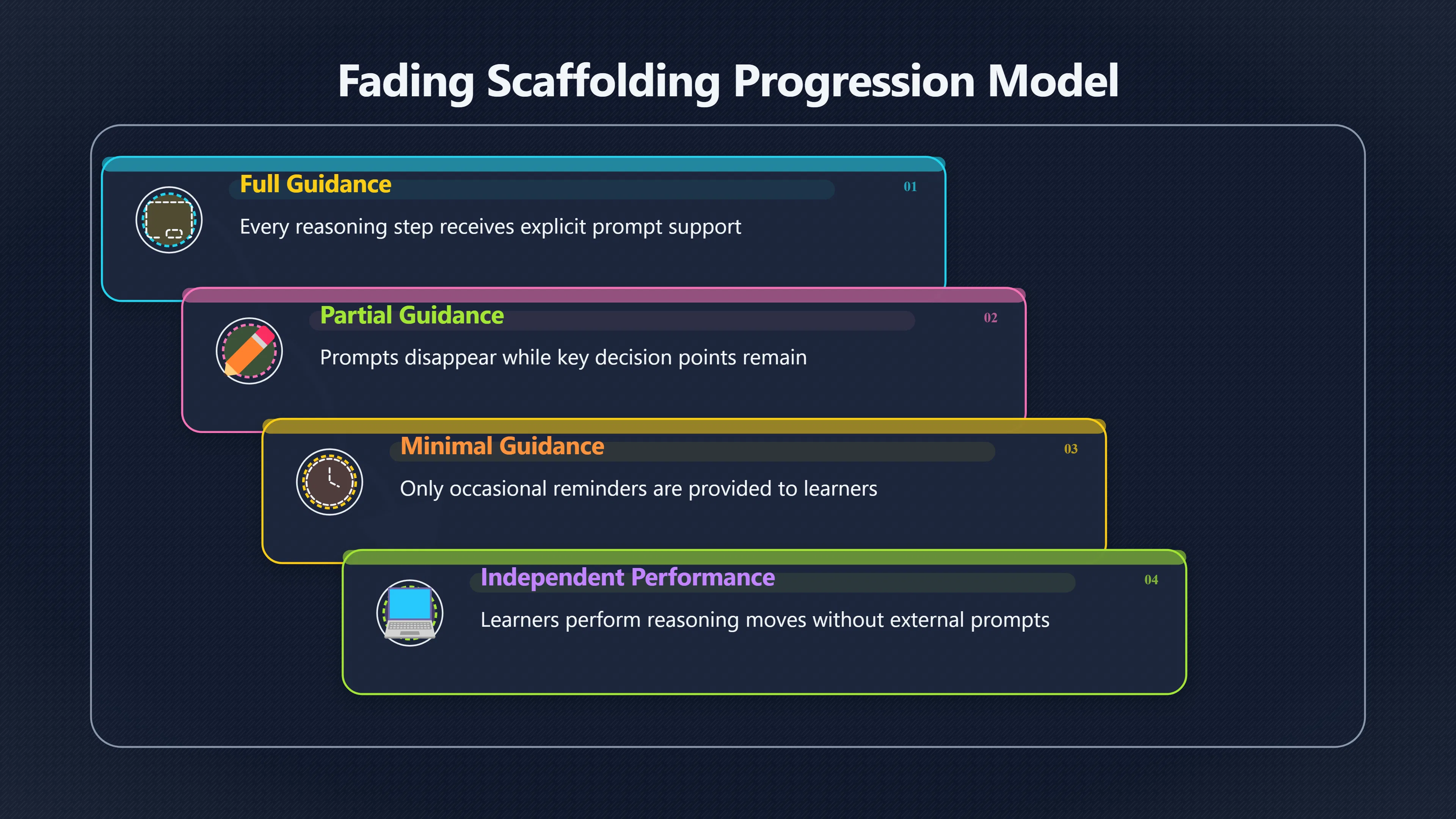
Fading addresses this problem by gradually increasing cognitive responsibility while keeping the task achievable. Typical progression includes:
- Full guidance: every reasoning step is explicitly prompted.
- Partial guidance: some prompts disappear while key decision points remain.
- Minimal guidance: only occasional reminders are provided.
- Independent performance: learners perform the reasoning move without external prompts.
This sequence balances two competing risks. Removing support too early may overload working memory and encourage guessing. Leaving support in place for too long can create dependence and reduce transfer to new situations. Cognitive load theory therefore recommends adapting instructional guidance to learners’ developing expertise rather than treating scaffolds as permanent features of instruction.[mr barton maths+2PMC]mrbartonmaths.comFading out and PromptsReflection is also…Read more…
A related finding is the expertise reversal effect. Instructional supports that help novices can become unnecessary or even distracting once learners possess sufficient knowledge. At that stage, simplified prompts may consume attention without contributing additional understanding, making gradual withdrawal an important part of effective instructional design.[Wikipedia]WikipediaWorked-example effectWorked-example effect
Lessons from data-rich classroom tasks
One of the clearest demonstrations comes from undergraduate physics laboratories designed to strengthen scientific reasoning rather than merely complete experiments.
Students were repeatedly prompted to compare data with theoretical models, identify discrepancies, improve experimental methods and justify revisions. These prompts were not intended to remain throughout the course. Instead, instructors progressively removed them after repeated practice.
When later completing laboratory work with far less guidance, students who had experienced faded prompting were substantially more likely than students in conventional laboratory courses to:
- improve their experimental methods without being instructed to do so;
- evaluate whether evidence supported theoretical models;
- explain limitations of those models using their own reasoning.
The important outcome was not simply better laboratory technique. Students had begun initiating the target reasoning behaviour spontaneously rather than waiting for instructions. This illustrates the central purpose of faded prompts: transferring ownership of the reasoning process from teacher to learner.[PMC]pmc.ncbi.nlm.nih.govNIHby ND Martin · 2018 · Cited by 109 — Our study explores the interplay between support embedded in instructional materials and sc…
Similar patterns appear beyond laboratory science. Studies of worked examples consistently show that learners transition more successfully from observing expert reasoning to solving problems independently when instructional steps are gradually removed instead of disappearing all at once. Self-explanation during this fading process further strengthens conceptual understanding by requiring learners to reconstruct missing reasoning rather than copy it mechanically.[mr barton maths]mrbartonmaths.comFading out and PromptsReflection is also…Read more…
Historical development of the fading idea
The concept emerged prominently within cognitive apprenticeship during the late 1980s. Rather than viewing expertise as knowledge that could simply be transmitted through lectures, researchers argued that complex thinking should be taught similarly to traditional apprenticeships.
Experts first demonstrate the craft, then coach learners through increasingly difficult performances while reducing assistance over time. Fading therefore became a defining feature rather than an optional extra. It distinguishes genuine scaffolding from permanent instructional support because the ultimate objective is independent competence.[American Federation of Teachers]aft.orgAmerican Federation of TeachersCognitive Apprenticeshipby A Collins · Cited by 3468 — There are four important aspects of traditional app…
During the following decades, cognitive load theory and worked-example research supplied complementary evidence. Investigators found that carefully designed fading procedures reduced unnecessary mental effort for novices while encouraging progressively greater learner responsibility. Rather than representing competing theories, cognitive apprenticeship and worked-example research converged on the same instructional policy: guidance should evolve as learners develop.[mr barton maths]mrbartonmaths.comFading out and PromptsReflection is also…Read more…
What successful fading looks like in practice
The strongest implementations share several characteristics.
The target reasoning move is explicit. Learners know exactly which behaviour is being practised, such as evaluating evidence quality or generating competing explanations.
Support is withdrawn intentionally. Prompts disappear according to learners’ growing competence rather than arbitrary timing.
Tasks remain authentic. Learners continue solving meaningful problems instead of practising isolated prompt completion.
Performance is monitored. If reasoning quality declines sharply after prompts are removed, instructors temporarily restore support before attempting another fade.
Research on distributed scaffolding also suggests that successful fading depends on responsive teaching. Static instructional materials may reduce guidance according to a fixed schedule, but teachers often need to adjust the pace in response to learners’ actual performance, providing additional coaching when necessary and withdrawing it when students demonstrate genuine independence.[PMC]pmc.ncbi.nlm.nih.govNIHby ND Martin · 2018 · Cited by 109 — Our study explores the interplay between support embedded in instructional materials and sc…
Common misconceptions
One misconception is that faded prompting means abandoning learners as quickly as possible. The evidence points to the opposite. Effective fading is gradual, responsive and tied to demonstrated competence rather than rigid timetables.[PMC]pmc.ncbi.nlm.nih.govNIHby ND Martin · 2018 · Cited by 109 — Our study explores the interplay between support embedded in instructional materials and sc…
Another misconception is that prompts should remain permanently because they improve performance during instruction. Immediate performance and long-term independence are not always the same objective. Learners may appear successful while prompts are present yet struggle once they disappear. Fading is designed precisely to bridge that transition.[mr barton maths]mrbartonmaths.comFading out and PromptsReflection is also…Read more…
A further misunderstanding is that fading applies only to mathematical procedures. Although much experimental evidence comes from mathematics and physics, the underlying principle extends to broader reasoning tasks, including interpreting scientific papers, evaluating arguments and making evidence-based decisions. Studies using cognitive apprenticeship to teach students how to identify argumentative structures in authentic research articles similarly rely on modelling, guided practice and progressively reduced support to cultivate independent analytical reading.[PMC]pmc.ncbi.nlm.nih.govby EB Van Lacum · 2014 · Cited by 88 — We used cognitive apprenticeship as the pedagogical approach. Abstract. The aim of this study i…
Amazon book picks
Further Reading
Books and field guides related to When should reasoning prompts disappear?. Use these as the next step if you want deeper reading beyond the article.
Make It Stick
Explains durable learning, retrieval practice, and reducing reliance on external supports as learners become more independent.
How Learning Happens
Summarizes major research on guidance, worked examples, cognitive load, and effective instructional scaffolding.
Why Don't Students Like School?
Explains how thinking develops and why instructional support should match learners' cognitive needs before being withdrawn.
Visible Learning for Teachers
Discusses evidence-based teaching practices, including effective feedback, guidance, and gradual release of responsibility.
eBay marketplace picks
Marketplace Samples
Example marketplace items related to this page. Use the search link to explore similar finds on eBay.

Endnotes
1.
Source: pmc.ncbi.nlm.nih.gov
Link:https://pmc.ncbi.nlm.nih.gov/articles/PMC6519686/
Source snippet
NIHby ND Martin · 2018 · Cited by 109 — Our study explores the interplay between support embedded in instructional materials and sc...
2.
Source: pmc.ncbi.nlm.nih.gov
Link:https://pmc.ncbi.nlm.nih.gov/articles/PMC12879535/
Source snippet
working memory moderate the effect of fading on math...by D Miller‐Cotto · 2025 · Cited by 2 — To remedy this, proponents have suggested...
3.
Source: Wikipedia
Title: Worked-example effect
Link:https://en.wikipedia.org/wiki/Worked-example_effect
4.
Source: learner.org
Link:https://www.learner.org/series/the-learning-classroom-theory-into-practice/watch-it-do-it-know-it-cognitive-apprenticeship/
Source snippet
Watch It, Do It, Know It: Cognitive ApprenticeshipThis program demonstrates how teachers help their students develop expertise and accomp...
5.
Source: youtube.com
Title: Cognitive Apprenticeship
Link:https://www.youtube.com/watch?v=Hz3S8z9gLzc
Source snippet
Teaching math so students learn with Craig Barton (Ep 63)...
6.
Source: aft.org
Link:https://www.aft.org/ae/winter1991/collins_brown_holum
Source snippet
American Federation of TeachersCognitive Apprenticeshipby A Collins · Cited by 3468 — There are four important aspects of traditional app...
7.
Source: mrbartonmaths.com
Title: Fading out and Prompts
Link:https://mrbartonmaths.com/resourcesnew/8.%20Research/Making%20the%20most%20of%20examples/Fading%20out%20and%20Prompts.pdf
Source snippet
Reflection is also...Read more...
8.
Source: pmc.ncbi.nlm.nih.gov
Link:https://pmc.ncbi.nlm.nih.gov/articles/PMC4041503/
Source snippet
by EB Van Lacum · 2014 · Cited by 88 — We used cognitive apprenticeship as the pedagogical approach. Abstract. The aim of this study i...
9.
Source: newsletter.jamieleeclark.com
Title: worked examples
Link:https://newsletter.jamieleeclark.com/p/worked-examples
Source snippet
Examples: Reduce Cognitive Load and Accelerate...A worked example is a step-by-step demonstration of how to solve a problem or complete...
Additional References
10.
Source: researchgate.net
Link:https://www.researchgate.net/publication/328795382_Fading_distributed_scaffolds_the_importance_of_complementarity_between_teacher_and_material_scaffolds
Source snippet
(PDF) Fading distributed scaffolds: the importance of...6 May 2026 — Our study explores the interplay between support embedded in instru...
Published: May 2026
11.
Source: researchgate.net
Link:https://www.researchgate.net/publication/200772684_Transitioning_From_Studying_Examples_to_Solving_Problems_Effects_of_Self-Explanation_Prompts_and_Fading_Worked-Out_Steps
Source snippet
Effects of Self-Explanation Prompts and Fading Worked-...Research indicates that learners can be effectively supported in transitioning...
12.
Source: scispace.com
Link:https://scispace.com/pdf/cognitive-apprenticeship-teaching-the-craft-of-reading-15l0uz4jrc.pdf
Source snippet
Cognitive Apprenticeship: Teaching the Craft of Reading, Writing...DOCUMENT RESUME. ED 284 181. CS 008 872. AUTHOR. Collins, Allan; And...
13.
Source: arxiv.org
Link:https://arxiv.org/html/2509.23619v2
Source snippet
scaffold' from textual rationales, creating a structured and interpretable training...Read more...
14.
Source: ijtsrd.com
Link:https://www.ijtsrd.com/papers/ijtsrd27913.pdf
Source snippet
The study is titled cognitive apprenticeship and the development of productive learning skills among emerging adults engaged in mechanic...
15.
Source: d-nb.info
Link:https://d-nb.info/1370823436/34
Source snippet
is a crucial aspect of scaffolding (referred to as contingency by Wood et al., 1976).Read more...
16.
Source: scholar.lib.vt.edu
Link:https://scholar.lib.vt.edu/ejournals/JITE/v33n3/duncan.html
Source snippet
v33n3 - Cognitive Apprenticeship in Classroom Instructionby SLS Duncan · 1996 · Cited by 98 — For example, coaching, scaffolding, and fad...
17.
Source: osf.io
Link:https://osf.io/download/s7dvk/
Source snippet
Abstract. Generative artificial intelligence (GenAI) is rapidly becoming a pervasive tech- nology across education, work, research, and e...
18.
Source: researchgate.net
Link:https://www.researchgate.net/publication/316178628_Learning_from_worked-examples_in_mathematics_students_relate_procedures_to_principles
Source snippet
cognitive load and serve as an efficient means to help students learn new...
19.
Source: youtube.com
Title: Vygotsky’s Theory of Cognitive Development in Social Relationships
Link:https://www.youtube.com/watch?v=8I2hrSRbmHE
Source snippet
Fading scaffolding cognitive apprenticeship worked examples Cognitive Apprenticeship Michael Mittag...
Topic Tree