Within Critical Skills
When Two Things Move Together, What Then?
Causal mistakes become less likely when people learn to ask about comparison groups, confounders and alternative explanations.
On this page
- The common trap of assuming cause
- Questions that test a causal claim
- Examples from health, finance and workplace data
Page outline Jump by section
Introduction
Many adult decisions turn on one question: did one thing actually cause another, or did they merely move together? A correlation means two things are associated; causation means changing one thing would change the other. The distinction matters because everyday choices about health, money and work often rely on causal claims: “this supplement improved my sleep”, “this fund manager creates higher returns”, or “this new policy boosted productivity”. Correlations can be useful clues, but they are not proof. Better thinking starts by asking about comparison groups, confounders and alternative explanations before acting on a pattern.
 The practical skill is not cynicism. It is disciplined curiosity. Causal inference researchers make the same point in more formal language: observational data can help answer causal questions, but only when the reasoning about possible causes, biases and missing variables is made explicit. [Sage Journals]journals.sagepub.comSage JournalsThinking Clearly About Correlations and Causationby JM Rohrer · 2018 · Cited by 1429 — Correlation does not imply causation…
The Trap: A Pattern Becomes a Story
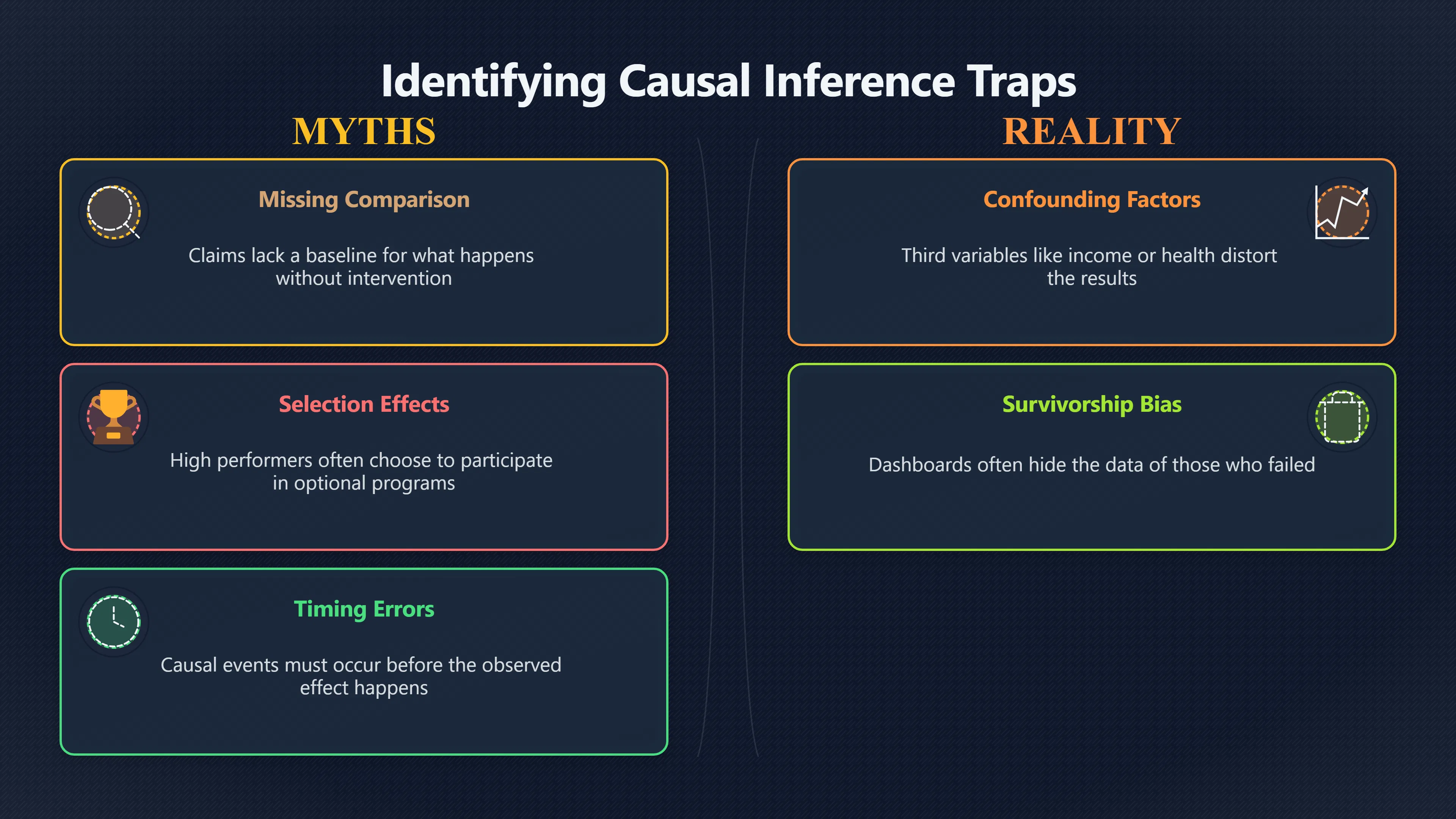
Correlation is persuasive because the mind likes tidy stories. If a person starts drinking green tea and then loses weight, it is tempting to credit the tea. If a company switches to hybrid working and sales rise, it is tempting to credit the policy. If a stock rises after a chief executive gives a confident interview, it is tempting to treat the interview as the cause. In each case, the pattern may be real while the explanation is wrong.
The most common error is ignoring the missing comparison: what would have happened without the tea, the workplace policy or the interview? Epidemiology makes this point sharply. The US Centers for Disease Control and Prevention describes the comparison group as a key feature of analytic epidemiology, because a claim about exposure and outcome cannot be assessed by looking only at people who had the exposure. [CDC Archive]archive.cdc.govCDC ArchiveSection 7: Analytic EpidemiologyThe key feature of analytic epidemiology is a comparison group. Consider a… Epidemiologic s…
Confounding is the second trap. A confounder is a third factor that is related both to the supposed cause and to the outcome. In health research, for example, people who choose a particular treatment, diet or supplement may also differ in income, existing health, education, exercise, access to care or risk tolerance. Those differences can make the exposure look beneficial or harmful even when it is not the true driver. [PMC]pmc.ncbi.nlm.nih.govPMCMethodological issues of confounding in analyticalPMCMethodological issues of confounding in analytical
A famous adult-decision example is menopausal hormone therapy. Earlier observational studies suggested possible cardiovascular benefit, but randomised evidence from the Women’s Health Initiative and later reviews changed the interpretation: hormone therapy did not show protective cardiovascular effects and increased risks such as stroke and venous thromboembolism. [PMC]pmc.ncbi.nlm.nih.govOpen source on nih.gov. The lesson is not that observational evidence is useless. It is that people who receive or choose an intervention may differ from those who do not, and those differences can distort causal judgement.
Questions That Test a Causal Claim
A good causal question changes the shape of a decision. Instead of asking, “Did these two things happen together?”, ask, “What would make this explanation more likely than the alternatives?” That shift is the mechanism that transfers beyond school: it turns critical thinking into a repeatable adult habit.
Useful questions include:
- What is the comparison group? A claim is weak if it only describes people, teams or investments that received the treatment, policy or exposure.
- What came first? A cause must occur before the effect. If the timing is unclear, the causal story is already shaky.
- What else could explain the result? Look for third factors such as age, income, seasonality, market conditions, workload, prior health or selection effects.
- Was the exposure chosen or assigned? Randomised controlled trials are often powerful for causal claims because randomisation reduces many pre-existing differences between groups. [PMC]pmc.ncbi.nlm.nih.govOpen source on nih.gov.
- Could the data be missing the people who failed? Workplace dashboards, investment backtests and health testimonials often overrepresent survivors and satisfied users.
- Would the claim survive in a new setting? A pattern found in one team, market cycle or patient group may not transfer elsewhere.
This does not mean only randomised trials count. In many adult decisions, randomisation is impossible, unethical, expensive or too slow. Observational studies are often necessary, especially in public health, social outcomes and business settings. The stronger approach is to treat causal claims from observational data as conditional: credible when the design, comparison and assumptions are strong; fragile when they are hidden. [PMC]pmc.ncbi.nlm.nih.govOpen source on nih.gov.

Health: When a Headline Overstates the Cause
Health headlines are fertile ground for causal mistakes because they often compress complex evidence into a simple instruction. “People who eat X have lower risk of Y” can become “X prevents Y”, even when the study only found an association. Research on health communication has found that causal claims in press releases and news can be brought into closer alignment with the underlying evidence without necessarily making the news less interesting. [PMC]pmc.ncbi.nlm.nih.govPMCClaims of causality in health news: a randomised trialPMCClaims of causality in health news: a randomised trial
A practical reader should therefore inspect the study design before changing behaviour. An observational study can suggest that a behaviour is linked with an outcome, but it may not settle whether the behaviour caused the outcome. People who eat more vegetables, sleep longer or use a preventive medicine may differ in many other ways from those who do not. [PMC]pmc.ncbi.nlm.nih.govPMCObservational StudiesPMCObservational Studies
The adult thinking move is to avoid both extremes. Do not dismiss every association, because many real causal discoveries begin as observed patterns. But do not treat every association as a prescription. Stronger confidence comes when several things line up: plausible mechanism, correct timing, consistent findings, good comparison groups, dose-response evidence where relevant, and research designs that reduce confounding.
Finance: When Backtests Pretend to Explain the Future
Finance makes correlation especially tempting because charts look precise. An investment strategy may appear to outperform when tested on historical data, or two assets may appear to move together in a stable way. But a historical pattern is not automatically a causal engine. It may reflect a specific market regime, data mining, omitted variables or luck.
Investor education bodies warn against treating past performance as a predictor. IOSCO’s investment risk education report lists the message that historical performance is a guide, not a predictor, and stresses that investors need to understand risk, diversification and their own tolerance before investing. [IOSCO]iosco.orgOpen source on iosco.org.
The causal question in finance is: what mechanism would make this pattern persist after costs, competition and changing conditions? A fund’s recent outperformance might come from skill, but it might also come from exposure to a booming sector, higher hidden risk, leverage, survivorship bias or simple chance. In quantitative investing, recent discussion has highlighted model risk when backtests and factor models rely too heavily on association without a convincing causal structure. [CFA Institute Research and Policy Center]rpc.cfainstitute.orgbacktests causality and model risk in quantitative investingbacktests causality and model risk in quantitative investing
For personal decisions, this translates into caution about confident explanations. “This asset rose when inflation rose” is not the same as “this asset will protect me from inflation next time”. A better question is whether the proposed cause still makes sense under different interest rates, policy choices, liquidity conditions and investor behaviour.
Work: When Dashboards Reward the Wrong Explanation
Workplace data can make weak causal claims look managerial and objective. A dashboard may show that employees who attend more training sell more, that teams using a certain software close tickets faster, or that people who work in the office more often receive higher performance ratings. Each pattern may be useful, but none automatically proves that the training, software or office attendance caused the result.
Selection effects are common. High performers may be more likely to attend optional training. Better-managed teams may adopt new software earlier. Employees who are more visible may receive higher ratings because managers notice them more, not because office presence directly improves output. Harvard Business Review has warned leaders that data-driven decisions can go wrong when organisations confuse correlation with causation and fail to ask how the data was generated. [Harvard Business Review]hbr.orgHarvard Business Review Leaders: Stop Confusing Correlation with CausationHarvard Business Review Leaders: Stop Confusing Correlation with Causation
The better workplace habit is to slow the jump from “associated with success” to “therefore we should mandate it”. Managers can ask whether comparable teams were used, whether the result appeared before or after the change, whether other changes happened at the same time, and whether a small trial or phased rollout could produce cleaner evidence. Even when a perfect experiment is impossible, a better comparison can prevent an expensive policy built on a misleading pattern.
The Payoff: Better Decisions Under Uncertainty
Learning the correlation-causation distinction does not make adult decisions perfectly scientific. It makes them less gullible. The point is to notice when a story has outrun the evidence and to ask what would make the causal claim stronger.
The most transferable habit is simple: whenever two things move together, pause before naming the cause. Ask what happened to a comparable group, what third factor might explain the link, whether the timing fits, and what alternative story could produce the same pattern. That routine works across health choices, financial decisions and workplace judgement because the same mechanism is at stake each time: turning an attractive association into a tested explanation before acting on it.
Amazon book picks
Further Reading
Books and field guides related to When Two Things Move Together, What Then?. Use these as the next step if you want deeper reading beyond the article.
The Book of Why
Directly explains the difference between correlation and causation and how to reason about causal claims.
Calling Bullshit
Shows readers how to evaluate statistical claims, misleading correlations, and evidence.
The Art of Statistics
Explains how to interpret data, uncertainty, and evidence behind causal claims.
How to Lie with Statistics
Helps readers recognize misleading statistical relationships and unsupported causal conclusions.
eBay marketplace picks
Marketplace Samples
Live-tested eBay searches with available results related to this page.


Endnotes
-
Source: archive.cdc.gov
Link: https://archive.cdc.gov/www_cdc_gov/csels/dsepd/ss1978/lesson1/section7.htmlSource snippet
CDC ArchiveSection 7: Analytic EpidemiologyThe key feature of analytic epidemiology is a comparison group. Consider a... Epidemiologic s...
-
Source: pmc.ncbi.nlm.nih.gov
Title: PMCMethodological issues of confounding in analytical
Link: https://pmc.ncbi.nlm.nih.gov/articles/PMC3755849/ -
Source: pmc.ncbi.nlm.nih.gov
Link: https://pmc.ncbi.nlm.nih.gov/articles/PMC3731075/ -
Source: pmc.ncbi.nlm.nih.gov
Link: https://pmc.ncbi.nlm.nih.gov/articles/PMC6235704/ -
Source: pmc.ncbi.nlm.nih.gov
Link: https://pmc.ncbi.nlm.nih.gov/articles/PMC8020490/ -
Source: pmc.ncbi.nlm.nih.gov
Title: PMCClaims of causality in health news: a randomised trial
Link: https://pmc.ncbi.nlm.nih.gov/articles/PMC6521363/ -
Source: pmc.ncbi.nlm.nih.gov
Title: PMCObservational Studies
Link: https://pmc.ncbi.nlm.nih.gov/articles/PMC10589119/ -
Source: pmc.ncbi.nlm.nih.gov
Link: https://pmc.ncbi.nlm.nih.gov/articles/PMC5118066/ -
Source: iosco.org
Link: https://www.iosco.org/library/pubdocs/pdf/ioscopd505.pdf -
Source: cdc.gov
Link: https://www.cdc.gov/field-epi-manual/php/chapters/design-conduct-analyze-field-studies.html -
Source: cdc.gov
Link: https://www.cdc.gov/field-epi-manual/php/chapters/analyze-interpret-data.html -
Source: hsph.harvard.edu
Link: https://hsph.harvard.edu/research/causalab/courses/ -
Source: hsph.harvard.edu
Link: https://hsph.harvard.edu/research/causalab/ -
Source: hbsp.harvard.edu
Title: H06OK3 PDF ENG
Link: https://hbsp.harvard.edu/product/H06OK3-PDF-ENG -
Source: youtube.com
Title: Correlation vs Causation Explained: Why Patterns Can Mislead Us
Link: https://www.youtube.com/watch?v=ofweqU0Lz4ISource snippet
CRITICAL THINKING - Fundamentals: Correlation and Causation...
-
Source: youtube.com
Title: CRITICAL THINKING
Link: https://www.youtube.com/watch?v=U-_f8RQIIiwSource snippet
Tools Podcast S2E2 | Correlation Does Not Mean Cause...
-
Source: journals.sagepub.com
Link: https://journals.sagepub.com/doi/10.1177/2515245917745629Source snippet
Sage JournalsThinking Clearly About Correlations and Causationby JM Rohrer · 2018 · Cited by 1429 — Correlation does not imply causation...
-
Source: ncbi.nlm.nih.gov
Link: https://www.ncbi.nlm.nih.gov/sites/books/NBK154456/ -
Source: rpc.cfainstitute.org
Title: backtests causality and model risk in quantitative investing
Link: https://rpc.cfainstitute.org/blogs/enterprising-investor/2026/backtests-causality-and-model-risk-in-quantitative-investing -
Source: rpc.cfainstitute.org
Title: the factor mirage how quant models go wrong
Link: https://rpc.cfainstitute.org/blogs/enterprising-investor/2025/the-factor-mirage-how-quant-models-go-wrong -
Source: hbr.org
Title: Harvard Business Review Leaders: Stop Confusing Correlation with Causation
Link: https://hbr.org/2021/11/leaders-stop-confusing-correlation-with-causation -
Source: pmc.ncbi.nlm.nih.gov
Link: https://pmc.ncbi.nlm.nih.gov/articles/PMC7737849/ -
Source: pmc.ncbi.nlm.nih.gov
Link: https://pmc.ncbi.nlm.nih.gov/articles/PMC12499922/ -
Source: pmc.ncbi.nlm.nih.gov
Link: https://pmc.ncbi.nlm.nih.gov/articles/PMC8786092/ -
Source: pmc.ncbi.nlm.nih.gov
Link: https://pmc.ncbi.nlm.nih.gov/articles/PMC3326437/ -
Source: pmc.ncbi.nlm.nih.gov
Link: https://pmc.ncbi.nlm.nih.gov/articles/PMC2266743/ -
Source: linkedin.com
Link: https://www.linkedin.com/posts/amycedmondson_where-data-driven-decision-making-can-go-activity-7229856878871126016-EN20
Additional References
-
Source: youtube.com
Link: https://www.youtube.com/watch?v=iMbcMMe0D_YSource snippet
This video is about how causal models (which use causal networks) allow us to infer causation from correlation, proving the common refrai...
-
Source: youtube.com
Title: Correlation CAN Imply Causation! | Statistics Misconceptions
Link: https://www.youtube.com/watch?v=HUti6vGctQMSource snippet
Correlation vs Causation Explained: Why Patterns Can Mislead Us - YouTube Correlation vs Causation Explained: Why Patterns Can Mislead Us...
-
Source: youtube.com
Title: Critical Thinking Tools Podcast S2E2 | Correlation Does Not Mean Cause
Link: https://www.youtube.com/watch?v=QQfPhzEq7iASource snippet
Correlation Doesn't Equal Causation: Crash Course Statistics #8...
-
Source: youtube.com
Title: Correlation Doesn’t Equal Causation: Crash Course Statistics #8
Link: https://www.youtube.com/watch?v=GtV-VYdNt_gSource snippet
Correlation CAN Imply Causation! | Statistics Misconceptions...
-
Source: sec.gov
Link: https://www.sec.gov/investor/locinvestorbehaviorbib.pdf -
Source: researchgate.net
Link: https://www.researchgate.net/publication/333135007_Claims_of_causality_in_health_news_A_randomised_trial -
Source: researchgate.net
Link: https://www.researchgate.net/publication/308927020_Observational_Research_Rigor_Alone_Does_Not_Justify_Causal_Inference -
Source: researchgate.net
Link: https://www.researchgate.net/publication/322778777_Thinking_Clearly_About_Correlations_and_Causation_Graphical_Causal_Models_for_Observational_Data -
Source: teachepi.org
Link: https://www.teachepi.org/wp-content/uploads/OldTE/documents/courses/bfiles/The%20B%20Files_File1_HRT_Final_Complete.pdf -
Source: efama.org
Link: https://www.efama.org/sites/default/files/files/EFAMA_Investor_Education_Report.pdf
Topic Tree