Within Metacognition
What Did This Reveal About Your Thinking?
The best after-task review asks what your result revealed about your judgement, not only whether you were right.
On this page
- Comparing predictions with what happened
- Finding overconfidence, underconfidence, and stuck points
- Turning one result into a better next strategy
Page outline Jump by section
Introduction
An after-action review is most valuable when it improves your future judgement rather than merely explaining a past result. The central question is not simply, “Was I right?”, but “What did this outcome reveal about how I was thinking?” That shift turns reflection into a metacognitive tool: instead of rewarding lucky successes or dwelling on obvious mistakes, it examines the quality of the reasoning that produced them.
 This approach is especially important because outcomes alone are unreliable teachers. A good decision can lead to a poor result through bad luck, while a weak decision can appear successful because circumstances happened to favour it. Effective after-action reviews therefore compare predictions with reality, examine confidence as well as correctness, and identify thinking habits that should be repeated, adjusted or abandoned. Research on after-action reviews, judgement biases and metacognition consistently shows that structured reflection is most useful when it focuses on decision processes rather than outcomes alone.[Better Evaluation+2American Psychological Association]betterevaluation.orgBetter EvaluationAfter action reviewThe after action review (AAR) is a simple method for facilitating an assessment of organisational per…
Comparing Predictions with What Actually Happened
The foundation of a useful review is a comparison between what you expected beforehand and what actually occurred afterwards. Without an explicit prediction, hindsight quickly fills the gap by convincing you that events were obvious all along.
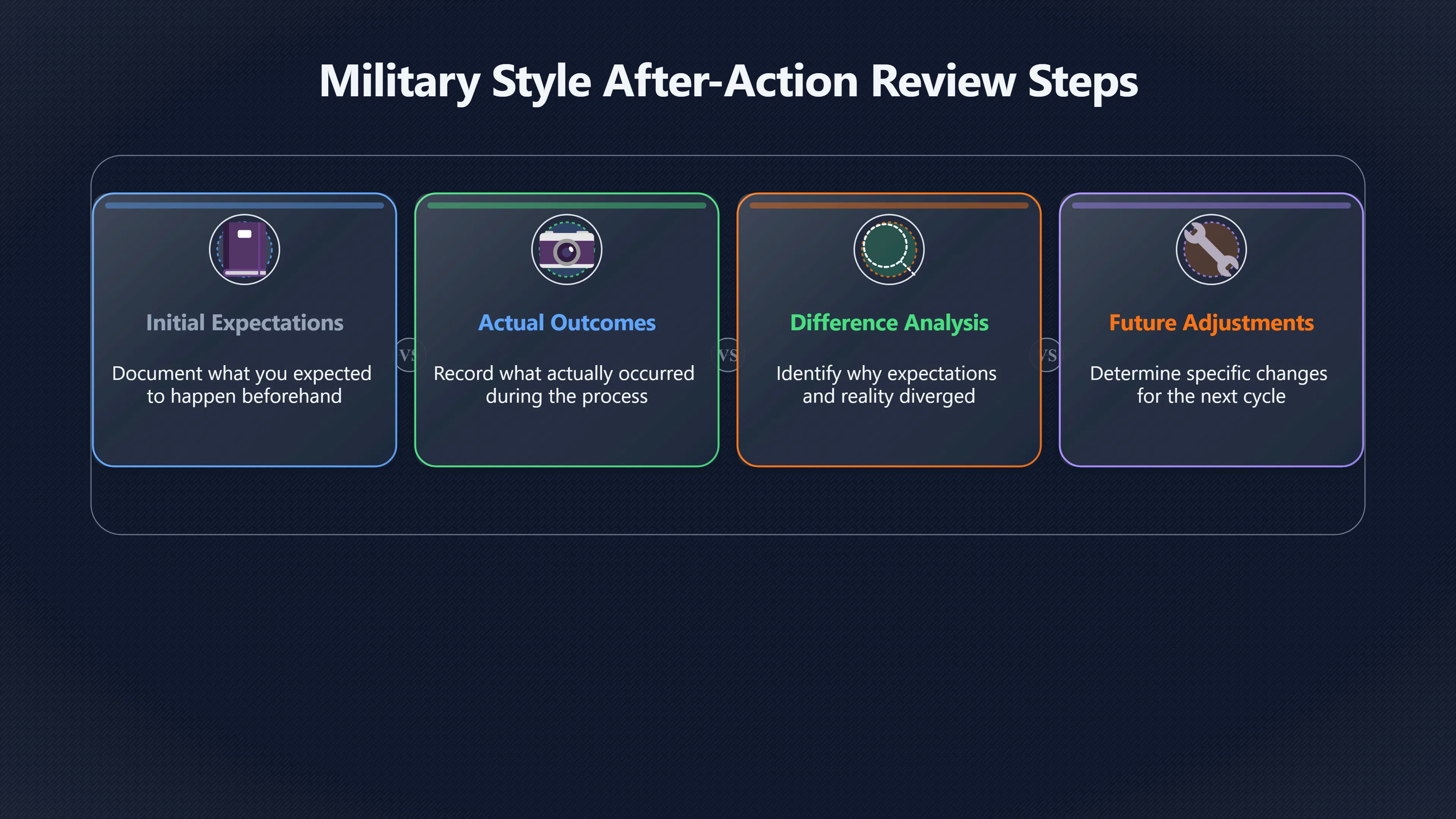
Many after-action review frameworks therefore begin with questions such as:[youtube.com]youtube.comAn Effective After-Action Review (AARFind Out Why You're REALLY Losing | MTG Limited | The Reflect Method…
- What did I expect to happen?
- What actually happened?
- Why was there a difference?
- What should I change next time?
This sequence originated in military training but has since spread to healthcare, education and organisational learning because it keeps attention on learning rather than blame. The comparison between expectation and reality creates a measurable feedback loop instead of relying on vague memories.[Better Evaluation+2My College]betterevaluation.orgBetter EvaluationAfter action reviewThe after action review (AAR) is a simple method for facilitating an assessment of organisational per…
For individual thinking, the same structure works well after completing an analysis, making a forecast or solving a difficult problem. Before reviewing the result, reconstruct your original reasoning as accurately as possible:
- What evidence did I rely on?
- Which assumptions mattered most?
- How confident was I?
- What alternative outcomes did I consider?
Only after documenting those answers should you compare them with reality. This preserves information that hindsight would otherwise distort.
Avoid Reviewing Only the Outcome
A common mistake is treating success as proof of good thinking and failure as proof of poor thinking. Decision researchers call this outcome bias: judging the quality of a decision primarily by what happened rather than by the information available when the decision was made. A well-reasoned decision can fail because of chance, while a poorly reasoned decision can succeed through luck.[Wikipedia]WikipediaOutcome biasOutcome bias
For that reason, an after-action review should separate two questions:[youtube.com]youtube.comAn Effective After-Action Review (AARFind Out Why You're REALLY Losing | MTG Limited | The Reflect Method…
- Was the reasoning sound given what was known at the time?
- What did the outcome teach that was genuinely unavailable beforehand?
Keeping these questions separate prevents every bad result from becoming evidence that the original thinking was necessarily flawed.
Finding Overconfidence, Underconfidence and Stuck Points
The most valuable discoveries usually concern calibration: whether confidence matched reality.
Detecting overconfidence
Overconfidence does not simply mean feeling confident. It means expressing more certainty than the evidence justified. Reviews often reveal patterns such as:
- dismissing alternative explanations too early;
- stopping information gathering once a preferred answer appeared;
- expressing near certainty despite substantial uncertainty;
- treating familiarity as evidence of accuracy.
Research consistently identifies overconfidence as one of the most common judgement biases affecting professional decision-making across domains.[PMC]pmc.ncbi.nlm.nih.govThe Impact of Cognitive Biases on Professionals' Decision…by V Berthet · 2022 · Cited by 305 — First, the literature reviewed shows…
Rather than asking, “Why was I wrong?”, ask:
- What made me so certain?
- Which evidence did I ignore?
- At what point should I have become less confident?
These questions target the thinking habit rather than the specific mistake.

Detecting underconfidence
Reviews also uncover the opposite problem.
Perhaps your reasoning was largely correct, but you repeatedly delayed acting because you underestimated your understanding. Alternatively, you may have generated useful ideas but abandoned them too quickly after encountering uncertainty.
Repeated patterns of unnecessary hesitation deserve as much attention as repeated overconfidence because both reduce judgement quality.
Identifying stuck points
Sometimes the review shows neither excessive confidence nor excessive doubt. Instead, it reveals recurring bottlenecks:
- becoming trapped in the first framing of a problem;
- collecting information without integrating it;
- spending too long refining low-value details;
- failing to notice when a strategy had stopped working.
These “stuck points” often indicate that future effort should focus on changing process rather than acquiring more knowledge.
Protecting the Review from Hindsight Bias
One reason after-action reviews often fail is hindsight bias: once the outcome is known, people remember their earlier beliefs as being much closer to reality than they actually were. This creates the illusion that they “knew it all along”, reducing opportunities for genuine learning. The Decision Lab+2Carlson School of Management[thedecisionlab.com]thedecisionlab.comThe Decision LabHindsight BiasThe hindsight bias describes our tendency to look back at an unpredictable event and think it was easily pr…
Several practical habits reduce this problem:
- Record predictions before the outcome is known.
- Estimate probabilities rather than making absolute claims.
- Keep notes explaining why you believed what you believed.
- Compare today’s review against those original records instead of memory.
Research also suggests that outcome feedback has two competing effects. It can distort memory through hindsight bias, but it can also improve future judgement when people extract diagnostic information from the feedback rather than simply rewriting their memories of earlier beliefs.[Carnegie Mellon University]cmu.eduOutcome FeedbackCarnegie Mellon UniversityOutcome Feedback: Hindsight and Informationby SJ Hoch · 1989 · Cited by 247 — Although "hindsight bias" researc…
Turning One Result into a Better Next Strategy
An after-action review becomes valuable only when it changes future behaviour.[youtube.com]youtube.comAn Effective After-Action Review (AARFind Out Why You're REALLY Losing | MTG Limited | The Reflect Method…
Instead of producing a long list of observations, identify one or two specific adjustments that directly address the thinking pattern you discovered. For example:
Review findingBetter next strategyI became certain after only two supporting facts.Delay committing until deliberately seeking contradictory evidence.I repeatedly underestimated task complexity.Break future work into explicit intermediate estimates before starting.I ignored uncertainty in my forecasts.Record probability ranges rather than single predictions.I abandoned promising approaches too early.Define in advance how much evidence is needed before changing strategy.
The improvement target is the decision process, not merely the outcome. Small changes that consistently improve reasoning often produce larger long-term gains than trying to eliminate every individual mistake.
Why High-Quality Reviews Feel Different
The best after-action reviews are not exercises in self-criticism or self-congratulation. They are investigations into how thinking produced results.
Organisations that use structured after-action reviews effectively emphasise psychological safety, factual reconstruction and shared learning instead of assigning blame. Reviews become ineffective when participants defend reputations instead of examining reasoning. The same principle applies to individual reflection: curiosity produces better learning than self-judgement.[Army University Press+2American Psychological Association]armyupress.army.milArmy University PressFuture Proof: How to Build a Learning OrganizationThe unit's key leaders gathered with their NTC observer coach/trai…
A useful review therefore ends with a narrow but powerful question:
Given what this result revealed about my judgement, what single thinking habit should I deliberately change before I face a similar decision again?
That question keeps the focus where metacognition is most effective—not on whether the last outcome was good or bad, but on whether the next piece of thinking will be better.
Amazon book picks
Further Reading
Books and field guides related to What Did This Reveal About Your Thinking?. Use these as the next step if you want deeper reading beyond the article.
Superforecasting
Emphasizes comparing predictions with reality, calibration, confidence, and learning from feedback.
Thinking in Bets
Directly addresses evaluating decisions by the quality of reasoning rather than outcomes, matching after-action reflection and metacognit...
Black Box Thinking
Explores structured learning from success and failure, reinforcing effective after-action review practices.
The Scout Mindset
Focuses on updating beliefs, recognizing bias, and improving reflective thinking after new evidence.
eBay marketplace picks
Marketplace Samples
Example marketplace items related to this page. Use the search link to explore similar finds on eBay.



Endnotes
1.
Source: pmc.ncbi.nlm.nih.gov
Link:https://pmc.ncbi.nlm.nih.gov/articles/PMC8601442/
Source snippet
The methodology originated in the United States Army and forms part of the...
2.
Source: Wikipedia
Title: Outcome bias
Link:https://en.wikipedia.org/wiki/Outcome_bias
3.
Source: pmc.ncbi.nlm.nih.gov
Link:https://pmc.ncbi.nlm.nih.gov/articles/PMC8763848/
Source snippet
The Impact of Cognitive Biases on Professionals' Decision...by V Berthet · 2022 · Cited by 305 — First, the literature reviewed shows...
4.
Source: Wikipedia
Title: Overconfidence effect
Link:https://en.wikipedia.org/wiki/Overconfidence_effect
5.
Source: Wikipedia
Title: Hindsight bias
Link:https://en.wikipedia.org/wiki/Hindsight_bias
6.
Source: armyupress.army.mil
Link:https://www.armyupress.army.mil/Journals/Military-Review/Online-Exclusive/2024-OLE/Future-Proof/
Source snippet
Army University PressFuture Proof: How to Build a Learning OrganizationThe unit's key leaders gathered with their NTC observer coach/trai...
7.
Source: betterevaluation.org
Link:https://www.betterevaluation.org/methods-approaches/methods/after-action-review
Source snippet
Better EvaluationAfter action reviewThe after action review (AAR) is a simple method for facilitating an assessment of organisational per...
8.
Source: apa.org
Link:https://www.apa.org/pubs/journals/releases/amp-amp0000246.pdf
Source snippet
American Psychological AssociationDebriefs: Teams Learning From Doing in Contextby JA Allen · 2018 · Cited by 230 — Psychological safety...
9.
Source: cmu.edu
Title: Outcome Feedback
Link:https://www.cmu.edu/dietrich/sds/docs/loewenstein/OutcomeFeedback.pdf
Source snippet
Carnegie Mellon UniversityOutcome Feedback: Hindsight and Informationby SJ Hoch · 1989 · Cited by 247 — Although "hindsight bias" researc...
10.
Source: my.chartered.college
Link:https://my.chartered.college/research-hub/research-informed-[practice
Source snippet
chartered.collegeResearch-informed practice: After-action reviewsAn after-action review (AAR) is a group process designed to give you cle...
11.
Source: thedecisionlab.com
Link:https://thedecisionlab.com/biases/hindsight-bias
Source snippet
The Decision LabHindsight BiasThe hindsight bias describes our tendency to look back at an unpredictable event and think it was easily pr...
12.
Source: carlsonschool.umn.edu
Title: vohs et al 2012 hindsight bias
Link:https://carlsonschool.umn.edu/sites/carlsonschool.umn.edu/files/2026-01/vohs-et-al-2012-hindsight-bias.pdf
Source snippet
Carlson School of ManagementScience Perspectives on Psychologicalby NJ Roese · 2012 · Cited by 926 — Hindsight bias occurs when people fe...
13.
Source: link.springer.com
Link:https://link.springer.com/article/10.3758/s13421-020-01012-w
Source snippet
hindsight bias | Memory & Cognitionby R Ackerman · 2020 · Cited by 29 — Our results show that learning the correct answers distorts memor...
Additional References
14.
Source: jbsfm.org
Link:https://jbsfm.org/vol3no1/biases-in-managerial-decision-making–overconfidence–status-quo–anchoring–hindsight–[availability
Source snippet
Biases in Managerial Decision Making: Overconfidence...30 Jul 2021 — Hindsight is a bias. Hindsight effect is when people claim that, af...
15.
Source: thrivingteams.com
Link:https://www.thrivingteams.com/post/building-a-high-performing-team-aar-team-learning-after-action-review-performance-improvement
Source snippet
The Power of After Action Reviews (AARs) for Performance...Aug 14, 2024 — “The Army's After Action Review (AAR) is arguably one of the m...
16.
Source: linkedin.com
Link:https://www.linkedin.com/pulse/after-action-review-powerful-tool-quality-improvement-joseph-gaw
Source snippet
use in military circles, but may be of benefit to other industries as well.Read more...
17.
Source: emerald.com
Title: Improving team learning in military teams learning
Link:https://www.emerald.com/tlo/article/28/3/242/382220/Improving-team-learning-in-military-teams-learning
Source snippet
learning-oriented leadership and psychological equality | The...Jan 25, 2021 — The sense of psychological equality may be analogous to t...
18.
Source: mcchrystalgroup.com
Title: the hidden cost of failing to learn unlocking the power of aars
Link:https://www.mcchrystalgroup.com/insights/detail/2025/02/19/the-hidden-cost-of-failing-to-learn–unlocking-the-power-of-aars
Source snippet
· Breaking Down the Four Key AAR Questions · Translate Lessons into Shared Consciousness.Read more...
19.
Source: youtube.com
Title: Find Out Why You’re REALLY Losing | MTG Limited | The Reflect Method
Link:https://www.youtube.com/watch?v=IRg-VAogc84
Source snippet
How This Poker Strategy Solves Your Toughest Money Decisions (Thinking in Bets)...
20.
Source: youtube.com
Title: How This Poker Strategy Solves Your Toughest Money Decisions (Thinking in Bets)
Link:https://www.youtube.com/watch?v=gWZP5ygF4uk
Source snippet
Clear Thinking By Shane Parrish | Book Insider...
21.
Source: missioncti.com
Link:https://missioncti.com/wp-content/uploads/2020/05/AAR-v.1.-10-02-2018.pdf
Source snippet
After Action Reviewsby C Ruiz · Cited by 3 — Pausing for learning: Applying the after action review process at the NASA Goddard Space Fli...
22.
Source: youtube.com
Title: An Effective After-Action Review (AAR)
Link:https://www.youtube.com/watch?v=aLGf8yjdBtM
Source snippet
Find Out Why You're REALLY Losing | MTG Limited | The Reflect Method...
23.
Source: youtube.com
Title: Clear Thinking By Shane Parrish | Book Insider
Link:https://www.youtube.com/watch?v=5Ehs_xrPl1c
Source snippet
What is After Action Review | Explained in 2 min...
Topic Tree