Within Project Failure
Why Weak Project Estimates Keep Winning Approval
Cost overruns often persist because project approval rewards confidence before it rewards accuracy.
On this page
- Technical error versus strategic misrepresentation
- What transport cost overrun data suggests
- How funding contests distort early forecasts
Page outline Jump by section
Introduction
Large projects rarely begin with forecasts that everyone knows are impossible. More often, they begin with estimates that are genuinely optimistic, selectively optimistic, or deliberately understated because optimistic proposals are more likely to secure approval than cautious ones. This creates a system-level problem: even if individual participants believe they are acting rationally, the overall funding process can reward inaccurate forecasts over realistic ones. Understanding this mechanism is an important analytical skill because it shifts attention away from blaming forecasting mistakes alone and towards examining the incentives that shape forecasts before a project is approved.
 Research on transport infrastructure provides one of the strongest evidence bases for this phenomenon. Decades of data show that cost overruns are not merely random forecasting errors. Instead, the persistence and direction of those errors suggest that the institutional environment often favours projects whose initial estimates appear unusually attractive.[Taylor & Francis Online+2arXiv]tandfonline.comTaylor & Francis OnlineCurbing Optimism Bias and Strategic Misrepresentation in…by B Flyvbjerg · 2008 · Cited by 696 — Second, the pap…
Why do weak estimates repeatedly win approval?
The striking feature of many large infrastructure projects is not simply that estimates are wrong. It is that they are wrong in a consistent direction. Initial costs tend to be too low while projected benefits are often too high.
If forecasting errors arose mainly from technical uncertainty, the mistakes would be expected to scatter around the true value. Some projects would prove cheaper than expected, others more expensive, with no systematic pattern. Instead, large datasets of transport projects show persistent underestimation of costs across countries and over long periods, suggesting that more than technical forecasting limitations are at work.[ResearchGate+2arXiv]researchgate.netResearchGate(PDF) How Optimism Bias and Strategic Misrepresentation…12 May 2016 — People tend to judge future events inaccurately in t…
This matters because approval decisions are typically competitive. Governments and investors rarely fund every proposed railway, road or airport. Projects therefore compete on apparent affordability and expected returns. In such contests, promoters who present conservative estimates may lose funding to promoters whose forecasts appear more attractive, even if those forecasts are less realistic.
The incentive structure therefore rewards confidence before it rewards accuracy.
Technical error versus strategic misrepresentation
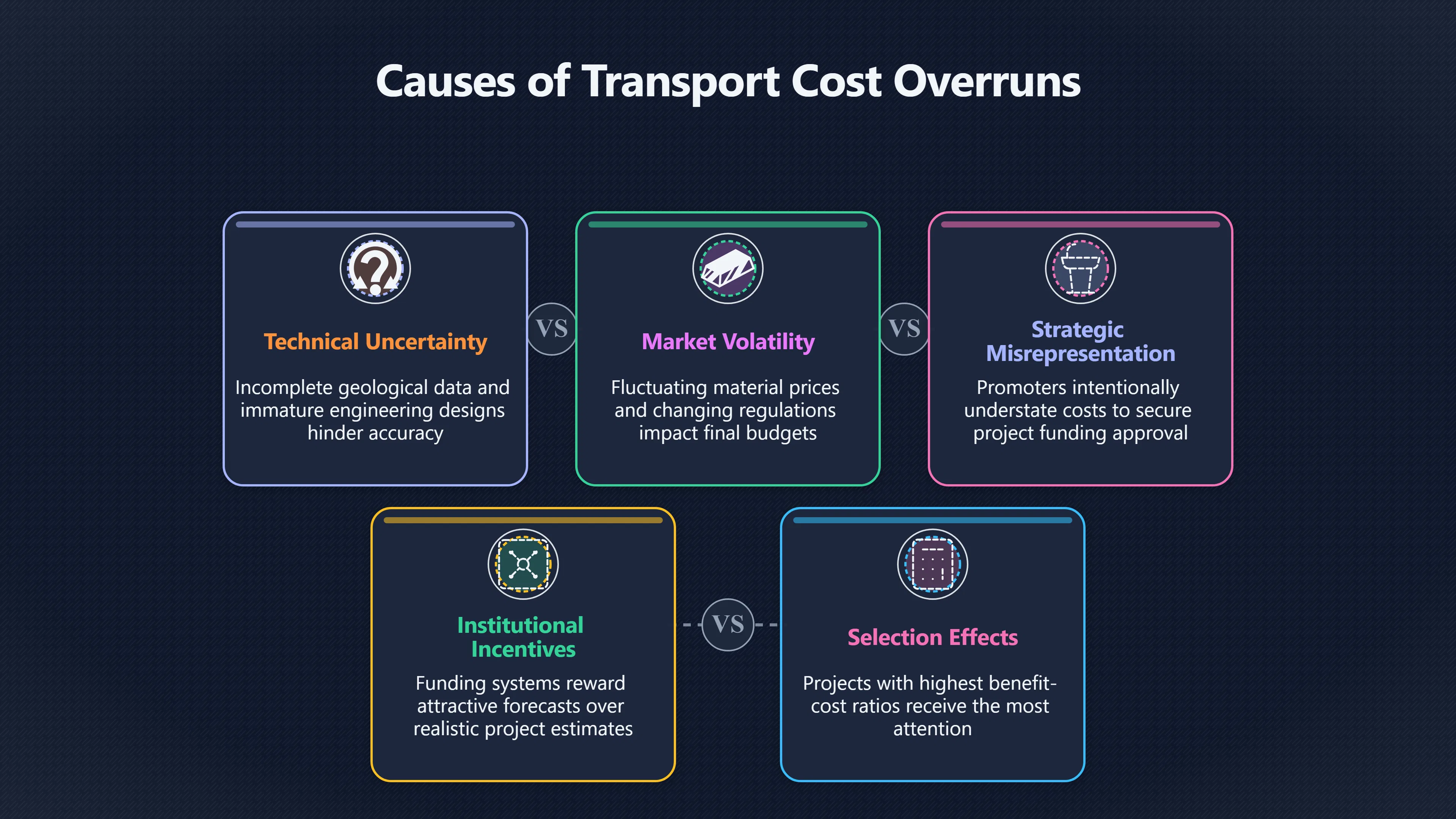
Researchers commonly distinguish between two broad explanations for persistent cost underestimation.
Technical error
The technical explanation assumes that planners are trying to estimate honestly but face imperfect information.
Sources of error include:
- incomplete geological information;
- immature engineering designs;
- uncertain material prices;
- changing regulations;
- limited historical data.
Under this explanation, improving forecasting models, collecting better information and hiring more experienced estimators should gradually eliminate systematic errors.
Yet this prediction is difficult to reconcile with decades of evidence showing remarkably persistent cost overruns despite advances in engineering, software and project management.[ResearchGate]researchgate.netResearchGate(PDF) How Optimism Bias and Strategic Misrepresentation…12 May 2016 — People tend to judge future events inaccurately in t…
Strategic misrepresentation
The second explanation focuses on incentives rather than capability.
Here, promoters recognise that optimistic forecasts increase the probability of receiving approval, funding or political support. Costs may therefore be understated, consciously or semi-consciously, because realistic estimates would make the project appear less competitive.
Bent Flyvbjerg and colleagues describe this as strategic misrepresentation: forecasts become advocacy documents rather than neutral predictions. Rather than asking “What is most likely?”, decision-makers begin asking “What estimate is most likely to secure approval?”[Springer+2Taylor & Francis Online]link.springer.comOptimism and Misrepresentation in Early Project Developmentby B Flyvbjerg · Cited by 71 — This chapter identifies optimism bias a…
The distinction is analytically important.
If inaccurate forecasts result primarily from technical limitations, the solution is better forecasting methods.
If they result primarily from incentive problems, technical improvements alone cannot solve them because the underlying reward structure remains unchanged.
What transport cost-overrun data suggests
Transport infrastructure has become the best-studied field for examining forecasting bias because many comparable projects exist across different countries.
Large datasets assembled by Flyvbjerg and collaborators found substantial average cost overruns across rail, bridge, tunnel and road projects, with rail projects exhibiting particularly large overruns on average. More importantly, the pattern remained remarkably stable over many decades, despite improvements in forecasting techniques.[World Bank+2Taylor & Francis Online]documents.worldbank.org•. The participation of risk capital should not mean that…Read more…
The persistence of these findings weakens the claim that inaccurate forecasts are mainly the product of immature forecasting methods. If technical capability were the dominant cause, one would expect forecasting accuracy to improve steadily over time.
Instead, the evidence suggests that institutional behaviour changes much more slowly than forecasting technology.
More recent reviews have also argued against reducing every cost overrun to optimism bias alone. Reviews published in 2023 note that although optimism bias clearly contributes to inaccurate estimates, its interaction with organisational incentives, governance structures and political pressures remains insufficiently understood. Rather than treating every inaccurate forecast as a psychological mistake, current research increasingly examines how behavioural and institutional mechanisms reinforce one another.[Sage Journals]journals.sagepub.comThe article identifies…Read more…
How funding contests distort early forecasts
Competitive funding creates several predictable pressures.
Selection effects. Among many proposed projects, the ones with the most attractive benefit-cost ratios naturally receive greater attention. If forecasts contain uncertainty, the projects with the largest underestimates of cost are also more likely to appear attractive enough to be approved.
Political timing. Decision-makers often seek approval before uncertainty has been fully resolved. Early estimates therefore receive greater political attention than later, more accurate estimates.
Escalation after approval. Once substantial political commitment has been made, revising estimates upwards becomes easier than cancelling the project entirely. Costs therefore tend to rise after approval rather than preventing approval in the first place.
These mechanisms do not require widespread dishonesty. Even without explicit deception, organisations learn which styles of forecasting are rewarded. Over time, optimistic assumptions become embedded in routine practice because they improve the probability of obtaining resources.[World Bank+2Project Management Institute]documents.worldbank.org•. The participation of risk capital should not mean that…Read more…
Why optimism can be individually rational but socially harmful
A useful systems insight is that behaviour benefiting one participant may damage the wider decision-making system.
For an individual project sponsor, presenting an optimistic estimate may increase the chance of winning funding.
For the funding system as a whole, however, repeated optimism produces distorted priorities.
The consequences include:
- projects entering construction without adequate contingency;
- budgets that systematically underestimate future public expenditure;
- reduced trust in official forecasts;
- fewer resources available for alternative projects that may have offered better value under realistic assumptions.
Viewed this way, persistent cost overruns are not merely forecasting failures. They become allocation failures: resources are directed using systematically biased information.

Improving judgement through the outside view
One practical response is to replace purely project-specific forecasting with reference class forecasting, sometimes called taking the “outside view”.
Instead of asking only how the current project differs from previous ones, analysts begin by examining how similar completed projects actually performed. Historical base rates provide an external benchmark against which optimistic assumptions can be tested.
The United Kingdom incorporated this idea into public project appraisal guidance through optimism-bias adjustments in the Green Book, recommending evidence-based uplifts to estimated costs and schedules when robust project-specific evidence is lacking. The intention is not to assume every project will fail equally badly, but to counter the predictable tendency for early estimates to be overly favourable.[GOV.UK+2GOV.UK]GOV.UKGreen Book supplementary guidance: optimism biasApril 21, 2013 — 21 Apr 2013 — This guidance provides cost and time uplift percentages for generic project categories which should be use…
For analytical thinking, the wider lesson extends beyond transport projects. Whenever forecasts determine which proposals receive scarce resources, ask not only whether the estimate appears technically sound, but also whether the surrounding incentive structure rewards realism or rewards optimism. That question often explains persistent forecasting failures better than the forecast itself.
Amazon book picks
Further Reading
Books and field guides related to Why Weak Project Estimates Keep Winning Approval. Use these as the next step if you want deeper reading beyond the article.
How Big Things Get Done
Explains why forecasts fail and how better estimation methods improve outcomes.
Megaprojects and Risk
Directly addresses systematic cost overruns, optimism bias and project approval incentives.
Thinking, Fast and Slow
Introduces optimism bias and forecasting errors that distort project estimates.
Forecasting: principles and practice
Provides sound forecasting principles that contrast with biased project estimation.
eBay marketplace picks
Marketplace Samples
Example marketplace items related to this page. Use the search link to explore similar finds on eBay.
Endnotes
1.
Source: arxiv.org
Title: Fourth, political
Link:https://arxiv.org/pdf/1307.2176
Source snippet
Cost overruns in Large-Scale Transportation Infrastructure...by CC Cantarelli · 2013 · Cited by 611 — Third, psychological explanat...
2.
Source: researchgate.net
Link:https://www.researchgate.net/publication/235953571_How_Optimism_Bias_and_Strategic_Misrepresentation_in_Early_Project_Development_Undermine_Implementation
Source snippet
ResearchGate(PDF) How Optimism Bias and Strategic Misrepresentation...12 May 2016 — People tend to judge future events inaccurately in t...
Published: May 2016
3.
Source: link.springer.com
Link:https://link.springer.com/chapter/10.1057/9780230236837_8
Source snippet
Optimism and Misrepresentation in Early Project Developmentby B Flyvbjerg · Cited by 71 — This chapter identifies optimism bias a...
4.
Source: researchgate.net
Link:https://www.researchgate.net/publication/371966934_Toward_a_Deeper_Understanding_of_Optimism_Bias_and_Transport_Project_Cost_Overrun
Source snippet
The article identifies significant gaps...
5.
Source: GOV.UK
Title: Green Book supplementary guidance: optimism bias
Link:https://www.gov.uk/government/publications/green-book-supplementary-guidance-optimism-bias
Source snippet
April 21, 2013 — 21 Apr 2013 — This guidance provides cost and time uplift percentages for generic project categories which should be use...
Published: April 21, 2013
6.
Source: assets.publishing.service.gov.uk
Link:https://assets.publishing.service.gov.uk/media/5a74dae740f0b65f61322c72/Optimism_bias.pdf
Source snippet
Green Book Guidance – Optimism BiasIt has been prepared from the results of a study by Mott MacDonald into the size and causes of cost an...
7.
Source: researchgate.net
Link:https://www.researchgate.net/publication/229167635_Plugging_the_Gaps%27_Between_Optimum_Bias_and_Strategic_Misrepresentation_and_Infrastructure_Cost_Overruns
Source snippet
While Flyvberg's research has made a significant...Read more...
8.
Source: researchgate.net
Link:https://www.researchgate.net/publication/27352865_Truth_and_Lies_about_Megaprojects
Source snippet
(PDF) Truth and Lies about MegaprojectsSeveral researchers have identified that social biases exist in project planning such as future-pe...
9.
Source: researchgate.net
Link:https://www.researchgate.net/publication/233258056_Curbing_Optimism_Bias_and_Strategic_Misrepresentation_in_Planning_Reference_Class_Forecasting_in_Practice
Source snippet
lass forecasting in planning practice.Read more...
10.
Source: researchgate.net
Link:https://www.researchgate.net/publication/260621078_Moving_Beyond_Optimism_Bias_and_Strategic_Misrepresentation_An_Explanation_for_Social_Infrastructure_Project_Cost_Overruns
Source snippet
An Explanation for Social Infrastructure Project Cost OverrunsResearch led by Flyvbjerg has suggested that misrepresentation and optimism...
11.
Source: researchgate.net
Link:https://www.researchgate.net/publication/4779626_An_Examination_of_the_UK_Treasury%27s_Evidence_Base_for_Cost_and_Time_Overrun_Data_in_UK_Value-for-Money_Policy_and_Appraisal
Source snippet
ance initiative (PFI) has reduced cost and time overruns.Read more...
12.
Source: researchgate.net
Link:https://www.researchgate.net/figure/Explanatory-power-of-optimism-bias-and-strategic-misrepresentation-respectively-in_fig1_233258056
Source snippet
itial estimates (Flyvbjerg, 2006 (Flyvbjerg,, 2008 Flyvbjerg et al...Read more...
13.
Source: assets.publishing.service.gov.uk
Link:https://assets.publishing.service.gov.uk/media/6093d448e90e0726f52fc54c/updating-the-evidence-behind-the-optimism-bias-uplifts-for-transport-appraisals.pdf
Source snippet
the evidence behind the optimism bias uplifts for...The underlying causes of this underestimation can include optimism bias (OB), strate...
14.
Source: openknowledge.worldbank.org
Link:https://openknowledge.worldbank.org/server/api/core/bitstreams/612f8e17-0564-5caf-9623-208835847868/content
15.
Source: tandfonline.com
Link:https://www.tandfonline.com/doi/abs/10.1080/09654310701747936
Source snippet
Taylor & Francis OnlineCurbing Optimism Bias and Strategic Misrepresentation in...by B Flyvbjerg · 2008 · Cited by 696 — Second, the pap...
16.
Source: documents.worldbank.org
Link:https://documents.worldbank.org/curated/en/968761468141298118/pdf/wps3781.pdf
Source snippet
•. The participation of risk capital should not mean that...Read more...
17.
Source: journals.sagepub.com
Link:https://journals.sagepub.com/doi/10.1177/87569728231180268
Source snippet
The article identifies...Read more...
18.
Source: pmi.org
Link:https://www.pmi.org/learning/library/what-you-should-know-megaprojects-11656
Source snippet
What You Should Know about Megaprojects and WhyFlyvbjerg presents strong evidence showing how megaprojects usually unfold. He identifies...
19.
Source: journals.sagepub.com
Link:https://journals.sagepub.com/doi/10.1177/87569728211049046
Source snippet
Sage JournalsTop Ten Behavioral Biases in Project Management14 Dec 2021 — We list the top 10 behavioral biases in project management: (1)...
20.
Source: dictionary.cambridge.org
Link:https://dictionary.cambridge.org/dictionary/english/strategic
Source snippet
English meaning - Cambridge DictionarySTRATEGIC definition: 1. helping to achieve a plan, for example in business or politics: 2. used...
21.
Source: transportfutures.institute
Title: optimism bias
Link:https://transportfutures.institute/optimism-bias/
Source snippet
in Transport Planning24 Feb 2011 — In 2005, Professor Bent Flyvbjerg identified two main causes of misinformation in policy and managemen...
22.
Source: journals.sagepub.com
Link:https://journals.sagepub.com/doi/pdf/10.1177/87569728231180268
Source snippet
The article identifies significant...
23.
Source: papers.ssrn.com
Link:https://papers.ssrn.com/sol3/papers.cfm?abstract_id=2742301
Source snippet
Flyvbjerg - The Project Interviewby B Flyvbjerg · 2013 · Cited by 3 — Main challenges identified are benefit shortfalls, cost overruns, a...
24.
Source: jtlu.org
Link:https://www.jtlu.org/index.php/jtlu/article/view/719/713
Source snippet
(2007), various sources of forecasting errors for transportation infrastructure projects can be boiled down to three...Read more...
Additional References
25.
Source: procurementoffice.com
Link:https://procurementoffice.com/how-over-optimism-leads-to-[project-failure
Source snippet
How Over-Optimism Leads to Project FailureWith highlights from some of Flyvbjerg's recent studies, this discussion explains how delays, c...
26.
Source: edinburghtraminquiry.org
Title: Common and How Large Are Cost Overruns in Transport Infrastructure
Link:https://www.edinburghtraminquiry.org/wp-content/uploads/2017/10/CEC02084257.pdf
Source snippet
Procedures for Dealing with Optimism Bias in Transport...by DT HOU · 2004 · Cited by 1 — The data and database are described in more det...
27.
Source: youtube.com
Title: Webinar – The reality check: benchmarking for increased cost confidence
Link:https://www.youtube.com/watch?v=39ObmJJ80Dg
Source snippet
How Big Things Get Done: a conversation with Professor Bent Flyvbjerg - YouTube How Big Things Get Done: a conversation with Professor Be...
Published: June 2025
28.
Source: jbs.cam.ac.uk
Link:https://www.jbs.cam.ac.uk/wp-content/uploads/2020/08/riskprize2014-crawford.pdf
Source snippet
The Infrastructure Risk Group (2013) states “Optimism bias may be increasing the cost of...Read more...
29.
Source: youtu.be
Title: 🎬 Project Planning 101
Link:https://youtu.be/9G_LwG8ozpo
Source snippet
🎒 A while back, I asked Project Managers in a couple of forums what material things you need to have, to do your job as a Project Manager...
30.
Source: committees.parliament.uk
Link:https://committees.parliament.uk/writtenevidence/100937/pdf/
Source snippet
(2004) is strategic misrepresentation (deception) and optimism...
31.
Source: pure.uj.ac.za
Title: moving beyond optimism bias and strategic misrepresentation an ex
Link:https://pure.uj.ac.za/en/publications/moving-beyond-optimism-bias-and-strategic-misrepresentation-an-ex/
Source snippet
Research led by Flyvbjerg has suggested that misrepresentation and optimism bias...Read mo...
32.
Source: papers.ssrn.com
Title: SSRN ID2712843 code1935014
Link:https://papers.ssrn.com/sol3/Delivery.cfm/SSRN_ID2712843_code1935014.pdf?abstractid=2278226&mirid=1&type=2
Source snippet
BUDGET, OVER TIME, OVER AND OVER AGAIN12 Jan 2011 — Optimism bias. Explanations of project underperformance in terms of optimism bias and...
33.
Source: papers.ssrn.com
Title: SSRN ID2278262 code1935014
Link:https://papers.ssrn.com/sol3/Delivery.cfm/SSRN_ID2278262_code1935014.pdf?abstractid=2278262
Source snippet
and Lies About MegaprojectsSep 26, 2007 — That is because it bypasses cognitive and political biases such as optimism bias and strategic...
34.
Source: mpra.ub.uni-muenchen.de
Link:https://mpra.ub.uni-muenchen.de/124708/
Source snippet
overruns of infrastructure projects – distributions...9 May 2025 — This paper analyses the accuracy of cost estimates for Swedish trans...
Published: May 2025
Topic Tree