Within Change Mind
Why Changing Your Mind Can Mean Changing Your Confidence
Evidence often justifies smaller confidence shifts rather than dramatic reversals.
On this page
- Confidence as a spectrum
- When partial updates are enough
- Avoiding all or nothing thinking
Page outline Jump by section
Introduction
One of the most useful answers to the question “What would change my mind?” is: “It would not necessarily make me abandon my view—it would make me less confident in it.” Good reasoning is rarely a choice between complete certainty and complete reversal. Instead, new evidence often justifies moving from, for example, 90% confidence to 75%, or from “very likely” to “more uncertain”. This kind of gradual updating makes beliefs more responsive to reality while avoiding the instability of changing positions with every new piece of information. Research in psychology, decision science, and Bayesian reasoning consistently suggests that treating confidence as something that can be adjusted in degrees leads to better calibrated judgement and reduces the risk of both dogmatism and overreaction.[PMC+2P.J. Healy]pmc.ncbi.nlm.nih.govPMCActively Open-Minded Thinking and Its Measurementby KE Stanovich · 2023 · Cited by 133 — Actively open-minded thinking (AOT) is measured by items that tap the willingness to consider…
Confidence as a spectrum
People often describe beliefs as though they were switches: either true or false, accepted or rejected. In practice, most important decisions involve uncertainty. Whether assessing an investment, evaluating scientific evidence, or deciding between competing explanations, the more realistic question is not “Do I believe this?” but “How strongly do I believe it?”
Thinking in terms of confidence creates room for evidence to have proportional effects. A single contradictory study, one disappointing business result, or an unexpected observation may reduce confidence without eliminating the overall case. Likewise, one supportive finding may strengthen a view without proving it beyond doubt.
This idea is closely related to Bayesian thinking. In Bayesian reasoning, beliefs begin with a prior level of confidence and are updated as new evidence arrives, producing a revised—or posterior—level of confidence. The important practical lesson is not that everyone must perform probability calculations, but that evidence should shift beliefs by an amount roughly proportional to its strength and reliability rather than triggering automatic reversals.[astrowizici.st+2HEC Paris]astrowizici.stBayesian Updating in PracticeAndy Casey2 Mar 2026 — The Bayesian view describes how probable it is some event will take place, and we update our beliefs about the wor…
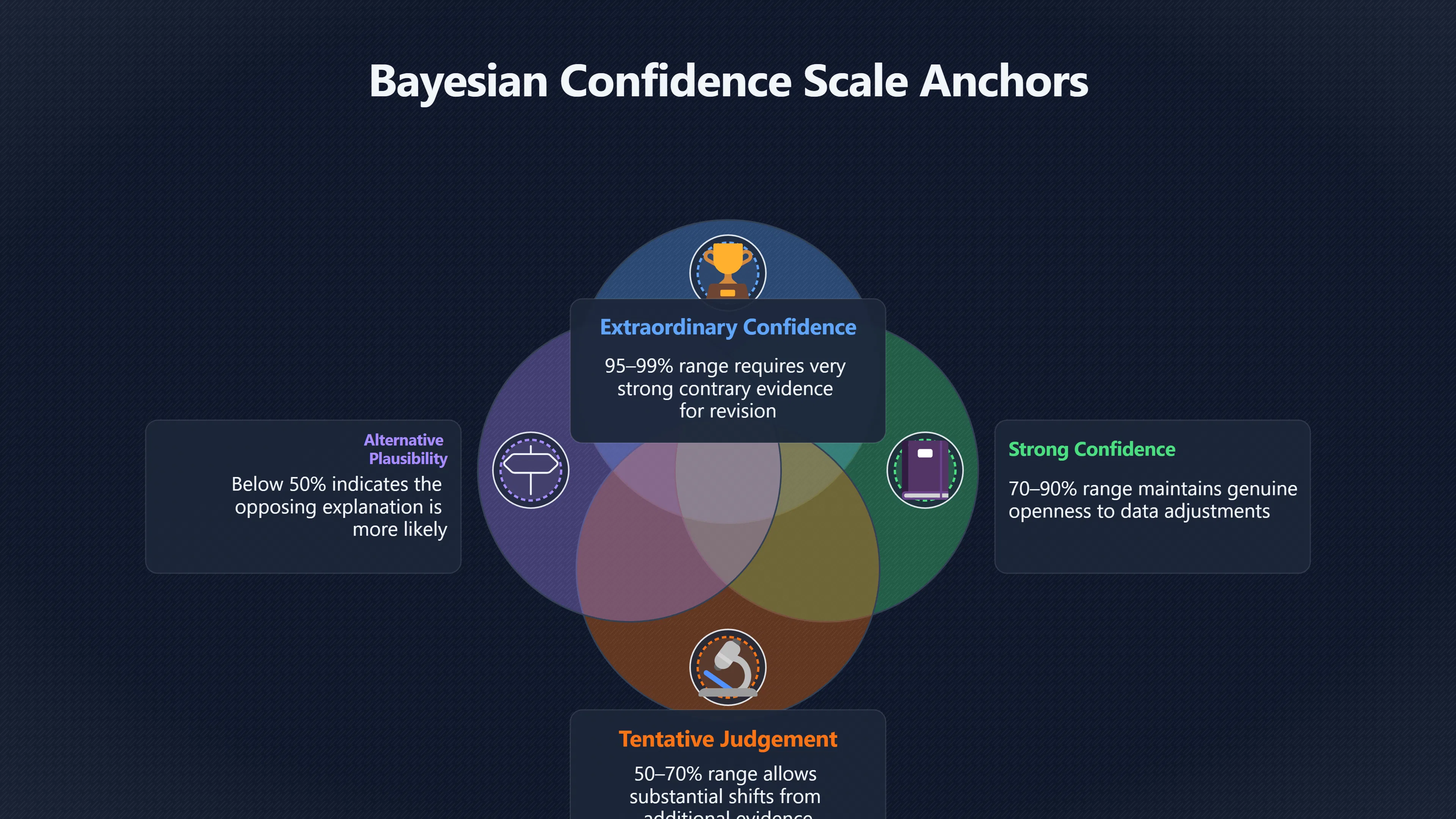
A useful mental scale might look like this:
- 95–99%: Extraordinary confidence; only very strong contrary evidence would justify a major revision.
- 70–90%: Strong confidence but genuine openness to adjustment.
- 50–70%: Tentative judgement where additional evidence could move confidence substantially.
- Below 50%: The alternative explanation appears more plausible.
The exact numbers matter less than recognising that confidence has many possible positions between certainty and rejection.
When partial updates are enough
Many decisions involve evidence that is informative without being decisive. Expecting every new fact either to confirm everything or overturn everything creates distorted thinking.
Partial updates are appropriate when:
- The new evidence is credible but limited in scope.
- Different pieces of evidence point in different directions.
- Existing evidence remains substantial despite new objections.
- The new information changes the estimated likelihood rather than the underlying possibility.
Consider a product launch. A company expects strong customer adoption. After the first month, uptake is weaker than expected, but customer satisfaction among early users is excellent. The rational response is rarely “The launch will definitely fail” or “Nothing has changed.” Instead, confidence in rapid growth may decrease while confidence in long-term potential remains relatively high.
Similarly, when evaluating a scientific claim, one failed replication should usually reduce confidence rather than eliminate belief, particularly if multiple earlier studies remain supportive. Conversely, one successful replication should increase confidence without implying that every remaining uncertainty has disappeared.
Updating confidence in this way prevents a common mistake: treating every new observation as if it deserved equal weight regardless of its quality or relevance.[NCBI]ncbi.nlm.nih.govNCBIReviewing the evidence: heuristics and biasesNIHby L Bojke · 2021 · Cited by 3 — This chapter reviewed evidence relating to the psychological biases of greatest relevance to S…
Avoiding all-or-nothing thinking
All-or-nothing thinking encourages unnecessary certainty. Once people feel committed to an extreme position, any concession can seem like admitting complete error. This creates psychological resistance to learning.
A confidence-based approach changes the incentives. Lowering confidence from 90% to 75% is not a failure. It is evidence that the belief is responding appropriately to new information.
This also makes discussions more productive. Instead of asking:
“Were you wrong?”
people can ask:
“How much should this evidence change your confidence?”
That question is usually easier to answer honestly because it allows proportionate responses instead of forcing binary choices.
Research on actively open-minded thinking describes this willingness to consider contrary evidence and delay premature certainty as a characteristic associated with better reasoning and more accurate judgement. Importantly, open-mindedness does not require abandoning beliefs easily; it requires allowing evidence to influence confidence appropriately.[PMC]pmc.ncbi.nlm.nih.govPMCActively Open-Minded Thinking and Its Measurementby KE Stanovich · 2023 · Cited by 133 — Actively open-minded thinking (AOT) is measured by items that tap the willingness to consider…
Why overconfidence makes updating harder
Confidence itself influences how people process new information.
Experimental neuroscience has shown that when individuals are highly confident in an initial judgement, they become more likely to process supporting information while giving less weight to contradictory evidence. High confidence therefore does more than reflect beliefs—it can actively make future belief revision less likely by changing how subsequent evidence is interpreted.[Nature]nature.comConfidence drives a neural confirmation biasby M Rollwage · 2020 · Cited by 269 — We show that holding high confidence in a decisio…
This helps explain why confidence should itself be treated as something worth monitoring.
Questions such as these can help:
- How certain was I before seeing this evidence?
- Is my confidence justified by the quality of the evidence, or simply by familiarity?
- Would someone who disagreed reasonably lower my confidence after seeing this information?
These questions separate confidence from commitment. They encourage calibration rather than stubbornness.
Practical ways to update confidence
Confidence updating works best when it is deliberate rather than intuitive.
A simple process is:
- State your current confidence. Even rough estimates such as “about 80% confident” create a baseline.
- Evaluate the new evidence. Consider its reliability, independence, and relevance rather than whether it supports your preferred conclusion.
- Adjust proportionally. Strong evidence deserves larger shifts than weak or ambiguous evidence.
- Look for accumulation. Several modest pieces of evidence may together justify a substantial update, even if none would do so individually.
This approach also reduces emotional attachment to particular conclusions. Instead of defending an identity or a position, you are continually refining an estimate.
The goal is calibration, not constant doubt
Updating confidence should not become permanent indecision. Good judgement aims for calibration: confidence that matches the available evidence as closely as possible.
Someone who never changes confidence is likely to ignore new information. Someone who dramatically changes position after every new observation is equally unlikely to reach consistently good conclusions. The most reliable thinkers tend to occupy the middle ground, making many small, evidence-based adjustments over time rather than waiting for dramatic reversals or reacting impulsively to isolated events.
Viewed this way, changing your mind does not always mean adopting the opposite conclusion. Often, the most rational response is simply becoming a little less certain—or a little more certain—than you were before. That steady process of calibration is one of the defining habits of sound analytical thinking.[PMC+2P.J. Healy]pmc.ncbi.nlm.nih.govPMCActively Open-Minded Thinking and Its Measurementby KE Stanovich · 2023 · Cited by 133 — Actively open-minded thinking (AOT) is measured by items that tap the willingness to consider…
eBay marketplace picks
Marketplace Samples
Live-tested eBay searches with available results related to this page.


Endnotes
1.
Source: pmc.ncbi.nlm.nih.gov
Title: PMCActively Open-Minded Thinking and Its Measurement
Link:https://pmc.ncbi.nlm.nih.gov/articles/PMC9966223/
Source snippet
by KE Stanovich · 2023 · Cited by 133 — Actively open-minded thinking (AOT) is measured by items that tap the willingness to consider...
2.
Source: healy.econ.ohio-state.edu
Title: Moore Healy Trouble With [Overconfidence]({{ ‘overconfidence/’ | relative_url }})
Link:https://healy.econ.ohio-state.edu/papers/Moore_Healy-TroubleWithOverconfidence.pdf
Source snippet
The Trouble With Overconfidence - P.J. Healyby DA Moore · 2008 · Cited by 3874 — Their confidence systematically exceeded their accu...
3.
Source: astrowizici.st
Title: Bayesian Updating in Practice
Link:https://astrowizici.st/[teaching
Source snippet
Andy Casey2 Mar 2026 — The Bayesian view describes how probable it is some event will take place, and we update our beliefs about the wor...
4.
Source: people.hec.edu
Title: Upd Conf JET
Link:https://people.hec.edu/hill/wp-content/uploads/sites/25/2023/03/UpdConfJET.pdf
Source snippet
This paper develops a belief update rule under ambiguity, motivated by the maxim: in the face of new information, retain those conditiona...
5.
Source: ncbi.nlm.nih.gov
Title: NCBIReviewing the evidence: heuristics and biases
Link:https://www.ncbi.nlm.nih.gov/books/NBK571047/
Source snippet
NIHby L Bojke · 2021 · Cited by 3 — This chapter reviewed evidence relating to the psychological biases of greatest relevance to S...
6.
Source: nature.com
Link:https://www.nature.com/articles/s41467-020-16278-6
Source snippet
Confidence drives a neural confirmation biasby M Rollwage · 2020 · Cited by 269 — We show that holding high confidence in a decisio...
7.
Source: pmc.ncbi.nlm.nih.gov
Link:https://pmc.ncbi.nlm.nih.gov/articles/PMC7935132/
Source snippet
bias is adaptive when coupled with efficient...by M Rollwage · 2021 · Cited by 95 — We suggest that confirmation bias is adaptive to the...
8.
Source: pmc.ncbi.nlm.nih.gov
Link:https://pmc.ncbi.nlm.nih.gov/articles/PMC12880994/
Source snippet
our certainty: how confidence judgments amplify belief...by KS Double · 2026 · Cited by 1 — The first is that eliciting confidence ratin...
9.
Source: pmc.ncbi.nlm.nih.gov
Link:https://pmc.ncbi.nlm.nih.gov/articles/PMC9039658/
Source snippet
of Dynamic Belief Updating in Psychosis—A Review...by T Katthagen · 2022 · Cited by 54 — The belief update combines Bayesian principles...
10.
Source: pmc.ncbi.nlm.nih.gov
Link:https://pmc.ncbi.nlm.nih.gov/articles/PMC12730000/
Source snippet
Experimental Study of Overconfidence Biases in Young...by DG Gültekin · 2025 · Cited by 3 — According to the literature, overconfidence...
Additional References
11.
Source: researchgate.net
Link:https://www.researchgate.net/publication/341649677_Confidence_drives_a_neural_confirmation_bias
Source snippet
(PDF) Confidence drives a neural confirmation biasWe conclude that confidence shapes a selective neural gating for choice-consistent info...
12.
Source: cear.gsu.edu
Link:https://cear.gsu.edu/files/2022/02/CEAR-WP-2020-11-Belief-Distributions-Bayes-Rule-and-Bayesian-Overconfidence-FEBRUARY-2022.pdf
Source snippet
Distributions, Bayes Rule and Bayesian Overconfidenceby GW Harrison · 2022 · Cited by 9 — We classify the belief distribution into one of...
Published: FEBRUARY 2022
13.
Source: itad.com
Title: bayesian confidence updating 3 lessons from applying this technique
Link:https://www.itad.com/article/bayesian-confidence-updating-3-lessons-from-applying-this-technique/
Source snippet
Bayesian Confidence Updating: 3 lessons from applying...12 Sept 2022 — Bayesian Confidence Updating is an innovative approach to robustl...
14.
Source: bibliothek.wzb.eu
Link:https://bibliothek.wzb.eu/pdf/2020/ii16-309r2.pdf
Source snippet
In contrast, in our experiment, belief updating is close to the Bayesian benchmark on average.Read more...
15.
Source: josephesweeney-48159.medium.com
Link:https://josephesweeney-48159.medium.com/the-power-of-bayesian-belief-updating-a-guide-for-leaders-and-decision-makers-e15b12aa4ce4
Source snippet
It provides a roadmap to navigate uncertainty, driving decisions grounded in evidence.Read more...
16.
Source: learnmoore.org
Link:https://learnmoore.org/mooredata/HOC.pdf
Source snippet
Perfect calibration implies a perfect correlation between confidence and accuracy...Read mo...
17.
Source: faculty.wharton.upenn.edu
Title: 2013 the role of actively open minded thinking 2
Link:https://faculty.wharton.upenn.edu/wp-content/uploads/2015/07/2013—the-role-of-actively-open-minded-thinking_2.pdf
Source snippet
Wharton Faculty PlatformThe role of actively open-minded thinking in information...by U Haran · 2013 · Cited by 427 — To the extent that...
18.
Source: edoc.rki.de
Link:https://edoc.rki.de/bitstream/handle/176904/11676/similarity%20updating%20model.pdf?isAllowed=y&sequence=1
Source snippet
Similarity-Updating Model of Probability Judgment and...by R Albrecht · 2021 · Cited by 11 — Four experimental studies demonstrate the m...
19.
Source: sjdm.org
Link:https://sjdm.org/dmidi/Actively_Open-Minded_Thinking_Beliefs.html
Source snippet
ng and deciding") is good. This scale is based on a much...Read more...
20.
Source: researchgate.net
Link:https://www.researchgate.net/publication/265394044_The_Role_of_Actively_Open-Minded_Thinking_in_Information_Acquisition_Accuracy_and_Calibration
Source snippet
tendency to maximize or satisfice when making decisions.Read more...
Topic Tree
Follow this branch
Parent topic
Change Mind What Evidence Would Change Your Mind?Related pages 5
- Disconfirming Evidence Why Contradictory Evidence Is More Useful Than More Proof
- Premortems Can a Premortem Reveal When You Should Reconsider?
- Review Triggers How Review Triggers Make Changing Course Easier
- Revision Rules What Would Actually Make You Change Your Mind?
- Wason 2 4 6 What the 2 4 6 Experiment Teaches About Better Decisions