Within Retrieval
Can You Explain It Without Looking?
Closing the source and explaining an idea in plain language exposes what you can actually reconstruct, not just recognise.
On this page
- Why recognition can feel like understanding
- How to write a useful closed book explanation
- How to compare, correct and retry
Page outline Jump by section
Introduction
Closing your notes and explaining an idea from memory is one of the simplest ways to discover whether you genuinely understand it. While rereading often creates a comforting sense of familiarity, a closed-book explanation requires you to reconstruct the idea without prompts. That difference matters because analytical thinking depends on being able to explain, connect and apply knowledge when the original source is no longer available. Research on retrieval practice consistently shows that actively recalling information strengthens learning and exposes misunderstandings that passive review can hide.[PMC+2PsychNet]pmc.ncbi.nlm.nih.govPMCThe Use of Retrieval Practice in the Health Professionsby MJ Serra · 2025 · Cited by 16 — Retrieval practice, or the active recall of information from memory, is a highly effective learning…
 A good closed-book explanation is therefore not a memory contest. It is a diagnostic tool. If your explanation becomes vague, skips key steps or falls apart when you try to give an example, those failures identify exactly what still needs to be learned. Instead of treating mistakes as evidence of failure, this approach uses them as information for improving understanding.
Why recognition can feel like understanding
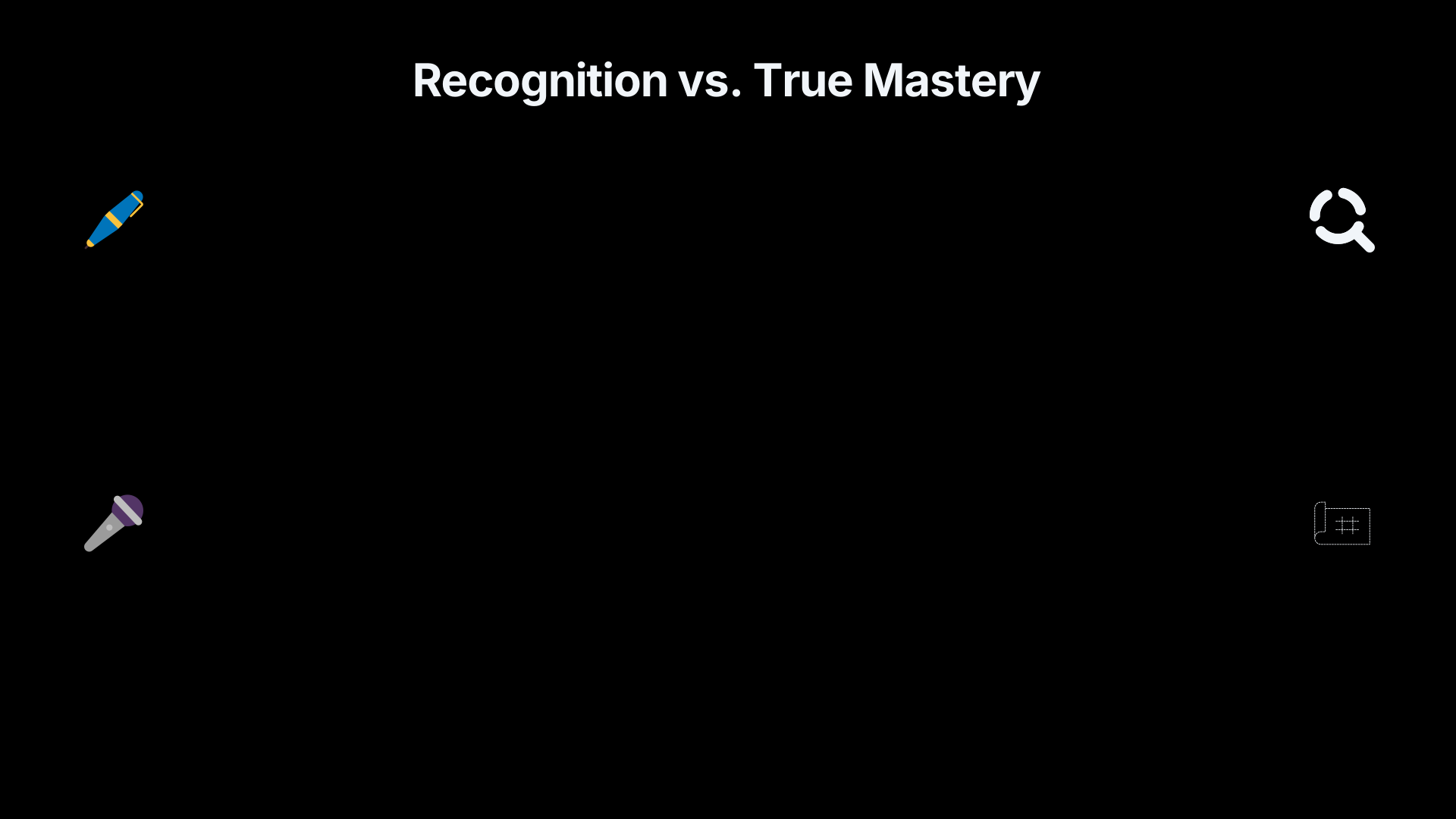
One reason people overestimate their understanding is that recognition is easier than recall. Looking at notes, diagrams or highlighted text provides constant cues. The material feels familiar, and that feeling is often mistaken for mastery.
Psychologists describe this as an illusion of competence. During study, learners can become highly confident because the correct information is visible. When those cues disappear, however, they may struggle to explain even the central idea. Studies of learning judgements have shown that people commonly overestimate future recall when information is present during study, and that retrieving information provides a more accurate picture of what they actually know.[Bjork Learning and Forgetting Lab+2PubMed]bjorklab.psych.ucla.eduBjork Learning and Forgetting LabIllusions of Competence in Monitoring One's Knowledge…by A Koriat · 2005 · Cited by 610 — The authors…
A closed-book explanation strips away those external supports. Instead of asking:
- “Does this paragraph look familiar?”
it asks:
- “Can I explain why this works?”
- “Can I reconstruct the reasoning?”
- “Can I use the idea in a different situation?”
Those questions resemble the demands of real analysis far more closely than simple recognition.
The warning signs of weak understanding
When explaining without looking, several patterns commonly appear.
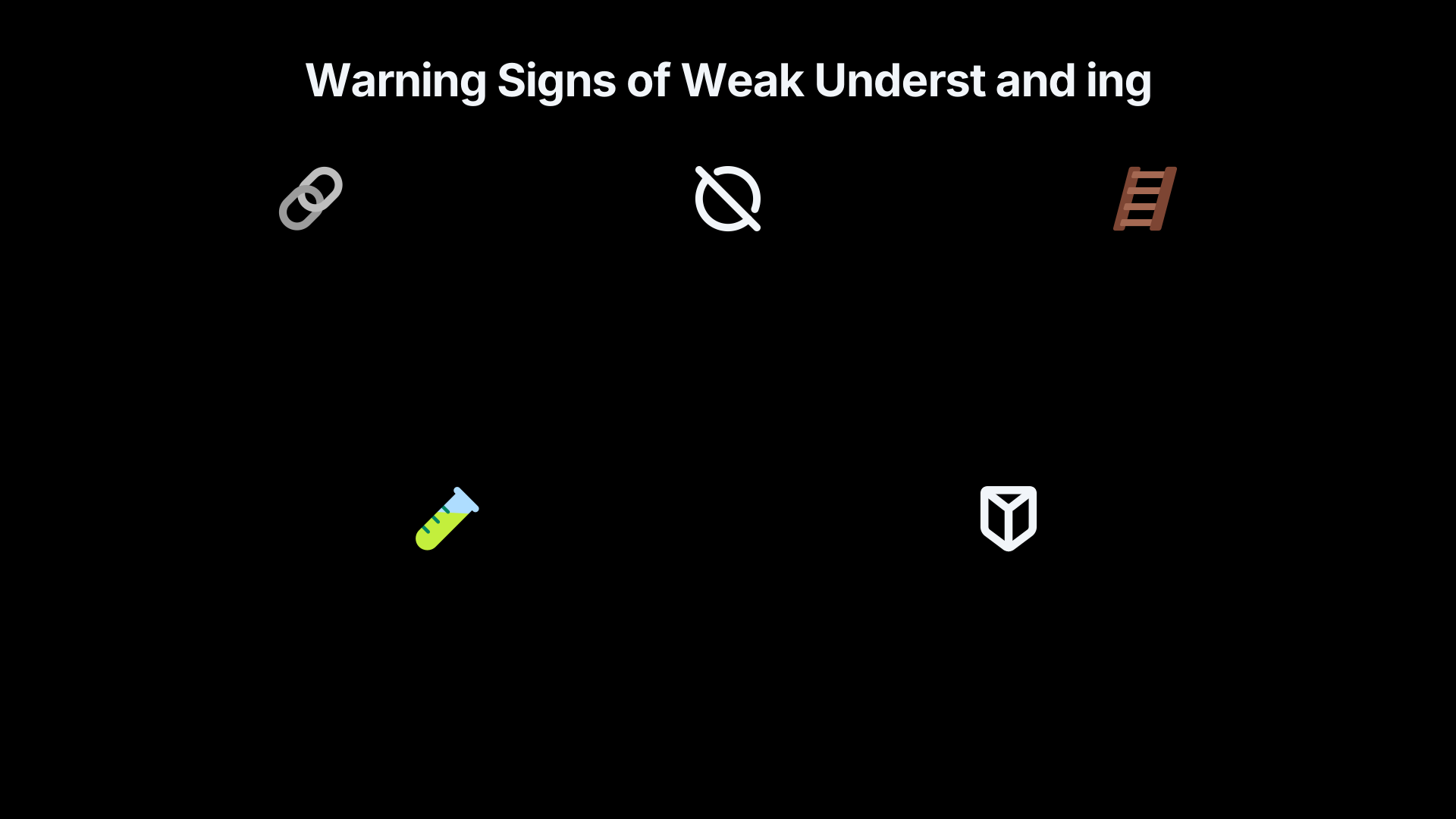
- Missing causal links. You remember the conclusion but cannot explain why it follows.
- Definition without meaning. You can repeat technical terms but cannot explain them in ordinary language.
- Procedural gaps. You know the first and last steps but forget the reasoning in between.
- Example failure. You can state the rule but cannot produce or evaluate a concrete example.
- Concept confusion. Similar ideas merge together because their differences were never fully understood.
These weaknesses often remain invisible while notes are open because the missing pieces are supplied automatically by the page.
How to write a useful closed-book explanation
The goal is not to reproduce a textbook paragraph word for word. A more useful test is whether you can explain the idea clearly enough that another interested person could follow your reasoning.
A practical sequence is:
- Study normally.
- Close every source.
- Write or speak an explanation entirely from memory.
- Use plain language wherever possible.
- Include one original example or application.
- State any uncertainties instead of guessing.
- Only then reopen the source.
This sequence turns retrieval into evidence. The written explanation becomes an observable record of what your memory actually contains rather than what feels familiar.
Aim for explanation rather than recital
A weak explanation often sounds like disconnected notes:
“Retrieval practice improves memory because testing effect… active recall… stronger learning.”
A stronger explanation connects the ideas:
“Retrieval practice improves learning because reconstructing information strengthens the memory itself. When I have to retrieve an idea without looking, I discover whether I really understand it. If I cannot explain part of the reasoning, I know exactly what needs further study.”
Notice that the second explanation contains relationships, causes and consequences instead of isolated phrases.
Research on self-explanation and elaborative interrogation suggests that generating explanations helps learners build more coherent mental models, particularly when they are required to explain why something is true rather than merely restate it.[The Learning Scientists+2PubMed]learningscientists.orgThe Learning ScientistsElaboration as Self-explanation20 Feb 2020 — Self-explanation involves students trying to explain concepts to them…

Use ordinary language first
An effective check is whether you can temporarily avoid specialist vocabulary.
Suppose you are learning about confirmation bias. Instead of beginning with the formal definition, first explain it as:
“People naturally notice evidence that agrees with what they already believe and overlook evidence that disagrees.”
Only afterwards introduce the technical term.
If you cannot explain the idea without relying on jargon, the underlying concept may still be fragile.
How to compare, correct and retry
The learning happens after the explanation, not before.
Once you reopen the original material, compare it carefully with what you produced from memory.
Instead of simply marking answers right or wrong, ask:
- Which important ideas were completely absent?
- Which relationships did I misunderstand?
- Which examples were inaccurate?
- Which parts sounded confident but were actually incorrect?
- Which sections became vague because I relied on recognition instead of understanding?
These comparisons identify specific weaknesses that can be repaired immediately.
Correct the explanation, not just the notes
Many learners simply reread the original chapter after spotting mistakes.
A more effective approach is to rewrite the explanation itself.
For example:[pmc.ncbi.nlm.nih.gov]pmc.ncbi.nlm.nih.govof face memory: Clarity breeds familiarity - PMCby HM Kleider · 2003 · Cited by 83 — When people perform a recognition memory task, they…
- Original explanation
- Compare with source
- Add missing reasoning
- Remove incorrect claims
- Produce a fresh closed-book explanation without looking again
Each cycle requires another reconstruction from memory rather than another exposure to the material.
Retrieval practice research consistently finds that learning improves when recall attempts are followed by corrective feedback. The retrieval attempt identifies gaps, while accurate feedback prevents those gaps from becoming permanent misconceptions.[PMC+2PsychNet]pmc.ncbi.nlm.nih.govPMCThe Use of Retrieval Practice in the Health Professionsby MJ Serra · 2025 · Cited by 16 — Retrieval practice, or the active recall of information from memory, is a highly effective learning…
What makes this different from memorising
A common misunderstanding is that closed-book explanation encourages rote learning.
Used well, it does the opposite.
Pure memorisation focuses on reproducing exact wording. Closed-book explanation focuses on reconstructing meaning. A learner who genuinely understands should usually be able to:
- explain the idea differently from the textbook,
- answer “why” as well as “what”,
- generate a new example,[researchgate.net]researchgate.netPDF) Effective Use of Elaborative Interrogation to Improve…Mar 28, 2025 — For example, elaborative interrogation, a strategy in which…
- distinguish the concept from similar ideas, and
- recognise the limits of their own explanation.
These are signs of usable knowledge rather than rehearsed language.
This also explains why closed-book explanations fit naturally alongside retrieval practice for improving analytical thinking. Analytical work rarely asks people to reproduce paragraphs verbatim. It asks them to justify decisions, interpret evidence, evaluate competing explanations and communicate reasoning clearly. Practising explanation without notes prepares learners for those demands far better than repeated recognition alone.
Amazon book picks
Further Reading
Books and field guides related to Can You Explain It Without Looking?. Use these as the next step if you want deeper reading beyond the article.
Make It Stick
Strongly supports explaining ideas from memory as a form of retrieval practice.
Powerful Teaching
Covers retrieval, elaboration and explanation techniques directly related to closed-book recall.
Small Teaching
Includes classroom and self-study activities built around explaining ideas from memory.
eBay marketplace picks
Marketplace Samples
Example marketplace items related to this page. Use the search link to explore similar finds on eBay.
Endnotes
1.
Source: pmc.ncbi.nlm.nih.gov
Title: PMCThe Use of Retrieval Practice in the Health Professions
Link:https://pmc.ncbi.nlm.nih.gov/articles/PMC12292765/
Source snippet
by MJ Serra · 2025 · Cited by 16 — Retrieval practice, or the active recall of information from memory, is a highly effective learning...
2.
Source: pmc.ncbi.nlm.nih.gov
Link:https://pmc.ncbi.nlm.nih.gov/articles/PMC4405771/
Source snippet
Judgments of Learning are Influenced by Multiple Cues In...by C Hertzog · 2013 · Cited by 65 — Metacognitive research has used CJs to...
3.
Source: pmc.ncbi.nlm.nih.gov
Link:https://pmc.ncbi.nlm.nih.gov/articles/PMC6449625/
Source snippet
Learning With Elaborative Interrogation Less Desirable...by T Kühl · 2019 · Cited by 16 — When learning with elaborative interrogation...
4.
Source: researchschool.org.uk
Link:https://researchschool.org.uk/devon/news/explaining-self-explanation
Source snippet
Explaining Self-explanation | Devon Research School7 Jul 2020 — Elaborative interrogation relies on prior knowledge, whereas self-explana...
5.
Source: psychnet.wustl.edu
Title: Roediger Karpicke 2006 PPS
Source snippet
& Roediger, 2006b), we have shown that if long-term retention is measured after a delay, the repeated...Read more...
6.
Source: pubmed.ncbi.nlm.nih.gov
Link:https://pubmed.ncbi.nlm.nih.gov/26173288/
Source snippet
Students' Learning With Effective...Elaborative interrogation, self-explanation, and interleaved practice received moderate utility asse...
7.
Source: bjorklab.psych.ucla.edu
Link:https://bjorklab.psych.ucla.edu/wp-content/uploads/sites/13/2016/07/Koriat_RBjork_2005.pdf
Source snippet
Bjork Learning and Forgetting LabIllusions of Competence in Monitoring One's Knowledge...by A Koriat · 2005 · Cited by 610 — The authors...
8.
Source: pubmed.ncbi.nlm.nih.gov
Link:https://pubmed.ncbi.nlm.nih.gov/17546739/
Source snippet
Illusions of competence and overestimation of associative...by AD Castel · 2007 · Cited by 208 — Illusions of competence and overe...
9.
Source: learningscientists.org
Link:https://www.learningscientists.org/blog/2020/2/20-1
Source snippet
The Learning ScientistsElaboration as Self-explanation20 Feb 2020 — Self-explanation involves students trying to explain concepts to them...
10.
Source: education-ni.gov.uk
Link:https://www.education-ni.gov.uk/sites/default/files/2025-04/May%20Newsletter%20-%20Retrieval%20Practice%20%20What%20it%20is%2C%20Why%20it%20Works%20and%20How%20to%20Do%20It%20Better.PDF
Source snippet
Department of EducationRetrieval Practice:Karpicke and Roediger (2008) noted that students who repeatedly re-read texts may develop an “i...
11.
Source: learningscientists.org
Link:https://www.learningscientists.org/blog/2017/4/20-1
Source snippet
When do the 6 Strategies for Effective Learning Work Best?Apr 20, 2017 — We have written a lot about the 6 strategies for effective learn...
12.
Source: pmc.ncbi.nlm.nih.gov
Link:https://pmc.ncbi.nlm.nih.gov/articles/PMC5676565/
Source snippet
of face memory: Clarity breeds familiarity - PMCby HM Kleider · 2003 · Cited by 83 — When people perform a recognition memory task, they...
13.
Source: pmc.ncbi.nlm.nih.gov
Link:https://pmc.ncbi.nlm.nih.gov/articles/PMC12372469/
Source snippet
practice enhances learning in real primary school...by L Franzoi · 2025 · Cited by 1 — This “illusion of competence” leads to faster but...
14.
Source: cirtl.ceils.ucla.edu
Title: learning strategies
Link:https://cirtl.ceils.ucla.edu/learning-strategies/
Source snippet
StrategiesSelf-explanation is similar to elaborative interrogation, except that educators ask students to explain their thought processes...
15.
Source: sites.google.com
Title: retrieval practice
Link:https://sites.google.com/view/efratfurst/[teaching
Source snippet
Practice - EfratFurstThis idea is related to the technique known as elaborative interrogation. This idea combines two key principles of l...
Additional References
16.
Source: merriam-webster.com
Link:https://www.merriam-webster.com/dictionary/illusion
Source snippet
ILLUSION Definition & Meaningdelusion, illusion, hallucination, mirage mean something that is believed to be true or real but that is act...
17.
Source: merriam-webster.com
Link:https://www.merriam-webster.com/dictionary/retrieval
Source snippet
RETRIEVAL Definition & Meaning3 days ago — 1. an act or process of retrieving 2. possibility of being retrieved or of recovering beyond r...
18.
Source: yukaichou.com
Link:https://yukaichou.com/gamification-analysis/retrieval-practice-testing-effect-roediger-karpicke-learning/
Source snippet
Retrieval Practice: The Testing Effect & Behavioral DesignRetrieval practice is the learning strategy of actively recalling information f...
19.
Source: facebook.com
Link:https://www.facebook.com/groups/sharingbestpractice/posts/2496208127379350/
Source snippet
Retrieval practice for better learningRetrieval practice involves recreating something you've learned in the past from your memory, and t...
20.
Source: researchgate.net
Link:https://www.researchgate.net/publication/390268429_Effective_Use_of_Elaborative_Interrogation_to_Improve_Academic_Performance
Source snippet
(PDF) Effective Use of Elaborative Interrogation to Improve...Mar 28, 2025 — For example, elaborative interrogation, a strategy in which...
21.
Source: facebook.com
Link:https://www.facebook.com/100090095881896/posts/most-students-think-theyre-bad-at-studyingwhen-in-reality-they-were-just-taught-/863743849972137/
Source snippet
Familiarity feels like understanding, but recognition ≠ recall. Your brain gets good...Read more...
22.
Source: ies.ed.gov
Title: retrieval oriented learning strategies
Link:https://ies.ed.gov/use-work/awards/retrieval-oriented-learning-strategies
Source snippet
ed.govRetrieval-Oriented Learning Strategies | IESThe objective of this research project is to identify the best practices for implementi...
23.
Source: theelearningcoach.com
Link:https://theelearningcoach.com/learning/elaboration-theory/
Source snippet
lf-explanation during initial learning to improve comprehension and to help...
24.
Source: researchgate.net
Title: 286159480 Strategies That Make Learning Last
Link:https://www.researchgate.net/publication/286159480_Strategies_That_Make_Learning_Last
Source snippet
(PDF) Strategies That Make Learning Last5 Jul 2020 — Elaborative interrogation, self-explanation, and interleaved practice received moder...
25.
Source: instagram.com
Link:https://www.instagram.com/reel/DU89afUEaSq/?hl=en
Source snippet
book or rewriting the same notes create what's called the illusion...
Topic Tree