Within Transfer
How Far Can a Thinking Skill Travel?
Near transfer is easier than far transfer because the new situation shares more visible cues with the original practice.
On this page
- Near transfer in similar tasks
- Far transfer across unfamiliar settings
- How to practise the bridge between them
Page outline Jump by section
Introduction
The value of a thinking skill is measured not by how well you use it in practice exercises, but by whether it appears when you face a real decision. This ability to carry a skill from one situation to another is known as transfer. The easiest form is near transfer, where the new task closely resembles the one you practised. The harder form is far transfer, where the surface details are different but the same underlying principle still applies. More than a century of research suggests that near transfer is common, while far transfer is much less reliable unless people deliberately learn to recognise deeper patterns rather than familiar examples.[Jay McTighe+2Structural Learning]jaymctighe.comJay McTigheTransfer of Learning by Perkins and SalomonNear transfer refers to transfer between very similar contexts, as for instance whe…
 For improving analytical thinking, this distinction matters because everyday decisions rarely announce which reasoning tool you should use. Buying insurance, judging a health claim, evaluating a workplace proposal and deciding whether to trust a striking statistic may all require the same habits of evidence-based thinking, even though they look unrelated at first glance.
Near transfer in similar tasks
Near transfer occurs when two situations share obvious features. The learner recognises the new problem because it resembles one already solved.
In everyday life, near transfer often feels effortless because the visible cues are familiar:
- Using the same budgeting spreadsheet for this month’s household expenses as last month’s.
- Applying a checklist for proofreading one report to another report in the same format.
- Spotting misleading percentages in a second newspaper article after analysing a similar one earlier in the week.
- Using the same framework for comparing two job offers after previously comparing university courses.
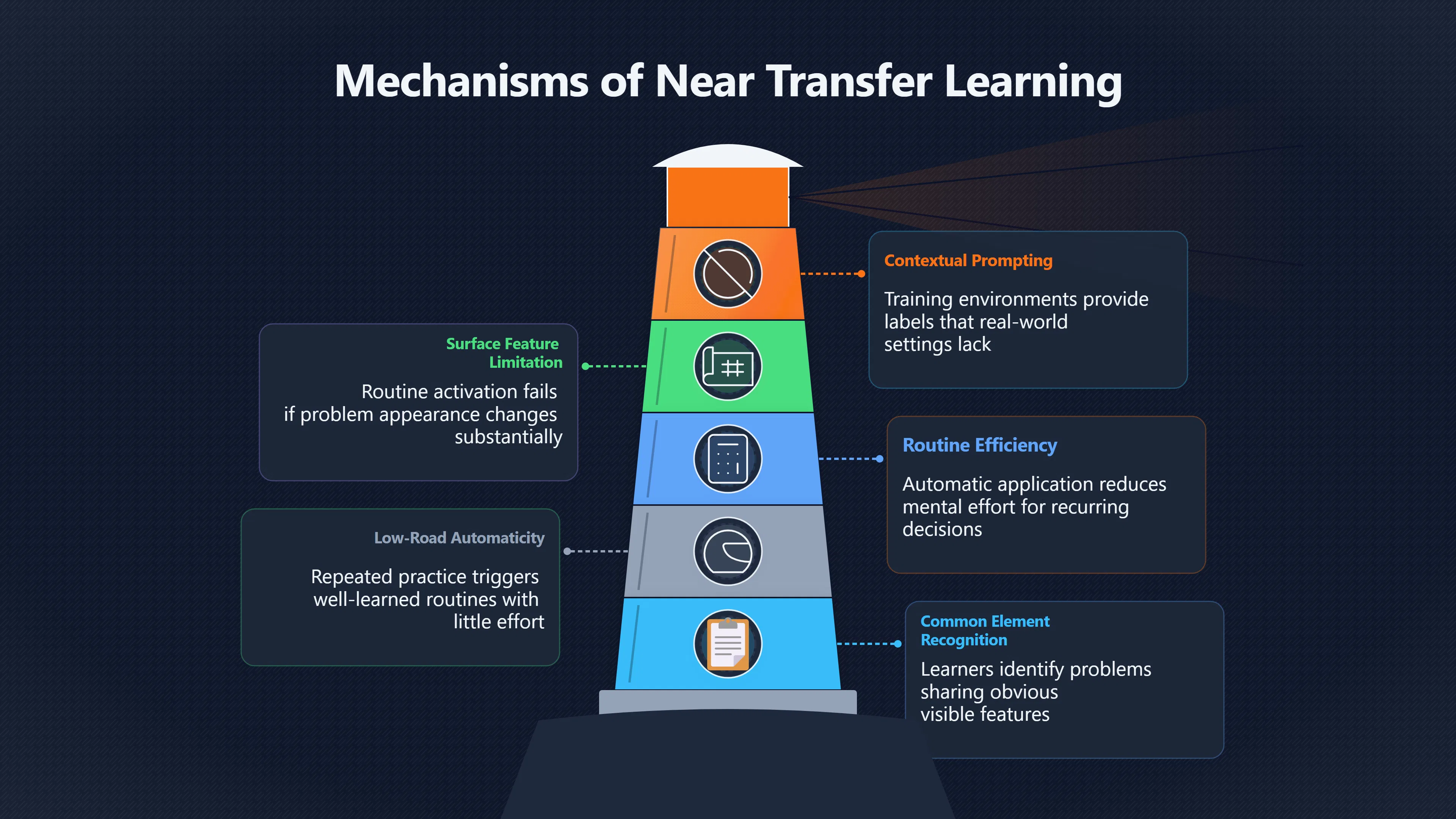
The classic explanation dates back to the work of Edward Thorndike and Robert Woodworth in the early twentieth century. They argued that transfer depends on the degree to which two situations share common elements, rather than on the existence of a general mental faculty that automatically improves reasoning everywhere. Their idea challenged the older belief that studying demanding subjects alone would naturally strengthen thinking across all areas of life.[Structural Learning]structural-learning.comStructural LearningTransfer of Learning: A Complete Guide5 days ago — Near transfer happens more naturally, while far transfer requires e…
David Perkins and Gavriel Salomon later described much near transfer as low-road transfer. After enough practice, familiar cues trigger well-learned routines with little conscious effort. A pilot’s pre-flight checklist, a nurse’s medication verification routine or an accountant’s reconciliation process are examples where repeated exposure encourages automatic application in similar situations.[Jay McTighe]jaymctighe.comJay McTigheTransfer of Learning by Perkins and SalomonNear transfer refers to transfer between very similar contexts, as for instance whe…
This automaticity is valuable because it reduces mental effort for routine decisions. However, it also creates a limitation: if the appearance of the problem changes substantially, the routine may never be activated.
Far transfer across unfamiliar settings
Far transfer asks a more demanding question: can you recognise that two very different situations share the same logical structure?
Instead of repeating a familiar procedure, you must ignore distracting surface differences and identify the underlying principle.
For example:
- Someone who understands experimental controls in science may apply the same reasoning when assessing whether a company’s new sales strategy really caused higher revenue.
- A person who has learned to distinguish correlation from causation in psychology may recognise the same mistake in financial commentary or social media discussions.
- A habit of comparing competing explanations while reading history may later improve decisions about workplace problems, where several causes could explain declining performance.
These examples require abstraction. The learner must mentally translate one domain into another before applying the reasoning strategy.
Research consistently finds this kind of transfer much harder than educators once hoped. Reviews of cognitive training and “brain training” programmes repeatedly conclude that while people generally improve at tasks very similar to those they practise, convincing evidence for broad far transfer into unrelated skills is limited. Improvements often remain close to the original training unless the new task shares important structural features.[nifdi.org+2Structural Learning]nifdi.orgNear and far transfer in cognitive trainingNear transfer occurs when skills learned in one context are applied to similar contexts, while…
This does not mean far transfer is impossible. Rather, it appears to depend on more than repeated exposure. Learners usually need to identify general principles, compare examples across contexts and consciously search for situations where those principles apply.
Why far transfer so often fails
Many thinking skills appear portable in theory but remain tied to the circumstances in which they were learned.
Several mechanisms explain this gap.
Surface features dominate attention. People naturally notice obvious similarities before deeper relationships. A medical study and a business experiment look different even if both require the same logic of comparison.
Context provides hidden prompts. During training, learners are told what topic they are studying. Outside training, nobody labels a conversation as an exercise in confirmation bias or probabilistic reasoning.
Knowledge and reasoning interact. Analytical habits depend on having enough background knowledge to recognise when a principle is relevant. Without understanding how scientific evidence, financial statements or legal arguments normally work, even excellent reasoning strategies may not activate appropriately.[ResearchGate]researchgate.netResearchGate(PDF) Transfer Of LearningTransfer includes near transfer (to closely related contexts and performances) and far transfer (to…
Time pressure encourages familiar routines. Everyday decisions often reward speed rather than careful abstraction. Under deadlines, people default to previously successful habits instead of searching for deeper analogies.
The result is that someone may genuinely understand a reasoning principle in one setting while failing to notice that it applies elsewhere.

How to practise the bridge between them
Fortunately, research suggests that transfer can be strengthened when learning is designed specifically to encourage it rather than assuming it will emerge automatically.
Compare different examples that share one principle
Instead of practising only one type of problem, deliberately study several situations that rely on the same reasoning.
For example, examine:
- a medical headline,
- an investment advertisement,
- a workplace performance dashboard, and
- a sports statistic,
all through the question: Does this evidence justify the conclusion?
The changing contexts encourage attention to the underlying reasoning rather than the surface story.[Jay McTighe]jaymctighe.comJay McTigheTransfer of Learning by Perkins and SalomonNear transfer refers to transfer between very similar contexts, as for instance whe…
Name the principle, not just the example
Rather than remembering, “This article confused correlation with causation,” state the more general lesson:
“Whenever two events occur together, I should ask whether another explanation could account for both.”
General statements travel more easily across domains than memories tied to one specific case.
Look backwards from new decisions
Perkins and Salomon describe high-road transfer as deliberately searching memory for relevant ideas when facing a new situation. Instead of asking, “Have I seen this exact problem before?”, ask:
- What does this situation remind me of?
- Have I encountered a similar pattern elsewhere?
- Which reasoning strategy worked then?
This conscious search helps build bridges between apparently unrelated experiences.[Jay McTighe]jaymctighe.comJay McTigheTransfer of Learning by Perkins and SalomonNear transfer refers to transfer between very similar contexts, as for instance whe…
Practise under realistic conditions
Transfer improves when practice resembles the uncertainty of everyday decisions.
Rather than always analysing neatly prepared textbook cases, include situations with incomplete information, conflicting evidence and ambiguous conclusions. These conditions more closely resemble workplace, financial and personal decisions, where recognising the relevant thinking skill is itself part of the challenge.
Historical perspective: from general mental training to specific transfer
Ideas about transfer have changed substantially over the past century.
Early educational traditions often assumed that studying demanding subjects automatically strengthened general reasoning. Mathematics, classical languages and formal logic were believed to improve the mind broadly.
Thorndike and Woodworth’s research challenged this assumption by arguing that transfer depends on shared elements between learning and application rather than on universal mental strengthening. Later work by Perkins and Salomon refined the picture further by distinguishing automatic low-road transfer from deliberate high-road transfer, recognising that broad transfer is possible but usually requires conscious abstraction rather than passive exposure.[Wikipedia+2Jay McTighe]WikipediaTransfer of learningTransfer of learning
Modern evidence broadly supports this more cautious position. Near transfer is routinely observed, whereas far transfer demands careful instructional design, varied practice and active reflection rather than simply increasing the amount of practice on one task.[nifdi.org+2Lirias]nifdi.orgNear and far transfer in cognitive trainingNear transfer occurs when skills learned in one context are applied to similar contexts, while…
What this means for everyday decisions
The practical lesson is not that thinking skills are trapped within individual domains, but that they rarely travel by themselves.
Near transfer lets familiar routines become efficient habits, making recurring decisions faster and more reliable. Far transfer requires recognising that very different situations share the same structure, then deliberately adapting a principle instead of repeating a procedure.
People who consistently improve their analytical thinking tend to build this bridge intentionally. They practise identifying common patterns across different contexts, give names to the principles behind successful decisions and regularly ask where else those principles might apply. Over time, the distance between “similar” and “different” situations begins to shrink, making transfer more likely whenever a genuinely new decision appears.
Amazon book picks
Further Reading
Books and field guides related to How Far Can a Thinking Skill Travel?. Use these as the next step if you want deeper reading beyond the article.
Make It Stick
Covers retrieval, varied practice, interleaving, and transfer-relevant learning methods.
How We Learn
Covers varied contexts and learning conditions that influence whether knowledge transfers.
Peak
Mozart wasn't born with perfect pitch. Most athletes are not born with any natural advantage. Three world-class chess players were sister...
Range
The #1 New York Times bestseller that has all America talking: as seen/heard on CNN's Fareed Zakaria GPS, Morning Joe, CBS This Morning,...
eBay marketplace picks
Marketplace Samples
Live-tested eBay searches with available results related to this page.

Top pick
critical thinking card game
Open a targeted eBay search for items related to this topic.
Browse eBay
Related search
critical thinking game
Open a targeted eBay search for items related to this topic.
Browse eBay
Related search
skill poster
Open a targeted eBay search for items related to this topic.
Browse eBay
Related search
skill memorabilia
Open a targeted eBay search for items related to this topic.
Browse eBayEndnotes
1.
Source: structural-learning.com
Link:https://www.structural-learning.com/post/transfer-learning-complete-guide-teachers
Source snippet
Structural LearningTransfer of Learning: A Complete Guide5 days ago — Near transfer happens more naturally, while far transfer requires e...
2.
Source: researchgate.net
Link:https://www.researchgate.net/publication/2402396_Transfer_Of_Learning
Source snippet
ResearchGate(PDF) Transfer Of LearningTransfer includes near transfer (to closely related contexts and performances) and far transfer (to...
3.
Source: Wikipedia
Title: Transfer of learning
Link:https://en.wikipedia.org/wiki/Transfer_of_learning
4.
Source: nifdi.org
Link:https://www.nifdi.org/resources/88-news/kerry-hempenstall/758-near-and-far-transfer-in-cognitive-training.html
Source snippet
Near and far transfer in cognitive trainingNear transfer occurs when skills learned in one context are applied to similar contexts, while...
5.
Source: jaymctighe.com
Link:https://jaymctighe.com/wp-content/uploads/2011/04/Transfer-of-Learning-Perkins-and-Salomon.pdf
Source snippet
Jay McTigheTransfer of Learning by Perkins and SalomonNear transfer refers to transfer between very similar contexts, as for instance whe...
6.
Source: lirias.kuleuven.be
Link:https://lirias.kuleuven.be/retrieve/7bdad7dd-02ee-49af-b74b-73adbf8de3d8
Source snippet
Perkins and Salomon (1994) indicated that transfer can be near or far. When acquired skills are applied to solve...Read more...
Additional References
7.
Source: firth.substack.com
Title: the vital role of transfer in education
Link:https://firth.substack.com/p/the-vital-role-of-transfer-in-education
Source snippet
Vital Role of Transfer in Education (Part 1)'Near transfer' relates to learning transferring to similar tasks.... “Very often, in instru...
8.
Source: peoplealchemy.com
Title: models of learning transfer
Link:https://peoplealchemy.com/blog/models-of-learning-transfer/
Source snippet
11 Oct 2023 — Near and far transfer. In effect, the theory predicts that while near transfer takes place often, far transfer is much less...
9.
Source: pmc.ncbi.nlm.nih.gov
Link:https://pmc.ncbi.nlm.nih.gov/articles/PMC12629222/
Source snippet
The findings from near–far transfer studies suggest that successful far transfer learning begins with the near transfer.Read more...
10.
Source: youtube.com
Title: The Future Belongs to People with Many Interests
Link:https://www.youtube.com/watch?v=OoZfGTWGijE
Source snippet
Transfer of Learning | Taking Learning Seriously...
11.
Source: youtube.com
Title: Transfer of Learning | Taking Learning Seriously
Link:https://www.youtube.com/watch?v=xEx6wHszmIg
Source snippet
What is 'transfer of learning'? | Julie Stern...
12.
Source: youtube.com
Title: Transfer of Training Theory
Link:https://www.youtube.com/watch?v=pKA57lz7tx8
Source snippet
What Is 'Transfer of Learning' and How Does It Help Students?...
13.
Source: youtube.com
Title: What is ‘transfer of learning’? | Julie Stern
Link:https://www.youtube.com/watch?v=q3rH5mLQfRw
Source snippet
Transfer of Training Theory...
14.
Source: youtube.com
Title: What Is ‘Transfer of Learning’ and How Does It Help Students?
Link:https://www.youtube.com/watch?v=N8QfkT8L9lo
Topic Tree