Within Sharper Thinking
What Is the Claim Really Based On?
Good analysis depends on separating what is being claimed from the evidence and assumptions that supposedly support it.
On this page
- Spot the conclusion
- Separate evidence from opinion
- Find hidden assumptions
Page outline Jump by section
Introduction
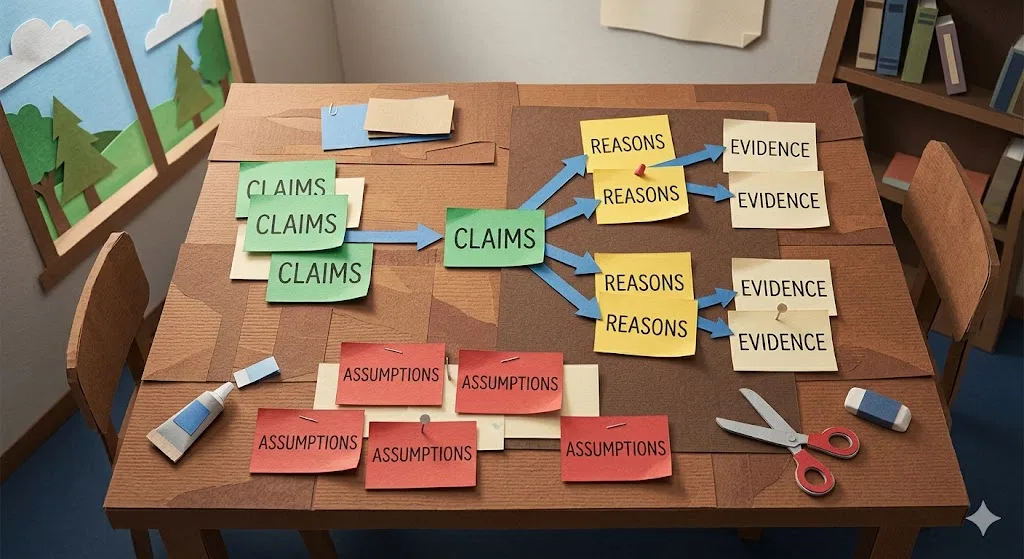
Everyday arguments become clearer when you separate three things: the claim someone wants you to accept, the evidence offered for it, and the assumptions that connect the evidence to the claim. A claim says “this is true”, “this is likely”, or “we should do this”. Evidence is the material meant to support it: data, examples, testimony, documents, observations, or expert findings. Assumptions are the often unstated links: “this example is typical”, “this source is reliable”, “this cause really produced that effect”, or “this value matters more than that one”.
This matters because weak arguments often look strong when these parts are blended together. A confident opinion may borrow the language of evidence. A striking example may be treated as proof. A true fact may be used to support a conclusion it does not actually justify. Learning to ask “What exactly is being claimed, what supports it, and what has to be assumed?” is one of the most practical analytical habits a person can build. It helps in work decisions, health claims, news stories, online debates, and personal disagreements.
Spot the Conclusion Before Judging the Argument
The first move is to find the conclusion. In argument analysis, the conclusion is the point being argued for, while premises are the reasons or evidence offered in support of it. This sounds simple, but ordinary conversation rarely arrives in neat “premise, premise, conclusion” form. People tell stories, vent, imply, exaggerate, change scope, or present a recommendation before giving reasons. Open critical-thinking guides use the same basic distinction: an argument is a set of statements in which reasons or premises are meant to support a conclusion.[Open Oklahoma State Library]open.library.okstate.eduArguments. Arguments are a set of statements (premises and conclusion). The premises provide evidence, reasons, and grounds for the concl…
A conclusion is not always the loudest sentence. In “The team missed the deadline again, the brief changed twice, and we need a better project manager”, the conclusion is probably “we need a better project manager”. The missed deadline and changed brief are reasons, but they do not automatically prove that the project manager is the cause. The argument also assumes that management, rather than staffing, planning, client behaviour, or workload, is the decisive factor.
A useful test is to ask: What does the speaker want me to believe, decide, or do? That reveals the claim. Then ask: What are they giving me as support? That reveals the evidence. Finally ask: What has to be true for that support to justify the claim? That reveals the assumptions.
Consider four everyday versions of the same structure:
SituationClaimEvidence offeredHidden assumptionWork“This software is slowing the team down.”“Three people complained this week.”Those complaints are representative, and the software is the main cause of delay.News“This policy is failing.”“A bad outcome happened after it was introduced.”The timing shows causation, not coincidence or another cause.Health“This supplement works.”“My friend felt better after taking it.”The improvement was caused by the supplement rather than recovery, placebo effect, lifestyle changes, or chance.Relationships“They do not respect my time.”“They replied late twice.”Late replies reliably indicate disrespect rather than busyness, stress, or different communication habits.
The point is not to dismiss the claim. Sometimes the claim is right. The point is to make the route from claim to support visible before accepting it.
Separate Evidence From Opinion
Evidence and opinion are not enemies. Good judgement often needs both. Evidence helps answer “What is true or likely?” Opinion, values, and priorities help answer “What matters?” The problem comes when a value judgement is presented as if it were a factual finding, or when a factual claim is supported only by personal confidence.
A statement such as “The new policy is unfair” may contain two layers. One layer is factual: who is affected, what changed, what outcomes followed, and whether comparable people are treated differently. The other layer is evaluative: what counts as fair. If the conversation treats “unfair” as self-evident, people may argue past each other. One person is disputing the facts; another is disputing the values.
Evidence also varies in strength. A single anecdote can be useful as a clue, especially when it points to a problem worth investigating, but it is usually weak evidence for a broad claim. A pattern across many cases is stronger. A well-designed study is stronger still for certain kinds of causal claims. In health research, for example, evidence-based medicine uses explicit ways to grade evidence, while also warning that flawed evidence should be acknowledged rather than hidden. The Oxford Centre for Evidence-Based Medicine says evidence levels are intended to make the process of finding appropriate evidence “feasible” and its results explicit, not to replace judgement.[cebm.ox.ac.uk]cebm.ox.ac.ukoxford centre for evidence based medicine levels of evidence march 2009oxford centre for evidence based medicine levels of evidence march 2009
The same distinction matters outside medicine. If someone says, “Remote work makes people less productive”, different kinds of evidence would support different versions of the claim. Productivity data across teams would support one version. A manager’s impression would support another, weaker version. A story about one employee would support only a narrow claim unless there is reason to think the case is typical.
A practical way to test evidence is to classify it:
- Anecdote: “This happened to me” or “I know someone who…”
- Observation: “I saw this pattern repeatedly.”
- Documented example: “Here is a record, message, policy, or timestamp.”
- Data pattern: “Here are numbers across many cases.”
- Expert interpretation: “Someone with relevant expertise has assessed the evidence.”
- Causal study or structured comparison: “The design helps test whether one thing produced another.”
None of these is automatically useless or decisive. The quality depends on the claim. A screenshot may be excellent evidence that a message was sent, but poor evidence that a person had bad intentions. A randomised controlled trial may be powerful evidence for a treatment effect, but not the right tool for every ethical, historical, or personal question.

Find the Assumption Doing the Work
An assumption is what an argument takes for granted. In Stephen Toulmin’s influential model of argument, the basic parts include a claim, grounds or data, and a warrant. The warrant is the connecting principle that explains why the evidence supports the claim. Educational summaries of Toulmin’s model commonly define the warrant as the assumption on which the move from evidence to claim depends.[Blinn College]blinn.eduOpen source on blinn.edu.
This is why assumptions are so important: they are often where the real argument lives. The visible evidence may be true, but the assumption may be weak.
Take the claim: “We should cancel the meeting because only four people accepted the invitation.” The evidence may be accurate. But the argument assumes that attendance numbers determine meeting value, that the people who declined are essential, and that the topic can wait. If the four attendees are the only decision-makers needed, cancellation may be a mistake.
Hidden assumptions often fall into a few everyday types:
Typicality assumptions. One example is treated as representative. “One customer hated the new design, so users will reject it.”
Causation assumptions. One event is treated as the cause of another. “Sales fell after the price change, so the price change caused the fall.”
Source assumptions. A person, outlet, or organisation is treated as reliable enough for the claim. “A senior colleague said it, so it must be right.”
Value assumptions. A conclusion depends on what should matter most. “The cheapest option is best” assumes cost outranks durability, safety, convenience, or fairness.
Definition assumptions. The argument depends on a contested word. “This is success” may mean profit, learning, speed, wellbeing, reputation, or something else.
Risk assumptions. The argument assumes a level of uncertainty is acceptable. “It will probably be fine” may be reasonable for a low-stakes choice and careless for a high-stakes one.
The most revealing question is often: Could someone accept the evidence but still reject the conclusion? If yes, the disagreement probably sits in an assumption.
Why True Evidence Can Still Support a Weak Claim
A common mistake is to ask only whether the evidence is true. That is necessary, but not enough. The stronger question is whether the evidence is relevant, sufficient, and properly connected to the claim.
A fact can be true and still be weak support. “This company made a profit last year” is relevant to “the company is not bankrupt”, but weak support for “the company will be a good employer”, “the share price will rise”, or “the leadership team is ethical”. Each stronger conclusion needs additional evidence and assumptions.
This is especially important with causal claims. Health news provides a clear example because headlines often move too quickly from association to causation. Research on health news has examined how causal language can become misaligned with the underlying evidence; one randomised trial explicitly aimed to improve the match between causal claims and evidence without making news less interesting.[PMC]pmc.ncbi.nlm.nih.govPMCClaims of causality in health news: a randomised trialPMCClaims of causality in health news: a randomised trial
The broader lesson applies everywhere: when an argument says “X led to Y”, look for rival explanations. Did Y start before X? Was there another change at the same time? Is the comparison fair? Could the observed pattern be due to selection effects, measurement problems, chance, or confounding factors? Public-policy researchers use the term confounding when groups differ in ways that affect the outcome apart from the policy or exposure being studied; this can make simple before-and-after claims misleading.[Springer]link.springer.comOpen source on springer.com.
The same applies in ordinary life. If a new routine begins and mood improves, the routine may have helped. But sleep, weather, social contact, expectation, workload, or natural recovery may also explain the change. The right conclusion might be modest: “This seems worth continuing and watching”, not “This definitely caused the improvement.”
Everyday Arguments Often Hide Value Judgements
Not every disagreement can be settled by more data, because many arguments combine evidence with values. “We should hire the more experienced candidate” may be supported by evidence about past performance, but it also assumes experience should matter more than growth potential, salary, diversity of skills, or team fit. “The school should ban phones” may draw on evidence about distraction, but it also assumes safety, independence, learning, and enforcement should be balanced in a particular way.
This does not make the argument irrational. It means the value judgement should be made explicit. Analytical thinking is not about pretending values do not exist; it is about stopping values from masquerading as facts.
A useful phrase is: “That may be true, but what does it show?” For example:
- “This option costs less.” True, perhaps. Does it show it is best, or only that it is cheaper?
- “Most people in the survey disliked the change.” Relevant, perhaps. Does it show the change is bad, or that the rollout was poorly explained?
- “They have done this before.” Important, perhaps. Does it show a fixed pattern, or does context matter?
- “Experts disagree.” True, perhaps. Does it show the evidence is evenly balanced, or that a small minority dissents from a strong consensus?
The question does not dismiss the evidence. It asks what conclusion the evidence can honestly bear.

How Bias Enters Through Evidence Selection
People do not usually evaluate claims from a neutral starting point. Existing beliefs, identity, emotions, incentives, and social pressures shape what evidence feels convincing. Classic research by Charles Lord, Lee Ross, and Mark Lepper found that people with opposing views on capital punishment evaluated mixed evidence in ways that tended to support their prior positions, a pattern often discussed under biased assimilation and attitude polarisation.[Frank Baumgartner]unc.eduFrank Baumgartner Biased Assimilation and Attitude Polarization: The EffectsFrank Baumgartner Biased Assimilation and Attitude Polarization: The Effects
Later work has complicated the story, but the practical warning remains useful: people often scrutinise disagreeable evidence more harshly than agreeable evidence. A flaw in an opposing study feels decisive; the same flaw in a friendly study feels minor. An anecdote that supports your view feels revealing; one that challenges it feels like an exception.
This is why “look at the evidence” is not always enough. You also need to ask how the evidence was selected. Did the person search for counterexamples? Did they include inconvenient data? Are they using the same standard for both sides? What would they count as a serious reason to change their mind?
One simple discipline is to require at least one best opposing reason before settling on a conclusion. Not a weak caricature, but the strongest reason a thoughtful person might disagree. This exposes assumptions that would otherwise stay hidden.
Online Claims Need Source Checks as Well as Logic Checks
Online arguments add another layer: before evaluating whether evidence supports a claim, you may need to verify whether the evidence is real, current, and shown in context. Digital-literacy researchers at Stanford and the Digital Inquiry Group have repeatedly studied “civic online reasoning”: the ability to locate, evaluate, and verify online information about public issues. Their materials emphasise that students and adults often struggle to evaluate online claims, sources, and evidence without specific strategies.[Taylor & Francis Online]tandfonline.comOpen source on tandfonline.com.
A widely taught method for online verification is SIFT: Stop, Investigate the source, Find better coverage, and Trace claims, quotes, and media back to the original context. The method was developed by Mike Caulfield and is now used in many library and digital-literacy guides.[UChicago Library Guides]guides.lib.uchicago.eduLibrary Guides The SIFT MethodLibrary Guides The SIFT Method
For everyday arguments, SIFT helps because many online claims arrive with borrowed authority. A post may show a graph without a source, quote a study without linking it, or use an expert’s credentials outside their area of expertise. The issue is not only whether the claim is plausible. It is whether the evidence can be traced and whether better sources frame it differently.
A quick online evidence check might ask:
- What is the exact claim? Not “crime is out of control”, but which crime, where, compared with when?
- Where did the evidence originate? A primary report, a news article, a repost, a screenshot, or a commentary account?
- Is the evidence current? Old figures often recirculate as if they describe today.
- Is the context intact? A quote, image, or statistic may change meaning when restored to its original setting.
- Do better sources agree? Independent coverage can reveal whether the claim is mainstream, disputed, exaggerated, or false.
This adds source judgement to argument judgement. Both are needed.
A Simple Method for Everyday Use
The best method is one you can actually use during a meeting, family conversation, article reading session, or decision. A full formal argument map is sometimes useful, but the everyday version can be compact.
Write or say the argument in three lines:
Claim: What am I being asked to accept?
Evidence: What is being offered as support?
Assumption: What must be true for the evidence to support the claim?
Then test it with four questions:
Is the claim too broad?
“One person had a bad experience” may support “there is a risk”, but not “the whole system is broken”.
Is the evidence strong enough for the stakes?
A low-stakes restaurant choice can rely on a friend’s recommendation. A medical, financial, or legal decision needs stronger evidence.
Is the missing assumption reasonable?
If the argument assumes “late replies mean disrespect”, “newer technology is better”, or “popular means trustworthy”, that assumption needs examination.
What would weaken the conclusion?
Look for the evidence that would matter if it appeared: a fairer comparison, a larger sample, a source correction, a credible alternative explanation, or a changed value priority.
Argument mapping research suggests that making reasoning visible can improve critical-thinking performance, especially when learners practise mapping natural-language arguments and receive feedback. Studies and reviews of argument mapping describe its core value as exposing the structure of reasoning: claims, reasons, objections, rebuttals, and the links between them.[ajet.org.au]ajet.org.auImproving critical thinking using web based argumentImproving critical thinking using web based argument
You do not need software for the basic benefit. Even a rough sketch can reveal that a heated disagreement is actually about one hidden assumption.

What Better Analysis Sounds Like in Practice
Better analytical thinking often sounds less dramatic than poor thinking. It uses narrower claims, clearer evidence, and more honest uncertainty.
Instead of: “This always happens because management does not care.”
Try: “This has happened three times in two months. The evidence suggests a recurring process problem, but we need to know whether the cause is management decisions, workload, unclear ownership, or client changes.”
Instead of: “That study proves the policy works.”
Try: “That study supports the policy under these conditions. Before generalising, we need to check the comparison group, context, outcome measured, and whether other evidence points the same way.”
Instead of: “Everyone knows they are unreliable.”
Try: “The claim is about reliability. What examples do we have, how recent are they, and are we comparing them with the same standard we use for others?”
Instead of: “I saw a graph online, so it must be true.”
Try: “The graph may be useful, but we need the source, date, definitions, and original context before using it as evidence.”
The aim is not to drain conversation of confidence or judgement. It is to make confidence proportionate. Strong claims should carry strong evidence. Broad claims should survive more than one example. Causal claims should consider alternatives. Value claims should admit the values behind them. Assumptions should be visible enough to test.
The Core Habit
Claims, evidence, and assumptions form the working parts of everyday arguments. The claim tells you where the argument is going. The evidence tells you what is supposed to support it. The assumptions tell you why that support is supposed to be enough.
Once you can separate those parts, arguments become less slippery. You can agree with the evidence but reject the conclusion. You can accept the conclusion while asking for better support. You can spot when a dispute is really about values rather than facts. You can notice when your own preferred claim is resting on a convenient assumption.
The practical habit is simple: before asking “Do I agree?”, ask “What is the claim really based on?” That question turns vague reaction into analysis.
Amazon book picks
Further Reading
Books and field guides related to What Is the Claim Really Based On?. Use these as the next step if you want deeper reading beyond the article.
The Demon-Haunted World
Rating: 4.5/5 from 43 Google Books ratings
Directly addresses how to assess claims, examine evidence, and uncover faulty reasoning and hidden assumptions.
The Art of Thinking Clearly
Explains common reasoning errors that cause people to confuse opinion, evidence, and justified conclusions.
Critical Thinking
Covers argument analysis, premises, conclusions, assumptions, evidence evaluation, and logical fallacies in a practical format.
How to Read a Book
Teaches analytical reading skills that help readers identify claims, supporting reasons, and unstated assumptions in texts.
eBay marketplace picks
Marketplace Samples
Example marketplace items related to this page. Use the search link to explore similar finds on eBay.



Endnotes
1.
Source: cebm.ox.ac.uk
Title: oxford centre for evidence based medicine levels of evidence march 2009
Link:https://www.cebm.ox.ac.uk/resources/levels-of-evidence/oxford-centre-for-evidence-based-medicine-levels-of-evidence-march-2009
Published: march 2009
2.
Source: cebm.ox.ac.uk
Title: ocebm levels of evidence
Link:https://www.cebm.ox.ac.uk/resources/levels-of-evidence/ocebm-levels-of-evidence
3.
Source: blinn.edu
Link:https://www.blinn.edu/writing-centers/wide/toulmin-argument.html
4.
Source: pmc.ncbi.nlm.nih.gov
Title: PMCClaims of causality in health news: a randomised trial
Link:https://pmc.ncbi.nlm.nih.gov/articles/PMC6521363/
5.
Source: link.springer.com
Link:https://link.springer.com/article/10.1007/s40471-022-00288-7
6.
Source: guides.lib.uchicago.edu
Title: Library Guides The SIFT Method
Link:https://guides.lib.uchicago.edu/c.php?g=1241077&p=9082322
7.
Source: ajet.org.au
Title: Improving critical thinking using web based argument
Link:https://ajet.org.au/index.php/AJET/article/download/1154/402/3631
8.
Source: ed.stanford.edu
Title: it doesn t take long learn how spot misinformation online stanford study finds
Link:https://ed.stanford.edu/news/it-doesn-t-take-long-learn-how-spot-misinformation-online-stanford-study-finds
9.
Source: stacks.stanford.edu
Title: SHEG Evaluating Information Online
Link:https://stacks.stanford.edu/file/druid%3Afv751yt5934/SHEG%20Evaluating%20Information%20Online.pdf
10.
Source: stacks.stanford.edu
Title: COR Curriculum Evaluation
Link:https://stacks.stanford.edu/file/druid%3Axr124mv4805/COR%20Curriculum%20Evaluation.pdf
11.
Source: cebm.net
Link:https://www.cebm.net/
12.
Source: link.springer.com
Link:https://link.springer.com/rwe/10.1007/978
13.
Source: open.library.okstate.edu
Link:https://open.library.okstate.edu/criticalthinking/chapter/unknown/
Source snippet
Arguments. Arguments are a set of statements (premises and conclusion). The premises provide evidence, reasons, and grounds for the concl...
14.
Source: fbaum.unc.edu
Title: Frank Baumgartner Biased Assimilation and Attitude Polarization: The Effects
Link:https://fbaum.unc.edu/[teaching
15.
Source: tandfonline.com
Link:https://www.tandfonline.com/doi/abs/10.1080/00933104.2017.1416320
16.
Source: tandfonline.com
Link:https://www.tandfonline.com/doi/full/10.1080/13546783.2023.2276975
17.
Source: pmc.ncbi.nlm.nih.gov
Link:https://pmc.ncbi.nlm.nih.gov/articles/PMC9162080/
18.
Source: pubmed.ncbi.nlm.nih.gov
Link:https://pubmed.ncbi.nlm.nih.gov/36791606/
19.
Source: pmc.ncbi.nlm.nih.gov
Link:https://pmc.ncbi.nlm.nih.gov/articles/PMC2677430/
20.
Source: pmc.ncbi.nlm.nih.gov
Link:https://pmc.ncbi.nlm.nih.gov/articles/PMC3124652/
21.
Source: Wikipedia
Title: Argument map
Link:https://en.wikipedia.org/wiki/Argument_map
22.
Source: guides.dtwd.wa.gov.au
Title: dtwd.wa.gov.au North Metropolitan TAFE Library: Evaluate Your
Link:https://guides.dtwd.wa.gov.au/nmtafe-library/sift
23.
Source: ouci.dntb.gov.ua
Link:https://ouci.dntb.gov.ua/en/works/4zqv08P7/
24.
Source: minerva-access.unimelb.edu.au
Link:https://minerva-access.unimelb.edu.au/handle/11343/214519
25.
Source: guides.lib.wayne.edu
Link:https://guides.lib.wayne.edu/sift
26.
Source: history.idaho.gov
Title: Civic Online Reasoning
Link:https://history.idaho.gov/wp-content/uploads/Civic-Online-Reasoning.pdf
27.
Source: clark.libguides.com
Link:https://clark.libguides.com/evaluating-information/SIFT
28.
Source: springernature.figshare.com
Title: Additional file 1 of Claims of causality in health news a randomised trial
Link:https://springernature.figshare.com/articles/journal_contribution/Additional_file_1_of_Claims_of_causality_in_health_news_a_randomised_trial/8136125
Additional References
29.
Source: youtube.com
Title: Mastering Critical Thinking: Assumptions, Arguments, and Evidence
Link:http://www.youtube.com/watch?v=kqczfvouPyw
Source snippet
"Claims evidence and assumptions" critical thinking Critical Thinking Explained | Stop Believing Everything You Hear Think Again with Shu...
30.
Source: youtube.com
Title: The Toulmin Model of Argumentation: Claims, Data, and [Warrants]({{ ‘warrants/’ | relative_url }}), Oh My!
Link:http://www.youtube.com/watch?v=HALSBMQlSqU
Source snippet
Mastering Critical Thinking: Assumptions, Arguments, and Evidence...
31.
Source: researchgate.net
Link:https://www.researchgate.net/publication/333135007_Claims_of_causality_in_health_news_A_randomised_trial
32.
Source: researchgate.net
Link:https://www.researchgate.net/publication/281202252_Critical_thinking_skills_Identifying_analysing_and_evaluating_arguments
33.
Source: linkedin.com
Link:https://www.linkedin.com/pulse/argument-mapping-underrated-yet-powerful-tool-teachers-priya-rao-cxnpc
34.
Source: reasoninglab.com
Link:https://www.reasoninglab.com/research-on-critical-thinking-argument-mapping/
35.
Source: merriam-webster.com
Link:https://www.merriam-webster.com/dictionary/critical
36.
Source: researchgate.net
Link:https://www.researchgate.net/publication/322326062_Can_Students_Evaluate_Online_Sources_Learning_From_Assessments_of_Civic_Online_Reasoning
37.
Source: bvanudgeconsulting.com
Link:https://www.bvanudgeconsulting.com/bias-of-the-week/confirmation-bias/
38.
Source: thedecisionlab.com
Link:https://thedecisionlab.com/biases/confirmation-bias
Topic Tree