Within Humility
Does Humility Make You Harder to Fool?
Recent research links intellectual humility with better separation of true and false claims, not with blanket disbelief.
On this page
- What misinformation discernment studies measure
- Why humility is not the same as gullibility
- How metacognitive insight improves source checks
Page outline Jump by section
Introduction
Does intellectual humility make you harder to fool? The balance of recent evidence suggests that it does—but not because intellectually humble people automatically distrust information. Instead, they appear to be better at distinguishing accurate from inaccurate claims, more aware of when they might be mistaken, and more willing to investigate uncertain information before accepting or sharing it. This is an important distinction for anyone trying to improve their thinking. The goal is not blanket scepticism, where every source is treated as equally unreliable, but better calibration: matching confidence to the quality of the evidence.
 This research fits naturally within the broader idea of intellectual humility without cynicism. False information spreads most easily when people are either excessively confident in their first impressions or so distrustful that they reject reliable evidence alongside unreliable claims. Studies increasingly suggest that intellectual humility helps avoid both errors by improving judgement rather than encouraging disbelief.[Advances.in+2Advances.in]advances.inIntellectual humility and misinformation receptivityA new meta-analytic review demonstrates who is most resilient…
What misinformation discernment studies actually measure
Much discussion of misinformation assumes that the important question is whether someone “believes fake news”. Modern research uses a more precise approach.
Participants are typically shown a mixture of genuine and fabricated news headlines without being told which are which. Researchers then measure several separate abilities rather than treating every incorrect judgement as the same mistake.
Common measures include:
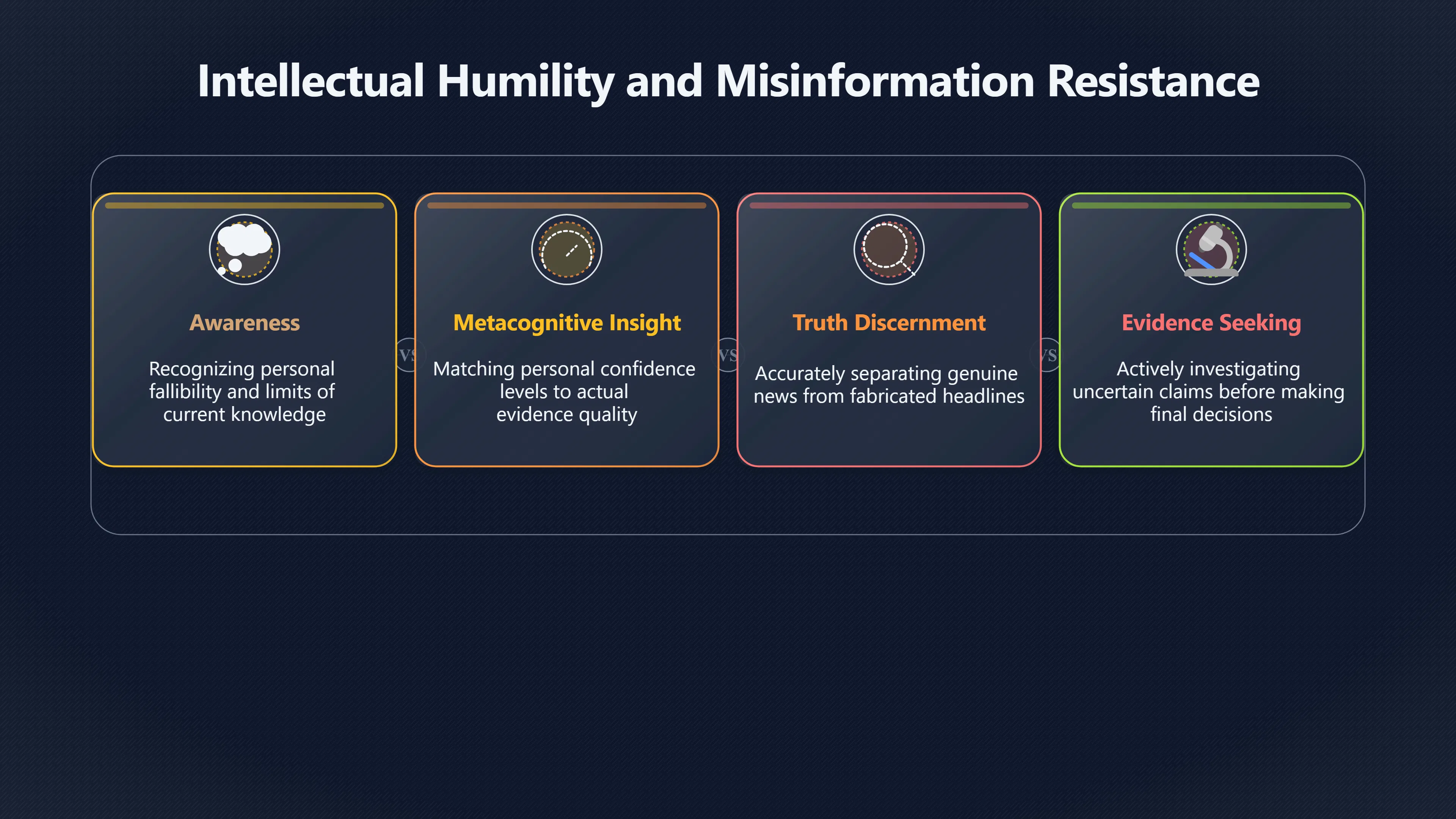
- Truth discernment: how accurately someone separates true headlines from false ones.
- Response bias: whether someone has a general tendency to believe everything or dismiss everything regardless of evidence.
- Metacognitive accuracy: whether confidence rises when a judgement is correct and falls when it is mistaken.
This distinction matters because two people may achieve similar overall accuracy for very different reasons. One might carefully evaluate evidence, while another simply rejects nearly everything. The second strategy may occasionally avoid believing false stories, but it also causes unnecessary rejection of true information.
Recent experimental work involving news-headline judgement tasks found that intellectual humility was associated with stronger truth discernment and better metacognitive insight, but not with a general tendency to label more headlines as false. In other words, humble participants were not merely more sceptical—they were better at telling the difference.[Advances.in]advances.indiscernment of true and false… intellectual humility and pseudoscience beliefs, conspiratorial ideation, and susceptibility to fake ne…
Why humility is not the same as gullibility
One common misconception is that admitting you could be wrong makes you easier to manipulate. The evidence points in almost the opposite direction.
Intellectual humility does not ask people to lower their standards of evidence. Instead, it encourages recognising the possibility of error while continuing to evaluate claims critically. Someone high in intellectual humility may say:
- “This looks convincing, but I want another source.”
- “I might be wrong, so I’ll check.”
- “The evidence changed, so I’ll revise my view.”
These responses differ sharply from gullibility, which accepts claims too readily, and from cynicism, which dismisses claims without evaluation.
A 2024 meta-analysis combining findings across multiple studies found that intellectual humility was associated with lower belief in misinformation overall, including fake news and conspiracy beliefs. The relationships were generally modest rather than dramatic, which is typical in psychological research, but they were consistent enough to suggest that humility provides a measurable protective advantage. The strongest behavioural association was with a greater willingness to investigate uncertain claims before deciding whether they were true.[Advances.in]advances.inIntellectual humility and misinformation receptivityA new meta-analytic review demonstrates who is most resilient…
Importantly, the same review found little evidence that humility simply makes people reject more information. Instead, it appears to encourage evidence-seeking behaviours that improve judgement quality.[Advances.in]advances.inIntellectual humility and misinformation receptivityA new meta-analytic review demonstrates who is most resilient…
How metacognitive insight improves source checks
Perhaps the most interesting finding is that intellectual humility appears closely connected with metacognition—thinking about the quality of one’s own thinking.
Researchers distinguish between making a correct judgement and knowing how likely that judgement is to be correct.
Imagine reading two unfamiliar news stories.
In one case, the evidence seems clear, several independent outlets agree, and the source has a strong reputation. High confidence may be justified.
In the second case, the claim relies on anonymous social media posts, emotional language and no supporting documentation. Even if the conclusion eventually turns out to be right, low confidence is the better intellectual position until stronger evidence appears.
Studies suggest intellectually humble individuals are better at matching confidence to actual accuracy. They are more likely to recognise when they are guessing and less likely to express unwarranted certainty. This metacognitive calibration reduces the risk that incorrect beliefs become entrenched simply because they were held confidently.[Advances.in]advances.indiscernment of true and false… intellectual humility and pseudoscience beliefs, conspiratorial ideation, and susceptibility to fake ne…
In practical terms, this often translates into behaviours such as:
- checking whether multiple independent sources agree;
- distinguishing original reporting from repeated commentary;
- noticing when confidence exceeds available evidence;
- delaying judgement until additional information becomes available.
These habits improve information quality without requiring universal distrust.
What the evidence says about investigating claims
One consistent finding across studies is that intellectual humility predicts curiosity about evidence rather than passive acceptance.
People scoring higher on intellectual humility report stronger intentions to:[ggsc.berkeley.edu]ggsc.berkeley.eduThe authors of this study define intellectual humility as a “nonthreatening awareness of one's intellectual…Read more…
- investigate questionable claims;
- verify evidence before sharing information;
- engage with evidence-based guidance;[par.nsf.gov]par.nsf.gov10650198 intellectual humility misinformation receptivity meta analytic reviewviews. Research has found that IH is correlated with less belief in misinformation, greater intentions to engage in evidence-based behavi…
- avoid passing on information whose accuracy remains uncertain.
Interestingly, these relationships are generally stronger than the relationship between humility and simply believing fewer false claims. This suggests that humility changes the process of reasoning as much as the final outcome. Instead of functioning like a built-in lie detector, it encourages behaviours that make accurate conclusions more likely over time.[Advances.in]advances.inIntellectual humility and misinformation receptivityA new meta-analytic review demonstrates who is most resilient…
Important limits and unresolved questions
The current evidence is encouraging but should not be overstated.
Most observed relationships are statistically reliable but moderate in size. Intellectual humility is one influence among many. General reasoning ability, scientific literacy, media literacy, political identity, emotional investment, prior beliefs and social trust also affect susceptibility to misinformation.
Researchers have also found that different questionnaires capture somewhat different aspects of intellectual humility. Some emphasise recognising one’s fallibility, others focus more on openness to revising beliefs or respect for opposing viewpoints. These differences partly explain why studies sometimes produce varying effect sizes.[PMC]pmc.ncbi.nlm.nih.govPMCPredictors and consequences of intellectual humilityby T Porter · 2022 · Cited by 359 — Intellectual humility involves acknowledging the limitations of one's knowledge and that one's bel…
Another important qualification comes from research examining belief revision. Intellectual humility often helps people update beliefs when presented with credible corrective evidence, but the effects are not universal. In some highly polarised situations, especially where participants already strongly endorse false beliefs, humility alone may not guarantee successful correction. Identity, social pressures and motivated reasoning can still interfere with evidence-based updating.[PubMed]pubmed.ncbi.nlm.nih.govWe examined whether the character…Read more…
These findings reinforce an important point: intellectual humility should be viewed as an aid to reasoning, not a guarantee of correctness.

What this means for everyday thinking
The research suggests that becoming harder to fool is less about becoming more suspicious and more about becoming better calibrated.
Useful habits supported by the evidence include:
- Separate confidence from certainty. Strong evidence justifies confidence; weak evidence justifies caution.
- Ask what evidence would change your mind before deciding that nothing could.
- Treat fact-checking as a normal part of reasoning rather than an admission of weakness.
- Pay attention not only to whether a claim is true but also to how confident you should be that it is true.
- Resist both extremes: accepting claims because they feel convincing and rejecting claims simply because they come from institutions, experts or unfamiliar sources.
Intellectual humility therefore works best as a practical form of epistemic self-awareness. Rather than encouraging people to distrust everything, it improves their ability to notice the difference between well-supported knowledge, uncertain claims and confident assertions that lack sufficient evidence. The emerging research indicates that this combination of better discernment and better metacognitive calibration—not indiscriminate scepticism—is what makes intellectually humble people more resistant to misinformation.[Advances.in+2Advances.in]advances.indiscernment of true and false… intellectual humility and pseudoscience beliefs, conspiratorial ideation, and susceptibility to fake ne…
eBay marketplace picks
Marketplace Samples
Example marketplace items related to this page. Use the search link to explore similar finds on eBay.



Endnotes
1.
Source: advances.in
Title: Intellectual humility and misinformation receptivity
Link:https://advances.in/psychology/10.56296/aip00026/
Source snippet
A new meta-analytic review demonstrates who is most resilient...
2.
Source: advances.in
Link:https://advances.in/psychology/10.56296/aip00025/
Source snippet
discernment of true and false... intellectual humility and pseudoscience beliefs, conspiratorial ideation, and susceptibility to fake ne...
3.
Source: pmc.ncbi.nlm.nih.gov
Title: PMCPredictors and consequences of intellectual humility
Link:https://pmc.ncbi.nlm.nih.gov/articles/PMC9244574/
Source snippet
by T Porter · 2022 · Cited by 359 — Intellectual humility involves acknowledging the limitations of one's knowledge and that one's bel...
4.
Source: pubmed.ncbi.nlm.nih.gov
Link:https://pubmed.ncbi.nlm.nih.gov/38421055/
Source snippet
We examined whether the character...Read more...
5.
Source: Wikipedia
Link:https://en.wikipedia.org/wiki/Intellectual
Source snippet
IntellectualAn intellectual is a person who engages in critical thinking, research, and reflection about the nature of reality...
6.
Source: dictionary.cambridge.org
Link:https://dictionary.cambridge.org/us/dictionary/english/intellectual
Source snippet
definition | Cambridge English Dictionaryrelating to the ability to think and understand ideas at a high level, or involving ideas: He wa...
7.
Source: par.nsf.gov
Title: 10650198 intellectual humility misinformation receptivity meta analytic review
Link:https://par.nsf.gov/biblio/10650198-intellectual-humility-misinformation-receptivity-meta-analytic-review
Source snippet
views. Research has found that IH is correlated with less belief in misinformation, greater intentions to engage in evidence-based behavi...
Additional References
8.
Source: wp.nyu.edu
Link:https://wp.nyu.edu/motivationlab/wp-content/uploads/sites/6235/2024/06/British-J-Social-Psychol-2024-Gollwitzer-Intellectual-humility-as-a-tool-to-combat-false-beliefs-An-individual%E2%80%90based.pdf
Source snippet
Web PublishingIntellectual humility as a tool to combat false beliefsby A Gollwitzer · 2024 · Cited by 9 — This finding suggests that int...
9.
Source: merriam-webster.com
Link:https://www.merriam-webster.com/dictionary/intellectual
Source snippet
INTELLECTUAL Definition & Meaning5 days ago — 1. a: of or relating to the intellect or its use b: developed or chiefly guided by the in...
10.
Source: researchgate.net
Link:https://www.researchgate.net/publication/353958311_Clarifying_the_Relations_between_Intellectual_Humility_and_Misinformation_Susceptibility
Source snippet
News truth discernment. IH tended to be significantly, positively related to truth. discernment...Read more...
11.
Source: blogs.cardiff.ac.uk
Title: ruminating on fake news online education and intellectual humility
Link:https://blogs.cardiff.ac.uk/openfordebate/ruminating-on-fake-news-online-education-and-intellectual-humility/
Source snippet
on Fake News, Online Education, and Intellectual...18 Jun 2018 — Ruminating on Fake News, Online Education, and Intellectual Humility...
12.
Source: researchgate.net
Link:https://www.researchgate.net/publication/359133100_Clarifying_the_Relations_between_Intellectual_Humility_and_Pseudoscience_Beliefs_Conspiratorial_Ideation_and_Susceptibility_to_Fake_News
Source snippet
nd conspiratorial beliefs (Bowes and Tasimi, 2022) and more factchecking behavior...Read more...
13.
Source: digital.library.adelaide.edu.au
Link:https://digital.library.adelaide.edu.au/items/abc4498d-5545-42c4-a57f-dacba7bb4c9f
Source snippet
lse; misinformation discernment) and decided whether to report or withhold...Read more...
14.
Source: researchgate.net
Link:https://www.researchgate.net/publication/384032606_Intellectual_humility_is_associated_with_greater_misinformation_discernment_and_metacognitive_insight_but_not_response_bias
Source snippet
n susceptibility due to improved discernment of true and false claims and...
15.
Source: thesaurus.com
Title: INTELLECTUA L Synonyms & Antonyms
Link:https://www.thesaurus.com/browse/intellectual
Source snippet
INTELLECTUAL Synonyms & Antonyms - 79 wordsFind 79 different ways to say INTELLECTUAL, along with antonyms, related words, and example se...
16.
Source: gordonpennycook.com
Title: Gordon Pennycook Published Work
Link:https://gordonpennycook.com/published-work/
Source snippet
Published Work - Gordon PennycookIntellectual humility questionnaires fail to [predict]({{ 'predict/' | relative_url }}) metacognitive skill: Implications for theory and me...
17.
Source: ggsc.berkeley.edu
Link:https://ggsc.berkeley.edu/what_we_do/major_initiatives/intellectual_humility/introduction_intellectual_humility_research
Source snippet
The authors of this study define intellectual humility as a “nonthreatening awareness of one's intellectual...Read more...
Topic Tree