Within Mistakes
When evidence search becomes self defense
Confirmation bias often begins with one-sided questions that make a preferred answer feel better supported than it really is.
On this page
- One sided questions and selective evidence
- Hiring, health and finance examples
- How to look for disconfirming evidence
Page outline Jump by section
Introduction
Confirmation bias turns evidence gathering into advocacy when the purpose of a search quietly shifts from discovering what is true to defending what already feels true. The change is often subtle. Instead of asking, “What does the evidence show?”, people ask, “Why am I right?” or “Where can I find support for the conclusion I already prefer?” The result is not simply an incomplete search. It is a search strategy designed—often unconsciously—to make one answer appear stronger than it really is. This matters because many important decisions in hiring, health and finance are made under uncertainty, where selective evidence can create unwarranted confidence rather than better judgement. Research consistently shows that confirmation bias affects what people look for, how they interpret ambiguous information and what they remember afterwards.[UCSD Pages]pages.ucsd.eduPages Confirmation Bias: A Ubiquitous Phenomenon in ManyUCSD PagesConfirmation Bias: A Ubiquitous Phenomenon in Many…October 6, 2004 — by RS Nickerson · 1998 · Cited by 12455 — Confirmation…
How a search becomes an act of self-defence
Confirmation bias is commonly described as the tendency to seek, interpret and recall information in ways that support an existing belief. However, the more revealing mechanism is that the search itself changes purpose. Instead of treating evidence as something that could overturn a hypothesis, people begin treating evidence as something that should justify it. Raymond Nickerson’s influential review argues that this process is usually not deliberate deception. Rather, people unknowingly become selective in how they acquire and use evidence.[UCSD Pages]pages.ucsd.eduPages Confirmation Bias: A Ubiquitous Phenomenon in ManyUCSD PagesConfirmation Bias: A Ubiquitous Phenomenon in Many…October 6, 2004 — by RS Nickerson · 1998 · Cited by 12455 — Confirmation…
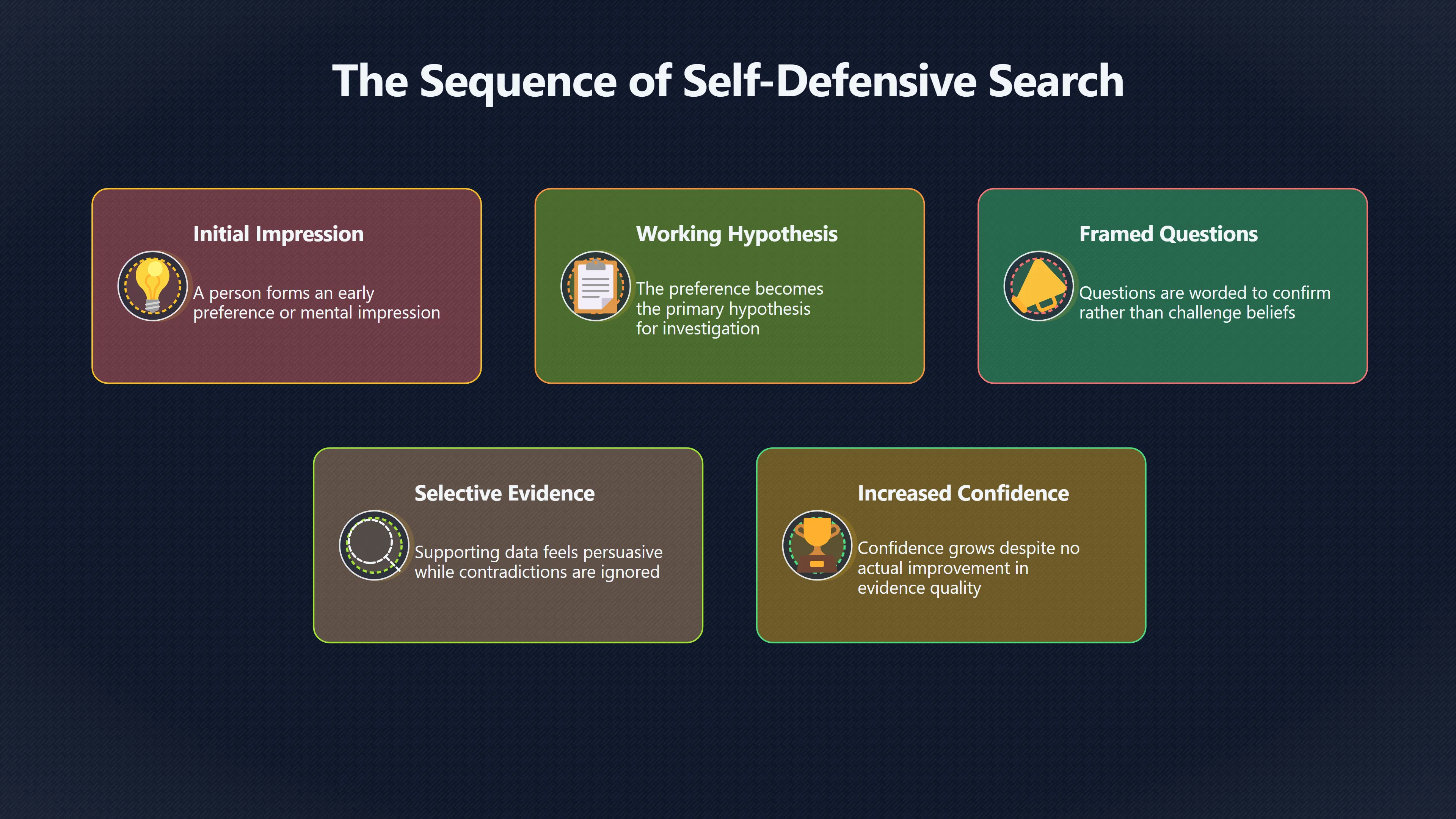
The shift often follows a simple sequence:
- A person forms an early preference or impression.
- That preference becomes the working hypothesis.
- Questions are framed to confirm rather than challenge it.
- Supporting evidence feels persuasive because contradictory evidence was never actively sought.
- Confidence increases, even if the overall quality of evidence has not improved.
The critical point is that confidence grows because the search was one-sided, not because the evidence genuinely became stronger.[UCSD Pages]pages.ucsd.eduPages Confirmation Bias: A Ubiquitous Phenomenon in ManyUCSD PagesConfirmation Bias: A Ubiquitous Phenomenon in Many…October 6, 2004 — by RS Nickerson · 1998 · Cited by 12455 — Confirmation…
One-sided questions create one-sided evidence
The wording of a question determines the evidence that can be found.
A neutral investigator asks:
- What explanations best fit the evidence?
- What evidence would distinguish between competing explanations?
An advocate tends to ask:
- Why is this idea correct?
- What evidence supports this conclusion?
- Who agrees with me?
Those questions almost guarantee supportive answers because they exclude competing possibilities before the search begins.
Psychological research on hypothesis testing has repeatedly shown that people often favour “positive tests”—looking for evidence expected if their hypothesis is true—rather than seeking observations that would prove it wrong. This approach is efficient in many situations but becomes misleading when several competing explanations could also fit the available evidence.[Wikipedia]WikipediaConfirmation biasConfirmation bias
The internet amplifies this tendency. Search engines can return excellent information, but if someone searches for “benefits of investment X” rather than “evidence against investment X” or “risks of investment X”, the initial query has already narrowed the information landscape.
Why supportive evidence feels more convincing than it is
Confirmation bias is not simply collecting favourable information. It also changes how evidence is interpreted.
When people encounter:
- evidence supporting their belief, they often treat it as reliable and representative;
- ambiguous evidence, they interpret it in the direction they already favour;
- contradictory evidence, they scrutinise its weaknesses more aggressively than they scrutinised supporting evidence.
This creates an uneven standard of proof. Evidence that agrees with existing beliefs receives relatively little scepticism, while opposing evidence is expected to overcome a much higher bar.
Because these different standards are applied unconsciously, people often believe they are evaluating both sides equally, even when they are not.[UCSD Pages]pages.ucsd.eduPages Confirmation Bias: A Ubiquitous Phenomenon in ManyUCSD PagesConfirmation Bias: A Ubiquitous Phenomenon in Many…October 6, 2004 — by RS Nickerson · 1998 · Cited by 12455 — Confirmation…
How it appears in hiring, health and finance
Hiring
A manager may form a positive impression within the first few minutes of an interview.
From that point onward, later questions subtly become confirmation exercises:
- asking about achievements rather than failures;
- interpreting confident behaviour as evidence of competence;
- overlooking inconsistent answers;
- remembering information that fits the favourable first impression.
The interview gradually becomes an attempt to justify the initial judgement instead of testing whether it survives further evidence. This is one reason structured interviews, standardised questions and independent scoring generally produce better hiring decisions than informal conversations.[Wikipedia]WikipediaConfirmation biasConfirmation bias
Health
Someone who wants a particular treatment may search almost exclusively for success stories, testimonials or articles supporting it while avoiding systematic reviews or clinical guidelines that discuss limitations.
Conversely, someone convinced a treatment is dangerous may seek only reports of adverse effects while overlooking evidence about effectiveness and risk magnitude.
In both cases, the search protects the preferred conclusion rather than evaluating the overall balance of evidence.[UCSD Pages]pages.ucsd.eduPages Confirmation Bias: A Ubiquitous Phenomenon in ManyUCSD PagesConfirmation Bias: A Ubiquitous Phenomenon in Many…October 6, 2004 — by RS Nickerson · 1998 · Cited by 12455 — Confirmation…
Finance
Investors frequently become emotionally attached to a company or investment thesis.
Once committed, searches often change from:
“Should I own this investment?”
to
“Why will this investment succeed?”
Negative earnings reports, changing market conditions or competing analyses may receive much less attention than optimistic forecasts that reinforce the existing position.
The danger is not simply missing information. It is gradually constructing an increasingly persuasive narrative from a selectively chosen evidence base.[UCSD Pages]pages.ucsd.eduPages Confirmation Bias: A Ubiquitous Phenomenon in ManyUCSD PagesConfirmation Bias: A Ubiquitous Phenomenon in Many…October 6, 2004 — by RS Nickerson · 1998 · Cited by 12455 — Confirmation…
Looking for disconfirming evidence
The most effective safeguard is usually not trying to suppress bias but deliberately changing the search process.
A practical routine is to identify the strongest reason you might be wrong before collecting further evidence.
Useful questions include:
- What evidence would genuinely change my mind?
- Which explanation competes most seriously with mine?
- What would someone who disagrees point to first?
- If I wanted to prove my current conclusion false, where would I start?
This shifts the search from defending one explanation to comparing several plausible alternatives.
Experimental work by Lord, Lepper and Preston found that prompting people to “consider the opposite” reduced biased social judgement more effectively than simply instructing them to avoid bias. The intervention worked because it required participants to actively generate alternative explanations rather than merely intending to be objective.[PubMed]pubmed.ncbi.nlm.nih.govConsidering the opposite: a corrective strategy for social…by CG Lord · 1984 · Cited by 1170 — It is proposed that several biase…
Practical habits that keep search analytical rather than defensive
Small procedural changes often work better than relying on willpower alone.
Before beginning a search:
- Write your current conclusion separately from your confidence in it.
- State what evidence would lower your confidence.
- List at least one plausible competing explanation.
While searching:
- Look for the strongest opposing source before reading additional supporting material.
- Search symmetrical questions, such as both “benefits” and “risks”.
- Compare evidence quality rather than counting supporting articles.
After searching:
- Ask whether your conclusion changed because of stronger evidence or simply because you found more agreement.
- Check whether you remember contrary evidence as clearly as supportive evidence.
- Imagine explaining your decision to someone who holds the opposite view.
These routines do not eliminate confirmation bias, but they interrupt its most important mechanism: turning evidence gathering into an exercise in protecting an answer already chosen.
The key lesson
Confirmation bias rarely begins with ignoring evidence. It usually begins earlier, with the questions people ask. A search framed as “Help me defend this conclusion” naturally accumulates confirming information, increasing confidence without necessarily increasing accuracy. Reframing the task as “Help me discover whether this conclusion survives serious challenge” changes the purpose of evidence gathering from advocacy back to inquiry, making better judgement far more likely.[UCSD Pages+2PubMed]pages.ucsd.eduPages Confirmation Bias: A Ubiquitous Phenomenon in ManyUCSD PagesConfirmation Bias: A Ubiquitous Phenomenon in Many…October 6, 2004 — by RS Nickerson · 1998 · Cited by 12455 — Confirmation…
Amazon book picks
Further Reading
Books and field guides related to When evidence search becomes self-defense. Use these as the next step if you want deeper reading beyond the article.
The Art of Thinking Clearly
Includes confirmation bias and many related reasoning traps.
Mistakes Were Made (but Not by Me)
Explores self-justification and why people defend existing beliefs.
eBay marketplace picks
Marketplace Samples
Live-tested eBay searches with available results related to this page.



Endnotes
1.
Source: pages.ucsd.edu
Title: Pages Confirmation Bias: A Ubiquitous Phenomenon in Many
Link:https://pages.ucsd.edu/~mckenzie/nickersonConfirmationBias.pdf
Source snippet
UCSD PagesConfirmation Bias: A Ubiquitous Phenomenon in Many...October 6, 2004 — by RS Nickerson · 1998 · Cited by 12455 — Confirmation...
Published: October 6, 2004
2.
Source: Wikipedia
Title: Confirmation bias
Link:https://en.wikipedia.org/wiki/Confirmation_bias
3.
Source: britannica.com
Title: confirmation bias
Link:https://www.britannica.com/science/confirmation-bias
Source snippet
Encyclopedia BritannicaConfirmation bias | Definition, Examples, Psychology, & Facts11 Jun 2026 — Confirmation bias, people's tendency to...
4.
Source: pubmed.ncbi.nlm.nih.gov
Link:https://pubmed.ncbi.nlm.nih.gov/6527215/
Source snippet
Considering the opposite: a corrective strategy for social...by CG Lord · 1984 · Cited by 1170 — It is proposed that several biase...
5.
Source: simplypsychology.org
Title: confirmation bias
Link:https://www.simplypsychology.org/confirmation-bias.html
Source snippet
In Psychology: Definition & Examples22 Jun 2023 — Confirmation bias is the tendency to look for information that supports, rather than re...
Additional References
6.
Source: thedecisionlab.com
Link:https://thedecisionlab.com/biases/confirmation-bias
Source snippet
Confirmation BiasConfirmation bias describes our underlying tendency to notice, focus on, and provide greater credence to evidence that f...
7.
Source: wrap.warwick.ac.uk
Title: WRAP confirmation bias emerges approximation Bayesian reasoning 2024
Link:https://wrap.warwick.ac.uk/id/eprint/181714/7/WRAP-confirmation-bias-emerges-approximation-Bayesian-reasoning-2024.pdf
Source snippet
C Pilgrim · 2024 · Cited by 32 — Confirmation bias is the search...
8.
Source: researchgate.net
Title: 340798496 What Is the Function of Confirmation Bias
Link:https://www.researchgate.net/publication/340798496_What_Is_the_Function_of_Confirmation_Bias
Source snippet
(PDF) What Is the Function of Confirmation Bias?20 May 2026 — Confirmation bias evolved because it helps us influence people and social s...
Published: May 2026
9.
Source: semanticscholar.org
Link:https://www.semanticscholar.org/paper/Confirmation-Bias%3A-A-Ubiquitous-Phenomenon-in-Many-Nickerson/70c93e5e38a8176590f69c0491fd63ab2a9e67c4
Source snippet
Confirmation Bias: A Ubiquitous Phenomenon in Many...1 Jun 1998 — Confirmation bias, as the term is typically used in the psychological...
10.
Source: youtube.com
Title: Confirmation Bias: The Reason Smart People Are Usually the Most Wrong
Link:https://www.youtube.com/watch?v=ld0sTjTFL50
Source snippet
How Cognitive Bias Ruins Your Marketing (and How to Outsmart Your Brain)...
11.
Source: youtube.com
Title: Obstacles to Problem Solving (Intro Psych Tutorial #90)
Link:https://www.youtube.com/watch?v=PGvyIZFKtOM
Source snippet
Confirmation Bias: The Reason Smart People Are Usually the Most Wrong...
12.
Source: youtube.com
Title: How to “See” Your Bias Blind Spot?
Link:https://www.youtube.com/watch?v=nUBRBiIX8l8
Source snippet
Obstacles to Problem Solving (Intro Psych Tutorial #90)...
13.
Source: youtube.com
Title: How Cognitive Bias Ruins Your Marketing (and How to Outsmart Your Brain)
Link:https://www.youtube.com/watch?v=Vzw3S22djkI
14.
Source: youtube.com
Title: Naive Realism and the Bias Blind Spot
Link:https://www.youtube.com/watch?v=6wv2aQ5074Q
Source snippet
How to "See" Your Bias Blind Spot?...
Topic Tree