Within Objections
Can the Best Opposing Case Beat Yours?
A real steelman makes the opposing case strong enough to expose which assumptions your preferred answer depends on.
On this page
- State the rival view fairly
- Find the evidence that makes it plausible
- Name the condition that would change the decision
Page outline Jump by section
Introduction
Steelmanning a rival view means deliberately constructing the strongest credible version of the best argument against your preferred conclusion before you commit to a decision. Unlike a straw man, which weakens an opposing position to make it easier to defeat, a steelman aims to make the alternative as persuasive and accurate as its supporters would recognise it. The purpose is not to be fair for its own sake. It is to expose which assumptions your own judgement depends on, reduce confirmation bias, and identify the evidence that would genuinely justify changing course. Research on confirmation bias consistently shows that people naturally seek and interpret information that supports what they already believe, making this step a practical safeguard rather than an intellectual luxury.[Wikipedia]WikipediaConfirmation biasConfirmation bias

What makes a real steelman different?
A genuine steelman is demanding because it requires temporarily suspending the urge to defend your preferred answer. Instead of asking, “How can I prove I’m right?”, you ask, “What is the strongest reason an informed, reasonable person would disagree?”
This differs from ordinary disagreement in several important ways:
- It represents the rival view faithfully. Someone who holds that position should be able to say, “Yes, that’s my argument.”
- It strengthens rather than weakens the opposing case. You remove obvious flaws, clarify ambiguities, and include the strongest available supporting evidence.
- It focuses on the central disagreement. Rather than collecting many minor objections, it identifies the few assumptions on which the decision actually depends.
The philosophical principle of charity has long argued that arguments should be interpreted in their strongest rational form before criticism. Steelmanning extends that idea into practical decision-making by treating accurate reconstruction as part of good reasoning rather than good manners.[Wikipedia]WikipediaPrinciple of charityPrinciple of charity
State the rival view fairly
The first task is to describe the competing position without adding exaggerations or removing important qualifications.
A useful test is simple: if someone who disagrees with you would immediately object to your description of their position, you have not yet produced a steelman.
Instead of writing:
“Opponents are simply afraid of change.”
write something closer to:
“The strongest argument for delaying implementation is that current evidence is incomplete, early mistakes could create lasting costs, and gathering another three months of data may substantially reduce uncertainty.”
Notice that this version does not concede the conclusion. It merely presents the reasoning in its strongest credible form.
In organisations, this often means separating disagreement over goals from disagreement over methods. Two people may agree completely on the desired outcome while disagreeing about whether the proposed route is sufficiently robust.
Find the evidence that makes the rival view plausible
A steelman without evidence is merely a more polite opinion.
After stating the rival case, actively search for the strongest evidence supporting it. This often means looking beyond sources that normally reinforce your own beliefs.
Useful questions include:
- Which published evidence would supporters cite first?
- Which historical examples favour their prediction?
- Which experts disagree with my current position?
- Which assumptions in my own reasoning are least well supported?
This stage deliberately interrupts confirmation bias. Decades of psychological research show that people naturally search for confirming evidence and often evaluate supporting evidence more generously than contradictory evidence. A steelman reverses that instinct by treating opposing evidence as diagnostically valuable rather than inconvenient.[Wikipedia]WikipediaConfirmation biasConfirmation bias
The goal is not equal weighting of every opinion. Weak objections remain weak. The point is that your preferred conclusion should survive the strongest available competing explanation, not merely the weakest criticism.
Name the condition that would change the decision
The most valuable part of a steelman is identifying the decision-changing condition.
Many debates continue because participants never specify what evidence would actually alter their judgement.
Ask questions such as:
- What observation would make the rival explanation more convincing than mine?
- What future result would justify changing plans?
- Which assumption, if disproved, would require a different decision?
For example:
Current preferenceStrong rival viewDecision-changing conditionLaunch the product immediatelyDelay because support systems are untested and reputational damage from early failures could outweigh first-mover advantageIf pilot testing reveals significantly higher failure rates than expected, postpone launch and improve operational readiness.Expand into a new marketWait because customer demand estimates rely on limited dataDelay expansion if independent market testing fails to confirm projected demand.Invest in Project AChoose Project B because its expected return is lower but uncertainty is substantially smallerSwitch if revised risk estimates show Project A’s downside exceeds acceptable limits.
The condition should be concrete enough that someone else could later evaluate whether it occurred.
Why steelmanning improves analytical judgement
Steelmanning works because it changes the sequence of thinking.
Without it, reasoning often follows this pattern:
- Form an initial conclusion.
- Collect supporting evidence.
- Defend the conclusion against criticism.
With steelmanning, the sequence becomes:
- Form a provisional conclusion.
- Build the strongest competing explanation.
- Compare both explanations against the available evidence.
- Commit only after testing the assumptions that separate them.
This process resembles structured analytical techniques developed for intelligence and decision analysis, such as comparing competing hypotheses rather than simply accumulating evidence for the first plausible explanation. The emphasis shifts from proving one answer correct to discovering which explanation best fits the evidence.[Wikipedia]WikipediaConfirmation biasConfirmation bias
Common mistakes that look like steelmanning
Several habits imitate steelmanning without providing its analytical benefits.
Choosing an obviously weak opponent. If the rival position is easy to dismiss, it cannot reveal weaknesses in your own reasoning.
Arguing against motives instead of arguments. Explaining why someone supposedly believes something is rarely a substitute for addressing their evidence.
Adding claims the rival side never made. A steelman strengthens existing arguments rather than inventing new ones.
Treating balance as accuracy. Every position does not deserve equal confidence. Steelmanning requires presenting the best opposing case fairly, not pretending that all conclusions are equally well supported.
Stopping after describing the rival view. The exercise is incomplete unless you identify what evidence would actually favour one explanation over the other.
A practical routine before committing to a decision
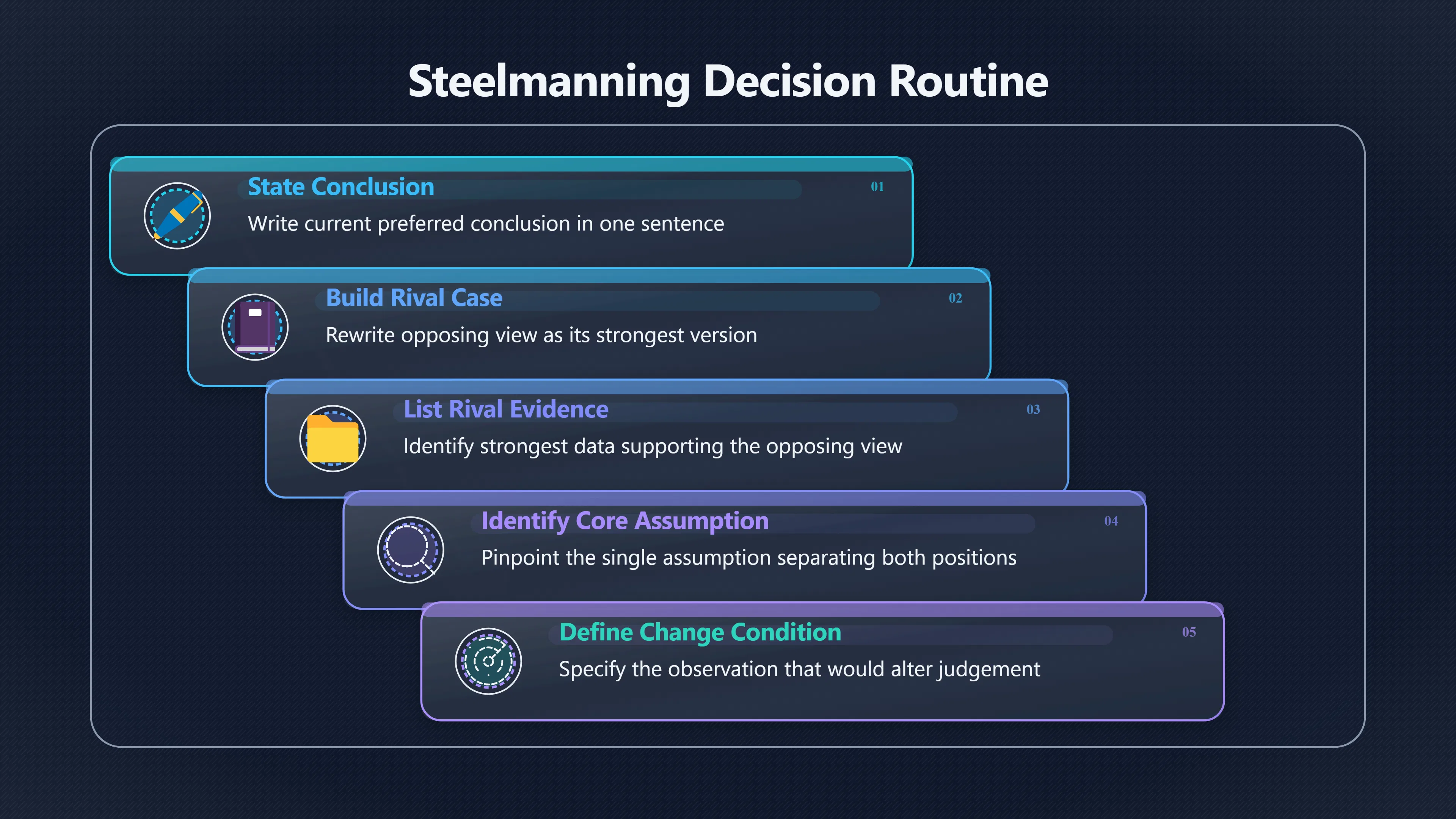
For important decisions, a concise routine is often enough:
- Write your current conclusion in one sentence.
- Rewrite the strongest opposing conclusion as its supporters would recognise it.
- List the best evidence supporting that rival view.
- Identify the single assumption that most clearly separates the two positions.
- Specify the observation or evidence that would cause you to change your decision.
- Only then decide whether your original conclusion still appears stronger.
This routine is intentionally brief. Its value comes from forcing your preferred answer to compete with its strongest credible alternative while changing direction is still relatively inexpensive. By making the rival case difficult to dismiss, you gain a clearer picture of what your own judgement truly depends upon.
Amazon book picks
Further Reading
Books and field guides related to Can the Best Opposing Case Beat Yours?. Use these as the next step if you want deeper reading beyond the article.
The Scout Mindset
Directly encourages understanding opposing arguments fairly and accurately.
Mistakes Were Made (but Not by Me)
Explains self-justification and why people resist strong opposing arguments.
eBay marketplace picks
Marketplace Samples
Example marketplace items related to this page. Use the search link to explore similar finds on eBay.



Endnotes
1.
Source: Wikipedia
Title: Confirmation bias
Link:https://en.wikipedia.org/wiki/Confirmation_bias
2.
Source: Wikipedia
Title: Principle of charity
Link:https://en.wikipedia.org/wiki/Principle_of_charity
Additional References
3.
Source: youtube.com
Title: How To Steel Man An Opposing Argument (feat. Sam Harris and Jordan Peterson)
Link:https://www.youtube.com/watch?v=Uh-DKbKlfag
Source snippet
this is how to improve your critical thinking according to neuroscience | THE ONLY VIDEO THAT WORKS...
4.
Source: researchgate.net
Title: (PDF) Steelmanning First
Link:https://www.researchgate.net/publication/396679679Steelmanning_First-_Charity_Virtue_and_Public_Reason_as_a_Unified_Method_of_Philosophical_Inquiry
Source snippet
Charity, Virtue, and Public...19 Oct 2025 — This paper argues that steelmanning—presenting an interlocutor's position in its strongest...
5.
Source: youtube.com
Link:https://www.youtube.com/watch?v=mHkOk3W48gk
Source snippet
How to Win ANY Workplace Disagreement (Without Being the Boss)...
6.
Source: youtube.com
Title: Neil Bearden
Link:https://www.youtube.com/watch?v=Y9KcgVu-QRI
Source snippet
Analysis of Competing Hypotheses (ACH): A Structured Analytic Technique (SAT) for FinCrime...
7.
Source: youtube.com
Link:https://www.youtube.com/watch?v=Y-J0FYOQRMY
8.
Source: youtube.com
Title: How to Win ANY Workplace Disagreement (Without Being the Boss)
Link:https://www.youtube.com/watch?v=Sct5rKxS6lc
Source snippet
Neil Bearden - Principle of Charity...
Topic Tree