Within Active Learning
Predict First, Then Let Evidence Correct You
Making a prediction before checking the answer turns passive reading into a comparison between expectation and evidence.
On this page
- Why prediction makes reading active
- How to write useful pre reading predictions
- What to do when evidence disagrees
Page outline Jump by section
Introduction
One of the simplest ways to turn passive reading into active thinking is to make a prediction before reading an analysis. Rather than immediately accepting an author’s explanation, you first commit yourself to an expectation: what you think the conclusion will be, which evidence will matter most, or how the argument is likely to unfold. Once you read the analysis, you compare your prediction with the evidence instead of merely recognising familiar ideas.
 This approach matters because it exposes assumptions that would otherwise remain hidden. A prediction creates a record of your current mental model. Whether the prediction proves right or wrong, the comparison that follows helps you understand not only the topic but also how your own reasoning works. Research on prediction, pretesting, and errorful generation suggests that attempting an answer before receiving instruction can improve later learning, even when the initial answer is incorrect.[PMC+2Springer Nature Link]pmc.ncbi.nlm.nih.govPMCPredicting as a learning strategyNIHby G Brod · 2021 · Cited by 77 — This article attempts to delineate the procedural and mechanistic characteristics of predicting…
Why prediction makes reading active
Reading an expert analysis is often deceptively easy. Because the finished argument is coherent, readers can mistake agreement with understanding. Prediction interrupts this passive process by forcing the reader to generate an explanation before seeing the author’s.
Instead of asking, “Do I understand this analysis?”, prediction asks, “What do I think explains this?” That subtle shift changes the role of the reader from observer to participant.
Several cognitive processes appear to contribute:
- Activation of prior knowledge. Predicting requires recalling relevant ideas before new information arrives, making it easier to connect incoming evidence with existing knowledge.[PMC]pmc.ncbi.nlm.nih.govPMCPredicting as a learning strategyNIHby G Brod · 2021 · Cited by 77 — This article attempts to delineate the procedural and mechanistic characteristics of predicting…
- Attention to diagnostic evidence. Once a prediction exists, readers naturally notice which pieces of evidence confirm or contradict it.
- Metacognitive calibration. Comparing prediction with reality reveals whether confidence matched accuracy, improving judgement about one’s own understanding over time.
- Deeper encoding. Generating an answer—even an incomplete one—often produces stronger memory than simply receiving the answer because the learner actively constructs rather than passively receives information.[PMC+2OSF]pmc.ncbi.nlm.nih.govPMCPredicting as a learning strategyNIHby G Brod · 2021 · Cited by 77 — This article attempts to delineate the procedural and mechanistic characteristics of predicting…
The goal is not to predict correctly. The goal is to create something that can later be evaluated.
How to write useful pre-reading predictions
Effective predictions are brief, specific, and testable. They should make your current reasoning visible without attempting to reproduce the entire forthcoming analysis.
Before opening an article or expert explanation, write one or more statements such as:
- “I think the main cause will be…”
- “The strongest evidence will probably come from…”
- “I expect explanation A to be stronger than explanation B because…”
- “If I had to recommend a decision now, I would choose…”
Keep predictions concise—usually one to three sentences. Long speculative essays become difficult to compare against the actual analysis.
Good predictions also include a reason. Instead of writing:
“I think the policy failed.”
write:
“I think the policy failed because it created incentives that people could easily avoid.”
The explanation exposes the assumptions that can later be confirmed, refined, or rejected.

What to do when evidence disagrees
The most valuable outcome is often discovering that your prediction was wrong.
Many learners instinctively treat an incorrect prediction as failure. Research suggests the opposite can occur. Attempting an answer before instruction—even unsuccessfully—can improve later learning because the subsequent correction becomes more meaningful. This phenomenon has been demonstrated across a variety of materials including text, lectures, and factual learning, although the size of the benefit depends on factors such as the type of material, feedback, and task design.[Springer Nature Link+2PMC]link.springer.comSpringer Nature LinkPrequestioning and Pretesting Effects: a Review of Empirical…by SC Pan · 2023 · Cited by 104 — In this review, we…
When your prediction differs from the evidence, avoid simply replacing the old answer with the new one. Instead, ask three questions:
- Which assumption turned out to be incorrect?
- What evidence did I overlook or underestimate?
- Would my original reasoning work in any similar situations, or was the underlying model flawed?
These questions transform disagreement into an opportunity for model revision rather than mere correction.
For example, if you predicted that a company’s falling profits resulted from declining demand, but the analysis shows that supply-chain disruptions were the dominant cause, the important lesson is not merely the correct answer. It is recognising which cues led you to favour the wrong explanation and why those cues were insufficient.
Common mistakes that reduce the benefit
Prediction is effective only when it genuinely commits you to an expectation before seeing the answer.
Several habits weaken the exercise:
- Making vague predictions. Statements that could fit almost any outcome (“There will be several factors”) cannot meaningfully be evaluated.
- Changing predictions while reading. Revising your guess halfway through removes the comparison that drives learning.
- Treating wrong predictions as embarrassing. Incorrect predictions often generate the strongest opportunities for conceptual change when followed by clear feedback.[PMC]pmc.ncbi.nlm.nih.govPMCPredicting as a learning strategyNIHby G Brod · 2021 · Cited by 77 — This article attempts to delineate the procedural and mechanistic characteristics of predicting…
- Skipping reflection after reading. Without explicitly comparing prediction and evidence, much of the metacognitive value is lost.
Another subtle mistake is predicting what the author will say based on style or reputation instead of predicting what you genuinely believe. The exercise is designed to reveal your own reasoning, not your ability to anticipate another person’s conclusions.
Limits and when to use the strategy carefully
Prediction is a useful learning tool, but it is not universally beneficial.
Research generally supports prediction and pretesting for promoting later learning, yet the effects vary across subjects, learner characteristics, and instructional designs. Some studies have found limited or even negative effects in particular contexts, especially when predictions become overly speculative, when readers lack enough background knowledge to generate meaningful expectations, or when misconceptions are left uncorrected. Prompt, accurate feedback is therefore an important part of the process.[Springer Nature Link+2EasyChair]link.springer.comSpringer Nature LinkPrequestioning and Pretesting Effects: a Review of Empirical…by SC Pan · 2023 · Cited by 104 — In this review, we…
Prediction is therefore best used when:
- the learner possesses at least some relevant prior knowledge;
- corrective evidence follows soon afterwards;
- the comparison between prediction and evidence is explicit rather than assumed.
For complete beginners, predictions should focus on broad mechanisms or expectations rather than precise technical details that cannot yet be reasoned about.
Turning prediction into a lasting thinking habit
Within active learning, prediction works because it creates a visible record of thought before evidence arrives. Instead of judging an analysis only by whether it seems convincing, you also examine how your own expectations changed.
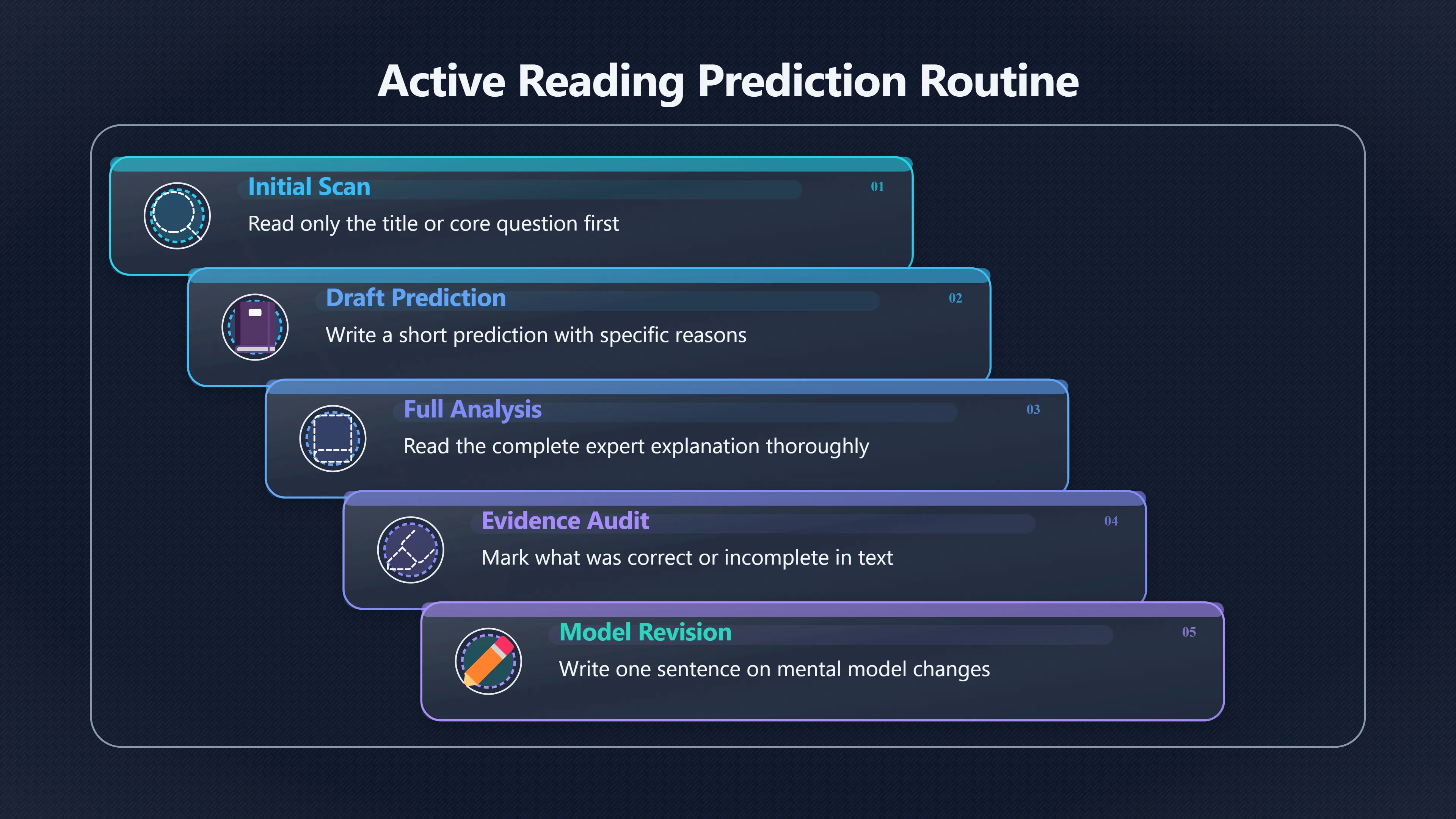
A simple routine is enough:
- Read only the title or question.
- Write a short prediction with one or two reasons.
- Read the full analysis.
- Mark what was correct, incorrect, or incomplete.
- Write one sentence describing how your mental model changed.
Repeated over many articles, reports, and case studies, this habit develops something more valuable than occasional correct guesses. It develops the ability to notice assumptions, update beliefs in response to evidence, and distinguish genuine understanding from the comforting familiarity that passive reading often creates.
Amazon book picks
Further Reading
Books and field guides related to Predict First, Then Let Evidence Correct You. Use these as the next step if you want deeper reading beyond the article.
Make It Stick
Explains retrieval practice, pretesting, and desirable difficulties that closely align with predicting before reading.
How We Learn
Covers evidence-based learning strategies including testing, generation, and correcting mistakes.
Ultralearning
Emphasizes active learning, self-testing, and engaging directly with material rather than passively consuming it.
The Art of Learning
Focuses on developing effective learning habits through active engagement, reflection, and continual correction.
eBay marketplace picks
Marketplace Samples
Example marketplace items related to this page. Use the search link to explore similar finds on eBay.
Endnotes
1.
Source: pmc.ncbi.nlm.nih.gov
Title: PMCPredicting as a learning strategy
Link:https://pmc.ncbi.nlm.nih.gov/articles/PMC8642250/
Source snippet
NIHby G Brod · 2021 · Cited by 77 — This article attempts to delineate the procedural and mechanistic characteristics of predicting...
2.
Source: link.springer.com
Link:https://link.springer.com/article/10.1007/s10648-023-09814-5
Source snippet
Springer Nature LinkPrequestioning and Pretesting Effects: a Review of Empirical...by SC Pan · 2023 · Cited by 104 — In this review, we...
3.
Source: osf.io
Link:https://osf.io/download/un87v
Source snippet
pretesting vs. posttestingby SC Pan · Cited by 127 — pretesting is highly competitive with posttesting and can yield similar, if not g...
4.
Source: pmc.ncbi.nlm.nih.gov
Link:https://pmc.ncbi.nlm.nih.gov/articles/PMC12292081/
Source snippet
Pretesting Effect: Exploring the Impact of Feedback and...by Y Mera · 2025 · Cited by 1 — The pretesting effect suggests that attempting...
5.
Source: easychair.org
Link:https://easychair.org/publications/preprint/tDPk/open
Source snippet
How Do Predictions Change Learning from Science Texts?12 Jul 2020 — Making predictions before explaining failed to improve comprehension...
6.
Source: link.springer.com
Link:https://link.springer.com/article/10.1007/s10648-023-09766-w
Source snippet
the Effort: the Start and Stick to Desirable Difficulties...by ABH de Bruin · 2023 · Cited by 90 — The negative subjective experiences o...
7.
Source: pmc.ncbi.nlm.nih.gov
Link:https://pmc.ncbi.nlm.nih.gov/articles/PMC10858853/
Source snippet
by ABH de Bruin · 2023 · Cited by 7 — Students often interpret the high effort and the absence of immediate learning effects as indica...
8.
Source: ouci.dntb.gov.ua
Link:https://ouci.dntb.gov.ua/en/works/9joLjew7/
Source snippet
as a learning strategyIn this review, we summarize the emerging evidence for prequestioning and pretesting effects on memory and transfer...
Additional References
9.
Source: researchgate.net
Link:https://www.researchgate.net/publication/374157738Prequestioning_and_pretesting_effects_a_review_of_empirical_research_theoretical_perspectives_and_implications_for_educational[practice
Source snippet
(PDF) Prequestioning and Pretesting Effects: a Review of...Sep 4, 2023 — In this review, we summarize the emerging evidence for prequest...
10.
Source: researchgate.net
Link:https://www.researchgate.net/publication/369552662_Worth_the_Effort_the_Start_and_Stick_to_Desirable_Difficulties_S2D2_Framework
Source snippet
the Start and Stick to Desirable Difficulties (S2D2) FrameworkMar 14, 2023 — Learners often do not appreciate the beneficial effects of d...
11.
Source: learninglab.uchicago.edu
Link:https://learninglab.uchicago.edu/Pre-[Testing
Source snippet
ces long-term memory, particularly when the information is successfully retrieved from memory.Read more...
12.
Source: youtube.com
Link:https://www.youtube.com/watch?v=MnEVEr-kmvg
Source snippet
If AI Can Do Everything What's Left For You? is highly relevant because it explores the cognitive significance of the generation effect...
13.
Source: theeffortfuleducator.com
Title: article review pretesting enhances learning in the classroom
Link:https://theeffortfuleducator.com/2023/09/08/article-review-pretesting-enhances-learning-in-the-classroom/
Source snippet
Article Review: Pretesting Enhances Learning in the...Sep 8, 2023 — The article, Pretesting Enhances Learning in the Classroom, takes a...
14.
Source: theeffortfuleducator.com
Title: pretesting the benefits of errorful generation
Link:https://theeffortfuleducator.com/2021/11/05/pretesting-the-benefits-of-errorful-generation/
Source snippet
Pretesting: The Benefits of Errorful Generation5 Nov 2021 — Both test types (pre or posttesting) enhanced memory relative to a no-test co...
15.
Source: structural-learning.com
Title: Information learners create sticks better than information they read.Read more
Link:https://www.structural-learning.com/post/generation-effect-active-learning
Source snippet
The Generation Effect: Why Creating Information Beats29 Dec 2025 — The generation effect improves memory, according to researchers...
16.
Source: researchgate.net
Title: 350390831 Predicting as a learning strategy
Link:https://www.researchgate.net/publication/350390831_Predicting_as_a_learning_strategy
Source snippet
(PDF) Predicting as a learning strategy29 Mar 2021 — This article attempts to delineate the procedural and mechanistic characteristics of...
17.
Source: structural-learning.com
Title: pretesting effect testing before [teaching]({{ ‘teaching/’ | relative_url }})
Link:https://www.structural-learning.com/post/pretesting-effect-testing-before-teaching
Source snippet
The Pretesting Effect: Why Testing Before Teaching WorksApr 24, 2026 — The pretesting effect shows that assessing pupils before teaching...
18.
Source: dr.lib.iastate.edu
Link:https://dr.lib.iastate.edu/server/api/core/bitstreams/f5307c4f-8de3-4997-a6c7-30dfc3612446/content
Source snippet
meta-analytic review of the prequestion effect by Kyle...by KJS Hilaire · 2022 · Cited by 22 — In this dissertation, I aimed to 1) quali...
Topic Tree