Within Claims
The Hidden Bridge in Every Argument
The warrant is the quiet bridge between evidence and claim, and finding it often reveals where the disagreement really sits.
On this page
- Claim, grounds, and warrant in plain language
- How to spot the assumption doing the work
- Testing whether the bridge is strong enough
Page outline Jump by section
Introduction
When people disagree, they often think they are arguing about facts. In many cases, however, the real disagreement sits elsewhere: in the hidden assumption that connects those facts to a conclusion. Stephen Toulmin, the philosopher who developed the Toulmin model of argumentation in the 1950s, called this connecting assumption the warrant. The warrant is the reason the evidence is supposed to support the claim. Without it, facts and conclusions simply sit side by side.[Purdue OWL]owl.purdue.eduOWLToulmin ArgumentPurdue OWLToulmin Argument - Purdue OWLThe Toulmin method is a style of argumentation that breaks arguments down into six component parts…
 For anyone trying to improve their thinking and analytical skills, warrants matter because they reveal the often-unspoken logic inside everyday arguments. Once the warrant becomes visible, it is easier to understand why reasonable people can look at the same evidence and reach different conclusions. The debate is often not about the evidence itself but about whether the bridge from evidence to claim is justified.[Purdue OWL]owl.purdue.eduOWLOrganizing Your ArgumentPurdue OWLOrganizing Your Argument - Purdue OWLWarrant (Bridge): In this section, you explain why or how your data supports the claim. As…
The Hidden Bridge in Every Argument
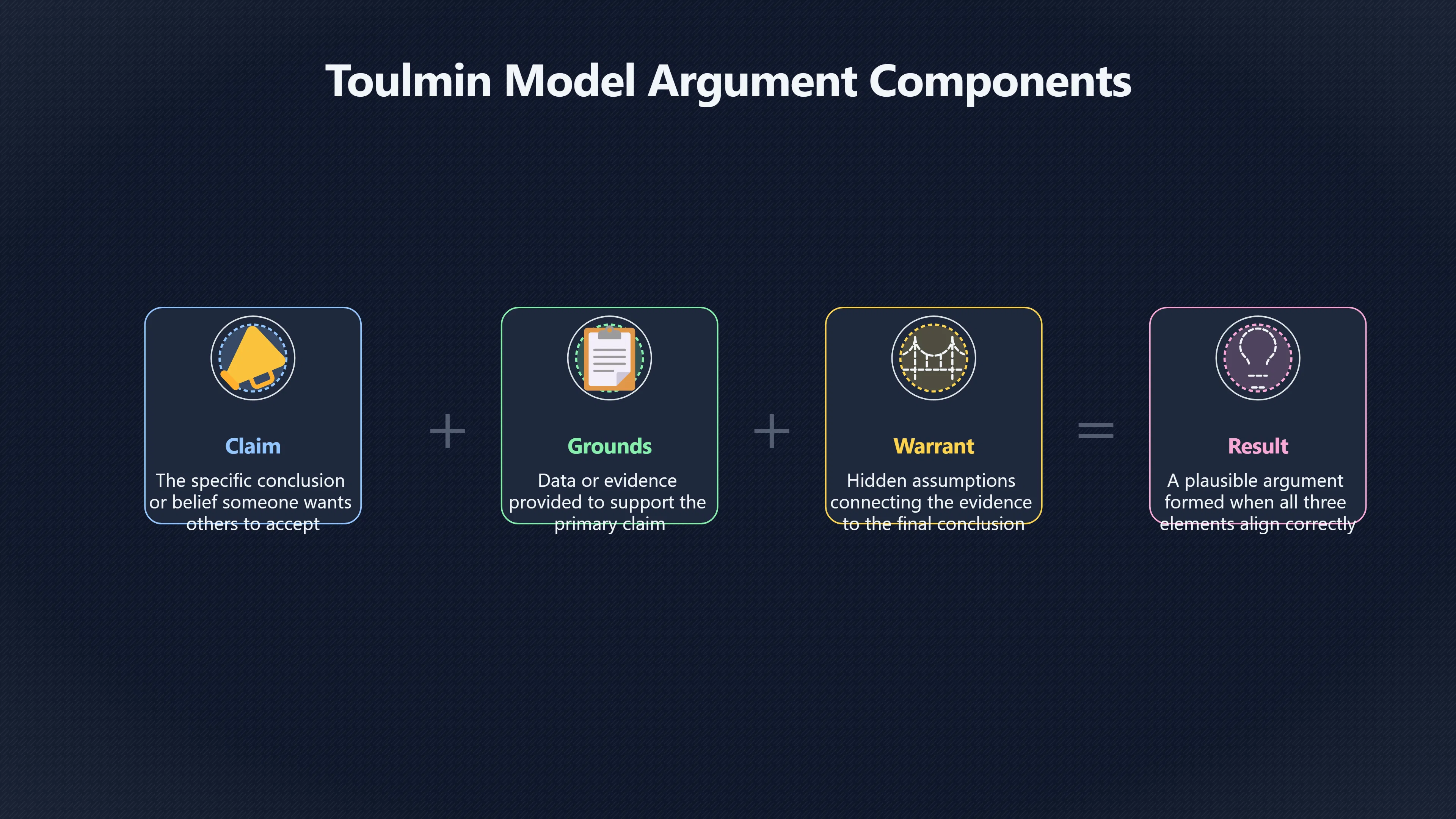
Claim, grounds, and warrant in plain language
Toulmin’s model identifies three core elements present in ordinary arguments:[youtube.com]youtube.comToulmin Model of ArgumentationThe Toulmin Method of Argumentation | THUNK…
- Claim: what someone wants you to believe.
- Grounds (or data): the evidence offered in support.
- Warrant: the assumption or principle that explains why the evidence supports the claim.[Purdue OWL+2mhcc.pressbooks.pub]owl.purdue.eduOWLToulmin ArgumentPurdue OWLToulmin Argument - Purdue OWLThe Toulmin method is a style of argumentation that breaks arguments down into six component parts…
A simple example shows the difference:
- Claim: “This restaurant is worth visiting.”
- Grounds: “It is always busy on weekends.”
- Warrant: “Restaurants that attract many customers are usually good.”
The evidence alone does not force the conclusion. The conclusion becomes plausible only if the listener accepts the warrant. If someone instead believes that popularity often reflects marketing rather than quality, they may reject the conclusion while accepting the evidence.
This is why Toulmin described warrants as the mechanism that authorises movement from grounds to claims. They are the hidden rules of reasoning that make an argument seem sensible.[Argument-Centered Education]argumentcenterededucation.comour adaptation of the toulmin model of argumentArgument-Centered EducationOur Adaptation of the Toulmin Model of ArgumentJul 17, 2019 — In The Uses of Argument, he says that a warrant…
Why warrants are often invisible
In everyday conversation, people rarely state their warrants directly. They assume listeners already share them. Writing guides based on Toulmin’s work consistently note that warrants are frequently implicit rather than explicitly stated.[purdueglobalwriting.center]purdueglobalwriting.centerThe Toulmin Model of Argument PodcastThe warrant is the assumption, or belief, the writer has in mind when forming an argument. The under…
Consider these examples:
GroundsClaimLikely warrant”She has twenty years of experience.”“She should lead the project.”Experience usually improves judgement and leadership.”The policy was introduced last year, and costs increased.”“The policy caused the increase.”Events that occur before a change are likely responsible for it.”Several friends recommend the film.”“The film is probably good.”Trusted recommendations are useful indicators of quality.
In each case, the warrant quietly does the heavy lifting. Without it, the grounds do not automatically support the claim.
How to Spot the Assumption Doing the Work
One of the most useful analytical habits is learning to uncover the warrant beneath an argument.
A practical technique is to ask:
“Why does that evidence make this conclusion reasonable?”
The answer usually exposes the warrant.
Imagine someone says:
“Three employees resigned this month, so morale must be poor.”
The grounds are clear: three resignations. The claim is that morale is poor. The hidden warrant is something like:
“When multiple employees leave in a short period, low morale is usually a significant cause.”
Now the discussion becomes more precise. Instead of arguing vaguely about the conclusion, people can examine the assumption itself. Perhaps resignations were caused by higher salaries elsewhere. Perhaps a restructuring programme was announced. The real issue is whether the warrant fits the situation.
This is one reason Toulmin’s model remains influential in argument analysis. By separating claims, grounds, and warrants, it allows each part to be evaluated independently.[Blinn College]blinn.eduBlinn CollegeToulmin ArgumentIdentify each argument's claims, data, and warrants. Look for qualifiers, rebuttals, and backing for the war…
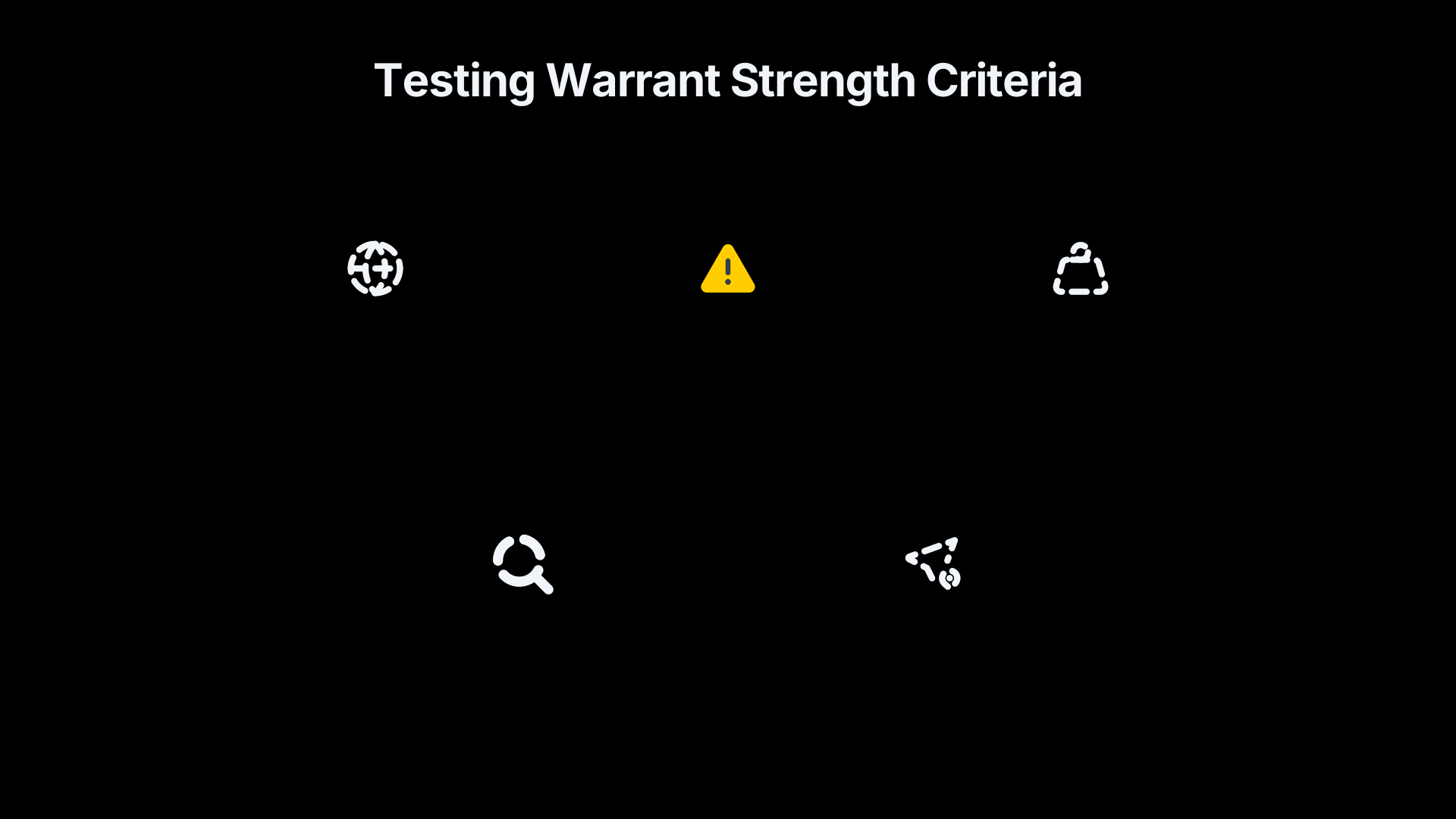
Where disagreements often really live
Many public and personal disagreements turn out to be warrant disputes.
For example:
- Health discussions: Two people may agree that someone improved after taking a supplement. One accepts the warrant that improvement indicates effectiveness; the other questions whether recovery, placebo effects, or other factors explain the change.
- Workplace debates: Colleagues may agree that a team missed deadlines. They disagree about whether missed deadlines indicate poor management or unrealistic workload expectations.
- News and politics: People may accept the same facts but disagree over whether those facts demonstrate success, failure, fairness, or responsibility.
The evidence is not always the source of conflict. Often the conflict lies in different assumptions about what the evidence means.
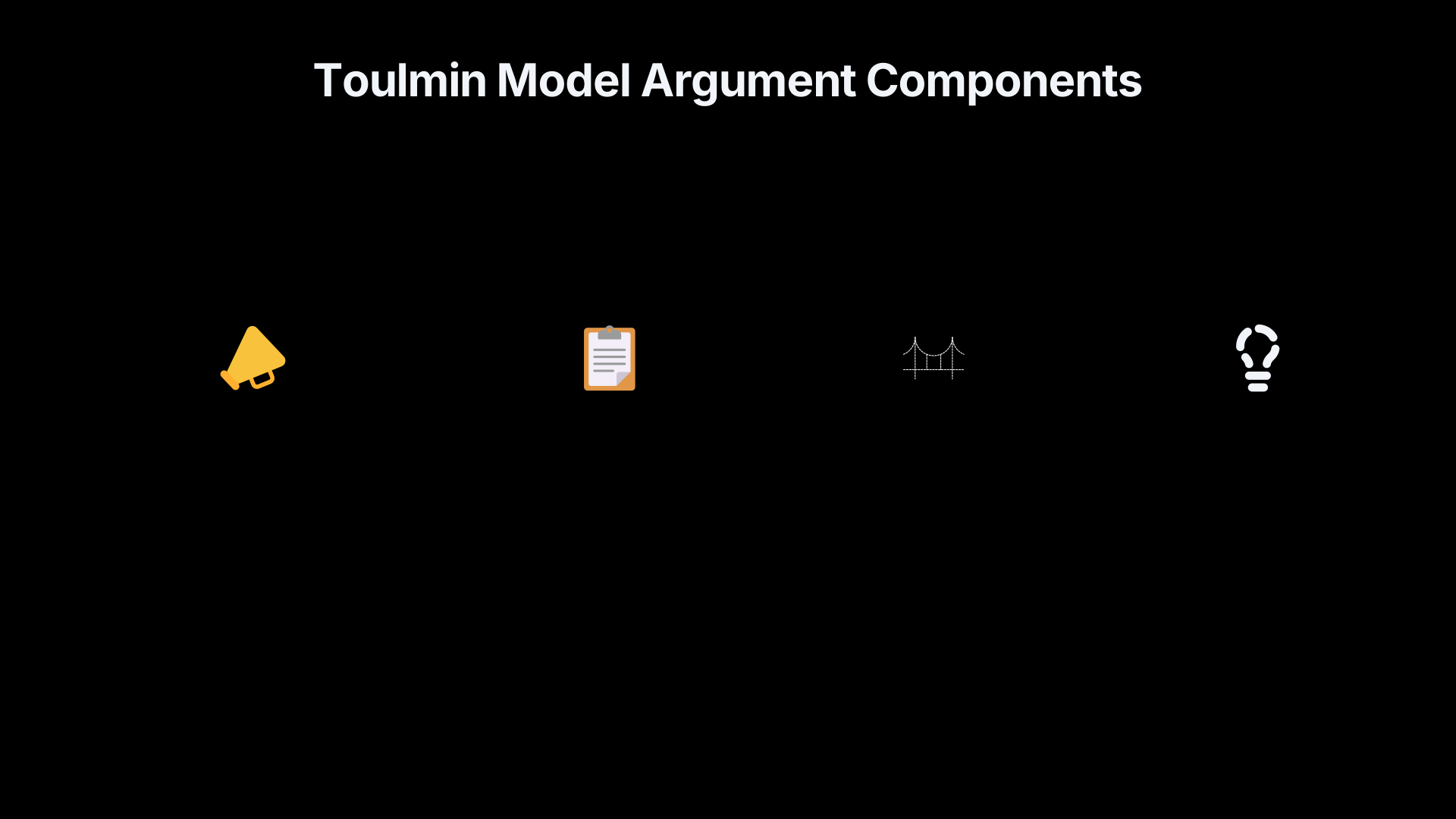
Testing Whether the Bridge Is Strong Enough
Recognising a warrant is only the first step. The next question is whether it is a good warrant.
Ask whether the warrant is generally true
A strong warrant usually connects evidence and conclusion through a principle that works in many comparable situations.
For example:
- Grounds: “The bridge inspection found structural damage.”
- Claim: “The bridge should be repaired.”
- Warrant: “Structural damage creates safety risks.”
This warrant is broadly reliable.
Compare it with:[blinn.edu]blinn.eduBlinn CollegeToulmin ArgumentIdentify each argument's claims, data, and warrants. Look for qualifiers, rebuttals, and backing for the war…
- Grounds: “The bridge inspection found structural damage.”
- Claim: “The city council is incompetent.”
- Warrant: “Infrastructure problems always result from incompetence.”
That warrant is much more questionable because alternative explanations are easy to imagine.
Look for exceptions
Toulmin emphasised that arguments should be tested against possible objections and exceptions. A warrant that collapses when a few obvious exceptions appear is usually weak.[Open Oco]open.ocolearnok.orgOpen OcoModels of Argumentation – First-Year English CompositionToulmin emphasizes first identifying all of the potential objections to t…
Consider:
- Grounds: “The company is profitable.”
- Claim: “Employees must be happy.”
- Warrant: “Profitable companies treat employees well.”
Many exceptions immediately come to mind. Profitability and employee satisfaction are related in some circumstances but not reliably enough to support a confident conclusion.
Check whether the warrant matches the strength of the claim
A common reasoning error occurs when a modest warrant is used to support a sweeping conclusion.
For example:
- Grounds: “Two customers complained.”
- Claim: “The product is a failure.”
- Warrant: “Customer complaints indicate product quality.”
Even if the warrant has some truth, it does not justify such a broad claim. The evidence and warrant support only a much weaker conclusion, such as “the product may have issues worth investigating”.
Strong reasoning requires proportionality between grounds, warrant, and claim.[ResearchGate]researchgate.netResearchGate(PDF) Good Reasoning on the Toulmin Model… The step from the data to the claim is guaranteed by a warrant, which is any gen…
Why Toulmin’s Idea Remains Useful
Toulmin developed his model partly because real-world arguments often do not resemble formal logic exercises. People reason through examples, practical experience, expert testimony, probabilities, and shared assumptions rather than through strict mathematical deduction. His framework focuses on how justification works in ordinary human reasoning.[Springer]link.springer.comToulmin's Model of Argumentation | Springer Nature LinkToulmin presents in his model of argumentation a novel approach to analyzi…
That practical focus explains why the concept of the warrant remains valuable. It directs attention to the precise point where evidence becomes meaning. Whenever an argument feels persuasive—or suspicious—the most revealing question is often not “Is the evidence true?” but “What assumption is connecting that evidence to the conclusion?”
Finding that hidden bridge frequently reveals where the real conversation should begin.[Purdue OWL+2ciris.info]owl.purdue.eduOWLOrganizing Your ArgumentPurdue OWLOrganizing Your Argument - Purdue OWLWarrant (Bridge): In this section, you explain why or how your data supports the claim. As…
Amazon book picks
Further Reading
Books and field guides related to The Hidden Bridge in Every Argument. Use these as the next step if you want deeper reading beyond the article.
The Uses of Argument
Introduces the Toulmin model itself, including claims, grounds, warrants, backing, and rebuttals.
Asking the Right Questions
Teaches readers to uncover hidden assumptions and evaluate how evidence supports conclusions.
Critical Thinking
Covers argument structure, inference, assumptions, and evaluating support for claims.
Attacking Faulty Reasoning
Helps readers test whether reasoning bridges are strong enough and identify weak warrants.
eBay marketplace picks
Marketplace Samples
Example marketplace items related to this page. Use the search link to explore similar finds on eBay.

Endnotes
1.
Source: owl.purdue.edu
Title: OWLToulmin Argument
Link:https://owl.purdue.edu/owl/general_writing/academic_writing/historical_perspectives_on_argumentation/toulmin_argument.html
Source snippet
Purdue OWLToulmin Argument - Purdue OWLThe Toulmin method is a style of argumentation that breaks arguments down into six component parts...
2.
Source: link.springer.com
Link:https://link.springer.com/rwe/10.1007/978
Source snippet
Toulmin's Model of Argumentation | Springer Nature LinkToulmin presents in his model of argumentation a novel approach to analyzi...
3.
Source: owl.purdue.edu
Title: OWLOrganizing Your Argument
Link:https://owl.purdue.edu/owl/general_writing/academic_writing/establishing_arguments/organizing_your_argument.html
Source snippet
Purdue OWLOrganizing Your Argument - Purdue OWLWarrant (Bridge): In this section, you explain why or how your data supports the claim. As...
4.
Source: idaho.pressbooks.pub
Link:https://idaho.pressbooks.pub/write/chapter/toulmin-argument-model/
Source snippet
Toulmin Argument Model – Write What MattersA warrant links data and other grounds to a claim, legitimizing the claim by showing the groun...
5.
Source: mhcc.pressbooks.pub
Link:https://mhcc.pressbooks.pub/2ndwr122/chapter/8/
Source snippet
Analysis (Claims and Data)The Toulmin method is a style of argumentation that breaks arguments down into six component parts: claim, grou...
6.
Source: purdueglobalwriting.center
Link:https://purdueglobalwriting.center/the-toulmin-model-of-argument/
Source snippet
The Toulmin Model of Argument PodcastThe warrant is the assumption, or belief, the writer has in mind when forming an argument. The under...
7.
Source: blinn.edu
Link:https://www.blinn.edu/writing-centers/wide/toulmin-argument.html
Source snippet
Blinn CollegeToulmin ArgumentIdentify each argument's claims, data, and warrants. Look for qualifiers, rebuttals, and backing for the war...
8.
Source: researchgate.net
Link:https://www.researchgate.net/publication/225363701_Good_Reasoning_on_the_Toulmin_Model
Source snippet
ResearchGate(PDF) Good Reasoning on the Toulmin Model... The step from the data to the claim is guaranteed by a warrant, which is any gen...
9.
Source: ciris.info
Link:https://www.ciris.info/learningcenter/toulmins-model/
Source snippet
Toulmin's model of ArgumentationThe Toulmin model shows how reasoning moves from evidence (grounds) to a conclusion (claim), supported by...
10.
Source: utsa.pressbooks.pub
Link:https://utsa.pressbooks.pub/fromcollegetocareer/chapter/the-toulmin-argument-model/
Source snippet
Toulmin Argument Model – From College to CareerAny rebuttal is an argument in itself, and thus may include a claim, warrant, backing, and...
11.
Source: researchgate.net
Link:https://www.researchgate.net/figure/Toulmins-six-components-of-argument-adapted-from-Purdue-Online-Writing-Lab-nd_fig1_387473773
Source snippet
t of 'warrant' in Toulmin's mode of argumentation within EFL/ESL settings...Read more...
12.
Source: owl.purdue.edu
Title: strong> In a work of persuasive writing, the writer presents
Link:https://owl.purdue.edu/owl/general_writing/academic_writing/establishing_arguments/organizing_your_argument.%20In%20this%20case%2C%20your%20paper%20will%20be%20completed%20by%20a%20standard%20author.%20It%20does%20not%20mean%20that%20your%20paper%20will%20be%20of%20poor%20quality.The%20%3Cstrong%3EToulmin%3C/strong%3E%20model%20can%20be%20used%20as%20a%20framework%20to%20test%20an%20argument%27s%20validity%20by%20identifying%20the%20%3Cstrong%3Eclaim%3C/strong%3E%2C%20evidence%2C%20%3Cstrong%3Ewarrants%3C/strong%3E%2C%20backing%2C%20counterarguments%2C%20and%20qualifiers.%20In%20an%20academic%20%3Cstrong%3Eessay%3C/strong%3E%2C%20the%20%3Cstrong%3Ewarrant%3C/strong%3E%20and%20backing%20would%20be%20allotted%20the%20most%20in-depth%20discussion%20because%20these%20aspects%20are%20normally%20unstated%20and%20taken%20for%20granted%20in%20causal%20arguments.%203.%20Each%20is%20explained%20below.%20%3Cstrong%3EClaims%3C/strong%3E%20In%20a%20work%20of%20persuasive%20writing%2C%20the%20writer%20presents
Source snippet
ChoicesThe <strong>Toulmin</strong> model can be used as a framework to test an argument's validity by identifying the <strong>claim</str...
13.
Source: youtube.com
Title: Toulmin Model of Argumentation
Link:https://www.youtube.com/watch?v=JJ2XgVfpKXc
Source snippet
The Toulmin Method of Argumentation | THUNK...
14.
Source: argumentcenterededucation.com
Title: our adaptation of the toulmin model of argument
Link:https://argumentcenterededucation.com/2019/07/17/our-adaptation-of-the-toulmin-model-of-argument/
Source snippet
Argument-Centered EducationOur Adaptation of the Toulmin Model of ArgumentJul 17, 2019 — In The Uses of Argument, he says that a warrant...
15.
Source: open.ocolearnok.org
Link:https://open.ocolearnok.org/englishcomposuokc/chapter/using-the-toulmin-system-to-build-an-argument/
Source snippet
Open OcoModels of Argumentation – First-Year English CompositionToulmin emphasizes first identifying all of the potential objections to t...
16.
Source: purdueglobal.edu
Title: Purdue Global
Link:https://www.purdueglobal.edu/
Source snippet
An Accredited Online UniversityPurdue Global is 100% online so you can fit earning a degree into your busy life. Take undergraduate cours...
Additional References
17.
Source: statisticssolutions.com
Link:https://www.statisticssolutions.com/expanding-on-the-basic-toulmin-model-when-writing-a-literature-review/
Source snippet
Expanding on the Basic Toulmin ModelThe Toulmin model of argumentation contains six elements: Claim, Grounds, Warrant, Qualifier, Backing...
18.
Source: reddit.com
Link:https://www.reddit.com/r/Debate/comments/1hefj1/toulmin_method/
Source snippet
Toulmin Method: r/DebateThe tenets he includes are Claim, Ground, Warrant, Backing, Rebuttal, and Qualifier. Can anyone else confirm whe...
19.
Source: sjsu.edu
Link:https://www.sjsu.edu/writingcenter/docs/handouts/Toulmin%20Model%20of%20Argumentative%20Writing.pdf
Source snippet
Toulmin's Model of Argumentative WritingIt consists of six parts: three fundamental elements are the claim, grounds, and warrant; then, t...
20.
Source: purduesports.com
Link:https://purduesports.com/
Source snippet
Home Page - Purdue Boilermakers - Official Athletics WebsiteThe Official Athletic Site of Purdue University, partner of WMT Digital...
21.
Source: learn.academy4sc.org
Title: the toulmin model of argumentation claims data and warrants oh my
Link:https://learn.academy4sc.org/video/the-toulmin-model-of-argumentation-claims-data-and-warrants-oh-my/
Source snippet
Toulmin Model of Argumentation: Claims, Data, and...Toulmin identified six elements of an effective argument: claims, data, warrants, ba...
22.
Source: journals.indianapolis.iu.edu
Link:https://journals.indianapolis.iu.edu/index.php/teachingwriting/article/download/821/810/2733
Source snippet
USING TOULMIN'S MODEL OF ARGUMENTATIONCited by 132 — These three elements-claim, grounds, and warrant are present in every argument...
23.
Source: vappingo.com
Title: the claim evidence reasoning model for university essays
Link:https://www.vappingo.com/word-blog/the-claim-evidence-reasoning-model-for-university-essays/
Source snippet
The Claim–Evidence–Reasoning Model for University...19 Mar 2026 — In Toulmin's model of argument, this link is called the “warrant.” A w...
24.
Source: bmhs-la.org
Title: Toulmin Arguments | Bishop Montgomery High School
Link:https://www.bmhs-la.org/apps/video/watch.jsp?v=49181
Source snippet
December 4, 2017 — high class welcome to your toulmin argument model video this is the third of the three argument model I just spent abo...
Published: December 4, 2017
25.
Source: rationaleonline.com
Title: toulmins model of argument warrants and rationale
Link:https://rationaleonline.com/blog/93xpat/2015/4/13/toulmins-model-of-argument-warrants-and-rationale
Source snippet
Toulmin's Model of Argument, Warrants and Rationale23 Apr 2015 — The first three elements, "claim," "data," and "warrant," are considered...
26.
Source: psychologyandeducation.net
Title: Argument Pattern in Student Argumentative Essays
Link:https://psychologyandeducation.net/pae/index.php/pae/article/view/3099
Source snippet
Toulmin argument structure model consisting of six elements: Claim, data, warrant, backing, qualifier, and rebuttal. Thirty-five students...
Topic Tree