Within Project Failure
How Risk Starts Feeling Normal
Small accepted exceptions can become the new normal until teams stop recognising that the project is operating outside safe limits.
On this page
- How repeated survival teaches false confidence
- From shuttle safety to everyday project habits
- Warning signs that exceptions have become routine
Page outline Jump by section
Introduction
Normalisation of deviance describes a gradual shift in judgement in which practices that were originally recognised as unsafe, exceptional or outside agreed standards come to be treated as normal because they repeatedly appear to work. The danger is not that people suddenly become reckless. Rather, each successful outcome without an immediate failure encourages the belief that the original safety margin was overly cautious. Over time, the organisation stops seeing itself as taking unusual risks at all. This mechanism is especially important for improving analytical thinking because it explains why intelligent, conscientious teams can collectively drift into poor decisions without anyone deliberately choosing an obviously dangerous course. The concept, developed by sociologist Diane Vaughan through her study of the Challenger disaster, has since become a widely used explanation for failures in engineering, healthcare and project management.[University of Chicago Press]press.uchicago.eduUniversity of Chicago PressThe Challenger Launch DecisionShe reveals how and why NASA insiders, when repeatedly faced with evidence that…
How repeated survival teaches false confidence
The most important feature of normalisation of deviance is that success becomes misleading evidence.
Projects rarely move directly from safe practice to serious failure. Instead, a small exception is made: a test is shortened, a review is skipped, a deadline is protected by accepting an unresolved issue, or a known defect is judged “acceptable for now”. If nothing visibly goes wrong, the exception becomes easier to justify next time. Eventually the exception no longer feels like an exception.
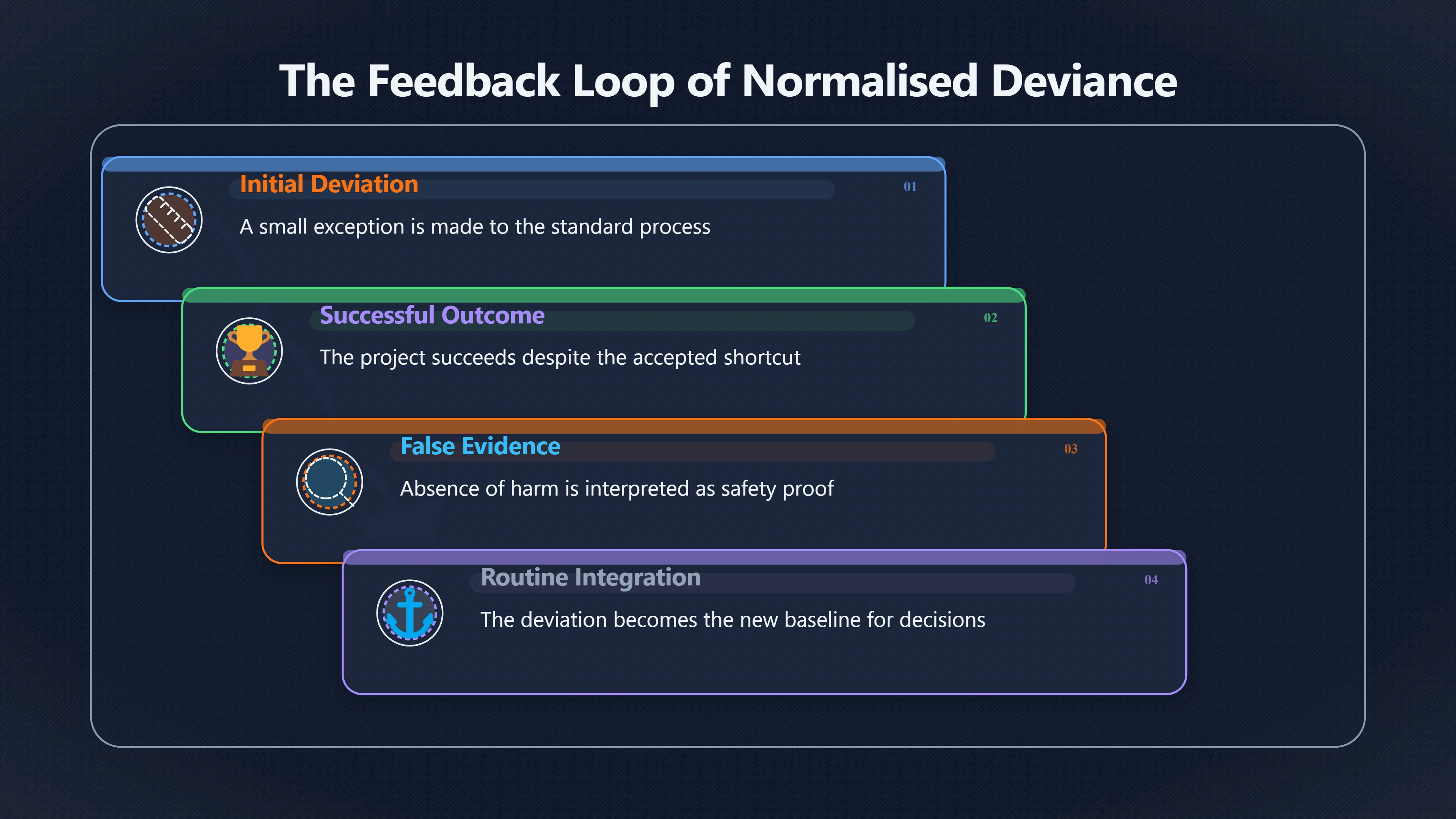
This creates a dangerous feedback loop:
- A deviation from the intended process occurs.
- The project succeeds despite the deviation.
- The absence of immediate harm is interpreted as proof that the deviation is safe.
- The deviation becomes routine.
- Future decisions begin from the new baseline rather than the original standard.
The key analytical mistake is confusing survival with evidence of safety. A project may avoid disaster because of luck, hidden safety margins or favourable circumstances rather than because the shortcut was genuinely harmless. Every successful outcome increases confidence while providing very little information about how close the project came to failure.[PubMed+2Cranfield University DSpace]pubmed.ncbi.nlm.nih.govWhen Doing Wrong Feels So Right: Normalization of…by MR Price · 2018 · Cited by 116 — Normalization of deviance is a term first…
From shuttle safety to everyday project habits
The Challenger disaster remains the defining historical example because it illustrates this gradual drift rather than a single catastrophic mistake.
Engineers at NASA and contractor Morton Thiokol had observed erosion and damage to the solid rocket booster O-rings on previous shuttle flights. These observations did not initially fit the intended design assumptions. However, because successive launches completed successfully, the damage gradually came to be regarded as an acceptable operating condition rather than evidence that the design required correction. Vaughan argued that decision-makers did not suddenly abandon safety standards. Instead, they slowly redefined what counted as acceptable evidence of risk.[University of Chicago Press+2Columbia Magazine]press.uchicago.eduUniversity of Chicago PressThe Challenger Launch DecisionShe reveals how and why NASA insiders, when repeatedly faced with evidence that…
This is precisely why the Challenger case remains valuable for ordinary projects. Most organisations never face life-or-death engineering decisions, but many experience comparable forms of drift:
- Temporary workarounds become permanent operating procedures.
- Schedule pressure justifies incomplete documentation.
- Risk registers accumulate unresolved items that no longer receive attention.
- Defects are repeatedly accepted because previous releases caused no visible problems.
- Governance meetings approve exceptions so frequently that they cease to function as exceptions.
None of these decisions appears dramatic in isolation. Their significance lies in the accumulated change to what the organisation considers normal. Research on project governance has argued that normalised deviance develops through a sequence of individually understandable choices that become institutionalised until the organisation loses sight of its original standards.[Cranfield University DSpace]dspace.lib.cranfield.ac.ukOpen source on cranfield.ac.uk.
The lesson is not that every exception is wrong. Projects often require informed trade-offs. The problem begins when repeated exceptions quietly redefine the baseline without deliberate review.
Why ordinary decisions are especially vulnerable
Large disasters often attract attention because of spectacular technical failures, but normalisation of deviance usually grows through routine administrative decisions.
Several organisational pressures make this mechanism particularly attractive:
Deadline pressure. Teams under delivery pressure naturally ask whether a known issue is “good enough for now”. Repeating this judgement without reassessing cumulative risk gradually lowers standards.
Familiarity. Hazards that are encountered repeatedly become psychologically less alarming. What once prompted escalation becomes another routine item on a meeting agenda.
Performance incentives. If managers are rewarded for maintaining delivery dates rather than exposing uncertainty, evidence supporting continuation receives more attention than evidence supporting delay.
Incremental change. Small adjustments rarely trigger the scrutiny that would accompany a major policy change. Because each individual step appears modest, no single decision feels like crossing an important boundary.
These pressures do not require dishonesty or incompetence. They arise from normal organisational behaviour, making them particularly difficult to recognise while a project is underway.[Cranfield University DSpace+2IDEAS/RePEc]dspace.lib.cranfield.ac.ukOpen source on cranfield.ac.uk.
Warning signs that exceptions have become routine
Analytically, the important question is not whether a project contains exceptions—it almost certainly does—but whether the organisation still recognises them as exceptions.
Warning signs include:
- Teams describing known deviations as “the way we always do it”.
- Risk acceptance being justified primarily by previous successful outcomes.
- Temporary fixes remaining in place for months without formal review.
- Safety or quality thresholds gradually changing without explicit approval.
- Repeated waivers becoming easier to obtain than resolving the underlying problem.
- Engineers or specialists expressing concern while management increasingly views those concerns as routine rather than unusual.
Another warning sign is a subtle change in language. Teams stop asking, “Does this meet the intended standard?” and instead ask, “Have we got away with this before?” The first question measures performance against design intent; the second measures it against recent experience.

Preventing deviance drift in project decisions
The practical defence against normalisation of deviance is not to ban every exception but to prevent today’s exception from silently becoming tomorrow’s standard.
Useful practices include:
- Review repeated waivers together. A single approved exception may be reasonable; ten similar exceptions indicate that the underlying process or design needs attention.
- Separate schedule decisions from technical judgement. Technical experts should be able to describe risk without simultaneously defending delivery commitments.
- Record the original rationale. Comparing current practice with the original design assumptions helps reveal how far operational behaviour has drifted.
- Treat successful near misses as learning opportunities. A problem that caused no visible harm should still be analysed if it required unusual recovery or depended on fortunate circumstances.
- Invite periodic external review. Fresh reviewers are less likely to accept local assumptions that long-serving teams now regard as normal.
These practices shift attention away from whether the project survived and towards whether its decisions remain consistent with the standards the organisation intended to uphold.
Why this mechanism matters for better thinking
Normalisation of deviance is fundamentally a reasoning error embedded within organisations. It replaces evidence about safe operating limits with evidence about recent survival. The distinction is subtle but crucial.
For anyone trying to improve analytical thinking, the lasting lesson from Challenger is not simply “listen to experts” or “take safety seriously”. It is to recognise that repeated success can sometimes reduce rather than improve judgement. The most dangerous project decisions are often those that no longer feel like decisions at all because accumulated exceptions have quietly become the accepted way of working. The Columbia Accident Investigation Board later warned that similar organisational patterns had again contributed to disaster, reinforcing the broader lesson that institutions must continually question risks that have become familiar rather than assuming familiarity makes them acceptable.[EHSS+2AIChE]ehss.energy.gov0308 caib report volume1The central element of the patch was the microgravity symbol, µg, flowing into the rays of the Astronaut symbol.Read more…
Amazon book picks
Further Reading
Books and field guides related to How Risk Starts Feeling Normal. Use these as the next step if you want deeper reading beyond the article.
Black Box Thinking
Encourages learning from failure rather than allowing risky habits to become accepted.
Thinking, Fast and Slow
Provides the cognitive framework behind biased judgement and misplaced confidence.
The Checklist Manifesto
Shows how disciplined processes help prevent gradual drift from safe practice.
The Challenger Launch Decision
Explains how repeated success with unsafe practices becomes organisationally normal.
eBay marketplace picks
Marketplace Samples
Example marketplace items related to this page. Use the search link to explore similar finds on eBay.




Endnotes
1.
Source: magazine.columbia.edu
Link:https://magazine.columbia.edu/article/challenger-disaster-normalization-deviance
Source snippet
Vaughan was asked to sit on the Columbia Accident Investigation Board.Read more...
2.
Source: ideas.repec.org
Link:https://ideas.repec.org/h/elg/eechap/21314_15.html
Source snippet
IDEAS/RePEcNormalization of deviance in projects: its causes and implicby JK Pinto · 2023 · Cited by 4 — This chapter examines the behavi...
3.
Source: ehss.energy.gov
Title: 0308 caib report volume1
Link:https://ehss.energy.gov/deprep/archive/documents/0308_caib_report_volume1.pdf
Source snippet
The central element of the patch was the microgravity symbol, µg, flowing into the rays of the Astronaut symbol.Read more...
4.
Source: aiche.org
Title: self evaluation tool key lessons columbia shuttle disaster
Link:https://www.aiche.org/ccps/self-evaluation-tool-key-lessons-columbia-shuttle-disaster
Source snippet
Self evaluation tool: Key lessons from the Columbia Shuttle...20 Feb 2020 — It is significant that a similar “normalization of deviance”...
5.
Source: nasa.gov
Link:https://www.nasa.gov/
Source snippet
National Aeronautics and Space Administration. NASA explores the unknown in air and space, innovates for the benefit of humanity, and...
6.
Source: nasa.gov
Link:https://www.nasa.gov/wp-content/uploads/2015/01/55691main_Diaz_020204.pdf
7.
Source: press.uchicago.edu
Link:https://press.uchicago.edu/ucp/books/book/chicago/C/bo22781921.html
Source snippet
University of Chicago PressThe Challenger Launch DecisionShe reveals how and why NASA insiders, when repeatedly faced with evidence that...
8.
Source: pubmed.ncbi.nlm.nih.gov
Link:https://pubmed.ncbi.nlm.nih.gov/25742063/
Source snippet
When Doing Wrong Feels So Right: Normalization of...by MR Price · 2018 · Cited by 116 — Normalization of deviance is a term first...
9.
Source: dspace.lib.cranfield.ac.uk
Link:https://dspace.lib.cranfield.ac.uk/server/api/core/bitstreams/be88cd44-9590-4be0-bc43-abf5964f5448/content
10.
Source: humanfactors101.com
Title: normalisation of deviance
Link:https://humanfactors101.com/2016/08/09/normalisation-of-deviance/
Source snippet
9 Aug 2016 — "Normalisation of deviance" is when deviations from agreed standards or working practices become incorporated into the routine...
11.
Source: psychsafety.com
Title: normalisation of deviance
Link:https://psychsafety.com/normalisation-of-deviance/
Source snippet
The Challenger Disaster: Normalisation of Deviance24 Nov 2023 — Normalisation of deviance occurs when people within an organisation becom...
12.
Source: Wikipedia
Link:https://en.wikipedia.org/wiki/NASA
Source snippet
NASA - WikipediaThe National Aeronautics and Space Administration is an independent agency of the U.S. federal government responsible...
13.
Source: Wikipedia
Title: Columbia Accident Investigation Board
Link:https://en.wikipedia.org/wiki/Columbia_Accident_Investigation_Board
Source snippet
Columbia Accident Investigation BoardThe board found both the immediate physical cause of the accident and also what it called organiz...
14.
Source: theguardian.com
Link:https://www.theguardian.com/science/nasa
Source snippet
June 2026 · 'Earth's first starfleet': Nasa reveals Artemis III crew and project's next steps · Nasa tells astronauts to return to Intern...
Published: June 2026
15.
Source: research.abdn.ac.uk
Title: abdn.ac.uk Normalisation of deviance
Link:https://research.abdn.ac.uk/applied-psych-hf/energy-project/
Source snippet
of deviance - Applied Psychology and Human...Through this process, what was once considered 'deviant' gradually become integrated into n...
16.
Source: web.mit.edu
Title: The Challenger Launch Decision 1
Link:https://web.mit.edu/esd.83/www/notebook/The%20Challenger%20Launch%20Decision_1.pdf
Source snippet
Review - The Challenger Launch Decisionby D Vaughan · 1996 — Diana Vaughan explores the normalization of deviance in chapter five and als...
Additional References
17.
Source: utahavalanchecenter.org
Link:https://utahavalanchecenter.org/blog/27476
Source snippet
Blog: The Normalization of DevianceThe Normalization of Deviance refers to an individual or organization's tendency to cut corners or tak...
18.
Source: humanfactors101.com
Link:https://humanfactors101.com/incidents/space-shuttle-columbia/
Source snippet
Space Shuttle Columbia.177 The Columbia Accident Investigation Board (CAIB) reports that NASAʼs organisational culture had as much to do...
19.
Source: westgard.com
Link:https://westgard.com/lessons/patient-safety-concepts/normal-lab-deviance.html
Source snippet
Normalization of Deviance - Patient Safety ConceptsIn 1996, Diane Vaughan coined the term "Normalization of Deviance" to...
20.
Source: researchgate.net
Title: 273148155 When Doing Wrong Feels So Right Normalization of Deviance
Link:https://www.researchgate.net/publication/273148155_When_Doing_Wrong_Feels_So_Right_Normalization_of_Deviance
Source snippet
(PDF) When Doing Wrong Feels So Right: Normalization of...1 Aug 2018 — Normalization of deviance is a term first coined by sociologist D...
21.
Source: researchportal.lsbu.ac.uk
Title: normalization of deviance in the construction industry a manageri 3
Link:https://researchportal.lsbu.ac.uk/en/publications/normalization-of-deviance-in-the-construction-industry-a-manageri-3/
Source snippet
of deviance in the construction industry, a...by S Hajikazemi · 2019 — This phenomenon has been referred to as “Normalization of Devianc...
22.
Source: goodreads.com
Link:https://www.goodreads.com/book/show/995029.The_Challenger_Launch_Decision
Source snippet
hing was wrong, normalized the deviance so that it became acceptable to...Read more...
23.
Source: researchgate.net
Title: Challenger disaster and found a series of missteps,
Link:https://www.researchgate.net/profile/Jeffrey-Pinto-2/publication/260295571_Project_management_governance_and_the_normalization_of_deviance/links/5b7d6b67299bf1d5a71c5030/Project-management-governance-and-the-normalization-of-deviance.pdf
Source snippet
term "normalization of deviance" was first coined by Diane Vaug...
24.
Source: cypres.aero
Title: jackys classroom talk 3 normalization of deviance
Link:https://www.cypres.aero/jackys-classroom-talk-3-normalization-of-deviance/
Source snippet
Jacky's Classroom Talk (3): "Normalization of deviance"25 Mar 2020 — Normalization of deviance: What do the Challenger desaster and skydi...
25.
Source: thehumandiver.com
Title: normalisation of deviance not about rule breaking
Link:https://www.thehumandiver.com/post/normalisation-of-deviance-not-about-rule-breaking
Source snippet
Normalisation of Deviance: It's not about rule-breaking22 Jul 2022 — The term 'Normalisation of Deviance' was coined by Diane Vaughan in...
26.
Source: medium.com
Link:https://medium.com/%40qhsestandard/the-normalization-of-deviance-the-definitive-encyclopedia-of-why-great-companies-fail-c6156f6d1e8e
Source snippet
cross that safety boundary without realizing it...Read more...
Topic Tree