Within Three Parts
How do better thinkers manage their learning?
Planning, monitoring and evaluating learning helps thinkers choose better strategies for specific tasks instead of relying on effort alone.
On this page
- Planning before reasoning begins
- Monitoring progress during a task
- Evaluating what worked after feedback
Page outline Jump by section
Introduction
Self-regulated learning is the practical side of metacognition: it is the process of deliberately planning, monitoring and evaluating your own learning so that your thinking improves over time. For analytical work, this matters because better reasoning rarely comes from trying harder alone. It comes from choosing appropriate strategies, noticing when those strategies are failing, and adapting before errors become entrenched. Research over several decades consistently shows that successful learners actively regulate their goals, attention, motivation and methods rather than relying on repetition or intuition.[PMC+2ResearchGate]pmc.ncbi.nlm.nih.govSelf-regulated learning (SRL) includes the cognitive, metacognitive, behavioral, motivational, and emotional/affective aspects of learnin…
 Within the broader goal of improving analytical thinking, self-regulated learning connects abstract metacognitive awareness with everyday practice. It turns questions such as “Am I thinking clearly?” into concrete habits: defining the task before starting, checking progress while working, and reviewing both successes and mistakes afterwards. These habits help people become more accurate, adaptable and independent thinkers rather than simply more knowledgeable.[PMC]pmc.ncbi.nlm.nih.govSelf-regulated learning (SRL) includes the cognitive, metacognitive, behavioral, motivational, and emotional/affective aspects of learnin…
Planning before reasoning begins
Strong analysis starts before the first argument is evaluated. Self-regulated learners spend time understanding the problem they are trying to solve instead of immediately generating answers.
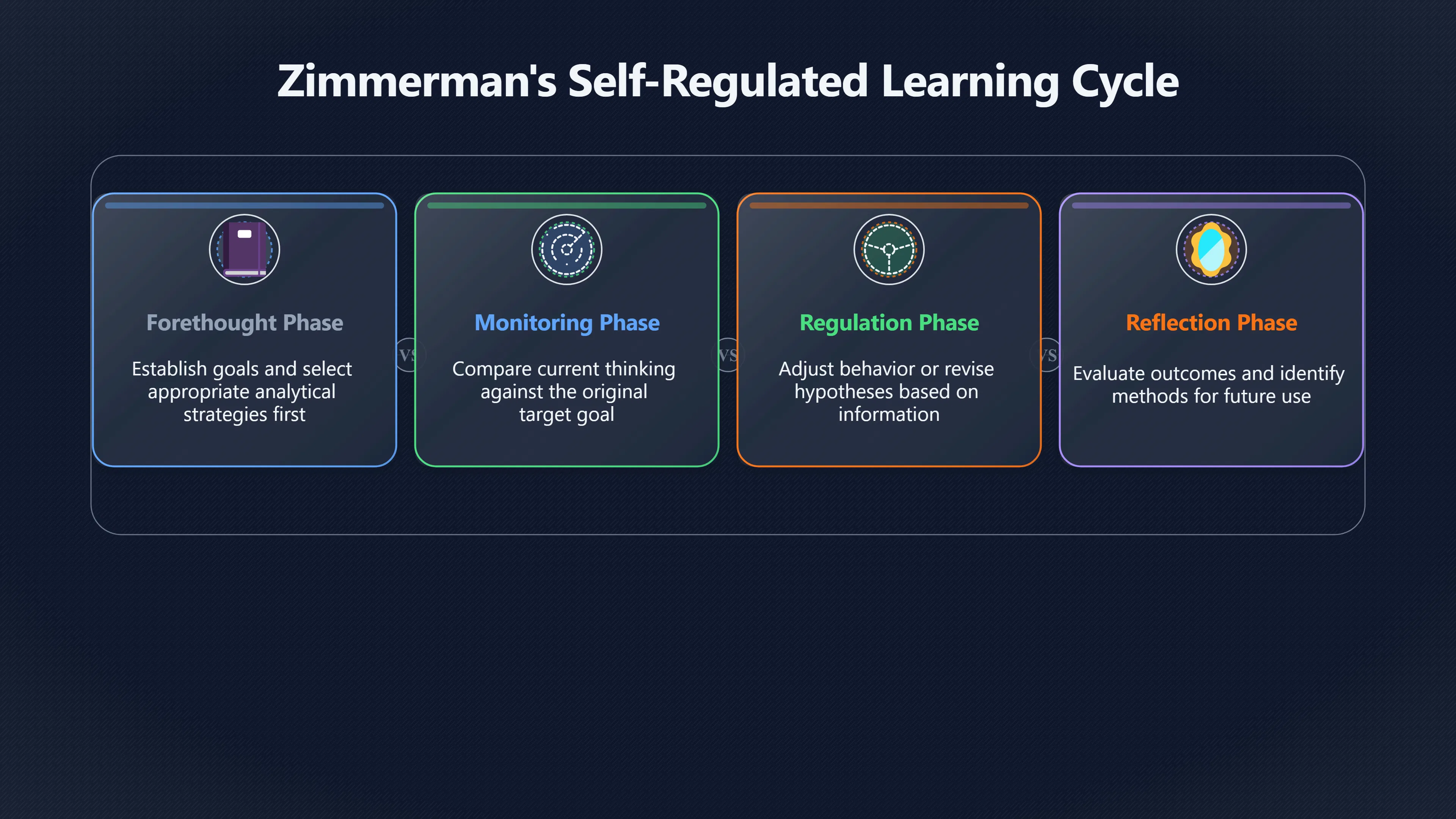
Barry Zimmerman and other researchers describe the first phase of self-regulated learning as one of forethought. Before beginning a task, learners establish goals, consider what the task requires, estimate possible difficulties and select strategies appropriate to those demands. This planning stage influences everything that follows because poor task definitions often lead to poor reasoning, even when later thinking is careful.[ResearchGate]researchgate.netSelf-regulated learning and academic achievement: TheoryFrom a self-regulation perspective, learner autonomy is closely assoc…
For analytical work, effective planning typically includes asking questions such as:
- What exactly is the problem?
- What evidence will count as convincing?
- What assumptions am I making?
- Which analytical tools are appropriate?
- How will I know whether my conclusion is reliable?
Notice that none of these questions concern the answer itself. Instead, they define the process by which an answer will be judged.
Research on self-regulated learning also emphasises that planning depends on realistic self-assessment. Learners consider not only external task demands, such as deadlines or available evidence, but also internal conditions including prior knowledge, confidence and motivation. Choosing a strategy therefore becomes an informed decision rather than a habit.[ResearchGate]researchgate.netResearchGate(PDF) Self‐Regulated LearningMoreover, self-regulation is students' ability to monitor, evaluate, and engage their learning b…
For example, someone analysing conflicting scientific studies might decide in advance to compare research methods before examining reported conclusions. Someone evaluating a business proposal may first identify measurable success criteria rather than becoming persuaded by presentation quality.
Monitoring progress during a task
Planning is valuable only if thinking continues to be monitored while work is underway.
Self-monitoring means continuously comparing current thinking against the original goal. Instead of assuming that reasoning remains on track, self-regulated learners actively look for signs that their understanding or strategy needs adjustment.
During complex analytical tasks, monitoring often involves questions such as:
- Am I still answering the original question?
- Does this evidence actually support my conclusion?
- Have I overlooked contradictory information?
- Am I becoming overconfident because one explanation feels familiar?
- Should I slow down or change strategy?
These questions interrupt automatic thinking before mistakes become expensive.
Research distinguishes between simply noticing progress and actively controlling learning. Monitoring provides information; regulation uses that information to change behaviour. A learner who realises they are misunderstanding a dataset but continues regardless is monitoring without regulating. Effective self-regulated learning requires both recognising the problem and adapting accordingly.[Frontiers]frontiersin.orgFrontiersClassic and modern models of self-regulated learningby C Tinajero · 2024 · Cited by 66 — The model subdivides the performance ph…
This adaptive element explains why self-regulated learners often outperform equally intelligent peers. Rather than persisting with ineffective approaches, they revise hypotheses, consult additional sources, reorganise notes or seek clarification when necessary. These adjustments improve analytical quality long before the final answer is produced.[PMC]pmc.ncbi.nlm.nih.govSelf-regulated learning (SRL) includes the cognitive, metacognitive, behavioral, motivational, and emotional/affective aspects of learnin…
Monitoring also extends beyond purely cognitive processes. Attention, effort and emotional state influence reasoning quality. Becoming aware that frustration is encouraging premature conclusions or that fatigue is reducing careful evaluation allows learners to modify their approach rather than unknowingly allowing these factors to shape judgement.[PMC]pmc.ncbi.nlm.nih.govSelf-regulated learning (SRL) includes the cognitive, metacognitive, behavioral, motivational, and emotional/affective aspects of learnin…
Evaluating what worked after feedback
The final stage of self-regulated learning is reflection.[d2tic4wvo1iusb.cloudfront.net]d2tic4wvo1iusb.cloudfront.netMetacognition and Self-Regulated Learning - Evidence reviewApproaches that promoted self-directed learning often mirrored Zimme…
After completing a task, strong thinkers do not ask only whether they reached the correct conclusion. They also ask why they succeeded or failed and whether their methods should be reused.
Zimmerman’s model describes this as self-reflection, in which learners evaluate outcomes against their original goals and consider how their strategies contributed to performance. This reflection creates the feedback loop that allows future improvement.[ResearchGate]researchgate.netSelf-regulated learning and academic achievement: TheoryFrom a self-regulation perspective, learner autonomy is closely assoc…
Useful post-task evaluation includes questions such as:
- Which strategy produced the strongest evidence?
- Where did my reasoning become weakest?
- Which assumptions proved incorrect?
- What surprised me?
- What should I change next time?
These reflections are especially valuable after receiving external feedback. Instead of treating criticism simply as confirmation of success or failure, self-regulated learners compare external evaluations with their own judgements. Differences between the two often reveal calibration problems—for example, consistently overestimating understanding or underestimating uncertainty.
Importantly, reflection should focus on controllable processes rather than fixed ability. Research consistently associates adaptive learning with attributing outcomes to strategy use, preparation and effort directed towards appropriate methods rather than believing success or failure reflects permanent intelligence alone.[ResearchGate]researchgate.netResearchGate(PDF) Self‐Regulated LearningMoreover, self-regulation is students' ability to monitor, evaluate, and engage their learning b…
Why self-regulated learning improves analytical thinking
Self-regulated learning strengthens analysis because it reduces common reasoning failures before they become embedded.
Instead of treating reasoning as a single event, it treats it as a cycle of continuous improvement:
- Define the task accurately.
- Select an appropriate strategy.
- Monitor progress while reasoning.
- Adjust when evidence suggests the approach is failing.
- Reflect afterwards to improve future performance.
Each cycle increases not only knowledge but also judgement about when particular methods work best.
Research reviews describe self-regulated learning as integrating cognitive, metacognitive, motivational and behavioural processes rather than viewing thinking as an isolated intellectual skill. Analytical performance therefore improves not because people memorise more reasoning rules, but because they become better at selecting, applying and revising those rules under real conditions.[PMC]pmc.ncbi.nlm.nih.govSelf-regulated learning (SRL) includes the cognitive, metacognitive, behavioral, motivational, and emotional/affective aspects of learnin…
Common misconceptions
Several misunderstandings limit the effectiveness of self-regulated learning.[d2tic4wvo1iusb.cloudfront.net]d2tic4wvo1iusb.cloudfront.netMetacognition and Self-Regulated Learning - Evidence reviewApproaches that promoted self-directed learning often mirrored Zimme…
It is not simply studying independently. Working alone does not automatically involve planning, monitoring or evaluation. Independent learners can still use ineffective strategies repeatedly.
It is not just reflection at the end. Reflection matters, but planning and monitoring are equally important. Waiting until the task has finished often means mistakes can no longer be corrected.
It is not an extra activity separate from learning. Effective self-regulation is embedded within the task itself. The most successful approaches integrate planning, monitoring and evaluation directly into reading, writing, problem solving and analysis rather than teaching them as isolated “thinking skills”.[ERIC+2Cloudfront]eric.ed.govERICMetacognition and Self-Regulated LearningGuidance Reportby A Quigley · 2018 · Cited by 149 — This guidance report reviews the best available research to offer teachers and senior…
Turning self-regulation into an analytical habit
For people aiming to strengthen analytical thinking, self-regulated learning is most useful when it becomes routine rather than exceptional.
A simple cycle can be applied to almost any reasoning task:
- Before beginning: define the question, success criteria and strategy.
- During the task: periodically check evidence, assumptions and progress against the original goal.
- After completion: compare outcomes with expectations, identify which strategies helped, and record one improvement for the next similar task.
Educational guidance informed by extensive research recommends explicitly teaching and practising these planning, monitoring and evaluation processes because they are learnable skills rather than fixed personal traits. When embedded consistently within real tasks instead of treated as abstract theory, they help learners become progressively more accurate, adaptable and independent in their reasoning.[EEF+2EEF]educationendowmentfoundation.org.ukn learning…
eBay marketplace picks
Marketplace Samples
Example marketplace items related to this page. Use the search link to explore similar finds on eBay.




Endnotes
1.
Source: researchgate.net
Link:https://www.researchgate.net/publication/243783857_Self-regulated_learning_and_academic_achievement_Theory
Source snippet
Self-regulated learning and academic achievement: TheoryFrom a self-regulation perspective, learner autonomy is closely assoc...
2.
Source: educationendowmentfoundation.org.uk
Link:https://educationendowmentfoundation.org.uk/education-evidence/teaching-learning-toolkit/metacognition-and-self-regulation
Source snippet
n learning...
3.
Source: d2tic4wvo1iusb.cloudfront.net
Link:https://d2tic4wvo1iusb.cloudfront.net/production/documents/tenders/metacognition-and-self-regulation_evidence-review_v.2.2.0.pdf?v=1775638474
Source snippet
Metacognition and Self-Regulated Learning - Evidence reviewApproaches that promoted self-directed learning often mirrored Zimme...
4.
Source: researchgate.net
Link:https://www.researchgate.net/publication/229971208_Self-Regulated_Learning
Source snippet
ResearchGate(PDF) Self‐Regulated LearningMoreover, self-regulation is students' ability to monitor, evaluate, and engage their learning b...
5.
Source: researchgate.net
Link:https://www.researchgate.net/publication/285323162_Self-regulation_Where_metacognition_and_motivation_intersect
Source snippet
(PDF) Self-regulation: Where metacognition and motivation...In this chapter, we use a social cognitive model of self-regulated learning...
6.
Source: eric.ed.gov
Title: ERICMetacognition and Self-Regulated Learning
Link:https://eric.ed.gov/?id=ED612285
Source snippet
Guidance Reportby A Quigley · 2018 · Cited by 149 — This guidance report reviews the best available research to offer teachers and senior...
7.
Source: educationendowmentfoundation.org.uk
Link:https://educationendowmentfoundation.org.uk/education-evidence/guidance-reports/metacognition
Source snippet
and Self-Regulated Learning13 Nov 2025 — This guidance report reviews the best available research to offer teachers and senior leaders pr...
8.
Source: d2tic4wvo1iusb.cloudfront.net
Title: Metacognition and Self-Regulated Learning
Link:https://d2tic4wvo1iusb.cloudfront.net/production/eef-guidance-reports/metacognition/metacognition-and-self-regulated-learning_guidance-report.v.2.4.0.pdf
Source snippet
Reciprocal teaching involves...Read more...
9.
Source: pmc.ncbi.nlm.nih.gov
Link:https://pmc.ncbi.nlm.nih.gov/articles/PMC5408091/
Source snippet
Self-regulated learning (SRL) includes the cognitive, metacognitive, behavioral, motivational, and emotional/affective aspects of learnin...
10.
Source: frontiersin.org
Link:https://www.frontiersin.org/journals/psychology/articles/10.3389/fpsyg.2024.1307574/full
Source snippet
FrontiersClassic and modern models of self-regulated learningby C Tinajero · 2024 · Cited by 66 — The model subdivides the performance ph...
11.
Source: educationendowmentfoundation.org.uk
Title: updated eef guide to metacognition and self regulation
Link:https://educationendowmentfoundation.org.uk/news/updated-eef-guide-to-metacognition-and-self-regulation
Source snippet
The updated EEF guide to metacognition and self-regulation.14 Nov 2025 — Helping pupils plan, monitor, and evaluate learning through meta...
12.
Source: educationendowmentfoundation.org.uk
Title: metacognition and self regulation guidance report
Link:https://educationendowmentfoundation.org.uk/education-evidence/evidence-reviews/metacognition-and-self-regulation-guidance-report
Source snippet
Metacognition and self-regulation evidence review9 Sept 2024 — Review of the evidence commissioned by the EEF to inform the Metacognition...
13.
Source: educationendowmentfoundation.org.uk
Link:https://educationendowmentfoundation.org.uk/education-evidence/guidance-reports
Source snippet
, and present actionable recommendations...
14.
Source: educationendowmentfoundation.org.uk
Title: promoting metacognitive talk in the classroom
Link:https://educationendowmentfoundation.org.uk/news/promoting-metacognitive-talk-in-the-classroom
Source snippet
EEF4 Mar 2026 — Recommendation 4 of the EEF's Metacognition and Self-regulated Learning guidance states: promote and develop metacognitiv...
15.
Source: pmc.ncbi.nlm.nih.gov
Link:https://pmc.ncbi.nlm.nih.gov/articles/PMC7838083/
Source snippet
of Self-Regulated Learning on Student's Reading...by X Qi · 2021 · Cited by 37 — Control strategy is one component of metacognition that...
16.
Source: support-for-early-career-teachers.education.gov.uk
Title: education.gov.uk Evidence
Link:https://support-for-early-career-teachers.education.gov.uk/education-development-trust/year-1-developing-effective-classroom-practice/spring-week-2-ect-evidence/
Source snippet
Effective metacognitive strategies get learners to think...Read more...
Additional References
17.
Source: oecd.org
Link:https://www.oecd.org/content/dam/oecd/en/topics/policy-issues/future-of-education-and-skills/learning-compass-constructs/Meta-learning.pdf
Source snippet
Meta-learningMeta-learning can be described as "the process by which learners become aware of and increasingly in control of habits of pe...
18.
Source: oecd.org
Link:https://www.oecd.org/en.html
19.
Source: oecd.org
Link:https://www.oecd.org/en/publications/2023/04/innovating-assessments-to-measure-and-support-complex-skills_b0255009/full-report/component-16.html
Source snippet
Innovating Assessments to Measure and Support Complex...28 Apr 2023 — creative thinking, self-regulation and collaboration...
20.
Source: linkedin.com
Link:https://www.linkedin.com/posts/greenshaw-research-school_metacognition-and-self-regulated-learning-activity-7394674207554699264-oUQy
Source snippet
EEF updates guidance on metacognition and self-...The Education Endowment Foundation (EEF) has released updated guidance on Metacognitio...
21.
Source: teachertoolkit.co.uk
Link:https://www.teachertoolkit.co.uk/wp-content/uploads/2018/04/EEF_Metacognition_and_self-regulated_learning.pdf
Source snippet
Metacognition and self-regulated learning | TeacherToolkitWhile there may be some benefit to introducing pupils to the general importance...
22.
Source: sk.sagepub.com
Link:https://sk.sagepub.com/hnbk/edvol/download/education/chpt/selfregulated-learning.pdf
Source snippet
SAGE Knowledge21st Century Education: A Reference HandbookFurthermore, Zimmerman identified three important characteristics in self-regul...
23.
Source: thinkingmatters.com
Link:https://www.thinkingmatters.com/views/self-regulated-learning-and-the-meta-learner
Source snippet
Self-Regulated Learning and the Meta-LearnerMetacognition and self-regulated learning now rank as the top educational strategies for high...
24.
Source: my.chartered.college
Link:https://my.chartered.college/impact_article/metacognition-self-regulation-and-self-regulated-learning-whats-the-difference/
Source snippet
chartered.collegeMetacognition, self-regulation and self-regulated learningby J Mannion · Cited by 30 — To recap: metacognition is monito...
25.
Source: researchschool.org.uk
Link:https://researchschool.org.uk/norfolk/news/eefs-updated-guidance-on-metacognition-and-self-regulated-learning-whats-new-and-why-it-matters
Source snippet
EEF's Updated Guidance on Metacognition and… | Norfolk...13 Nov 2025 — The updated Guidance Report on Metacognition and Self-Regulated L...
26.
Source: thinkingmatters.com
Link:https://www.thinkingmatters.com/self-regulated-learning-and-the-meta-learner
Topic Tree