Within Alternatives
What Else Could Silence Mean?
A late message can feel personal, but the same silence may come from travel, stress, uncertainty, illness, or simple oversight.
On this page
- Why no reply supports many stories
- Signals that make avoidance more likely
- How to avoid over reading weak social evidence
Page outline Jump by section
Introduction
A delayed reply often feels emotionally meaningful because the absence of information invites the mind to fill in the gaps. It is easy to conclude that someone is angry, losing interest, or deliberately ignoring you. Yet a single observation—silence—usually fits many different explanations. From the perspective of good reasoning, the question is not whether your preferred explanation is possible, but whether the available evidence distinguishes it from realistic alternatives.
 This is a practical example of analytical thinking. Instead of treating “no reply” as evidence for one story, ask what other stories predict the same observation, what evidence would separate them, and whether you have enough information to justify a confident conclusion. This approach reduces unnecessary anxiety while producing more accurate judgements.[Sage Journals]journals.sagepub.comSage JournalsConfirmation Bias: A Ubiquitous Phenomenon in Many…Confirmation bias is perhaps the best known and most widely accepted n…
Why no reply supports many stories
Silence is unusually poor evidence because it is compatible with numerous everyday situations. Before interpreting motives, it helps to recognise how many ordinary circumstances produce the same outward behaviour.
Common rival explanations include:
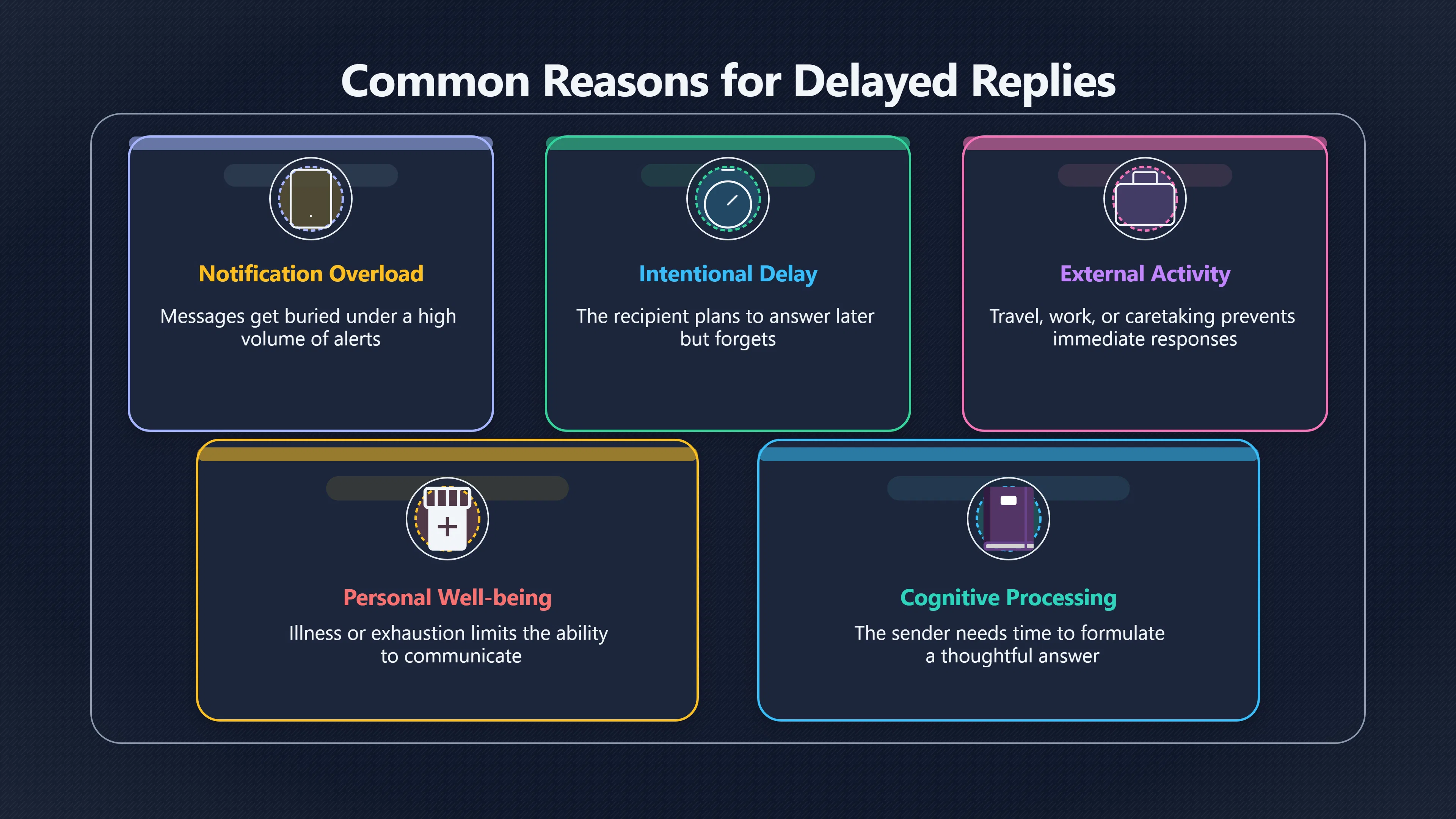
- The message was overlooked among many notifications.
- The person read it but intended to reply later and forgot.
- They are travelling, working, studying, or caring for someone.
- They are ill, exhausted, or dealing with a personal problem.
- They need time to think before answering.
- They feel uncertain how to respond.
- They are reducing phone use generally.
- They are intentionally avoiding this particular conversation.
The important point is that every one of these explanations predicts the same initial observation: no immediate response. Until additional evidence appears, the observation itself does little to distinguish between them.
This illustrates a broader principle in reasoning. Evidence is strongest when it is diagnostic—that is, when it is much more likely under one explanation than its rivals. A delayed reply, on its own, is rarely diagnostic.
Why the mind jumps to personal explanations
People naturally search for causes when something unexpected happens. In social situations, however, we often overestimate personal motives and underestimate situational influences. Psychologists describe this tendency as part of attribution bias and the fundamental attribution error: observers commonly explain behaviour by referring to personality or intention while overlooking circumstances that may be invisible to them.[The Oxford Review - OR Briefings+2iMotions]oxford-review.comThe Oxford ReviewOR BriefingsAttribution Bias - Definition and ExplanationMarch 14, 2024 — 14 Mar 2024 — Attribution bias is a psychological phenomenon th…
For example:
- “They have not replied because they do not respect me.”
- “They must be angry.”
- “They are deliberately ignoring me.”
Each may eventually prove correct, but none follows logically from silence alone.
The problem becomes worse when emotions are involved. If you already fear rejection, you are more likely to notice information supporting that fear while discounting competing explanations. This is a form of confirmation bias: once an initial interpretation forms, people tend to interpret new information in ways that reinforce it rather than challenge it.[Sage Journals]journals.sagepub.comSage JournalsConfirmation Bias: A Ubiquitous Phenomenon in Many…Confirmation bias is perhaps the best known and most widely accepted n…
Signals that make avoidance more likely
Although one delayed reply is weak evidence, patterns over time can become more informative.
Evidence becomes more consistent with deliberate avoidance when several indicators occur together rather than in isolation. Examples include:
- Repeatedly ignoring direct questions while responding normally to unrelated conversations.
- Consistent delays only with one particular person.
- Multiple reminders receiving no acknowledgement over an extended period.
- Replies that repeatedly avoid the topic rather than merely arriving late.
- Explicit statements about not wishing to continue communication.
- A long-term pattern of withdrawal across similar interactions.
Even then, these remain probabilistic signals rather than proof. Personal crises, mental health difficulties, burnout, family emergencies, or changing priorities can produce remarkably similar behavioural patterns.
Good judgement therefore weighs the entire context rather than treating any single cue as decisive.

Weak evidence versus stronger evidence
One useful way to improve reasoning is to rank observations by how much they actually discriminate between explanations.
Weak evidence
- One unanswered message.
- A reply taking longer than expected.
- Seeing someone online without receiving a response.
- Changes from one day to the next.
These observations fit many competing explanations.
Stronger evidence
- Consistent behavioural patterns across weeks or months.
- Direct communication about boundaries or reduced contact.
- Behaviour repeated across multiple situations.
- Independent information that supports one explanation over another.
Analytical thinking improves when confidence rises only as evidence becomes more selective.
How to avoid over-reading weak social evidence
When interpreting silence, replacing automatic conclusions with structured questions helps reduce error.
Instead of asking:
“Why are they ignoring me?”
Ask:
- What are at least three plausible explanations?
- Which explanation best predicts everything I currently know?
- What evidence would make me change my mind?
- Am I treating missing information as if it were positive evidence?
- Would I interpret the same delay differently if someone else experienced it?
This shifts thinking from defending an initial story to comparing competing hypotheses.
Another practical habit is to distinguish between facts and interpretations.
For example:
Fact: “My message has not been answered for two days.”
Interpretation: “They no longer value the friendship.”
Keeping these separate makes it easier to revise beliefs as new evidence appears.

Practical examples
Imagine three people who all fail to reply for 48 hours.
Person A later apologises and explains they were travelling with poor reception.
Person B replies thoughtfully after saying they needed time to think about a difficult question.
Person C repeatedly ignores messages over several months while remaining active with everyone else and eventually says they do not wish to continue the relationship.
All three produced the same initial observation—silence—but the later evidence strongly separates the explanations. Judging all three cases identically from the first delayed reply would have been an avoidable reasoning error.
The analytical lesson
Delayed replies are an excellent reminder that everyday evidence is often ambiguous. Human judgement improves when we resist treating a single observation as confirmation of the explanation that feels most emotionally compelling.
The most reliable approach is to generate realistic rival explanations, wait for evidence that distinguishes between them, and allow confidence to grow only when the evidence becomes genuinely selective. This habit not only reduces mistaken relationship judgements but also strengthens analytical thinking in many other areas where incomplete information can support several competing stories.
Amazon book picks
Further Reading
Books and field guides related to What Else Could Silence Mean?. Use these as the next step if you want deeper reading beyond the article.
The Art of Thinking Clearly
Directly addresses mistaken inferences, overinterpretation, and reasoning under uncertainty.
Super Thinking
Introduces mental models for considering multiple explanations instead of fixating on one story.
Mistakes Were Made (but Not by Me)
Explores self-justification and biased interpretation of ambiguous social situations.
The Scout Mindset
Encourages weighing competing hypotheses and resisting emotionally driven conclusions.
eBay marketplace picks
Marketplace Samples
Example marketplace items related to this page. Use the search link to explore similar finds on eBay.




Endnotes
1.
Source: oxford-review.com
Title: The Oxford Review
Link:https://oxford-review.com/attribution-bias-definition-and-explanation/
Source snippet
OR BriefingsAttribution Bias - Definition and ExplanationMarch 14, 2024 — 14 Mar 2024 — Attribution bias is a psychological phenomenon th...
Published: March 14, 2024
2.
Source: imotions.com
Title: what is attribution theory
Link:https://imotions.com/blog/insights/what-is-attribution-theory/?srsltid=AfmBOoqVjlMs9MX1hSR6w4plwHsvamIl3EuMSaEqoHZ6WNMISgpM-q32
Source snippet
?7 Jan 2024 — Attribution Theory explains how people interpret the causes of behaviors and events, distinguishing between internal (dispo...
3.
Source: journals.sagepub.com
Link:https://journals.sagepub.com/doi/10.1037/1089-2680.2.2.175
Source snippet
Sage JournalsConfirmation Bias: A Ubiquitous Phenomenon in Many...Confirmation bias is perhaps the best known and most widely accepted n...
4.
Source: britannica.com
Title: confirmation bias
Link:https://www.britannica.com/science/confirmation-bias
Source snippet
Encyclopedia BritannicaConfirmation bias | Definition, Examples, Psychology, & Facts11 Jun 2026 — Confirmation bias, people's tendency to...
Additional References
5.
Source: ebsco.com
Link:https://www.ebsco.com/research-starters/psychology/attributional-biases
Source snippet
Attributional biases | Psychology | Research StartersAttributional biases refer to systematic errors in how individuals interpret and ass...
6.
Source: positivepsychology.com
Link:https://positivepsychology.com/fundamental-attribution-error/
Source snippet
Fundamental Attribution Error: Shifting the Blame GameThe fundamental attribution error is the tendency to attribute others' actions to t...
7.
Source: verywellmind.com
Title: what is a confirmation bias 2795024
Link:https://www.verywellmind.com/what-is-a-confirmation-bias-2795024
Source snippet
Confirmation Bias: How to Identify and Overcome It30 Apr 2026 — Confirmation bias is a cognitive tendency to prioritize information that...
8.
Source: opentextbc.ca
Title: biases in attribution
Link:https://opentextbc.ca/socialpsychology/chapter/biases-in-attribution/
Source snippet
BCcampus Open Publishing5.3 Biases in Attribution – Principles of Social Psychologyby R Jhangiani · 2022 · Cited by 3 — Like the fundamen...
9.
Source: youtube.com
Title: Analysis of Competing Hypotheses (ACH): Finding Plausible Answers
Link:https://www.youtube.com/watch?v=xt4EnzvGA4w
Source snippet
Analysis of Competing Hypotheses (ACH): A Structured Analytic Technique (SAT) for FinCrime...
10.
Source: pmc.ncbi.nlm.nih.gov
Link:https://pmc.ncbi.nlm.nih.gov/articles/PMC4090078/
Source snippet
Dynamics with Confirmation Bias - PMC - NIHby AE Allahverdyan · 2014 · Cited by 190 — Confirmation bias is the tendency to acquire or eva...
11.
Source: youtube.com
Title: Abduction (Inference to the Best Explanation)
Link:https://www.youtube.com/watch?v=7TeM7rBhRmw
Source snippet
Analysis of Competing Hypotheses (ACH): Finding Plausible Answers...
12.
Source: youtube.com
Link:https://www.youtube.com/watch?v=Y-J0FYOQRMY
Source snippet
Evidence Interpretation Diagnostics...
Topic Tree