Within Active Learning
Training That Rehearses the Real Decision
Workplace learning becomes more useful when teams practise the judgments they will later need under real pressure.
On this page
- Why briefings do not prove usable skill
- Premortems, incident reviews and case classification
- Designing practice around real workplace decisions
Page outline Jump by section
Introduction
Active learning becomes genuinely valuable at work when it rehearses the decisions employees will later have to make under real constraints. Reading procedures, attending briefings and completing compliance modules can increase familiarity, but they do not prove that people can recognise a situation, weigh competing evidence and act appropriately when time is limited, information is incomplete or consequences are significant. The strongest workplace learning therefore shifts from information delivery to structured decision rehearsal: practising the judgement itself rather than merely reviewing the rules. Research from organisational psychology, naturalistic decision-making and simulation-based learning consistently shows that realistic practice, combined with structured reflection, improves the transfer of knowledge into performance more effectively than passive instruction alone.[PMC+2PMC]pmc.ncbi.nlm.nih.govNaturalistic Decision Making in After-Action Review Meetingsby R Reiter-Palmon · 2014 · Cited by 71 — The purpose of this study was to…
Why briefings do not prove usable skill
Many organisations still equate training with exposure to information. Employees attend presentations, read policy documents or complete online modules, then are assumed to be prepared. The weakness is that recognising information is different from applying it in an ambiguous situation.
Real workplace decisions rarely resemble textbook examples. A project manager must decide whether a schedule slip justifies escalation. A customer-service adviser must distinguish between a difficult client and a genuine safeguarding concern. A cybersecurity analyst must decide whether unusual network activity represents a harmless anomaly or the beginning of an attack. None of these judgements depends solely on remembering facts. They require recognising patterns, weighing uncertainty and anticipating consequences.
Research on naturalistic decision-making emerged precisely because laboratory decision models often failed to explain how experienced professionals actually work. Studies of firefighters, military commanders, emergency clinicians and other experts found that they frequently identify workable options by recognising familiar patterns and mentally simulating likely outcomes instead of comparing long lists of alternatives. Such expertise develops through repeated exposure to realistic cases rather than repeated exposure to written information.[ResearchGate+2Sage Journals]researchgate.netInvestigations of Naturalistic Decision Making and the…March 1, 1996 — 25 Nov 2015 — This monograph reviews 3 years of res…
This helps explain why workplace learning often disappoints. Employees may pass a knowledge assessment immediately after training yet struggle months later because they never rehearsed recognising when the knowledge should be applied.
Why realistic rehearsal changes judgement
Decision rehearsal works because it strengthens several abilities simultaneously.
- Pattern recognition: learners begin noticing cues that distinguish routine situations from exceptional ones.
- Mental simulation: they practise imagining how different actions might unfold before committing to one.
- Calibration: they discover where confidence exceeds competence because scenarios expose mistakes safely.
- Shared judgement: teams develop common expectations about what good decisions look like under pressure.
Simulation-based professional education repeatedly finds that learners benefit from making realistic decisions, receiving immediate feedback and repeating challenging situations until sound judgement becomes more automatic. The value lies not simply in “learning by doing” but in practising the same cognitive work required during real operations. Springer Nature Link+2Northumbria University Research Portal[link.springer.com]link.springer.comSpringer Nature LinkSimulation-based training in professional education: learning…by C Sellberg · 2026 · Cited by 6 — Simulations prov…
Importantly, the rehearsal should preserve uncertainty. If every exercise has one obvious correct answer, participants learn to identify the trainer’s preferred response rather than improving real judgement.
Premortems, incident reviews and case classification
Premortems: rehearsing failure before it happens
One of the simplest ways to rehearse judgement is the premortem, developed by Gary Klein. Instead of asking, “What could go wrong?”, participants imagine that a project has already failed and independently write down the reasons why.
This subtle change matters because it reduces social pressure to appear optimistic and encourages people to voice concerns they might otherwise suppress. Klein linked the technique to research on “prospective hindsight”, which found that imagining an event has already occurred improves people’s ability to identify plausible causes.[Harvard Business Review]hbr.orgHe is the authorHarvard Business ReviewPerforming a Project PremortemSeptember 1, 2007 — Gary Klein (gary@decisionmaking.com) is the chief scientist of K…
Premortems do more than generate risk lists. They rehearse an important workplace judgement: identifying weak signals before commitment makes changing course politically difficult.
Incident reviews that improve future decisions
Post-incident reviews often become exercises in assigning blame or documenting compliance. Effective reviews instead reconstruct the decisions that participants faced using only the information available at the time.
The goal is not to ask why people failed to predict an outcome that is now obvious, but how the situation appeared before the result was known. This distinction reduces hindsight bias and produces lessons that transfer to future situations.
Research on After Action Reviews (AARs) shows that structured discussion of what happened, why it happened and what should change can improve future decision-making, particularly when participants openly discuss reasoning rather than merely listing procedural errors.[PMC]pmc.ncbi.nlm.nih.govNaturalistic Decision Making in After-Action Review Meetingsby R Reiter-Palmon · 2014 · Cited by 71 — The purpose of this study was to…
Case classification builds better recognition
Another overlooked form of rehearsal involves comparing multiple cases instead of studying each individually.
For example, fraud investigators might classify previous incidents by behavioural warning signs rather than by financial loss. Engineers may group equipment failures according to underlying mechanisms instead of component type. HR teams might sort employee relations cases by patterns of evidence rather than legal category.
Classification forces learners to identify diagnostic features that separate superficially similar situations. This mirrors real work, where the first challenge is often recognising which kind of problem is actually present.
Designing practice around real workplace decisions
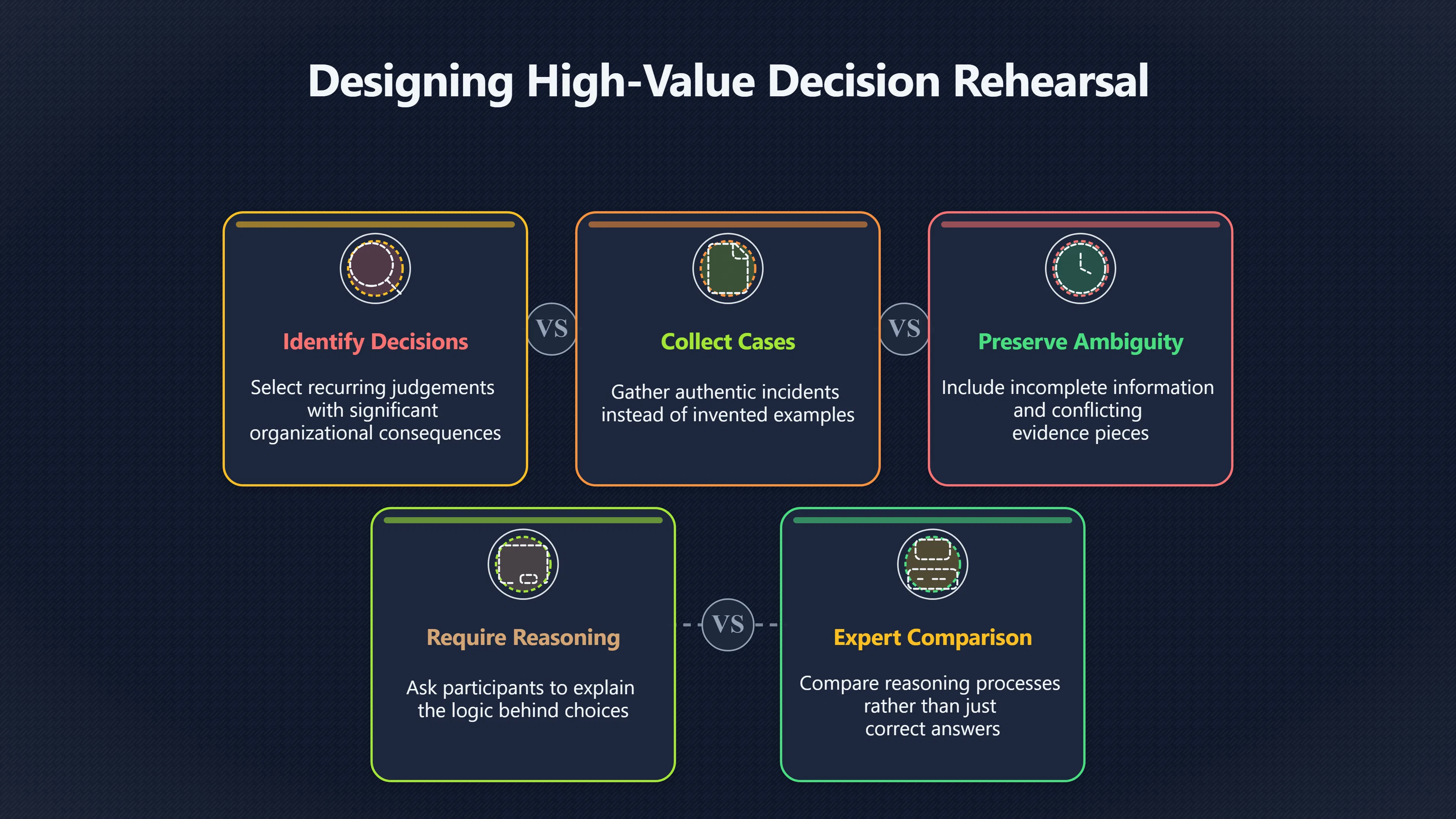
Effective workplace rehearsal begins by identifying the decisions that genuinely determine organisational performance rather than the information employees are expected to remember.
A useful design process typically follows this sequence:
- Identify high-value decisions. Focus on recurring judgements with meaningful consequences, such as approving expenditure, diagnosing faults, responding to complaints or escalating risks.
- Collect authentic cases. Use real incidents, anonymised where necessary, instead of invented examples whenever possible.
- Preserve ambiguity. Include incomplete information, conflicting evidence and realistic time constraints.
- Require explicit reasoning. Ask participants to explain not only what they chose but why.
- Provide expert comparison. Feedback should compare reasoning processes, not simply reveal the correct answer.
- Repeat with variation. Similar decisions presented in different contexts strengthen transferable judgement rather than memorised responses.
This design reflects deliberate practice principles: repeated performance of clearly defined tasks with immediate feedback and opportunities for correction rather than passive review alone.[Northumbria University Research Portal]researchportal.northumbria.ac.ukNorthumbria University Research PortalAn Exploration of the Use of Deliberate Practice in Team-…by A Platt · 2024 · Cited by 3 — An in…
Historical shift from instruction to judgement
Traditional industrial training frequently reflected manufacturing logic: standardise procedures, document processes and teach employees to follow them consistently.
As work became more knowledge-intensive, organisations increasingly recognised that procedures alone cannot anticipate every situation. Aviation, healthcare, emergency response and military organisations were among the first to formalise simulation, scenario exercises and structured debriefing because many critical failures stemmed from judgement rather than lack of procedural knowledge.[Sage Journals+2PMC]journals.sagepub.comSage JournalsNaturalistic Decision Making and the Practice of Health Care16 Aug 2018 — A recent essay in this journal identified health c…
Today, similar ideas have spread into project management, software engineering, finance and human resources. Evidence-based management emphasises combining research evidence, organisational data, professional expertise and stakeholder perspectives instead of relying on habit or fashionable management practices. Decision rehearsal complements this approach by giving teams repeated opportunities to practise using evidence before important choices arise.[CIPD]cipd.orgEvidence-based practice for effective decision-makingEvidence-based practice for effective decision-makingMay 19, 2025 — Evidence-based practice is an approach for improving decision-mak…
Common mistakes when rehearsing workplace decisions
Organisations often undermine decision rehearsal by treating it as another presentation rather than a practice session.
Common problems include:
- Overly tidy scenarios where the correct answer becomes obvious within minutes.
- Exercises without feedback, leaving participants unsure why one judgement was stronger than another.
- Punishing mistakes, which encourages defensive thinking instead of experimentation.
- Measuring recall instead of reasoning, rewarding memorisation rather than judgement quality.
- Separating training from operational reality, so scenarios fail to resemble the decisions employees actually face.
A rehearsal succeeds when participants leave with better judgement, not merely higher confidence.

What good workplace rehearsal ultimately develops
The most valuable outcome is not faster answers but better calibrated thinking. Employees become more skilled at recognising when a familiar solution fits, when assumptions should be questioned and when additional evidence is needed before acting.
Within an active-learning approach, workplace rehearsal therefore serves a distinctive purpose. It converts abstract knowledge into practical judgement by repeatedly placing learners in situations that resemble the choices they will eventually encounter. Briefings may introduce concepts, but carefully designed decision practice develops the ability to use those concepts when uncertainty, time pressure and organisational consequences make good thinking matter most.
Amazon book picks
Further Reading
Books and field guides related to Training That Rehearses the Real Decision. Use these as the next step if you want deeper reading beyond the article.
Make It Stick
Explains why active retrieval, practice and realistic application outperform passive instruction.
The Checklist Manifesto
Explores improving real-world decisions under pressure through structured processes.
Sources of Power
Foundational work on naturalistic decision-making and realistic decision rehearsal.
The Fifth Discipline
Supports organisational learning through reflection, systems thinking and continuous improvement.
eBay marketplace picks
Marketplace Samples
Example marketplace items related to this page. Use the search link to explore similar finds on eBay.




Endnotes
1.
Source: pmc.ncbi.nlm.nih.gov
Link:https://pmc.ncbi.nlm.nih.gov/articles/PMC6020850/
Source snippet
Naturalistic Decision Making in After-Action Review Meetingsby R Reiter-Palmon · 2014 · Cited by 71 — The purpose of this study was to...
2.
Source: pmc.ncbi.nlm.nih.gov
Title: PMCDecision-Making During High-Risk Events
Link:https://pmc.ncbi.nlm.nih.gov/articles/PMC10564111/
Source snippet
Effective decision-making in crisis events is challenging due to time pressure, uncertainty, and dynamic decisional environments.Read more...
3.
Source: link.springer.com
Link:https://link.springer.com/article/10.1007/s11251-025-09763-2
Source snippet
Springer Nature LinkSimulation-based training in professional education: learning...by C Sellberg · 2026 · Cited by 6 — Simulations prov...
4.
Source: researchgate.net
Link:https://www.researchgate.net/publication/235188278_Investigations_of_Naturalistic_Decision_Making_and_the_Recognition-Primed_Decision_Model
Source snippet
Investigations of Naturalistic Decision Making and the...March 1, 1996 — 25 Nov 2015 — This monograph reviews 3 years of res...
Published: March 1, 1996
5.
Source: researchgate.net
Link:https://www.researchgate.net/publication/3229642_Performing_a_Project_Premortem
Source snippet
(PDF) Performing a Project PremortemThe pre-mortem, in which a group imagines that its chosen course has already failed and works backwar...
6.
Source: cipd.org
Title: Evidence-based practice for effective decision-making
Link:https://www.cipd.org/uk/knowledge/factsheets/evidence-based-practice-factsheet/
Source snippet
Evidence-based practice for effective decision-makingMay 19, 2025 — Evidence-based practice is an approach for improving decision-mak...
Published: May 19, 2025
7.
Source: researchgate.net
Link:https://www.researchgate.net/publication/327065292_Naturalistic_Decision_Making_and_the_Practice_of_Health_Care
Source snippet
Naturalistic Decision Making and the Practice of Health CareA recent essay in this journal identified health care as a fertile domain for...
8.
Source: journals.sagepub.com
Link:https://journals.sagepub.com/doi/10.1177/1555343418773915
Source snippet
Sage JournalsNaturalistic Decision Making and the Practice of Health Care16 Aug 2018 — A recent essay in this journal identified health c...
9.
Source: researchportal.northumbria.ac.uk
Link:https://researchportal.northumbria.ac.uk/ws/portalfiles/portal/168641528/1-s2.0-S1876139924000768-main.pdf
Source snippet
Northumbria University Research PortalAn Exploration of the Use of Deliberate Practice in Team-...by A Platt · 2024 · Cited by 3 — An in...
10.
Source: hbr.org
Title: He is the author
Link:https://hbr.org/2007/09/performing-a-project-premortem
Source snippet
Harvard Business ReviewPerforming a Project PremortemSeptember 1, 2007 — Gary Klein (gary@decisionmaking.com) is the chief scientist of K...
Published: September 1, 2007
Additional References
11.
Source: cgsc.contentdm.oclc.org
Link:https://cgsc.contentdm.oclc.org/digital/api/collection/p16040coll2/id/23/download
Source snippet
CONTENTdmRecognition-Primed Decision Making2) Experiment with various Naturalistic Decision Making processes for group decisions, and how...
12.
Source: crestresearch.ac.uk
Link:https://crestresearch.ac.uk/categories/decision-making/
Source snippet
Decision-makingThis systematic review had three goals to: (i) define interoperability; (ii) identify the structural principles that under...
13.
Source: globalcognition.org
Link:https://www.globalcognition.org/articles/phillips_JDM04_training-decision-skills.pdf
Source snippet
Expertise in judgment and decision makingThe naturalistic approach to conducting research around expert judgment is exemplified by the Na...
14.
Source: theuncertaintyproject.org
Link:https://www.theuncertaintyproject.org/tools/pre-mortem
Source snippet
Pre-MortemDeveloped by Gary Klein, the pre-mortem analysis is a tool intended to increase the probability of a project's success. It is b...
15.
Source: linkedin.com
Link:https://www.linkedin.com/posts/gary-klein-90b0a915_double-barreled-[pre-mortems
Source snippet
You conduct the regular Pre-mortem to identify risks to a plan. And then you run its twin, looking at the risks of...
16.
Source: youtube.com
Link:https://www.youtube.com/watch?v=MxF5R4B_t64
Source snippet
"Success Through Failure: The PreMortem Method" with Gary..."Success Through Failure: The PreMortem Method" with Gary Klein is the first...
17.
Source: youtube.com
Link:https://www.youtube.com/watch?v=CEAR5Zsld6g
18.
Source: emerald.com
Link:https://www.emerald.com/books/edited-volume/15782/chapter/87428911/Making-it-practical-simulation-naturalistic
Source snippet
computer simulation in team research, group decision-making theory, and the modeling...
19.
Source: shadowboxtraining.com
Title: a primer on recognition primed decision making rpd
Link:https://www.shadowboxtraining.com/news/2025/06/17/a-primer-on-recognition-primed-decision-making-rpd/
Source snippet
A Primer on Recognition Primed Decision-Making (RPD)17 Jun 2025 — In this article, I'll explain what RPD is, how it works, how it compare...
20.
Source: linkedin.com
Link:https://www.linkedin.com/pulse/20140703173128-30719498-naturalistic-decision-making-can-it-work-for-you
Source snippet
c mental simulation as opposed to formal RDM analysis.Read more...
Topic Tree