Within Teach It
When Jargon Hides What You Do Not Know
Technical words can create a false feeling of fluency when the real causal steps are still missing.
On this page
- Why familiar labels feel like understanding
- How to translate technical terms without losing meaning
- Examples of vague words that need testing
Page outline Jump by section
Introduction
Technical vocabulary is essential for experts, but it can also become a convenient substitute for understanding. A person who says that a market is experiencing “liquidity constraints”, that a disease involves “immune dysregulation”, or that an AI model “generalises from latent representations” may sound knowledgeable while still being unable to explain what actually happens, in what order, and why. The problem is not jargon itself. The problem is using jargon as a stopping point instead of as compressed shorthand for a causal explanation.
 This matters because improving your thinking depends on distinguishing genuine understanding from verbal fluency. Plain-English explanation works as a test precisely because it forces technical labels to unfold into the underlying mechanism. If that expansion fails, the label may be hiding a gap rather than representing mastery. Research on the illusion of explanatory depth consistently shows that people often overestimate how well they understand causal systems until they are asked to explain them step by step.[PMC]pmc.ncbi.nlm.nih.govby L Rozenblit · 2002 · Cited by 1499 — We argue here that people's limited knowledge and their misleading intuitive epistemology comb…
Why Familiar Labels Feel Like Understanding
Jargon creates an impression of understanding for several psychological reasons.
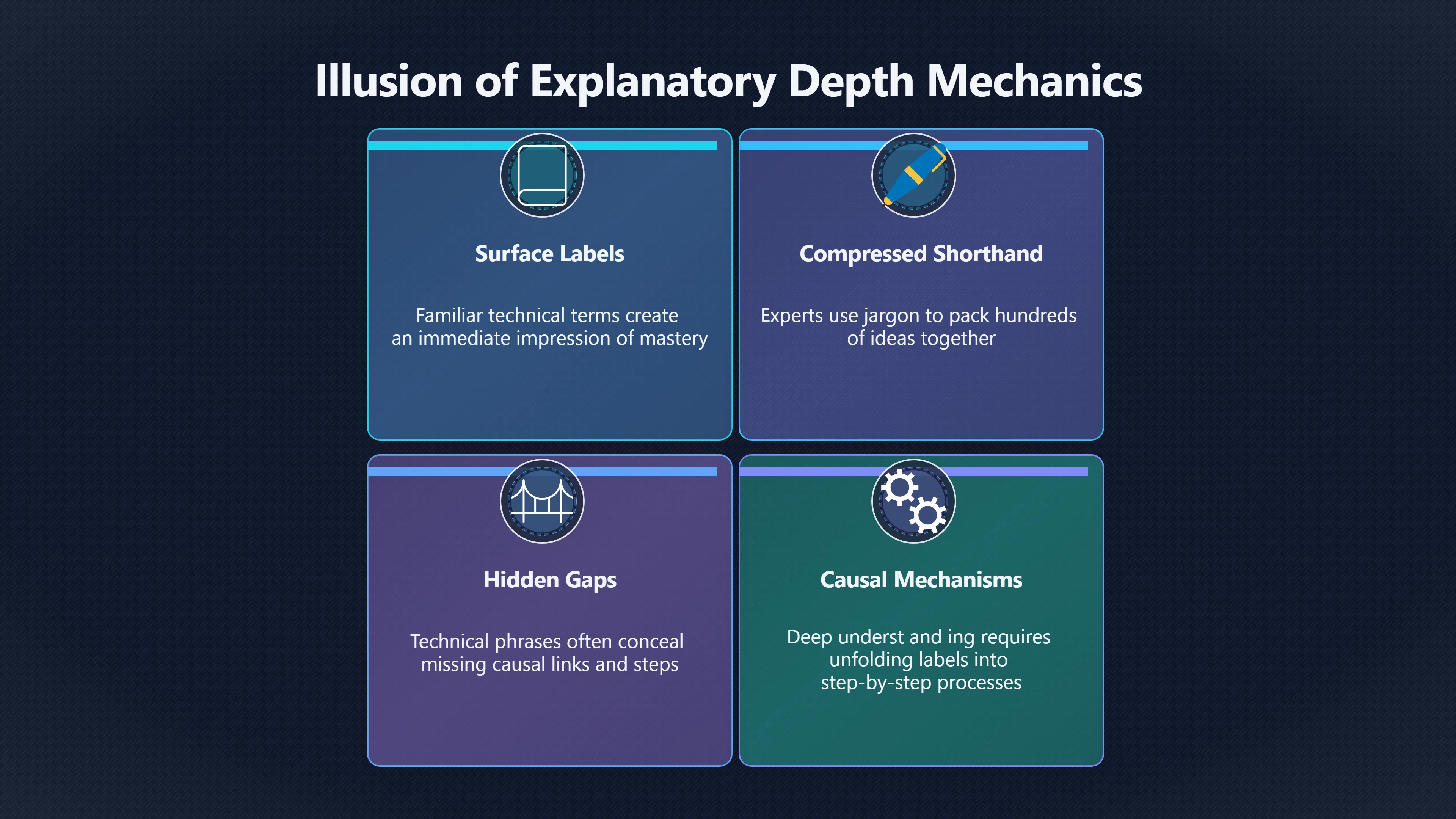
First, specialist words are efficient within a community. Experts use them because everyone involved already shares the detailed model behind the term. The label compresses hundreds of ideas into a few syllables. Someone learning the field may acquire the label long before acquiring the underlying model.
Second, recognising a familiar word feels similar to understanding it. Cognitive research suggests that people frequently confuse familiarity with explanatory knowledge. Knowing that a concept has a recognised name can produce confidence that exceeds what they could actually explain.[PMC]pmc.ncbi.nlm.nih.govby L Rozenblit · 2002 · Cited by 1499 — We argue here that people's limited knowledge and their misleading intuitive epistemology comb…
Third, technical language often conceals missing causal links. Consider these statements:
- “The treatment works by modulating inflammation.”
- “The economy adjusted because of market forces.”
- “The algorithm optimises the objective function.”
Each statement may be true, but none answers the questions that matter:
- What changes first?
- What causes the next step?
- Under what conditions does the explanation fail?
- Why does this process produce the claimed result rather than a different one?
The technical phrase has replaced the explanation instead of summarising one.
How Jargon Becomes a Hiding Place
The danger is rarely deliberate deception. More often, people unconsciously use specialist vocabulary to bridge gaps they have not yet recognised.
Several patterns appear repeatedly.
Replacing mechanisms with categories. Saying “confirmation bias” identifies a phenomenon, but it does not explain why a particular person ignored evidence in a specific situation.
Replacing processes with names. Saying “inflation” does not explain how rising demand, constrained supply, wage growth or monetary conditions combine to increase prices.
Replacing explanation with abstraction. Words such as “optimisation”, “emergence”, “adaptation” or “complexity” often describe that something happens without explaining how it happens.
The illusion becomes stronger because these labels are genuinely meaningful within expert conversations. When experts speak to one another, the omitted details are already understood. Outside that context, the same words can create an appearance of precision while leaving the causal story almost empty.
Research on the illusion of explanatory depth suggests that explanatory knowledge is especially vulnerable to this mistake. People tend to discover the gap only when they must produce a detailed causal account rather than merely recognise or define a concept.[PMC]pmc.ncbi.nlm.nih.govby L Rozenblit · 2002 · Cited by 1499 — We argue here that people's limited knowledge and their misleading intuitive epistemology comb…
How to Translate Technical Terms Without Losing Meaning
A useful thinking exercise is to treat every important technical term as a placeholder that must eventually expand into ordinary language.
Instead of asking, “Can I define this term?”, ask, “Can I unpack this term?”
For each piece of jargon, answer four questions:

- What is physically or logically happening?
- What causes the first change?
- What sequence connects the beginning to the outcome?
- What evidence would show this explanation is wrong?
For example:
Jargon: “The vaccine stimulates an immune response.”
Plain-English explanation: “The vaccine introduces material that resembles part of a virus. Certain immune cells recognise it as foreign. Those cells activate other immune cells, which produce antibodies and long-lasting memory cells. If the real virus appears later, those memory cells respond much faster.”
The technical sentence is not incorrect. The plain-English version simply reveals the mechanism hidden inside the label.
The goal is not to eliminate technical language. Once the mechanism is understood, the specialised term becomes a useful abbreviation rather than a substitute for thought.
Examples of Vague Words That Need Testing
Some words deserve immediate suspicion because they often conceal incomplete understanding.
Vague expressionBetter questionEfficientEfficient compared with what alternative?RobustRobust against which kinds of failure?OptimisedWhat objective is being optimised, and what trade-offs are accepted?IntelligentWhich specific capabilities justify that description?ComplexWhich interacting parts create the complexity?SystemicWhich connected parts produce the system-wide effect?NaturalWhat biological or physical process do you actually mean?SustainableSustainable under what resources, timescale or constraints?
These words are not inherently misleading. They become misleading when they end the explanation instead of beginning it.
A Quick Test for Hidden Knowledge Gaps
One reliable diagnostic is to remove every technical term temporarily.
Suppose someone explains machine learning by saying:
“The model generalises because of regularisation.”
Now ban both “generalises” and “regularisation”.
Can the explanation continue?
A stronger explanation might be:
“During training, the model could memorise every example, including accidental patterns that only appear in this dataset. The training process includes penalties that discourage overly complicated solutions, making it more likely that the model learns patterns that also appear in new data.”
If removing the jargon causes the explanation to collapse, the speaker may have learned terminology before learning the mechanism.
Researchers have repeatedly shown that asking people to generate detailed explanations reduces inflated confidence because it exposes these missing links. Simply attempting to explain often recalibrates people’s judgement of what they actually know.[PMC]pmc.ncbi.nlm.nih.govby L Rozenblit · 2002 · Cited by 1499 — We argue here that people's limited knowledge and their misleading intuitive epistemology comb…
The Aim Is Precision, Not Simplicity
Plain English should not be confused with oversimplification. Some ideas are genuinely difficult, and technical vocabulary often exists because ordinary language alone becomes cumbersome.
The real test is whether the specialist term could, if necessary, be expanded into a clear causal explanation appropriate for the audience. Experts usually can move comfortably between both levels. They know when shorthand is sufficient and when the underlying mechanism must be unpacked.
Someone with weaker understanding often moves only in one direction: from explanation to terminology. Someone with deeper understanding can move in both directions, compressing detailed knowledge into precise jargon when appropriate and expanding that jargon back into plain language whenever explanation demands it.
That flexibility is one of the clearest indicators that the words represent genuine understanding rather than merely the appearance of expertise.
Amazon book picks
Further Reading
Books and field guides related to When Jargon Hides What You Do Not Know. Use these as the next step if you want deeper reading beyond the article.
The Knowledge Illusion
Directly explores mistaken beliefs about what we really understand.
eBay marketplace picks
Marketplace Samples
Live-tested eBay searches with available results related to this page.




Endnotes
1.
Source: pmc.ncbi.nlm.nih.gov
Link:https://pmc.ncbi.nlm.nih.gov/articles/PMC3062901/
Source snippet
by L Rozenblit · 2002 · Cited by 1499 — We argue here that people's limited knowledge and their misleading intuitive epistemology comb...
2.
Source: Wikipedia
Title: Illusion of explanatory depth
Link:https://en.wikipedia.org/wiki/Illusion_of_explanatory_depth
Source snippet
Illusion of explanatory depthThe illusion of explanatory depth (IOED) is cognitive bias or an illusion where people tend to believe th...
Additional References
3.
Source: linkedin.com
Link:https://www.linkedin.com/pulse/what-i-learnt-today-[illusion-explanatory
Source snippet
What I Learnt Today About the Illusion of Explanatory DepthThis psychological phenomenon explains why most people believe they understand...
4.
Source: drbenvincent.medium.com
Link:https://drbenvincent.medium.com/the-illusion-of-explanatory-depth-why-our-mental-models-of-the-state-are-broken-62f1f4b91ef1
Source snippet
Illusion of Explanatory Depth: Why Our Mental Models of...Psychologists call this the illusion of explanatory depth (Rozenblit & Keil, 2...
5.
Source: researchgate.net
Title: The Misunderstood Limits of Folk Science
Link:https://www.researchgate.net/publication/50868445_The_Misunderstood_Limits_of_Folk_Science_An_Illusion_of_Explanatory_Depth
Source snippet
Illusions23 May 2026 — Leon Rozenblit and Frank Keil introduced this concept in 2002, demonstrating that people routinely overestimate ho...
Published: May 2026
6.
Source: cambridge.org
Link:https://www.cambridge.org/core/journals/judgment-and-decision-making/article/broad-effects-of-shallow-understanding-explaining-an-unrelated-phenomenon-exposes-the-illusion-of-explanatory-depth/9B9B8927C3E530EBCF0453504730E3F3
Source snippet
Cambridge University Press & AssessmentExplaining an unrelated phenomenon exposes the illusion...by EA Meyers · 2023 · Cited by 12 — The...
7.
Source: thedecisionlab.com
Link:https://thedecisionlab.com/biases/the-illusion-of-explanatory-depth
Source snippet
That is, they often mistake...Read more...
8.
Source: youtube.com
Title: The Feynman Technique: How to Learn Anything in 4 Steps (Richard Feynman)
Link:https://www.youtube.com/watch?v=JSyI4wM60d4
Source snippet
Why [Teaching]({{ 'teaching/' | relative_url }}) is a Top Tier Learning Strategy | The Feynman Technique...
9.
Source: scienceblogs.com
Link:https://scienceblogs.com/mixingmemory/2006/11/16/the-illusion-of-explanatory-de
Source snippet
The "Illusion of Explanatory Depth": How Much Do We Know...16 Nov 2006 — Rozenblit and Keil also found that in adults, the illusion of e...
10.
Source: youtube.com
Title: Why Teaching is a Top Tier Learning Strategy | The Feynman Technique
Link:https://www.youtube.com/watch?v=BsGkG6FfIMo
Source snippet
Richard Feynman: "What's the name of a bird?"...
11.
Source: youtube.com
Title: Richard Feynman: “What’s the name of a bird?”
Link:https://www.youtube.com/watch?v=ga_7j72CVlc
Source snippet
You Don't Know Anything - The Illusion of Explanatory Depth - FutureIQ...
12.
Source: youtube.com
Title: How Feynman Explained Anything to Anyone
Link:https://www.youtube.com/watch?v=lUn8YwzPrOU
Source snippet
The Feynman Technique: How to Learn Anything in 4 Steps (Richard Feynman)...
Topic Tree