Within Sharper Thinking
Why Rereading Is Not Enough
Analytical skill grows faster when people retrieve, explain, apply, and test ideas rather than merely reread them.
On this page
- Familiarity versus understanding
- Tasks that force use
- Active learning at work
Page outline Jump by section
Introduction
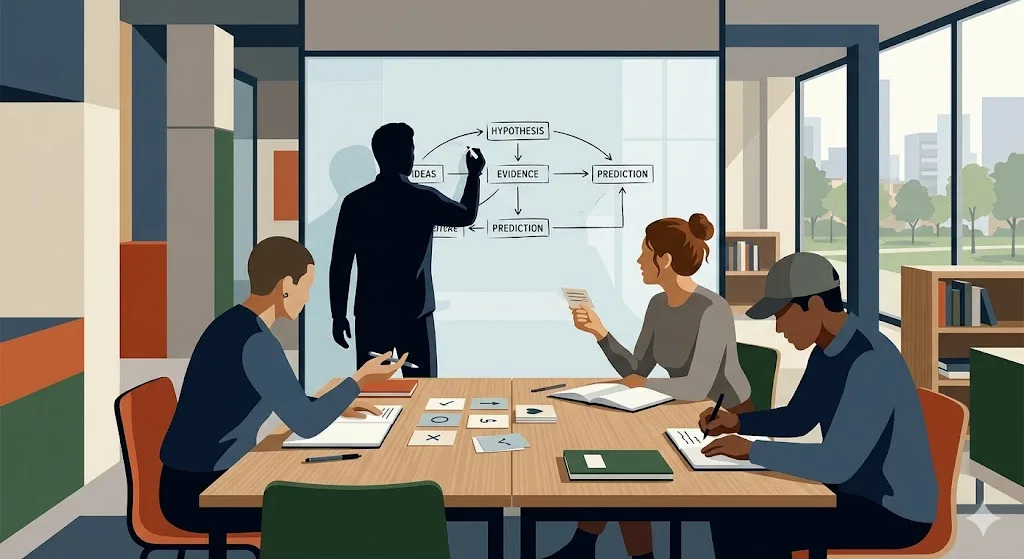
Rereading feels productive because it makes ideas look familiar. Active learning is more demanding because it asks a person to retrieve, explain, apply, test, or correct an idea before they feel fully ready. That difficulty is the point. For improving thinking and analytical skills, passive review mainly strengthens recognition: “I have seen this before.” Active learning strengthens usable understanding: “I can recall it, explain it, use it in a new case, and notice where my reasoning breaks.”
The practical shift is simple but uncomfortable: replace some review time with tasks that force use. Instead of rereading notes on argument quality, close the notes and reconstruct the argument. Instead of highlighting a chapter on bias, predict where the bias would appear in a real decision. Instead of watching someone solve a problem, solve a similar one, compare your route, and correct the gap. This matters because research on practice testing, retrieval practice, self-explanation and active classrooms repeatedly finds that learners often remember and transfer more when they actively generate answers than when they merely re-expose themselves to material.[PubMed+2Sage Journals]pubmed.ncbi.nlm.nih.govtaking memory tests improves long-term retentionby HL Roediger · 2006 · Cited by 4881 — Taking a memory test not only assesses what…
Familiarity Is Not the Same as Understanding
The main trap in passive review is not laziness. It is miscalibration. When a text becomes easier to read, the learner often mistakes processing fluency for mastery. The page feels clear because the eyes move through it smoothly, not necessarily because the knowledge can be retrieved or used. This is why rereading can produce confidence at exactly the moment when a more useful question would be: “Could I explain this without looking?”
The classic evidence comes from research on the “testing effect”. In Roediger and Karpicke’s 2006 study, students learned prose passages and either restudied them or practised recalling them. Restudying could help immediate performance, but retrieval practice produced stronger long-term retention, showing that a test can be more than a measurement device: it can be a learning event.[PubMed]pubmed.ncbi.nlm.nih.govtaking memory tests improves long-term retentionby HL Roediger · 2006 · Cited by 4881 — Taking a memory test not only assesses what…
A later review by Dunlosky and colleagues assessed common learning techniques and gave high-utility ratings to practice testing and distributed practice, while rereading was judged less powerful as a general-purpose learning strategy. The reason is not that rereading never helps. It can help with initial exposure, clarification and checking. The problem is that rereading alone gives too little evidence about whether knowledge is available under pressure, after delay, or in a changed context.[PubMed]pubmed.ncbi.nlm.nih.govImproving Students' Learning With Effective…Practice testing and distributed practice received high utility assessments because…
For analytical skill, this distinction is especially important. A person may recognise a definition of confirmation bias, causal reasoning, opportunity cost, or base-rate neglect when reading it. That does not mean they will use the concept when evaluating a news claim, diagnosing a failed project, or comparing explanations. Active learning narrows that gap by turning knowledge from something recognised into something callable.
What Active Learning Forces the Mind to Do
Active learning is not just “doing activities”. It is useful when the activity makes the learner perform part of the thinking that later judgement will require. The task should create a small but meaningful demand: recall the idea, organise it, explain why it applies, compare it with an alternative, or use it to solve a new problem.
Retrieval practice is the clearest example. Instead of asking, “Have I reviewed this?”, it asks, “Can I bring this back without help?” A 2017 meta-analysis of practice testing found that students who took practice tests often outperformed learners in non-testing conditions, including restudying. The value comes partly from strengthening memory and partly from revealing gaps that passive review can hide.[Sage Journals]journals.sagepub.comSage JournalsRethinking the Use of Tests: A Meta-Analysis of Practice…by OO Adesope · 2017 · Cited by 913 — Research demonstrates that…
Self-explanation adds another layer. It asks learners to explain steps, causes, assumptions or connections to themselves rather than merely accepting an explanation supplied by someone else. Research on self-explanation has found benefits for understanding because learners generate links between new material and prior knowledge, notice missing steps and correct misconceptions.[Andy Matuschak]andymatuschak.orgChi et al 1994 Eliciting self explanations improves understandingChi et al 1994 Eliciting self explanations improves understanding
Application then tests whether understanding survives contact with variation. Karpicke and Blunt’s 2011 work compared retrieval practice with elaborative studying through concept mapping and found that practising retrieval produced greater gains in meaningful learning. The result was striking because concept mapping looks deeper than testing, yet the act of reconstructing knowledge from memory helped learners perform better on later measures of understanding.[PubMed]pubmed.ncbi.nlm.nih.govOpen source on nih.gov.
For thinking skills, these mechanisms matter because analysis is not a spectator skill. You improve by doing the moves: stating the claim, identifying the evidence, naming the assumption, testing an implication, and revising the answer.
Tasks That Force Use
The best active-learning tasks are short, concrete and slightly uncomfortable. They should not become elaborate rituals that replace learning with administration. A useful test is whether the task produces evidence of understanding that rereading would not reveal.
Close-book recall. After reading a section, shut the source and write the three most important points from memory. Then reopen the source and correct omissions. This is simple retrieval practice, and it quickly shows the difference between recognition and recall.
Explain it as a causal chain. For analytical material, do not merely define a concept. Explain how it works. For example: “Why does survivorship bias lead to bad business advice?” A good answer should move from sample selection, to missing failures, to distorted conclusions.
Use a fresh example. After learning a reasoning principle, apply it to a case not used in the original lesson. If the concept is “correlation is not causation”, test it against a health headline, workplace metric or social trend. Transfer is where shallow familiarity often fails.
Predict before checking. Before reading an analysis, make a short prediction: what would I expect the data to show, which explanation seems most likely, or what objection might appear? Prediction turns reading into an active comparison between expectation and evidence.
Write the wrong answer and diagnose it. Deliberately sketch a plausible but flawed interpretation, then name the flaw. This is especially useful for analytical skill because many real errors are not absurd; they are attractive, fluent and incomplete.
Teach the idea briefly. A two-minute explanation to a colleague, study partner or imagined audience forces selection, sequencing and clarity. If the explanation depends on repeating a memorised sentence, the understanding is probably still brittle.
These tasks work best when they are low-stakes. The aim is not to make every learning moment feel like an exam. It is to create frequent moments where the learner has to bring knowledge into use before the final decision, essay, meeting, test or project.
Active Learning at Work
In the workplace, passive review often takes the form of reading a policy, watching a training module, sitting through a briefing, or scanning a slide deck. Those formats can transmit information, but they do not prove that people can use the information when a real problem appears. Active learning turns workplace learning into rehearsal for judgement.
A manager learning better decision-making might replace a reread of “decision bias” notes with a pre-mortem: “Assume this project failed six months from now. What were the most likely causes?” A team learning risk analysis might take a past incident and reconstruct the warning signs that were missed. A professional learning a new regulation might classify realistic cases rather than reread the rule. These tasks are still learning tasks, but they resemble the future performance more closely.
The classroom evidence supports this practical direction. Freeman and colleagues’ 2014 meta-analysis of 225 STEM studies found that active learning increased examination performance by just under half a standard deviation and that failure rates were higher under traditional lecturing. Although STEM courses are not identical to workplace training, the finding is relevant because it compares passive exposure with structured participation: learners did better when they had to engage in activities, discussion and problem-solving rather than only listen.[PNAS]pnas.orgActive learning increases student performance in science…by S Freeman · 2014 · Cited by 16015 — The data reported here indicate t…
For analytical skill, the workplace version should be designed around the decisions people actually make. A sales team does not need generic “critical thinking” slides as much as practice distinguishing signal from noise in pipeline data. A policy team does not need only a briefing on evidence quality; it needs repeated exercises comparing strong, weak and misleading evidence. A software team does not need merely to read a post-incident review; it needs to predict failure modes before deployment and then compare those predictions with what happened.
Why Passive Review Still Has a Place
The lesson is not “never reread”. Passive review can be useful at the beginning of learning, when the learner is still building vocabulary, orientation and basic comprehension. Rereading can also help when the first reading was rushed, when the material is dense, or when the goal is to locate a detail. The mistake is using rereading as the main proof of learning.
A better sequence is: read once for orientation, retrieve what matters, check the source, explain the idea, and apply it. In that sequence, rereading becomes a support tool rather than the centre of the learning strategy. It helps correct and refine active attempts instead of replacing them.
This matters because active learning can feel worse while working better. Retrieval is effortful. Self-explanation exposes confusion. Application produces mistakes. Those experiences can make learners underestimate their progress because the process feels less smooth than rereading. Yet the evidence on testing and retrieval suggests that difficulty can be productive when it is targeted, followed by feedback, and not so hard that it becomes discouraging.[Sage Journals]journals.sagepub.comSage JournalsRethinking the Use of Tests: A Meta-Analysis of Practice…by OO Adesope · 2017 · Cited by 913 — Research demonstrates that…
The practical balance is to use passive review for input and active learning for proof. If the goal is better thinking, the proof has to look like thinking.
How to Implement Active Learning Without Overcomplicating It
A useful active-learning routine can fit into ordinary study, training or professional development. The key is to convert review into repeated use.
Start by choosing the knowledge that must be available later. Not every detail deserves retrieval practice. Focus on principles, distinctions, procedures, common traps and decision rules. For analytical skill, that might include how to separate claims from evidence, how to compare hypotheses, how to test assumptions, or how to recognise when a conclusion is stronger than the data allows.
Then build short cycles:
- Input: read, watch or listen for initial understanding.
- Retrieve: close the source and write or say what matters.
- Explain: connect the idea to causes, examples or prior knowledge.
- Apply: use it on a new problem or case.
- Check: compare with a model answer, source, expert feedback or outcome.
- Repeat later: revisit after a delay rather than immediately cramming.
This is deliberately modest. The point is not to create a perfect learning system but to change the centre of gravity. A person who spends 30 minutes rereading could often learn more by spending 10 minutes reviewing, 10 minutes recalling and explaining, and 10 minutes applying and checking.
Feedback is the safeguard. Active learning without correction can rehearse errors. Practice questions need answers. Explanations need comparison against a reliable source. Workplace simulations need debriefs. Peer discussion needs a way to settle disputes. The learner should leave with a clearer map of what was right, what was missing, and what to try next.
What Changes for Analytical Thinking
Active learning improves analytical skill because it makes invisible weaknesses visible. Rereading can hide a vague concept, a missing step, or an untested assumption. Retrieval and application expose them.
The change shows up in four ways.
Better recall at the moment of use. Analytical concepts are useful only if they appear when needed. A person who has practised retrieving “base rate”, “alternative explanation” or “selection effect” is more likely to use the idea during an actual judgement.
Sharper explanations. Self-explanation forces the learner to move beyond labels. It is one thing to name “confirmation bias”; it is another to explain how a person selected evidence, ignored disconfirming cases and became more confident than the evidence justified.
Improved transfer. Applying ideas to varied examples helps prevent inert knowledge: knowledge that can be recited in the original setting but not used elsewhere. This is crucial for thinking skills because real problems rarely arrive in textbook form.
More accurate confidence. Active attempts give better feedback about what is known and what is shaky. That makes overconfidence easier to catch before it becomes a bad decision.
This is why active learning belongs at the centre of improving thinking and analytical skills. It is not a decorative study technique. It is the practice environment where reasoning becomes usable.
Common Failure Modes
Active learning can fail when it becomes performative rather than diagnostic. A discussion is not automatically active learning if nobody has to commit to an answer. A quiz is not automatically useful if it rewards trivial recall while the real goal is judgement. A group exercise can conceal weak understanding if one confident person does all the thinking.
The solution is to design tasks around the target skill. If the goal is better argument evaluation, the task should require identifying a claim, evidence, warrant and counterargument. If the goal is better problem diagnosis, the task should require comparing causes and stating what evidence would distinguish them. If the goal is better decision-making, the task should include prediction, uncertainty and review.
Another failure mode is making active learning too high-stakes. If every retrieval attempt is graded harshly, learners may avoid risk, hide confusion or memorise defensively. Low-stakes retrieval, practice cases and short debriefs are usually better for building skill because they make error informative rather than humiliating.
The final failure mode is abandoning active learning because it feels slower. Rereading covers more pages per hour, but coverage is not the same as capability. For analytical skill, the relevant measure is not how much material passed before the eyes. It is what the person can do with it afterwards.
The Core Habit
The practical habit is to ask, after any important idea: “How will I make myself use this?” That question turns passive review into active learning.
For a concept, use it in a fresh example. For a framework, diagnose a real case. For a decision rule, apply it before seeing the answer. For a mistake, explain why it was tempting. For a meeting or training session, replace some slides with a problem people must solve.
Rereading asks whether the material is familiar. Active learning asks whether the idea is available, explainable and usable. Analytical skill grows faster when practice is built around the second question.
Amazon book picks
Further Reading
Books and field guides related to Why Rereading Is Not Enough. Use these as the next step if you want deeper reading beyond the article.
Make It Stick
Directly explains why retrieval practice and active learning outperform rereading.
How We Learn
Covers evidence-based learning strategies including spacing, retrieval, and avoiding passive review.
Ultralearning
Emphasizes active practice, feedback, and deliberate application instead of passive study.
A Mind for Numbers
Provides practical techniques that replace passive rereading with retrieval, problem solving, and active engagement.
Endnotes
1.
Source: pnas.org
Link:https://www.pnas.org/doi/10.1073/pnas.1319030111
Source snippet
Active learning increases student performance in science...by S Freeman · 2014 · Cited by 16015 — The data reported here indicate t...
2.
Source: make.com
Link:https://www.make.com/en
3.
Source: pnas.org
Link:https://www.pnas.org/doi/abs/10.1073/pnas.1319030111
4.
Source: pubmed.ncbi.nlm.nih.gov
Link:https://pubmed.ncbi.nlm.nih.gov/16507066/
Source snippet
taking memory tests improves long-term retentionby HL Roediger · 2006 · Cited by 4881 — Taking a memory test not only assesses what...
5.
Source: journals.sagepub.com
Link:https://journals.sagepub.com/doi/abs/10.3102/0034654316689306
Source snippet
Sage JournalsRethinking the Use of Tests: A Meta-Analysis of Practice...by OO Adesope · 2017 · Cited by 913 — Research demonstrates that...
6.
Source: journals.sagepub.com
Title: Sage Journals Test-Enhanced Learning
Link:https://journals.sagepub.com/doi/10.1111/j.1467-9280.2006.01693.x
Source snippet
Roediger, Jeffrey D....by HL Roediger III · 2006 · Cited by 4885 — Practicing the skills during learning that are needed during retrieva...
7.
Source: pubmed.ncbi.nlm.nih.gov
Link:https://pubmed.ncbi.nlm.nih.gov/26173288/
Source snippet
Improving Students' Learning With Effective...Practice testing and distributed practice received high utility assessments because...
8.
Source: andymatuschak.org
Title: Chi et al 1994 Eliciting self explanations improves understanding
Link:https://andymatuschak.org/files/papers/Chi%20et%20al%20-%201994%20-%20Eliciting%20self-explanations%20improves%20understanding.pdf
9.
Source: pubmed.ncbi.nlm.nih.gov
Link:https://pubmed.ncbi.nlm.nih.gov/21252317/
10.
Source: pubmed.ncbi.nlm.nih.gov
Link:https://pubmed.ncbi.nlm.nih.gov/24821756/
11.
Source: pmc.ncbi.nlm.nih.gov
Link:https://pmc.ncbi.nlm.nih.gov/articles/PMC12372469/
12.
Source: pmc.ncbi.nlm.nih.gov
Link:https://pmc.ncbi.nlm.nih.gov/articles/PMC3983480/
13.
Source: pmc.ncbi.nlm.nih.gov
Link:https://pmc.ncbi.nlm.nih.gov/articles/PMC12189222/
14.
Source: pmc.ncbi.nlm.nih.gov
Link:https://pmc.ncbi.nlm.nih.gov/articles/PMC4477741/
15.
Source: pmc.ncbi.nlm.nih.gov
Link:https://pmc.ncbi.nlm.nih.gov/articles/PMC8653153/
16.
Source: dictionary.cambridge.org
Link:https://dictionary.cambridge.org/dictionary/english/retrieval
17.
Source: dictionary.cambridge.org
Link:https://dictionary.cambridge.org/dictionary/english-chinese-traditional/make
18.
Source: dictionary.cambridge.org
Link:https://dictionary.cambridge.org/us/dictionary/english/retrieval
19.
Source: education-ni.gov.uk
Link:https://www.education-ni.gov.uk/sites/default/files/2025-04/May%20Newsletter%20-%20Retrieval%20Practice%20%20What%20it%20is%2C%20Why%20it%20Works%20and%20How%20to%20Do%20It%20Better.PDF
20.
Source: journals.sagepub.com
Title: j.1467 9280.2006.01693.x
Link:https://journals.sagepub.com/doi/abs/10.1111/j.1467-9280.2006.01693.x
21.
Source: dis.fi
Title: PNAS 1319030111
Link:https://www.dis.fi/pdfs/PNAS-1319030111.pdf
22.
Source: frontiersin.org
Link:https://www.frontiersin.org/journals/psychology/articles/10.3389/fpsyg.2025.1632206/pdf
23.
Source: youtube.com
Link:https://www.youtube.com/watch?v=LB5CSKQyJ94
24.
Source: andymatuschak.org
Link:https://andymatuschak.org/prompts/Blunt2014.pdf
25.
Source: growthengineering.co.uk
Title: retrieval practice
Link:https://www.growthengineering.co.uk/retrieval-practice/
26.
Source: donaldclarkplanb.blogspot.com
Title: Roediger and Karpicke
Link:https://donaldclarkplanb.blogspot.com/2021/10/roediger-and-karpicke-retrieval.html
27.
Source: tabers.com
Link:https://www.tabers.com/tabersonline/view/Tabers-Dictionary/740432/0/retrieval?q=An
Additional References
28.
Source: youtube.com
Title: Active Recall: Why the Best Study Method Feels Like the Worst
Link:https://www.youtube.com/watch?v=qfHomRdzeik
Source snippet
3 Active Recall vs Passive Reading: Why Practice Tests Beat Notes Every Time...
29.
Source: youtube.com
Title: Active Recall vs Passive Reading: Why Practice Tests Beat Notes Every Time
Link:https://www.youtube.com/watch?v=UzpjaGQ740w
Source snippet
4 Effective Learning Strategies for Students...
30.
Source: youtube.com
Title: Active Recall vs Passive Learning What the Research Says
Link:https://www.youtube.com/watch?v=UIuKk37D0i4
Source snippet
2 Active Recall: Why the Best Study Method Feels Like the Worst...
31.
Source: youtube.com
Title: Effective Learning Strategies for Students
Link:https://www.youtube.com/watch?v=T6egjg3hLeY
Source snippet
5 Medical School Study Tips - Active Recall vs. Passive Learning...
32.
Source: researchgate.net
Link:https://www.researchgate.net/publication/262267588_Active_Learning_Increases_Student_Performance_in_Science_Engineering_and_Mathematics
33.
Source: researchgate.net
Link:https://www.researchgate.net/publication/404500954_Developing_Critical_Thinking_Skills_Through_Active_Learning_Strategies_for_Higher_Secondary_and_Undergraduate_Education
34.
Source: ascnhighered.org
Link:https://ascnhighered.org/ASCN/resources/178343.html
35.
Source: researchgate.net
Link:https://www.researchgate.net/publication/303833330_Distributed_Practice_and_Retrieval_Practice_in_Primary_School_Vocabulary_Learning_A_Multi-classroom_Study_Distributed_Practice_and_Retrieval_Practice
36.
Source: ccsenet.org
Link:https://www.ccsenet.org/journal/index.php/hes/article/view/35552
37.
Source: scribd.com
Link:https://www.scribd.com/document/293384196/Make-It-Stick-Summary
Topic Tree