Within Change Mind
What the 2 4 6 Experiment Teaches About Better Decisions
A classic psychology experiment shows why people often test ideas by confirming rather than challenging them.
On this page
- How the experiment worked
- Why confirming tests mislead
- Applying the lesson to real choices
Page outline Jump by section
Introduction
Peter Wason’s famous 2-4-6 experiment remains one of the clearest demonstrations of why people often fail to test their own beliefs effectively. Rather than deliberately looking for evidence that could prove their initial idea wrong, most participants searched for examples that confirmed it. The lesson reaches far beyond laboratory psychology. In everyday decisions—whether choosing investments, evaluating a medical concern, hiring someone, or deciding whether a relationship is working—the same tendency can leave people increasingly confident in incorrect conclusions because they ask the wrong questions. Wason’s experiment shows that better thinking depends not only on gathering more evidence, but on actively seeking evidence that could change your mind.[bear.warrington.ufl.edu]bear.warrington.ufl.eduwason qjep1960On the failure to eliminate hypotheses in a conceptual taskby PC Wason · Cited by 3767 — This investigation examines the extent to which…
How the experiment worked
In the original 1960 study, participants were shown the number sequence 2, 4, 6 and told that it followed a rule known only to the experimenter. Their task was to discover that rule by proposing additional triples of numbers. After each proposal, the experimenter simply replied whether it conformed to the rule or not. Participants could test as many examples as they wished before stating their answer.[bear.warrington.ufl.edu]bear.warrington.ufl.eduwason qjep1960On the failure to eliminate hypotheses in a conceptual taskby PC Wason · Cited by 3767 — This investigation examines the extent to which…
Many participants quickly formed a specific hypothesis such as:
- even numbers
- numbers increasing by two
- regularly spaced ascending sequences
They then generated more examples such as 8, 10, 12 or 20, 22, 24. Because these examples were accepted, participants became increasingly convinced their hypothesis was correct.
The actual rule, however, was far broader:
Any three numbers in ascending order.
Sequences such as 3, 5, 100, 1, 2, 9, or 14, 15, 16 also satisfied the rule. A sequence like 5, 4, 3 or 7, 7, 8 would have been rejected.
The striking feature was not that participants guessed incorrectly. It was that relatively few deliberately tested examples that might have disproved their own theory.[bear.warrington.ufl.edu]bear.warrington.ufl.eduwason qjep1960On the failure to eliminate hypotheses in a conceptual taskby PC Wason · Cited by 3767 — This investigation examines the extent to which…
Why confirming tests mislead
The experiment illustrates an important distinction between confirming a favourite explanation and challenging it.
Suppose someone believes the rule is “even numbers increasing by two.”
Testing 12, 14, 16 feels informative because it succeeds. Yet success reveals very little. That sequence would fit both the narrow hypothesis (“increase by two”) and the broader true rule (“ascending numbers”). It cannot distinguish between the competing explanations.
A much stronger test would be something like:
- 3, 5, 7
- 1, 4, 9
- 2, 3, 100
If any of these were accepted, the original hypothesis would immediately need revision.
The key insight is that evidence supporting multiple explanations is usually weak evidence. Progress comes from finding observations that separate one explanation from another. Wason described this contrast as the difference between seeking only confirming cases and attempting to eliminate competing hypotheses.[bear.warrington.ufl.edu]bear.warrington.ufl.eduwason qjep1960On the failure to eliminate hypotheses in a conceptual taskby PC Wason · Cited by 3767 — This investigation examines the extent to which…
Later researchers have argued that the phenomenon is more nuanced than a simple desire to confirm beliefs. Some suggest people naturally generate “positive tests” because they appear informative or are easier to imagine. Even so, the practical recommendation remains largely unchanged: deliberately search for cases your preferred explanation predicts should fail.[ResearchGate]researchgate.netGeneration of Hypotheses in Wason's 2–4–6 TaskThere are currently two competing interpretations of hypothesis testing in Waso…
Applying the lesson to real choices
The value of the 2-4-6 experiment lies in recognising the same pattern in ordinary decisions.
Career decisions
Imagine believing:
“This new job is clearly the right move.”
A confirming approach asks:
- What makes this company attractive?
- Why am I excited?
A Wason-style test asks:[researchgate.net]researchgate.net324150467 Confirmation Bias and the 2 4 6 Game How do we Test our PerspectivesConfirmation Bias and the 2-4-6 Game: How do we Test…This class activity builds on Peter Cathcart Wason's (1960) 2-4-6 Hypothesis Rule…
- What evidence would show this role is a poor fit?
- What information would make me decline the offer?
- Which current employees might tell a different story?
Those questions are more likely to uncover hidden risks.

Personal relationships
Someone who believes a relationship is healthy may notice affectionate moments while overlooking recurring patterns of avoidance or unresolved conflict.
A better question becomes:
- What behaviour would convince me that my current view is mistaken?
Rather than collecting pleasant examples, the focus shifts to identifying evidence that genuinely discriminates between alternative interpretations.
Financial decisions
An investor convinced that a company is undervalued can easily accumulate confirming news articles and optimistic analyst reports.
A stronger approach is to ask:
- Which financial results would invalidate my investment thesis?
- What would competitors need to achieve to prove me wrong?
- Which assumptions about future growth are most vulnerable?
This changes investing from defending a position to testing one.
Everyday planning
Even routine choices benefit from disconfirming tests.
Instead of asking:
“Does my plan seem reasonable?”
ask:
- What would cause this plan to fail?
- What assumptions have I never checked?
- What result would make me change course immediately?
These questions are practical versions of “What would change my mind?”

What later research adds
Wason’s experiment became one of the most influential studies in the psychology of reasoning and helped launch decades of research into hypothesis testing and confirmation bias. Researchers have refined, criticised and extended its interpretation rather than simply accepting the original explanation.[Taylor & Francis Online]tandfonline.comTaylor & Francis OnlineReasoning, biases and dual processes: The lasting impact…by JSBT Evans · 2016 · Cited by 82 — Wason (1960) publ…
Several findings are especially relevant:
- People often use a positive test strategy, examining cases where they expect the property to occur, even when this is not the best way to distinguish between competing hypotheses.[ResearchGate]researchgate.netGeneration of Hypotheses in Wason's 2–4–6 TaskThere are currently two competing interpretations of hypothesis testing in Waso…
- Performance improves when people are encouraged to think in contrasts or opposites rather than searching for supporting examples alone. Recent experiments have shown that prompting participants to generate contrasting possibilities substantially increases the proportion who discover the correct rule.[PMC]pmc.ncbi.nlm.nih.govby E Branchini · 2023 · Cited by 3 — With reference to Wason's 2-4-6 rule discovery task, this study investigated the effects of a sim…
- The experiment remains an active research tool because it captures an important feature of scientific reasoning: useful hypotheses expose themselves to potential failure instead of merely accumulating confirming observations.[Taylor & Francis Online]tandfonline.comTaylor & Francis OnlineReasoning, biases and dual processes: The lasting impact…by JSBT Evans · 2016 · Cited by 82 — Wason (1960) publ…
These developments do not weaken Wason’s central lesson. They clarify why the error occurs and suggest practical ways to reduce it.
A simple habit for better decisions
The 2-4-6 experiment can be translated into a straightforward thinking routine whenever an important judgement is at stake.
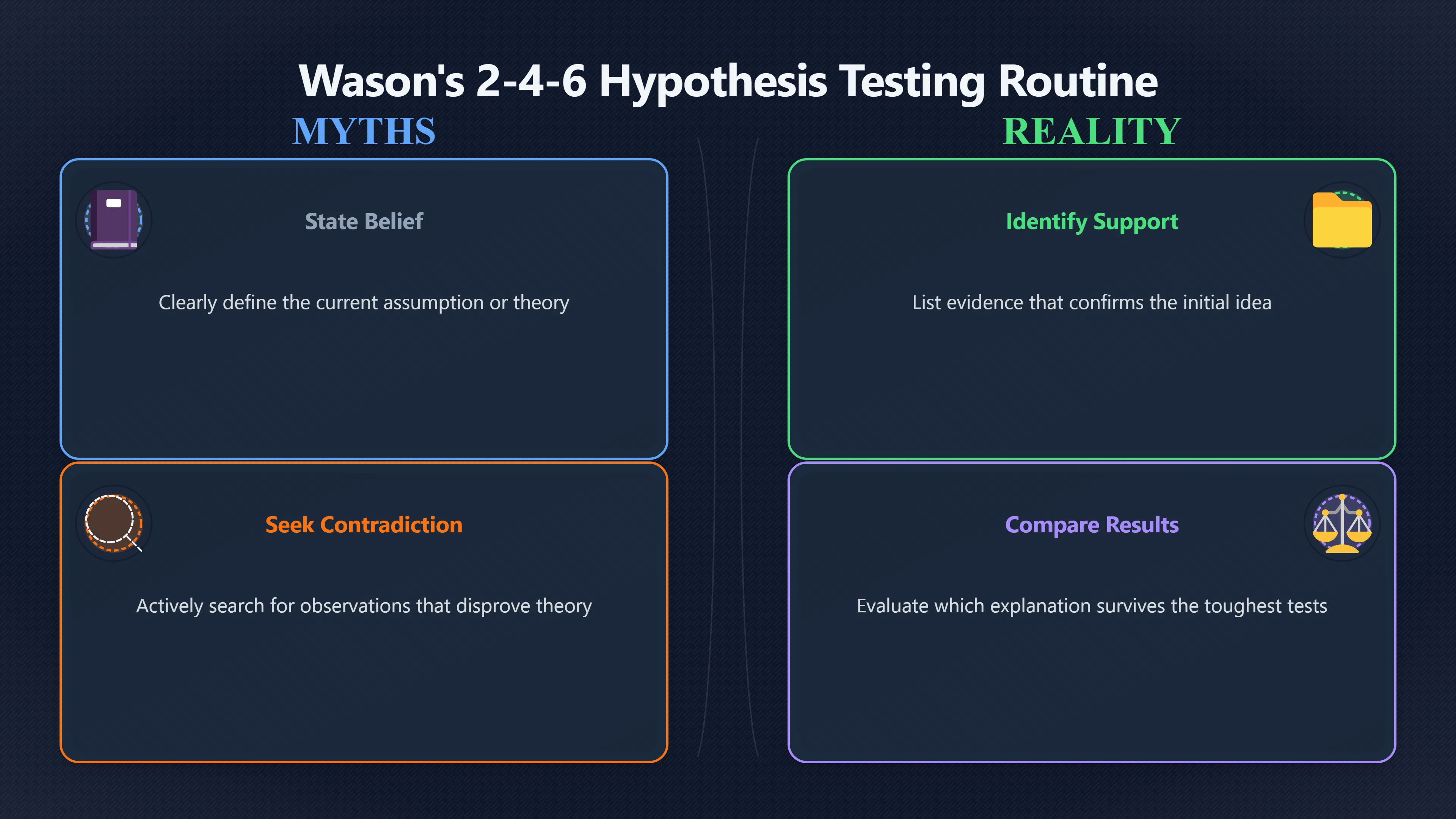
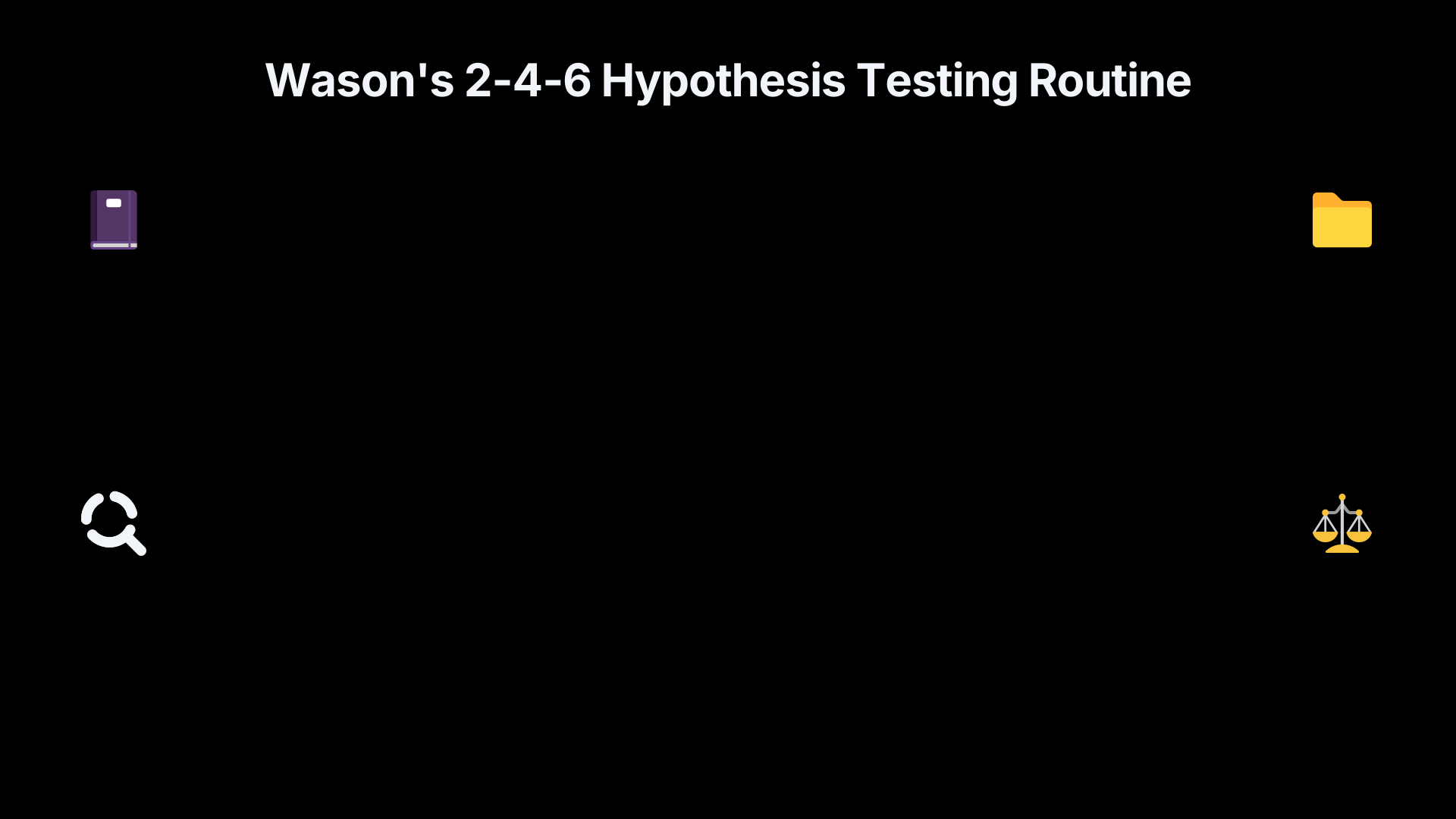
- State your current belief clearly.
- Ask what evidence would support that belief—but do not stop there.
- Deliberately search for the observation that would most strongly contradict it.
- Compare which explanation survives both confirming and disconfirming evidence.
The goal is not to become sceptical about everything. It is to make confidence depend on surviving serious tests rather than collecting agreeable examples. That is why the experiment continues to be closely associated with the practical question, “What would change my mind?” It encourages people to replace the comforting search for agreement with the more reliable search for evidence that genuinely distinguishes between competing explanations.[bear.warrington.ufl.edu]bear.warrington.ufl.eduwason qjep1960On the failure to eliminate hypotheses in a conceptual taskby PC Wason · Cited by 3767 — This investigation examines the extent to which…
eBay marketplace picks
Marketplace Samples
Live-tested eBay searches with available results related to this page.


Endnotes
1.
Source: bear.warrington.ufl.edu
Title: wason qjep1960
Link:https://bear.warrington.ufl.edu/brenner/mar7588/Papers/wason-qjep1960.pdf
Source snippet
On the failure to eliminate hypotheses in a conceptual taskby PC Wason · Cited by 3767 — This investigation examines the extent to which...
2.
Source: researchgate.net
Link:https://www.researchgate.net/publication/7838739_Generation_of_Hypotheses_in_Wason%27s_2-4-6_Task_an_Information_Theory_Approach
Source snippet
Generation of Hypotheses in Wason's 2–4–6 TaskThere are currently two competing interpretations of hypothesis testing in Waso...
3.
Source: researchgate.net
Title: 271672846 Reasoning Biases and Dual Processes The Lasting Impact of Wason 1960
Link:https://www.researchgate.net/publication/271672846_Reasoning_Biases_and_Dual_Processes_The_Lasting_Impact_of_Wason_1960
Source snippet
The Lasting Impact of Wason (1960)First, the 2-4-6 task itself was ingenious and yielded evidence of error and bias in the intelligent pa...
4.
Source: pmc.ncbi.nlm.nih.gov
Link:https://pmc.ncbi.nlm.nih.gov/articles/PMC10219317/
Source snippet
by E Branchini · 2023 · Cited by 3 — With reference to Wason's 2-4-6 rule discovery task, this study investigated the effects of a sim...
5.
Source: pmc.ncbi.nlm.nih.gov
Title: PMCThinking in opposites improves hypothesis testing
Link:https://pmc.ncbi.nlm.nih.gov/articles/PMC12402026/
Source snippet
NIHby E Branchini · 2025 · Cited by 2 — Wason's 2-4-6 task is a classic laboratory task used to study hypothesis testing. Wason int...
6.
Source: researchgate.net
Title: 324150467 Confirmation Bias and the 2 4 6 Game How do we Test our Perspectives
Link:https://www.researchgate.net/publication/324150467_Confirmation_Bias_and_the_2-4-6_Game_How_do_we_Test_our_Perspectives
Source snippet
Confirmation Bias and the 2-4-6 Game: How do we Test...This class activity builds on Peter Cathcart Wason's (1960) 2-4-6 Hypothesis Rule...
7.
Source: researchgate.net
Title: A nice bit of scandal About a disconfirmation bias in the Wasons 2 4 6 problem
Link:https://www.researchgate.net/profile/Sandrine-Rossi/publication/231179569_A_nice_bit_of_scandal_About_a_disconfirmation_bias_in_the_Wason%27s_2-4-6_problem/links/0fcfd50641f546f87e000000/A-nice-bit-of-scandal-About-a-disconfirmation-bias-in-the-Wasons-2-4-6-problem.pdf
Source snippet
Wason, 1960; Tweney et al., 1980) has been that participants were prone to confirmation bias: They would...Read more...
8.
Source: tandfonline.com
Link:https://www.tandfonline.com/doi/abs/10.1080/17470218.2014.914547
Source snippet
Taylor & Francis OnlineReasoning, biases and dual processes: The lasting impact...by JSBT Evans · 2016 · Cited by 82 — Wason (1960) publ...
9.
Source: pmc.ncbi.nlm.nih.gov
Link:https://pmc.ncbi.nlm.nih.gov/articles/PMC11495861/
Source snippet
(Diagnosing and Treating Confirmation...by RT Born · 2024 · Cited by 7 — Confirmation bias (CB) is a cognitive bias that allows us to fo...
10.
Source: get-alfred.ai
Title: confirmation bias
Link:https://get-alfred.ai/blog/confirmation-bias
Source snippet
Why We Find What We're Looking For19 Feb 2026 — Wason's 2-4-6 task (1960) showed that people test hypotheses by generating confirming exa...
Additional References
11.
Source: copernicanrevolution.org
Link:https://copernicanrevolution.org/cognitive-psychology/confirmation-bias
Source snippet
Confirmation Bias and Wason's 2-4-6 TaskIn-person game played with students, the mimicking scientific discovery with Wason's 2-4-6 Hypoth...
12.
Source: journals.sagepub.com
Link:https://journals.sagepub.com/doi/10.1080/17470216008416717
Source snippet
Sage JournalsOn the Failure to Eliminate Hypotheses in a Conceptual TaskThis investigation examines the extent to which intelligent young...
13.
Source: socialpsychology.org
Link:https://www.socialpsychology.org/teach/wason.htm
Source snippet
The Famous Four Card TaskSuppose each card has a number on one side and a letter on the other. Which of these cards are worth turning ove...
14.
Source: quizlet.com
Link:https://quizlet.com/study-guides/wason-s-2-4-6-task-and-confirmation-bias-insights-88402005-80dc-4ac7-91d9-682d0292f341
Source snippet
Wason's 2-4-6 Task and Confirmation Bias Insights15 Mar 2025 — This experiment illustrates how individuals can confidently assert incorre...
15.
Source: scribd.com
Link:https://www.scribd.com/document/306014726/Confirmation-Bias
Source snippet
ased on examples. Only about 20% of subjects correctly identified...
16.
Source: psychologytoday.com
Title: The Curious Case of Confirmation Bias
Link:https://www.psychologytoday.com/us/blog/seeing-what-others-dont/201905/the-curious-case-of-confirmation-bias
Source snippet
May 5, 2019 — Wason's data on the number triples (e.g., 2-4-6) showed that six of the 29 participants correctly guessed the rule on the v...
Published: May 5, 2019
17.
Source: explorable.com
Link:https://explorable.com/confirmation-bias
Source snippet
Instead of trying to falsify a hypothesis, people tend...
18.
Source: eneuro.org
Title: Stop Fooling Yourself!
Link:https://www.eneuro.org/content/11/10/ENEURO.0415-24.2024
Source snippet
(Diagnosing and Treating...by RT Born · 2024 · Cited by 5 — Confirmation Bias. In 1960, the cognitive psychologist Peter Cathcart Wason...
19.
Source: Wikipedia
Title: Peter Cathcart Wason
Link:https://en.wikipedia.org/wiki/Peter_Cathcart_Wason
Source snippet
Peter Cathcart WasonHe also coined the term "confirmation bias" to describe the tendency for people to immediately favor information t...
20.
Source: Wikipedia
Title: Wason selection task
Link:https://en.wikipedia.org/wiki/Wason_selection_task
Source snippet
Wason selection taskIn psychology, the Wason selection task (or four-card problem) is a logic puzzle devised by Peter Cathcart Wason i...
Topic Tree
Follow this branch
Parent topic
Change Mind What Evidence Would Change Your Mind?Related pages 5
- Confidence Updates Why Changing Your Mind Can Mean Changing Your Confidence
- Disconfirming Evidence Why Contradictory Evidence Is More Useful Than More Proof
- Premortems Can a Premortem Reveal When You Should Reconsider?
- Review Triggers How Review Triggers Make Changing Course Easier
- Revision Rules What Would Actually Make You Change Your Mind?